Gorgias bills on a billable-ticket model: $10/mo Starter (50 tickets), $60 Basic (300), $360 Pro (2,000), $900 Advanced (5,000), then custom Enterprise. Overage tickets cost $0.32 to $0.40 each, and the AI Agent bills $0.90 to $1.00 per automated resolution on top of the ticket, so a resolved conversation is double-charged.
- A ticket becomes billable the moment your helpdesk sends one message, whether from a human, the AI Agent, or an automated Rule, so volume, not inbound count, drives the bill.
- The AI Agent is metered separately per fully resolved conversation, and that resolution also counts as a helpdesk ticket, two line items for one ticket.
- Overages are the most common surprise: a busy promo or outage month can push the real bill well past your plan's sticker price.
- Annual billing drops AI resolutions from $1.00 to $0.90 and gives roughly two months free on the plan, so it is the default for any real volume.
- The right test is cost per ticket against the margin support protects: across the brands I have operated and advised, the win is deflecting volume, not paying for automation you have not configured.
Gorgias prices on a billable-ticket model: $10 a month for Starter (50 tickets), $60 for Basic (300), $360 for Pro (2,000), and $900 for Advanced (5,000), with Enterprise on a custom quote past 5,000 tickets. Go over your quota and every extra ticket runs $0.32 to $0.40. The AI Agent is a separate meter on top, billing $0.90 to $1.00 per automated resolution. The headline plan price is not the problem. The way tickets and resolutions stack is what surprises people.
I have signed for support tooling across a portfolio of brands. At WIN Brands Group, customer support was a direct lever on retention, refunds, and review scores, and the helpdesk sat at the center of all three, so I have approved these invoices at small scale and at high volume. Most "Gorgias pricing" content online quotes the plan tiers and stops. This is the version that walks the whole curve, including the ticket definition that catches people, the overage that spikes with your busiest months, and the AI fee that bills twice for one resolved conversation.
If you want the short answer, it is in the table in section three. If you want to understand why your bill moves the way it does, and how to keep automation from outrunning the volume it deflects, keep reading.
The sticker is small.
The model is the catch.
Ask "how much does Gorgias cost" and you get a clean starting number: $10 a month. That is true, and it is the least useful thing to know, because the starter tier is not where a real brand lives once support volume picks up. Where you live is the part of the curve set by how many conversations your helpdesk touches, and that number tends to grow with order volume, seasonality, and every time something goes wrong with shipping.
Here is the shift that catches operators. Gorgias does not bill you per agent seat, the way most older helpdesks did. It bills you on tickets, where a ticket is any conversation your helpdesk sends at least one message into. So adding headcount during a busy season does not raise your bill, but a flood of inbound questions does, and so does every automation you set up to answer them. The meter is conversations handled, not people on the team.
That single design choice explains almost everything strange about a Gorgias bill: why it climbs in November and December, why a viral moment or a shipping delay can blow past your plan in a week, and why two brands at the same revenue can pay wildly different amounts depending on how much repeat volume they deflect. The rest of this post is really about that one mechanic and how to work with it instead of against it.
One conversation,
one billable ticket.
The most important line in Gorgias pricing is the definition of a billable ticket. A ticket becomes billable the moment at least one message is sent from your helpdesk, whether that message comes from a human agent, the AI Agent, or an automated Rule (Ringly.io, Gorgias pricing, 2026). One conversation counts as exactly one ticket no matter how many back-and-forth messages it contains. A thread with twenty replies is one ticket, which is generous and works in your favor.
The part that does not work in your favor is the word any. A billable ticket is created when your helpdesk sends a message, not only when a human chooses to answer. So an auto-reply Rule that fires on an inbound message you never would have responded to still mints a ticket. A chatbot that greets a visitor and a flow that auto-acknowledges an order question both create billable conversations. The system rewards you for resolving threads in one ticket and quietly charges you for every automated touch you let it make.
Two pricing planes then sit on top of that ticket meter. The plan tier sets your monthly included ticket allotment and your feature set, from Starter through Advanced. The AI Agent (Gorgias Automate) is a separate meter that bills per resolved conversation, covered in section four. You pick the plan; your conversation volume sets whether you live inside the quota or spill into overages.
What it runs,
tier by tier.
Here is the published curve for the four standard plans, with the included ticket quota, the overage rate per extra ticket, and the included AI Agent allowance where it applies. Figures are Gorgias's published monthly pricing; Enterprise is sales-led, per the caveat above. Annual billing takes roughly two months off the plan price (about 16% off) on Basic through Advanced.
| Plan | Monthly Price | Included Tickets | Overage / Ticket | Notes |
|---|---|---|---|---|
Starter 3 user seats |
$10 |
50 |
$0.40 |
Entry |
Basic Unlimited users |
$60 |
300 |
$0.40 |
Core integrations |
Pro Recommended |
$360 |
2,000 |
$0.36 |
600 AI included |
Advanced Dedicated email server |
$900 |
5,000 |
$0.36 |
2,500 AI included |
Enterprise 5,000+ tickets |
Custom quote |
Negotiated |
~$0.32 |
Sales-led |
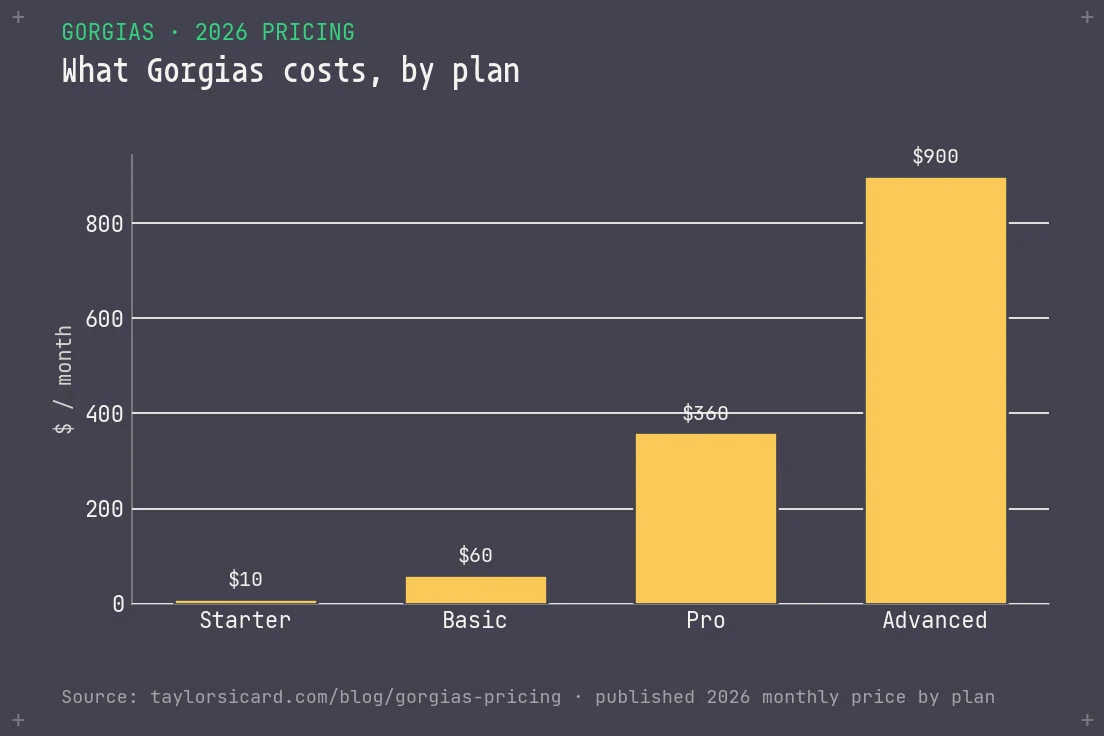
Read the shape more than the raw rows. The cost per ticket falls as you scale (you pay far less per conversation on Advanced than you do buying overages on Basic), which is normal usage-based behavior, but the gap between tiers is wide. The jump from Basic to Pro is a 6x price increase for a 6.7x ticket increase, so the moment you are consistently buying overages on a lower plan, the next tier up is almost always cheaper than staying put. A brand running real support volume with an active AI Agent is comfortably into the hundreds of dollars a month before the resolution meter in section four. For where this line sits inside the broader stack, the Shopify tech stack by revenue tier post maps what belongs at each stage.
See what the stack costs your margin
Gorgias is one line. The DTC profitability calculator rebuilds your full per-order P&L, so you can see what support, apps, processing, and fulfillment actually leave you at the bottom.
Open the profitability calculator →The AI Agent is a
separate meter on top.
The AI Agent, Gorgias's automation product, does not work like the helpdesk plan. The plan is priced by ticket quota; the AI Agent is priced by resolution. Each fully resolved conversation costs $1.00 on monthly billing and $0.90 on annual, charged separately from your plan's ticket allocation (Gorgias, AI Agent pricing, 2026). Pro and Advanced bundle a block of resolutions (600 and 2,500 respectively); past that allowance, each additional interaction runs about $1.50.
Here is the mechanic that bites, and it is the single most misread part of Gorgias pricing. An AI resolution also counts as a helpdesk ticket. So when the AI Agent resolves a conversation, you pay twice for it: once for the ticket and once for the resolution. There is one piece of relief built in: if the customer ends up reaching a human within 72 hours, the case is billed only as a ticket, not as a resolution. But for every conversation the AI closes cleanly on its own, two line items show up.
This is how the AI bill runs ahead of the plan bill. One Shopify App Store reviewer reported roughly $14,000 in AI Agent charges on top of a $13,500 annual Advanced subscription (MyAskAI, Gorgias AI Agent pricing, 2026), which means automation more than doubled what they expected to pay. The lesson is not that the AI Agent is overpriced. It is that the per-resolution number on the page ($0.90 to $1.00) hides the double-charge, so you have to model resolutions as their own line, separate from the plan, before you turn automation up.
- +The double-charge, since every clean resolution bills as a ticket and a resolution
- +Resolutions over your bundled allowance, which jump to about $1.50 each
- +Monthly instead of annual billing, paying $1.00 per resolution instead of $0.90
- +Automating low-value contacts that did not need a paid resolution at all
None of this means avoid the AI Agent. Done right, automated resolution is cheaper than a human handling the same volume, and it answers customers instantly. It means budget it as its own line with its own return target: every resolution should deflect a contact that would otherwise have cost agent time, and you should know your cost per resolution before you let it run at full volume.
The overage spike
nobody budgets for.
This is the part of Gorgias pricing that catches even disciplined finance teams. When your monthly ticket count crosses your plan's included quota, every additional ticket is billed at your tier's overage rate: $0.40 on Starter and Basic, $0.36 on Pro and Advanced, and around $0.32 on Enterprise (Lindy, Gorgias pricing, 2026). On its own each overage ticket is cheap. The problem is that ticket volume is spiky, and the months it spikes are exactly the months you are not watching the support meter.
Do the math on a real spike. A brand on Basic is allotted 300 tickets. A bad shipping week during a promotion drives 800 conversations. That is 500 overage tickets at $0.40, an extra $200 on a $60 plan, more than tripling the bill for a month nobody planned for. Multiply that across BFCM, a product recall, or a viral moment, and overages become the line that makes the Gorgias invoice unpredictable.
The fix is structural, not reactive. If you are buying overages most months, you are on the wrong plan, full stop. The next tier up bundles more tickets at a lower effective per-ticket rate, so right-sizing the plan is almost always cheaper than paying the per-ticket penalty. And the deeper fix is cutting the volume that creates the overage in the first place, which is section seven.
Where the bill
quietly leaks.
Beyond the headline plan, three mechanics inflate a Gorgias bill without anyone deciding to spend more. They are worth knowing before they show up on a statement.
Auto-reply Rules that mint tickets. Because any message sent from the helpdesk creates a billable ticket, an over-eager Rule can manufacture volume. An auto-acknowledgement that fires on every inbound, a chatbot greeting on every chat open, a flow that touches conversations a human would have left alone: each one converts contacts you would not have answered into billable tickets. Automation is supposed to deflect cost, not generate it, so audit every Rule for whether it is resolving a contact or just adding a ticket.
The AI double-charge compounds at scale. The resolution-plus-ticket double-billing from section four is not a one-off, it is structural, and it scales with how aggressively you automate. A brand resolving thousands of conversations a month with the AI Agent is paying the ticket line and the resolution line on every one, so a high automation rate that looks efficient on a deflection dashboard can be expensive on the invoice. Track cost per resolved conversation, not just resolution rate.
Monthly billing leaves money on the table. Annual billing drops AI resolutions from $1.00 to $0.90 and takes roughly two months off the plan price. For a brand running real volume, that is a meaningful, recurring discount left unclaimed by anyone who defaulted to monthly to stay flexible. Flexibility has a price, and at scale it is the wrong trade.
"Gorgias charges you for the conversations you touch, not the team you staff. The brands that pay the least are not the smallest, they are the ones that deflect the most volume before it ever opens a ticket."
Ticket deflection is
a P&L lever.
Because you pay per conversation your helpdesk touches, cutting the volume that ever opens a ticket is no longer just a CX move that lifts response times. It is a direct, recurring cost cut. The brands paying the least at any given revenue are running the same handful of disciplines, and none of them are exotic.
- ›Deflect repeat questions. A real help center, self-service order tracking, and self-serve returns kill the "where is my order" volume before it ever opens a ticket.
- ›Right-size the tier. If you buy overages most months, move up a plan. Bundled tickets beat the per-ticket penalty almost every time.
- ›Bill annually. Drop AI resolutions to $0.90 and take two months off the plan. At real volume, monthly billing is just a tax on flexibility.
- ›Audit your Rules. Every auto-reply that fires on a contact you would have ignored mints a billable ticket. Keep the ones that resolve, cut the ones that only touch.
- ›Negotiate at Enterprise. Past 5,000 tickets the per-ticket and per-resolution rates are negotiable, and the leverage is at renewal, not at signup.
The mindset shift is the whole game. It is tempting to treat the helpdesk as a cost you absorb and the AI Agent as free efficiency. Under usage-based billing, neither is true: every ticket and every resolution is a unit you pay for, so the goal is fewer total paid units, not more automation for its own sake. Done well, this is one of the few cost cuts that also improves the customer experience, because the fastest support is the contact a customer never had to send, since they could track their own order or start their own return.
Judge it on cost per
ticket, not on price.
The dollar figure on the invoice is the wrong thing to anchor on. The right test is your total cost per contact against the margin a resolved conversation protects, because support is not a cost center in a DTC brand, it is a lever on refunds, repeat purchase, and review scores. A Gorgias bill that looks big is fine if the volume under it is large and well-deflected; a bill that looks small is a problem if your cost per ticket is bloated by overages and double-charged resolutions.
Across the brands I have operated and advised, two rules of thumb hold up. First, your fully loaded cost per contact, helpdesk plus AI plus agent time, should fall as you scale and automate, not climb, because deflection and reuse are supposed to compound. Second, the support tooling line itself should land at a low percentage of the revenue and retention it protects. If your platform cost per ticket is creeping up while resolution rate looks healthy, the issue is almost always the AI double-charge compounding or overages from the wrong plan, not the sticker price.
So before you ever debate switching helpdesks to save on the bill, look at how much of the volume you should be deflecting actually gets deflected. A brand drowning in repeat "where is my order" tickets is not over-paying Gorgias; it is under-investing in self-service. The platform cost is rarely where the leverage is. To judge any of this against the margin you actually keep, start with contribution margin for DTC, and for how the support line sits next to the platform fee itself, the 2026 Shopify Plus pricing maps the bigger picture.
Cost is not the same
question as worth it.
This post answers what Gorgias costs. Whether it is worth that cost depends on whether you are actually running the channel. For a scaling Shopify brand, Gorgias is the deepest support helpdesk built natively for the platform, with order data, refunds, and subscriptions one click from every conversation, and support is a direct lever on the metrics that decide whether a brand retains customers. Shopify is also an investor in Gorgias, one of the app companies Shopify has backed rather than absorbed into the admin. If you are deflecting volume and automating the right contacts, the platform pays for itself, because a fast, accurate support experience protects revenue you would otherwise lose to refunds and churn. That "is it worth the cost" question applies to every app you run, and the way to answer it for the whole stack is in the guide to Shopify app bloat.
Where it stops being worth it is the brand paying for automation it has not configured: the AI Agent turned on, billing resolutions, without a help center deflecting the repeat questions underneath it, so it is automating volume that should never have existed. That brand is not over-paying for Gorgias. It is paying for the symptom instead of fixing the cause, and switching helpdesks will not fix a support operation that funnels everything into a paid ticket. Fix the deflection first; the bill takes care of itself. This is the same pattern as the Klaviyo pricing model, where the brands paying the least are the most disciplined about what they store and send.
If support operations and the tools under them, rather than the line item alone, are the actual question, that is part of the growth work I do with operators, and the DTC growth consulting practice is where we work through it.
How much does Gorgias cost in 2026?
It is priced by tier on a billable-ticket model. Starter is $10 a month for 50 tickets, Basic is $60 for 300, Pro is $360 for 2,000, and Advanced is $900 for 5,000, with Enterprise on a custom quote past 5,000. Every ticket over your quota carries an overage of $0.32 to $0.40. The AI Agent bills separately at $0.90 to $1.00 per automated resolution, on top of the ticket.
What counts as a billable ticket in Gorgias?
A ticket becomes billable the moment your helpdesk sends one message, whether from a human, the AI Agent, or an automated Rule. Each conversation counts as one ticket no matter how many messages it holds, so a twenty-reply thread is one ticket. But an auto-reply Rule that fires on a contact you would have ignored still mints a billable ticket. Your bill tracks conversations touched, not inbound volume alone.
How does Gorgias AI Agent pricing work?
The AI Agent bills per fully resolved conversation, separate from your ticket allocation: $1.00 monthly, $0.90 annual. The catch is that an AI resolution also counts as a ticket, so a resolved conversation is double-billed, once as the ticket and once as the resolution. If the customer reaches a human within 72 hours, it is billed only as a ticket. Interactions beyond your bundled allowance run about $1.50 each.
What are Gorgias overage charges?
Exceed your plan's monthly ticket quota and every extra ticket is billed at your tier rate: $0.40 on Starter and Basic, $0.36 on Pro and Advanced, around $0.32 on Enterprise. Overages are the most common surprise because volume spikes with promotions, seasonality, and outages. If you hit them most months, the next tier up is usually cheaper than paying per-ticket.
How do I lower my Gorgias bill?
Cut the ticket volume itself with a real help center, self-service order tracking and returns, and proactive notifications, so fewer conversations open. Right-size the tier so you are not paying overages monthly, and bill the AI Agent annually to drop resolutions from $1.00 to $0.90. Audit auto-reply Rules, since each can mint a ticket. At Enterprise the per-ticket and per-resolution rates are negotiable, best at renewal.
Is Gorgias worth the cost?
For most scaling Shopify brands, yes, because it is the deepest helpdesk built natively for Shopify and support is a direct lever on retention and refunds. The test is cost per ticket against the margin a resolution protects: a well-run support stack keeps total cost per contact low while lifting first-contact resolution. The failure mode is paying for automation you have not configured, where the AI Agent bills resolutions without deflecting enough volume to earn its fee.
Support operations, what to deflect, what to automate, and how to keep the tools from outrunning the volume they handle, is part of the work I do with operators. The fractional DTC growth consultant is where we work it through. The form takes two minutes: start the conversation.
Scaling a consumer brand?
I work with a deliberately small number of DTC operators. I have run brands at this scale myself, from $5M past $100M, with support sitting on top of retention, refunds, and review scores. If you are in that range, the form takes two minutes.
Start a conversation More about Taylor →