Klaviyo is free to 250 active profiles, then bills on your contactable contact count, not sends: about $20/mo at 500 profiles, $100 at 5,000, $400 at 25,000, and $720 at 50,000. SMS is a separate credit meter, and crossing $10,000 a month forces you onto Klaviyo One with a mandatory 20% surcharge.
- Since February 2025, you pay for every profile that could be emailed, whether you mailed them or not, so list bloat is now a direct cost, not just a deliverability issue.
- SMS runs on per-credit pricing (about $0.01 to $0.015 per US text) on top of your email plan, and a heavy SMS program can outgrow the email line.
- Klaviyo One adds 20% to your entire bill once monthly spend passes $10,000, with no opt-out, turning a $10K month into $12K.
- The 90-day unsuppress lock means reactivating a cold contact bills you for at least three cycles.
- The right test is return, not price: across the brands I have operated and advised, owned email and SMS should drive a large share of revenue for a low single-digit share of it in platform cost.
Klaviyo is free up to 250 active profiles, then the paid email plan starts at $20 a month and climbs with your contact count: roughly $30 at 1,000 profiles, $100 at 5,000, $400 at 25,000, and about $720 at 50,000. SMS layers a separate credit meter on top. And once your monthly spend crosses $10,000, Klaviyo moves you onto its enterprise tier, Klaviyo One, with a mandatory 20% surcharge on the entire bill. The headline price is not the problem. The billing model is what surprises people.
I have signed for Klaviyo across a portfolio of brands. At WIN Brands Group, email and SMS was one of the largest revenue lines we had, and Klaviyo was the engine under it, so I have approved these invoices at small scale and at eight figures. Most "Klaviyo pricing" content online quotes the starting tier and stops. This is the version that walks the whole curve, including the lines that show up later and the surcharge that hits exactly when you are growing fastest.
If you want the short answer, it is in the table in section three. If you want to understand why your bill moves the way it does, and how to keep it from outrunning the revenue it drives, keep reading.
The sticker is small.
The model is the catch.
Ask "how much does Klaviyo cost" and you get a clean starting number: $20 a month. That is true, and it is the least useful thing to know, because the starting tier is not where you live once you are a real brand. Where you live is the part of the curve set by how many contacts you store, and that number tends to grow faster than your revenue.
Here is the shift that catches operators. Klaviyo does not bill you on how many emails you send. It bills you on how many people you could send to. Every contactable profile in your account counts toward your tier, whether you mailed them this month, last month, or never. So a list full of people who opened a popup two years ago and never bought is not a deliverability problem anymore. It is a monthly invoice.
That single design choice explains almost everything strange about a Klaviyo bill: why it climbs when revenue is flat, why a big BFCM signup push raises your floor for months, and why disciplined brands pay less than sloppy ones at the same revenue. The rest of this post is really about that one mechanic and how to work with it instead of against it.
Active profiles, not
active senders.
In February 2025, Klaviyo moved from send-based billing to active-profile billing (Omnisend, Klaviyo pricing breakdown, 2026). An active profile is any contact in your account that can receive marketing, regardless of whether you emailed them. Subscribers count. So do people who handed over an email at checkout without formally opting in, if they are contactable. The meter is the size of your reachable list.
Two pricing planes sit on top of that. The email plan is priced by profile tier and includes a monthly email send allotment that is generous enough that most brands never hit it (the constraint is profiles, not sends). The email plus SMS plan adds text and push, starts a little higher, and bundles a small block of SMS credits, with the rest of SMS metered separately. You pick the plane; the profile count sets the tier.
The mechanic that bites is the upgrade. Klaviyo auto-upgrades your plan when your profile count crosses a tier boundary, at the start of the next billing cycle, with no opt-out (Retainful, Klaviyo pricing 2026). So a list-building sprint costs you for more than the month of the sprint. It resets your floor until you actively clean the list back down. That asymmetry, easy to go up, manual to come down, is the whole reason a Klaviyo bill drifts.
What it runs,
tier by tier.
Here is the published curve for the email plan, with an estimate for the email plus SMS plan at each tier. The SMS column adds the higher base plus a small bundled credit block; actual SMS usage is metered on top of it (section four). Figures are Klaviyo's published slider points where shown, and clearly marked estimates at the top, per the caveat above.
| Active Profiles | Email Plan | Email + SMS (base) | Send Allotment | Notes |
|---|---|---|---|---|
Up to 250 Free tier |
$0 |
$0 |
500 emails · 150 SMS credits |
Free |
251 – 500 |
~$20 |
~$35 |
5,000 emails · 1,250 SMS credits |
Entry |
1,000 |
~$30 |
~$45 |
10,000 emails |
Published |
5,000 |
~$100 |
~$140 |
50,000 emails |
Published |
25,000 |
~$400 |
~$510 |
250,000 emails |
Published |
50,000 |
~$720 |
~$900 |
500,000 emails |
Published |
100,000 |
~$1,380 (est.) |
~$1,600 (est.) |
1M+ emails |
Estimate |
250,000+ |
Custom quote |
Custom quote |
Sales-led |
Manual |
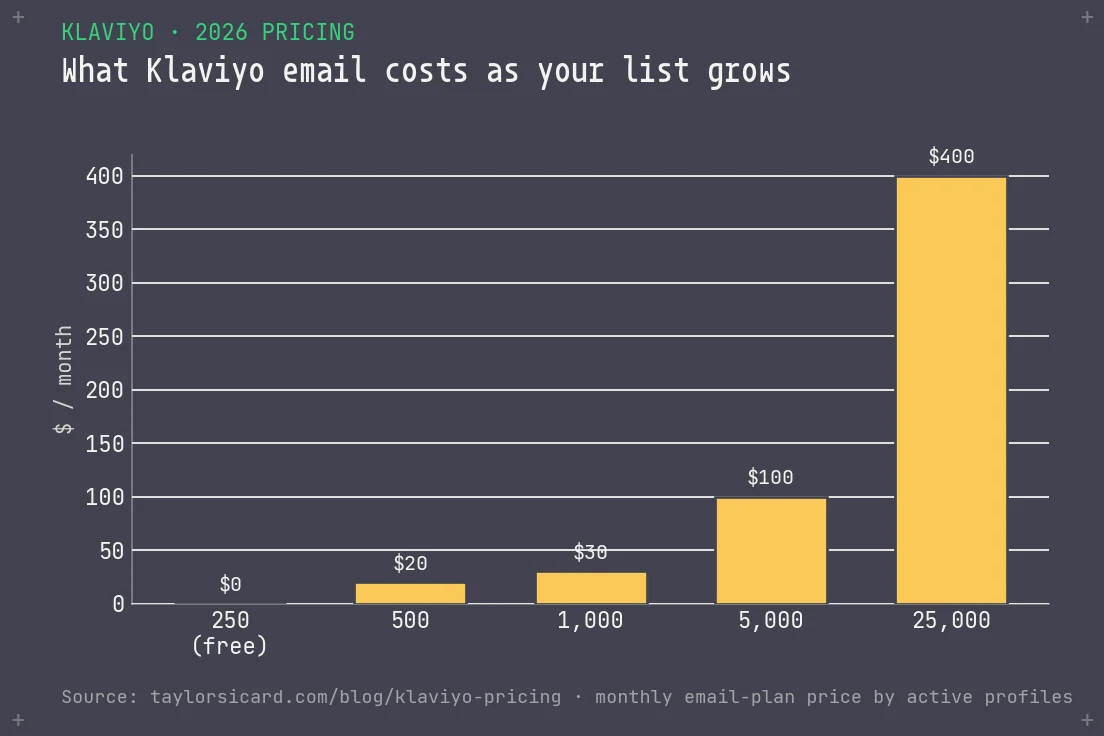
Read the shape, not just the rows. The cost per profile falls as you scale (you pay less per contact at 50,000 than at 500), which is normal SaaS behavior, but the absolute number climbs into four and then five figures a month well before you would call yourself an enterprise brand. A brand with a 50,000-person list and an active SMS program is comfortably past $1,000 a month on Klaviyo alone, and that is before the surcharge in section five. For where this line sits inside the broader stack, the Shopify tech stack by revenue tier post maps what belongs at each stage. The same usage-based logic runs through your help desk, which I decode in Gorgias pricing decoded.
See what the stack costs your margin
Klaviyo is one line. The DTC profitability calculator rebuilds your full per-order P&L, so you can see what email, apps, processing, and fulfillment actually leave you at the bottom.
Open the profitability calculator →SMS is a separate
meter on top.
SMS does not work like email inside Klaviyo. Email is priced by stored profiles; SMS is priced by credits per send. A standard US text costs one credit, roughly $0.01 to $0.015, and an MMS (anything with an image) costs three or more credits (First Pier, Klaviyo SMS pricing, 2026). International sends carry country-specific rates that run higher. You buy a monthly credit block and can let it auto-refill, which is convenient and also how the line quietly grows.
The math is simple and easy to underestimate. Send one MMS campaign to a 40,000-person SMS list and you have spent roughly 120,000 credits, on the order of $1,200 to $1,800 for that one send, before any automated flows fire. Run SMS at real frequency and the credit bill can pass your entire email plan. This is the line operators forget to model, because the email number is the one on the pricing page and SMS hides behind a credit balance. If you are pricing the channel on its own, compare it against what dedicated SMS platforms cost per text, where Postscript publishes rates from $0.007 plus carrier fees and Attentive quotes. If Attentive is the one you are being quoted on, what Attentive costs breaks the quote into its parts.
- +MMS over SMS, which costs 3x or more per message for the image
- +Send frequency, since SMS is metered per send with no profile cap
- +International recipients on higher country-specific credit rates
- +Auto-refill credit blocks that top up without anyone watching
None of this means avoid SMS. SMS is one of the highest-intent channels a DTC brand owns, and at the right cadence it earns its credits several times over. It means budget it as its own line with its own return target, separate from email, and decide deliberately when a message needs to be an MMS. Whether SMS even belongs in your mix yet, and where it beats email, is the subject of email vs SMS for DTC.
The 20% surcharge
nobody budgets for.
This is the part of Klaviyo pricing that catches even sophisticated finance teams. Once your standard monthly Klaviyo spend crosses $10,000, your account is automatically moved onto the enterprise tier, Klaviyo One, and a 20% surcharge is applied on top of your entire bill, with no opt-out (Ringly.io, Klaviyo enterprise pricing, 2026). The markup applies to everything: your contact tier, your SMS credits, your add-ons. A $10,000 month becomes $12,000. That is roughly $24,000 a year you did not plan for, triggered not by a decision you made but by your own growth pushing you over the line.
The structure is mandatory, but the contract around it is not. High-volume and Klaviyo One accounts have real room to negotiate the underlying rate, the contract term, and the practical effect of the surcharge, and the strongest leverage is at renewal rather than at the moment auto-upgrade flips you over. If you can see $10,000 a month coming, the move is to get ahead of it: talk to Klaviyo before the trigger, not after, and bring a clean picture of your contact count and growth so you are negotiating a deal rather than accepting a default.
The other defense is simply not crossing the line by accident. A meaningful share of the spend that tips brands over $10,000 is list bloat and over-frequent MMS, not real reach. Tighten both and some brands sit comfortably under the trigger at the same revenue, which is the cheapest negotiation there is.
Where the bill
quietly leaks.
Beyond the headline tier, three mechanics inflate a Klaviyo bill without anyone deciding to spend more. They are worth knowing before they show up on a statement.
The 90-day unsuppress lock. Once you unsuppress a contact, you cannot suppress them again for 90 days (Retainful, 2026). So if you run a win-back campaign, reactivate a dormant contact, and they immediately go cold again, you are paying for that profile across at least three billing cycles before you can remove them. Re-engagement is good practice, but it has a cost tail, and you should run it knowing reactivated contacts are billable whether or not they convert.
Add-ons stack on the base. Reviews, the customer data platform features, and other Klaviyo products are priced on top of email and SMS, and at enterprise scale they also sit underneath the Klaviyo One surcharge, so a 20% markup compounds across every add-on you carry. Each one can be worth it. The point is that they are separate lines, not bundled, and they all count toward the $10,000 trigger.
List bloat from non-marketing syncs. Plenty of brands pipe every customer, every quiz-taker, and every back-in-stock request into Klaviyo, then pay for all of them as active profiles forever. If a contact is contactable, you are billed, even if your strategy would never actually email them. Deciding which profiles belong in Klaviyo at all is as much a budget decision as a data-hygiene one.
"Klaviyo charges you for the list you keep, not the list you use. The brands that pay the least are not the smallest, they are the most disciplined about who they store."
List hygiene is now
a P&L lever.
Because you pay per contactable profile, cleaning your list is no longer just a deliverability move that lifts open rates. It is a direct, recurring cost cut. The brands paying the least at any given revenue are running the same handful of disciplines, and none of them are exotic.
- ›Run a real sunset flow. Auto-suppress contacts who have not engaged in a set window. They were dragging your deliverability and costing you a tier.
- ›Stop syncing non-marketing profiles. Keep contactable, marketable contacts in Klaviyo. Park the rest in your data warehouse or Shopify, not in your billable count.
- ›Time win-backs for the 90-day lock. Reactivate deliberately, knowing those profiles are billable for three cycles whether or not they buy.
- ›Default SMS to plain text. Reserve MMS for sends where the image genuinely lifts conversion, since it triples the credit cost.
- ›Negotiate before $10K, not after. Get ahead of the Klaviyo One trigger and renew on a real contract, not the auto-upgrade default.
The mindset shift is the whole game. Under the old send-based model, a big list was free to hold and only cost you when you mailed it, so hoarding contacts was harmless. Under active-profile billing, a big list is a standing monthly liability. Treat your subscriber count like inventory: every profile should earn its carrying cost, and the ones that do not should be retired. Done well, this is one of the few cost cuts that also improves performance, because a clean, engaged list deliverability-wise outperforms a bloated one.
Judge it on return,
not on price.
The dollar figure on the invoice is the wrong thing to anchor on. The right test is what email and SMS return against what they cost, because owned channels are supposed to be the cheapest revenue you have. A Klaviyo bill that looks big is fine if the channel under it is large; a bill that looks small is a problem if the channel is dead.
Across the brands I have operated and advised, two rules of thumb hold up. First, owned email and SMS should drive a meaningful, double-digit share of total revenue for a healthy DTC brand, and the strongest programs push well past that. Second, the Klaviyo line itself, email plus SMS, should land at a low single-digit percentage of the revenue it attributes. If your platform cost is creeping toward the revenue the channel produces, the issue is almost never the price. It is list bloat inflating the tier, or thin flows leaving money on the table, or both. To see where you sit against both rules, benchmark how much of your revenue is owned before you open the invoice again.
So before you ever debate switching platforms to save on the bill, debate whether the channel is actually working. A brand attributing 30% of revenue to email and SMS is not over-paying Klaviyo at $1,500 a month; it is under-investing if it stops there. The platform cost is rarely where the leverage is. To pressure-test the flows themselves, the Klaviyo flows every DTC brand should turn on post is the build list, and judging any of this against the margin you actually keep starts with DTC contribution margin.
Cost is not the same
question as worth it.
This post answers what Klaviyo costs. What it is worth to you comes down to whether you are actually running the channel. For a scaling DTC brand on Shopify, Klaviyo is the deepest, best-integrated tool for owned email and SMS, and owned revenue is the highest-margin growth you have. That depth is not incidental: Shopify's stake in Klaviyo is the largest position it has ever taken in an app it chose not to build itself. If you are building real flows and a real list, the platform pays for itself many times over, and the alternatives (Omnisend, Sendlane, and the rest) compete mostly on price at the low end, not depth at the high end.
Where it stops being worth it is the brand paying enterprise-tier money for a starter-tier program: a bloated list, a welcome flow and nothing else, no SMS strategy, no segmentation. That brand is not over-paying for Klaviyo. It is under-using it, and switching platforms will not fix an empty program. Fix the program first; the bill takes care of itself. Klaviyo is only one line on the invoice, though, and the same test applies to the whole stack: the guide to Shopify app bloat shows how to price every app against what it returns.
If owned channel strategy, rather than the line item, is the actual question, that is part of the growth work I do with operators, and the fractional DTC growth consultant is where we work it through.
Owned channel strategy, what to build, what to cut, and how to keep the tools from outrunning the revenue, is part of the work I do with operators. The DTC growth consultant is where we work it through. The form takes two minutes: start the conversation.
Scaling a consumer brand?
I work with a deliberately small number of DTC operators. I have run brands at this scale myself, from $5M past $100M, with email and SMS as one of the biggest revenue lines on the board. If you are in that range, the form takes two minutes.
Start a conversation More about Taylor →