Your Shopify app stack is not mainly about what to add. It is about what to add, what to cut, and how each decision changes as you move from one revenue tier to the next. Most brands accumulate apps and never audit them.
- Unaudited stacks quietly leak thousands a month on redundant and unused apps.
- Run a structured stack review at each revenue tier, not once every two years.
- App bloat compounds hardest when you are also carrying expensive working capital.
I was advising an $8M annual revenue brand last year. Sharp team, solid product, growing fast. When I asked to see their Shopify billing, we found $14,200 a month going out the door on apps. Most of that stack had been assembled over two years without a single structured review. Four apps were doing overlapping work in the loyalty and review space. Two were on auto-pay for features the team had stopped using eight months earlier after switching to something else. Nobody had noticed because the credit card charge was buried in operating costs and the monthly amount, viewed in isolation, didn't feel alarming.
We ran a proper audit. The redundant and genuinely unused spend came to $4,800 a month. That's $57,600 a year. Not going to product. Not going to acquisition. Going to apps that nobody was actively choosing to pay for, they just hadn't gotten around to canceling them. This kind of cost drag compounds especially hard if you're also carrying working capital debt at 20%+ APR, the app bloat is directly reducing the margin that should be servicing that debt.
The stack conversation isn't primarily about what to add. It's about what to add, what to cut, and when each of those decisions changes as you move from one revenue tier to the next. That's what this post covers.
This page covers the tools. For the strategy underneath them, the operating system that scales a brand from $5M to $50M is its own post: it's less about which app to add and more about what has to be true operationally before any app helps.
The tooling words,
explained like
you're new to it.
Before the stage-by-stage stacks, the plain-English version. Your tech stack is just the set of tools bolted onto Shopify that run the parts of your business Shopify itself does not: email, reviews, shipping, support, analytics. Every category has an acronym, and the acronyms are what make stack conversations sound more complicated than they are.
Here are the categories you will be choosing between, in language a normal person actually uses.
| Term | What it actually means |
|---|---|
3PL | Third-Party Logistics. A company you pay to store inventory, pack orders, and ship them. It takes warehousing off your plate. |
ESP | Email Service Provider. The tool that runs your email and SMS marketing (Klaviyo is the common one). Often your highest-ROI line item. |
OMS | Order Management System. The brain that routes orders, inventory, and fulfillment across channels and warehouses. Matters once you outgrow one sales channel. |
ERP | Enterprise Resource Planning. The central system for finance, inventory, and operations. A bigger-brand tool you adopt when spreadsheets break. |
CDP | Customer Data Platform. Software that unifies every piece of customer data into one profile for targeting. A later-stage luxury, not an early need. |
CRO | Conversion Rate Optimization. The practice, and the tools, for turning more of your existing traffic into buyers. Cheaper growth than buying more traffic. |
UGC | User-Generated Content. Photos, videos, and reviews made by your actual customers. Reviews and UGC apps collect and display it. |
Headless | Splitting your storefront's design layer from Shopify's commerce engine so you can build a fully custom front end. Powerful and expensive; rarely needed before real scale. |
API | Application Programming Interface. The connector that lets two pieces of software talk to each other. It is how your apps share data with Shopify. |
Middleware / iPaaS | The glue layer that passes data between systems that do not natively connect. You feel its absence as manual CSV exports. |
Subscriptions | Apps that enable recurring billing and repeat orders. They turn one-time buyers into predictable revenue. |
That is the vocabulary. Now the actual stacks: what belongs at $5M, what to add at $20M, and what is worth it at $50M.
Most brands don't manage
their app spend.
They just accumulate it.
The average Shopify app costs between $58 and $67 a month. That sounds trivial. A brand running 20 apps is spending $1,200 to $1,400 a month before counting the major platforms (Klaviyo, Triple Whale, Gorgias, Loop Returns) which are each $200 to $1,200 a month depending on your volume. The combined number gets real fast, and unlike paid media or headcount, app spend has no natural forcing function to review it. You just keep getting charged. Subscriptions are usually the biggest line in that bill, so it is worth knowing what Recharge charges on each tier.
App spending scales with revenue, roughly at 0.5–1.5% of net revenue for most Shopify brands. At $1M that's $5,000–$15,000 a year, manageable, easy to ignore. At $10M it's $50,000–$150,000 a year. At that level, undermanaged app spend is a meaningful drag on contribution margin, and it compounds because bloated stacks also slow your site down. Each app adds an average of 30–100ms to page load time. A 15-app stack has likely added a second or more to your load times, which hits conversion rate directly.
Stack decisions are also not symmetric by stage. The app that's worth $500/month at $3M revenue (because you have neither the team nor the process to do the thing manually) may be redundant at $15M when you've hired someone whose job description includes that function. Apps should fill gaps in capability that your team can't or shouldn't fill directly. When the team grows into a capability, the app covering it becomes a candidate for removal.
Stack bloat isn't always about overspending on any single tool. It's about accumulation over time without governance. A brand installs an attribution app at $1M, a loyalty app at $2M, a review app at $3M, a post-purchase survey tool at $4M, an A/B testing tool at $5M. Each decision made individually looked reasonable. Viewed together at $6M, the stack is doing overlapping work in three categories and has no single owner who is accountable for the overall picture. That is usually the moment to ask whether you need an inventory system of record rather than another app.
The right frequency for a structured app audit is quarterly. The right person to own it is whoever owns contribution margin, usually the operator, CFO, or founder. It should take about 45 minutes if you're doing it on schedule. The full method, including the speed cost most audits miss, is in the guide to Shopify app bloat and what your stack really costs.
Five categories that
every serious Shopify brand
eventually needs.
Before the tier breakdown, there are five categories where every brand above a certain scale needs a real solution. These aren't aspirational, they're the table-stakes infrastructure of a functional Shopify brand. The debate at each tier is about which tool within each category, not whether the category is necessary. If you want to see who actually leads attribution, email, reviews and the rest before you pick, the Shopify app ecosystem mapped by category is the reference.
| Category | Standard Tools | Price Range | Necessary When |
|---|---|---|---|
Email / SMS |
Klaviyo (standard above $1M). Omnisend for earlier-stage. |
$150–$1,200+/mo depending on list size |
Day one |
Reviews |
Judge.me (early), Okendo or Yotpo (scale). UGC + Q&A matters above $2M. |
$15–$500+/mo |
Day one |
Returns Management |
Loop Returns (standard), Narvar, AfterShip. Default Shopify flow breaks above ~$3M. |
$155–$340+/mo |
$2M–$3M |
Attribution / Analytics |
Triple Whale (most widely adopted). Northbeam for larger paid-media spenders. GA4 properly configured as baseline. |
$149–$1,200+/mo |
$1M–$2M |
Customer Service |
Gorgias, built specifically for Shopify, pulls order data directly into tickets. Zendesk is an option above $20M when complexity warrants it. |
$60–$750+/mo depending on ticket volume |
50+ tickets/day |
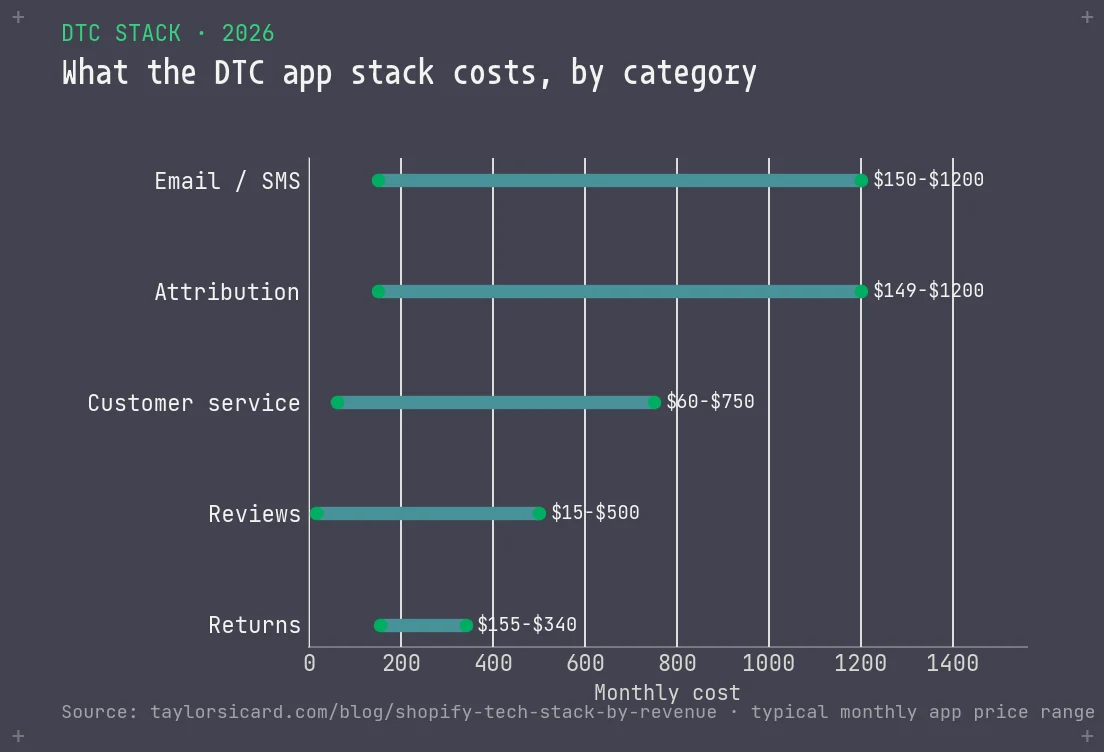
Klaviyo deserves a note here because it's genuinely platform-layer rather than another app. Its Shopify integration is deep enough that flows like post-purchase sequences, winback campaigns, and abandoned cart recover revenue that would otherwise be gone. Brands that treat Klaviyo as just an email sender are leaving most of its value untouched. At $1M and above, Klaviyo is the retention operating system, the investment that makes every other retention-adjacent app more effective. Shopify agrees in the most literal way available to it, having put $100M into Klaviyo and never sold a share. The post on Klaviyo flows for Shopify brands goes into the specific automations that drive the most revenue recovery at each stage. What that platform costs as you scale is in Klaviyo pricing decoded, and the email vs SMS split is its own call.
| Revenue Stage | Core Tools | Add This Stage | Cut / Upgrade | Spend Target |
|---|---|---|---|---|
$0–$2M Foundation |
Shopify Basic, Shopify Payments, Klaviyo (free tier), Judge.me or Junip |
Postscript (SMS), Recharge only if you are consumable or subscription-native |
Nothing: resist adding. Every install is overhead you cannot afford yet. |
Under $200/mo |
$2M–$5M Double down |
Klaviyo (paid), Postscript, Judge.me or Junip, Gorgias |
Loop Returns, Smile.io (loyalty), Checkout Components (once on Plus), Recharge if exploring recurring. Optional: a page builder (Replo or GemPages) for creative velocity. |
Reviews: move to Okendo or Yotpo only when UGC and syndication earn the premium. Any app a new hire now covers manually. |
$800–$2,000/mo |
$5M–$20M Add fuel |
Shopify Plus, Klaviyo, Northbeam (Triple Whale as dashboard-first alternative), Gorgias, Loop |
Fairing (post-purchase survey), Cleverific (order edits), Shoplift (A/B testing), Wonderment or AfterShip (shipping visibility, not a 3PL), Avalara (tax), Social Snowball (affiliate, timed right), Faire (wholesale, explore). Optional: Nosto, Searchspring, or Rebuy. |
Overlap in loyalty and review categories. Island apps with no integration to core platforms. |
$2,500–$6,000/mo |
$20M–$50M Scale & stability |
Shopify Plus, NetSuite (ERP), Daasity (data and reporting), Shopify Flow |
Cogsy or Inventory Planner (demand planning), Signifyd or NoFraud (fraud, often earlier at $5M–$20M as chargebacks scale), CDP layer (Klaviyo CDP or Segment) |
Any standalone app whose function has been absorbed by ERP or a platform-level feature. Prioritize integration quality over app count. |
$6,000–$15,000/mo |
What operational systems
you need before scaling
a Shopify brand past $5M.
Before a Shopify brand scales past $5M it needs four operational systems, in this order: financial reporting to contribution margin, inventory and demand planning, documented fulfilment and returns operations, and cohort-level retention reporting. None of them requires enterprise software at that size, and the benchmarks in this section tell you which one is missing.
People ask this as an apps question and it is not one. Apps are the last layer. What decides whether a brand survives the jump past $5M is whether four operational systems exist underneath them, and I have watched brands add $8,000 a month of tooling on top of none of them and get slower.
Here is the order I would build them in, and the test for whether you actually have one rather than a spreadsheet somebody updates when they remember.
| System | What it actually means | You have it when |
|---|---|---|
Inventory and demand planning | A forecast that drives purchase orders, with lead times and safety stock by SKU rather than by gut. | You can answer "what do we reorder Monday" without opening Shopify. |
Financial reporting to contribution margin | Margin after COGS, shipping, payment fees, returns and discounts, by SKU and by channel, monthly and closed. | You know which SKUs lose money at full price. Most brands past $5M cannot say. |
Order and fulfilment operations | Documented pick, pack, ship, exception and returns flows, with someone accountable for the exception queue. | A 3PL switch would take weeks, not quarters, because the process is written down. |
Customer data and retention reporting | Cohort repeat rate and revenue by acquisition month, not blended lifetime figures. | You can see whether the customers you bought last quarter are better or worse than a year ago. |
The pattern in every stalled brand I have looked at is the same. Tooling gets bought to paper over a missing system, then the tool needs its own owner, and now the brand has the original problem plus a subscription. Inventory Planner does not fix a business with no demand plan, it just puts a licence fee on top of guessing. The reporting stack does not create financial discipline, it displays whichever numbers you were already choosing to believe.
Sequencing matters more than selection. Financial reporting comes first, because it tells you which of the other three is costing you the most. Then inventory, because that is where cash gets trapped at this size. Then fulfilment, then retention reporting. A brand that does those four in that order can add apps opportunistically and get real returns from them. A brand that starts with apps gets the $14,200 a month bill in the audit above, with $4,800 of it doing nothing.
One caveat on all of it. None of these needs enterprise software at $5M. Three of the four can run on a spreadsheet that somebody genuinely owns and closes on a schedule. The system is the discipline and the accountability, not the licence.
The four tests above tell you whether a system exists. The numbers below tell you which one is costing you the most, and each one is a figure I already publish elsewhere on this site, so you can check the source and the date rather than take my word for it. Run your own numbers against this table before you buy anything.
| Measure | Benchmark | Source and date | If you are worse than this |
|---|---|---|---|
Repeat purchase rate | 18.8% aggregate across 156,110 customers in a February 2026 study; industry aggregators put it at 25% to 30%. Category sets it more than execution does. | DTC retention benchmarks, July 2026 | The retention reporting system is missing. You are buying growth you cannot keep, and no app fixes that. |
Fulfilment cost per order | $10 to $13 all-in for a mid-market brand on 2025 rate cards, of which $3 to $6 is the 3PL's pick, pack and handling before postage. | 3PL fulfilment cost benchmarks, 2025 rates | The fulfilment operations system is missing, or the rate card and the invoice have diverged on accessorials nobody quoted. |
Return rate | 19% to 20% of online orders blended (NRF 2025). Apparel 20% to 40%, footwear 17% to 30%, beauty 4% to 12%, home 15% to 20%. | Return rate benchmarks, NRF and Happy Returns 2025 | Use your category row, not the blend. Above it, the problem is sizing, product pages or quality, and a returns app only makes the loss easier to process. |
Cost per return | $10 to $65 all-in to take a unit back, process it and decide what to do with it, depending on category and channel. | The real cost of a DTC return, illustrative build | If this is not a line in your contribution margin, the financial reporting system is missing. Most brands past $5M have never built it. |
When inventory needs its own tool | Around 100 active SKUs, or three or more stock locations. Below that, Shopify's native inventory plus a weekly weeks-of-cover check is enough. | Shopify inventory management, June 2026, and when a DTC brand needs an ERP, July 2026 | Above the threshold with no tool, cash is trapped in the wrong SKUs. Below it with a tool, you bought a licence to paper over a missing demand plan. |
Paid acquisition cost | Meta ecommerce CPM near $16.80 in 2025, peaking at $22.98 in Q4; blended DTC CAC up 40% to 60% since 2023. | DTC channel benchmarks, 2025 platform data, updated July 2026 | If CAC rose and you cannot see cohort repeat rate by acquisition month, you cannot tell whether the rise is a channel problem or a product problem. |
Revenue per employee | $720K median across public DTC brands, $1.2M or more at the top quartile (Vita Coco, FIGS, YETI), which puts a $10M brand at roughly 14 people with contractors and agencies covering the rest. Updated September 2026 from an earlier, less-sourced $2M figure. | Eightx, DTC headcount benchmarks by revenue band, 2026 | Below it, headcount is doing work a system should do. Fix the system before the next hire. |
Two things to notice. Every row on that table is a number you can produce from your own Shopify, 3PL and ad accounts in an afternoon, so if you cannot produce one of them, that is the finding. And the one number the table does not carry is a median SKU count at $5M, because I have not published one and will not guess at it here; the threshold that matters is the 100-SKU line where forecasting complexity starts to justify a tool.
The best Shopify apps
to scale past $5M,
by what they protect.
There is no single best-apps list. The best Shopify apps for scaling a DTC brand past $5M are the ones that protect margin and retention at your current size, and the right stack changes as you cross each revenue line. The core that carries almost every brand is Klaviyo for lifecycle, Postscript for SMS, Judge.me or Junip for reviews, Gorgias for support, Loop Returns once returns get real, and one attribution layer you trust (Northbeam for heavier paid spenders, with Triple Whale as the dashboard-first alternative). Read the matrix below on two axes: stage tells you when to adopt, function tells you the job the tool does.
Two things the generic listicles get wrong. Checkout Components and the deeper checkout apps require Shopify Plus, so they belong once you are on Plus, not before (the triggers are in when to move to Shopify Plus). And shipping-visibility tools like Wonderment or AfterShip are not a 3PL: they tell the customer where the order is, they do not pick, pack, or ship it. Choosing a 3PL is an operations decision, not an app install. Below $5M I also do not name a heavyweight attribution tool. Native reporting, a properly configured GA4, and a post-purchase survey answer "how did you hear about us" better than a dashboard you are not yet staffed to act on.
I lead with Judge.me or Junip over Okendo and Yotpo, and with Northbeam over Triple Whale, because those are the tools I would personally run. The bigger-name alternatives are named on purpose: they are common, well supported, and the right call for some brands. The point is never the logo. It is naming the option, saying when it wins, and refusing to bolt on anything you cannot tie to a 90-day outcome.
Treat everything above as a strong starting default, not a rule. There is no fixed stack. The right tools vary brand by brand, shaped by more factors than any table can hold: your category, margin structure, catalog size, channel mix, team, fulfillment model, and where your growth is actually constrained. Two brands at the same revenue can need very different stacks.
So this is a general recommendation to start from, not an answer. The real work is a detailed audit of your specific business: confirming you have the right tools for your constraints, that you are actually using them to their full depth, and that the data flows cleanly between them. In practice most of the value is not in adding or cutting a single app. It is in fixing the usage and integration gaps between the tools you already pay for. If you want a fast first read on where yours stands, the free Shopify store audit is a good place to start.
Working through this at a brand past $5M? It's the work I do with DTC operators at that stage, and the form takes two minutes.
Lean, deliberate,
and hard to justify
adding to.
At this stage, simplicity is the strategy. You're still validating what works, which products convert, which acquisition channels are viable, what your actual repeat purchase rate is. The last thing you need is a complex stack that creates maintenance overhead and monthly costs before you've confirmed the model.
The $0–$2M Recommended Stack
Shopify Basic or Shopify plan (not Plus, Shopify Plus at $2,500/month is for brands above $1M in monthly revenue, not $1M in annual revenue). Shopify Payments built-in, which avoids the transaction fee on third-party gateways. Klaviyo, which is free up to 250 contacts, there's no reason not to start building flows from day one even at tiny list sizes, because the sequences you build early will compound. Judge.me Reviews at around $15/month, start here before Okendo or Yotpo, which charge a meaningful premium for features you don't need yet.
For SMS, Klaviyo SMS is the easiest path if you're already on Klaviyo, one platform, one integration, one billing relationship. Postscript is an alternative if you want a dedicated SMS tool with more advanced segmentation from the start. At this stage the difference matters less than the fact of having SMS at all. TikTok and Meta channels via Shopify's native integrations cover your pixel and catalog needs without an additional app.
That's the stack. Total app spend target: under $200/month.
The most common early-stage mistake: installing apps because they look useful, not because you have a specific problem they solve. Every app request you find in Shopify's app store has compelling marketing copy. None of them tell you that your time to configure, manage, and maintain them is a cost too, and at $0–$2M, your time is your scarcest resource.
Apps don't fix product-market fit problems. If your conversion rate is low, that's a product, pricing, or positioning problem, not a lack of upsell tools. If your repeat rate is low, that's a post-purchase experience or product satisfaction problem, not a lack of loyalty points. Identify the actual constraint before installing the app that claims to solve it.
This is where stack decisions
start having real
ROI implications.
At $2M–$5M, you have enough revenue to justify more sophisticated tooling, enough data to make decisions from, and enough repeat customers that retention infrastructure starts paying for itself. This is the tier where the right additions compound and the wrong ones just add cost.
What to Add at $2M–$5M
Upgrade reviews from Judge.me to Okendo or Yotpo. The step-up buys more than better-looking widgets: UGC collection, Q&A, deeper Klaviyo integration for post-review flows, and the ability to segment your best reviewers for loyalty and advocacy programs. Okendo starts around $88/month. That cost is justified when reviews are actively pulling conversion rate up and feeding your retention program.
Add a loyalty program: Smile.io or LoyaltyLion. Loyalty only matters when you have a meaningful base of repeat buyers to reward. Below $2M, the audience is often too small for a points program to change behavior at scale. Above $2M in most categories, you have enough repeat buyers that a real program, with VIP tiers, rewards on review submissions, and birthday campaigns, starts changing purchase frequency. Smile.io runs from $49/month (Starter) to $199/month (Growth). LoyaltyLion is more expensive and more customizable, right for brands that need complex tier logic.
Add retention analytics. Lifetimely or Triple Whale both give you contribution margin-based LTV tracking, which is the number you need to be making acquisition decisions from at this stage. Blended ROAS from Meta's reporting is not enough once you're spending real money. You need to know what each acquisition cohort actually contributes after COGS, returns, and shipping are factored in. Triple Whale runs $149/month at the entry tier, that's one of the clearest investments in the stack at this stage. For a full breakdown of how to build this model correctly, see the guide on the LTV math most Shopify brands are getting wrong.
Add Gorgias for customer service. The ROI on agent efficiency is real above 50 tickets a day. Gorgias pulls Shopify order data directly into the ticket view, so your support team doesn't have to tab-switch to answer most questions. Response times drop, ticket close rates improve, and agents handle more volume with the same headcount. Pricing starts around $60/month and scales with ticket volume.
Consider Loop Returns if you're in a high-return category. Apparel, footwear, anything with sizing complexity. Loop's exchange-over-refund flow regularly protects 15–25% of revenue that would otherwise have been refunded. The math works quickly if your return rate is above 15%.
Total app spend target at $2M–$5M: $800–$2,000/month.
"Every app you add should have a measurable outcome metric defined before you install it. If you can't articulate what success looks like in 90 days, you're not ready to add the app."
The efficiency layer,
and where bloat
gets expensive fast.
The $5M–$20M tier is where the most consequential stack decisions happen, and where I see the most mistakes. Revenue is there to justify more sophisticated tooling. But this is also where brands accumulate apps from the previous two stages without auditing them, add new capabilities on top of old ones, and end up with a stack doing redundant work across five categories simultaneously. The stack changes at this stage are inseparable from the broader operational changes that define the $5M inflection, team structure, financial visibility, and retention economics all evolve at the same time.
What to Add at $5M–$20M
Attribution: Triple Whale or Northbeam, properly configured, not just installed. At $5M+ in paid spend, attribution accuracy is worth real money. The difference between a blended ROAS number from Meta's self-reported data and an actual contribution-margin-weighted attribution model is not a rounding error, it can point to completely different channel allocation decisions. Triple Whale runs $149–$219/month at the standard tier, which is one of the better returns in the stack at this revenue level. Northbeam is more expensive ($1,000/month and up) and targets brands with more complex multi-channel spend; evaluate it when you're spending seriously across Meta, Google, TikTok, and influencer simultaneously. Once it is down to a shortlist, Triple Whale, Northbeam and Polar Analytics compared puts the pricing and the methodology side by side.
Subscriptions, if applicable: Recharge or Skio. Recharge is the long-established standard; Skio is newer with a better checkout experience and no-code migration tools. If subscriptions are part of your model and you've been managing them manually or through a lightweight tool, this is the tier where the right infrastructure pays for itself in subscription retention and payment recovery alone.
CRO tooling: Intelligems for price testing, VWO for broader A/B testing. At $5M+ in revenue, a 2% lift in conversion rate on your homepage or PDP is real money. You need a tool that can run tests cleanly without developer involvement on every experiment. Intelligems is specifically strong for Shopify price and offer testing, worth evaluating if pricing decisions are still being made without data. Before investing in testing infrastructure, run a manual product page CRO audit first, the quick wins are usually visible without a test.
Inventory forecasting: Inventory Planner or Cogsy. Spreadsheet-based inventory management breaks above $5M when you're managing multiple SKUs, seasonal demand curves, and 3PL lead times simultaneously. A stockout on a top SKU during peak costs more than a year of Inventory Planner. A meaningful overstock ties up cash that should be in acquisition or operations. Both tools start around $99–$200/month and connect directly to Shopify. For a deeper look at how inventory management decisions interact with unit economics across SKU depth, see the guide on Shopify inventory management for DTC brands.
SMS at scale: Postscript or Attentive. If you're still on Klaviyo SMS at $5M–$10M+ and sending volume is high, evaluate whether a dedicated SMS platform's deliverability, segmentation depth, and compliance tooling is worth the platform separation. Attentive targets brands at scale, pricing is volume-based and requires a conversation, not a self-serve signup. Postscript is more accessible and still strong at this tier.
Checkout extensibility (requires Shopify Plus): post-purchase upsell via Reconvert or ReCart, checkout extensions. The native Shopify checkout is good. Shopify Plus checkout with well-configured extensions is better, and the post-purchase upsell flow, when it's relevant to your product category, can add 5–15% incremental AOV without any additional acquisition spend. This requires upgrading to Shopify Plus ($2,500/month), which the math should support at $5M+ in annual revenue. The full case for when a brand should move to Shopify Plus covers the specific triggers that make the upgrade worth it versus premature.
| Tool | Category | Est. Monthly Cost | Priority |
|---|---|---|---|
Shopify Plus |
Platform |
$2,500/mo |
Core |
Klaviyo |
Email / SMS |
$600–$1,200/mo |
Core |
Triple Whale |
Attribution / Analytics |
$149–$300/mo |
Core |
Gorgias |
Customer Service |
$300–$750/mo |
Core |
Okendo |
Reviews / UGC |
$88–$350/mo |
Core |
Loop Returns |
Returns Management |
$155–$340/mo |
Core |
LoyaltyLion or Smile.io |
Loyalty |
$199–$500/mo |
High |
Inventory Planner |
Forecasting |
$99–$250/mo |
High |
Postscript |
Dedicated SMS |
$100–$500/mo |
Evaluate |
Reconvert / ReCart |
Post-Purchase Upsell |
$150–$400/mo |
Evaluate |
Intelligems |
Price / CRO Testing |
$99–$299/mo |
Category need |
Total app spend target at $5M–$20M: $2,500–$6,000/month (including Shopify Plus).
At $20M+, the question
shifts from which apps
to how they integrate.
Something changes structurally at $20M. The conversation stops being about finding the right app for a function and starts being about how your core systems share data with each other. A fragmented stack with 40 apps and weak integrations is measurably worse than a tighter stack of 15 apps connected by clean data pipelines. The operational overhead of managing 40 semi-integrated tools, triaging support tickets from multiple vendors, and managing data discrepancies across systems is a real cost that doesn't show up in the monthly billing line.
What Changes at $20M–$50M
ERP integration becomes serious. NetSuite, Cin7, or Brightpearl with a Shopify connector. At this revenue level, managing inventory, purchase orders, financials, and fulfillment in Shopify alone is not viable. You need a system of record that can handle multi-location inventory, purchase order management, landed cost tracking, and clean financial reporting. The Shopify-to-ERP integration is one of the more technically complex things to set up correctly, budget for a proper implementation, not a weekend project.
Data warehouse and BI layer. Glew and Daasity are the Shopify-native options at this tier; Looker or Tableau with a custom data pipeline is the right answer for brands that have serious analytical ambitions or internal data teams. The goal: a single source of truth that pulls from Shopify, your ERP, your ad platforms, and your email/SMS platform. If you're making revenue, margin, and channel decisions from four different dashboards that don't agree with each other, you have a data architecture problem.
Shopify Flow for automation. At $5M, Shopify Flow is a nice-to-have. At $20M+, it's essential. Automating inventory tagging, fraud holds, loyalty tier updates, customer segmentation changes, and fulfillment routing saves meaningful team hours weekly and removes human error from repetitive decisions. The investment is team time to configure and maintain flows, not incremental software cost.
Customer data platform consideration: Klaviyo CDP or Segment. Klaviyo's built-in CDP capabilities cover most use cases if you're a pure-Shopify operation. Segment is the right answer when you have multiple data sources feeding customer profiles and need a central layer to manage identity resolution and data routing. This is a $20M+ decision for most brands, below that level, it's complexity without corresponding benefit.
3PL integration via ShipStation, ShipBob direct API, or WMS connection. If you're running your own warehouse or working with a large 3PL at scale, the Shopify connection to your fulfillment operation needs to be clean and automated. Manual order management at this volume is an error factory. At $20M+ you also need an operator in place who owns the entire stack, not just the apps themselves. The post on when to hire your first DTC operator covers what that hire looks like and when the timing is right.
Dedicated fraud prevention: NoFraud or Signifyd. Shopify's native fraud tools are adequate below $5M in annual revenue. Above that threshold (and especially in high-AOV categories) dedicated fraud prevention with chargeback guarantees starts paying for itself. NoFraud and Signifyd both offer chargeback guarantees on approved orders, which changes the risk calculation materially.
Total app spend target at $20M–$50M: $6,000–$15,000/month for the app and platform layer. ERP and WMS costs at this scale often dwarf the app costs and should be budgeted separately.
The 45-minute audit
that every brand should
be running quarterly.
Most brands have never done this. Start by pulling up Shopify billing settings, every app subscription is listed there with its monthly cost. Print the list or copy it to a spreadsheet. That's step one: just knowing what you're paying for.
| # | Question to Ask | Decision Trigger |
|---|---|---|
01 |
When was this app last actively used? Check login history or platform activity, not just whether the app is installed. |
Not used in 60+ days: immediate candidate for removal. Get confirmation from any team member who might be using it before canceling. |
02 |
Who on the team owns this app? If you can't name a person, that's the problem, not the app. |
No named owner: assign one or remove the app. Ownerless apps accumulate cost and technical debt without accountability. |
03 |
Is another app in the stack doing the same or overlapping work? Category map your apps, email, reviews, loyalty, analytics, returns, CRO, etc. |
Category overlap: keep the one that integrates better with your core tools. Cut the other, not both, don't create capability gaps while fixing cost problems. |
04 |
Is this app sharing data cleanly with your other core tools? An app that operates as an island (no Klaviyo integration, no reporting connection, no data export) creates invisible blind spots. |
Island apps: evaluate whether the function could be covered by an existing tool with a native integration, even if the standalone app is technically better. |
05 |
Can you tie a measurable outcome to this app in the last 90 days? Revenue influenced, time saved, tickets deflected, returns exchanged, any concrete number works. |
No attributable outcome: either the app isn't being used correctly, or it's not the right app for the problem. Fix the usage first; if that doesn't work, remove it. |
The pattern that shows up in nearly every audit: 20% of the apps are generating 80% of the attributable value. Those are almost always the core email platform, the attribution tool, and the customer service tool. Everything else exists on a spectrum from clearly worth it to clearly not, with the middle full of apps that were once useful and have quietly become background noise.
One more thing the audit surfaces: apps with free tiers that you've long since outgrown, and are now silently charging you for features you could get cheaper elsewhere. Run a search for "was this on a paid tier when we switched?" for anything you've had installed for more than 18 months. Vendors change pricing frequently. What was free or cheap in 2023 may have moved to a higher tier without anyone noticing.
- $0–$2M: Klaviyo, Judge.me/Junip, Shopify Payments, Postscript
- $2M–$5M: Gorgias, Loop, Smile.io, Checkout Components (on Plus), Recharge
- $5M–$20M: Northbeam, Fairing, Shoplift, Cleverific, Wonderment, Avalara, Social Snowball
- $20M–$50M: NetSuite, Daasity, Cogsy/Inventory Planner, Signifyd/NoFraud, Shopify Flow
- Judge.me when Okendo/Yotpo covers the same ground better
- Any app a new team hire now covers manually
- Overlapping tools in the same category
- Apps not actively used in the last 60 days
- Island tools with no integration to your core platforms
- Inventory tagging and reorder triggers via Shopify Flow
- Customer segment updates on purchase behavior
- Fraud holds and fulfillment routing
- Loyalty tier progression without manual review
- Post-return Klaviyo win-back flows triggered by Loop
The underlying principle: your stack should be the smallest set of tools required to run the business effectively at your current revenue tier. Not the most sophisticated. Not the most impressive to show investors. The smallest effective set. Adding apps is easy. Removing them is what separates operators from collectors.
Questions operators ask
about the Shopify stack,
answered directly.
There is no universal number, but a useful signal is whether you can name the owner and measurable outcome for every app you're paying for. If you can't, you likely have too many. Most brands at $5M–$20M run 12–20 apps. The ones running it well have a named owner and a 90-day ROI case for each. The ones running it poorly have 30+ apps, no audit history, and cost drag they can't easily quantify. Quarterly audits keep this manageable.
The standard trigger is roughly $1M in monthly revenue (so $12M+ annually), where the per-transaction savings on Shopify Payments, the checkout extensibility, and the automation features in Shopify Flow collectively justify the $2,500/month platform cost. Brands on heavy third-party gateway fees sometimes find it worthwhile earlier. The common mistake is upgrading for prestige before you're using the Plus-specific features. The detailed breakdown is in the post on when to move to Shopify Plus.
Generally yes, if you are running paid media. At $2M in revenue with any meaningful Meta or Google spend, the difference between platform-reported ROAS and actual attributed contribution margin is worth knowing precisely. Triple Whale's entry tier at around $149/month is one of the more defensible investments in the stack at this stage. If you are not yet running paid media at any real scale, it can wait. The LTV and cohort-based views in Triple Whale are also significantly more useful at $3M+ when you have enough repeat purchase data to analyze meaningfully.
At $5M the core stack is Shopify Plus (or a plan to upgrade), Klaviyo, one attribution layer you trust (Northbeam for heavier paid spenders, or Triple Whale as a dashboard-first alternative), Gorgias for support, Judge.me or Junip for reviews (Okendo or Yotpo when UGC and syndication earn the premium), Loop Returns if your category has returns complexity, and a loyalty program like Smile.io. Total app spend at this stage sits in the $2,500–$6,000/month range including the platform cost. What you should audit out of the stack at this point: any holdover from the early stage that a new team hire now covers, and any category where you're running two tools doing similar work.
There is no single best-apps list; the right stack changes by revenue stage. The core that carries most brands is Klaviyo for lifecycle, Postscript for SMS, Judge.me or Junip for reviews, Gorgias for support, Loop Returns, and one attribution layer you trust (Northbeam or Triple Whale). Past $5M you add an operational and testing layer: Fairing for post-purchase attribution, Shoplift for on-site testing, Cleverific for order edits, Wonderment or AfterShip for shipping visibility, Avalara for tax, and Social Snowball for affiliate revenue. Pick the tool that protects margin or retention at your size, and cut anything you cannot tie to a 90-day outcome.
Quarterly, with a full ownership review annually. A quarterly audit takes about 45 minutes if you maintain a running list. Pull your Shopify billing settings, map every app to a category and an owner, flag anything unused in the last 60 days, and check for overlap. The annual review should go deeper: compare what each app costs against the documented ROI, and assess whether you've grown into or out of any category since the last review. Most brands that do this consistently find they can cut 15–30% of their app spend without losing any meaningful capability.
Matching your tech stack to your revenue stage keeps you from paying for tools you have not grown into yet. The DTC growth consulting practice helps you right-size it. When you want a second opinion on yours, start the conversation.
How a stack gets bloated
In the brands I've advised, roughly one in five installed apps drives about four in five dollars of measurable value. The bloat comes from accumulation without an owner: attribution at $1M, loyalty at $2M, reviews at $3M, a survey tool at $4M, a testing tool at $5M. Each was a sensible call at the time. At $6M the stack is doing overlapping work in three categories and nobody owns the whole picture.
Two habits fix most of it. Run one tool per category; two review apps at once is exactly the overlap a quarterly audit exists to catch. And when you evaluate a subscription or retention tool, check who owns it now, because consolidation can change a roadmap and a price list.
At the Plus end of that table the stack question becomes a sequencing question, which is what Shopify Plus advisory covers.
Scaling a consumer brand?
I take on one or two new clients a quarter and do the work myself, drawing on brands I've run from $5M past $100M. If you're in that range, the form takes two minutes.
Start a conversation Shopify Plus advisory →