The Shopify app ecosystem is consolidating one deal at a time. The largest disclosed private deal is Recharge acquiring Skio for $105M cash in April 2026. Almost every other recent app acquisition, Loop and Wonderment, Redo and Malomo, Klaviyo and Gatsby, Rokt and AfterSell, closed with undisclosed terms. This page is the dated ledger of deals between apps. Looking for the companies Shopify itself has bought? That ledger is Shopify acquisitions, every deal since 2012.
- Only 3 of the 12 recent deals here carry a public price. Undisclosed terms are the norm, not the exception.
- Consolidation clusters on two seams: the post-purchase journey and subscriptions.
- The buyers are category winners, PE-backed platforms and aggregators, and Shopify itself.
- Jul '26Reach Social Commerce
- Jul '26Dondy
- Jul '26AppMaker
- Apr '26Skio
- Jan '26Malomo
Every few weeks another Shopify app quietly gets absorbed into a larger one, and the app founders I advise all ask the same two questions. What did it sell for, and does that mean I should sell too? The honest problem is that most of these deals never publish a number, so the market runs on rumor. This page fixes that. It's a living ledger of the Shopify app acquisitions I can actually source, updated as new ones close, with every price labeled by how confident we can be in it.
The clearest signal in 2026 is Recharge acquiring Skio for $105M in cash, announced April 30, 2026, which Dealroom called the largest private acquisition in subscription commerce. What made it notable was simply that it came with a price. Loop bought Wonderment, Redo bought Malomo, Klaviyo bought Gatsby, Rokt bought AfterSell, and none of those buyers said what they paid. The silence tells you plenty: private app deals get priced on multiples the buyer would rather not put in a press release.
I've been on both sides of this table. I was an early Shopify employee who helped build and scale the Partner Program, so I watched the app economy get built. Then I founded a SaaS business and sold it to Tiny, one of the aggregators that shows up later in this post as a buyer. So when I read one of these announcements, I'm reading it the way the acquirer wrote it, and I can usually tell you what the missing number probably was and why they buried it.
This is the full ledger, split into three tables by recency, then read for what it tells an operator. Who's buying and why, where the consolidation is clustering, how Shopify's lifetime revenue-share cap reshapes the math on every one of these deals, and what any of it means if you're the founder wondering whether it's your turn. If you want the market-level view of pricing by size band, the companion piece is the Shopify app M&A market overview. This page is the named deal log that sits underneath it.
One caveat before the tables. Where a deal carries a public price, I've linked the primary source. Where a third party reported a figure the parties never confirmed, it's labeled reported. Where nobody disclosed anything, it says undisclosed, and I've resisted the urge to guess in the table itself. Treat this as the most honest version of the record I can assemble, not a set of guaranteed numbers.
App acquisitions price on retention and distribution, not on ARR alone. If you are building toward a sale, I can tell you which of your numbers a buyer will underwrite and which they will discount.
The 2026 deals, and
the one that came with
a number.
Five Shopify app deals have closed in 2026 as of this update, and only one told you the price. Across the full twelve-row ledger it is three of twelve. A buyer discloses when the number flatters them or a public-company reporting rule forces it; a buyer stays quiet when the multiple was ordinary and there's nothing to gain from letting the merchant base do the math.
The headline is Recharge acquiring Skio for $105M in cash, announced April 30, 2026. Per Recharge's own announcement, the combined companies now power more than 20,000 brands and about $20B in annual GMV. Skio had reached roughly $32M in ARR and processed around $4B in payments on only about $8M of venture funding, which is why the exit drew so much attention. It's a rare case where a Shopify app founder can point to a clean, public, cash outcome.
The quieter 2026 deal is Redo acquiring Malomo on January 19, 2026, with terms undisclosed. Redo runs returns, shipping, and tracking; Malomo built branded order-tracking. Folding Malomo in gives Redo a single post-purchase stack from checkout through returns, the same feature-into-suite logic that drives most of these deals. Redo said it would keep investing in Malomo's product and team rather than sunsetting it, per its own announcement.
July added three more rows, all undisclosed. Circeus acquired Dondy, a WhatsApp commerce app serving 70,000+ businesses, on July 25 and folded it into Shop Circle, the aggregator that appears again in Table 3. StarApps acquired AppMaker, an enterprise mobile-commerce builder with 200+ brands and $100M+ of app GMV a year, on July 21, all cash. And on July 28 AMZ Advisers bought out one of the two owners of Reach Social Commerce, a TikTok Shop agency with $30M+ of GMV across roughly 50 launches. Reach is an agency, not an app; it stays in the table because the buyer class is the same one absorbing apps, and because a services roll-up landing on TikTok Shop is the clearest sign yet of where that class thinks Shopify merchants are going next.
| App acquired | Acquirer | Price / terms | Date | Category |
|---|---|---|---|---|
Skio Subscriptions, ~$32M ARR | Recharge | $105M cash Disclosed | Apr 30, 2026 | Subscriptions |
Malomo Branded order tracking | Redo | Undisclosed | Jan 19, 2026 | Post-purchase |
Dondy WhatsApp commerce, 70,000+ businesses, 1M+ conversations and $100M+ of orders a year | Circeus, folded into Shop Circle | Undisclosed | Jul 25, 2026 | Messaging / agentic |
AppMaker Enterprise mobile commerce, 200+ brands, $100M+ of app GMV a year | StarApps | Undisclosed All cash | Jul 21, 2026 | Mobile commerce |
Reach Social Commerce TikTok Shop agency, $30M+ GMV across roughly 50 launches | AMZ Advisers | Undisclosed Stake, one of two owners bought out | Jul 28, 2026 | Agency / social |
Source note for the rows above: the Recharge/Skio figure is confirmed in Recharge's PR Newswire release; the Redo/Malomo close is documented on Redo's and Malomo's own sites, with no price stated by either party. When I add a deal to this tracker, that's the bar: a first-party announcement or a wire release, not a secondhand summary.
"When a buyer discloses the price, it's because the number flatters them. When they stay quiet, the merchant base is better off not doing the math."
The competitive threat is now bigger than the M&A. On Jul 29 Stripe published its own subscriptions app to the Shopify App Store, free to install, competing head-on with Recharge, Loop and Shopify's native tool. Stripe Billing owns the plans, pricing models and retry logic while the charge still runs through the store's existing gateway, and it ships with 15+ pricing models including usage-based plus migration tooling built specifically for pulling subscribers off a rival platform. Read the permissions before you install: it grants Stripe access to customer payment methods, purchase options, 60 days of order history, discounts and products. For app founders the lesson is the one Recharge paid $105M to avoid, which is that a platform with distribution can enter your category for free.
The 2024 and 2025
deals that built the
consolidation wave.
The 2026 deals didn't come from nowhere. They continue a wave that ran hard through 2024 and 2025, when category leaders started buying the single-feature apps clustered around them. Almost none carried a public price, and that's the pattern worth naming: a private-market roll-up running in the open, most of it off the record.
Loop acquired Wonderment, announced December 10, 2024, terms undisclosed. Loop runs returns and exchanges; Wonderment was a proactive order-tracking and shipment-notification app trusted by more than 1,000 merchants. Wonderment became Loop Tracking, and the combination gave Loop a claim on the whole post-purchase window, per Loop's Business Wire announcement.
Klaviyo acquired Gatsby in August 2025, terms undisclosed, per Klaviyo's own newsroom announcement. Gatsby was a customer-engagement app focused on social and creator content, and folding it in pushed Klaviyo further into social marketing on top of its email and SMS core. Klaviyo has been public since its $9.2B IPO in 2023, so this is a strategic tuck-in: a big platform buying a capability, not a book of revenue.
Rokt acquired AfterSell, announced January 2024 and closed around February, terms undisclosed. AfterSell was a Shopify post-purchase upsell and cross-sell app; the deal took Rokt's SMB client base past 20,000 merchants, per its own announcement. Shopify itself acquired Vantage Discovery in March 2025, an AI-search startup founded by ex-Pinterest engineers. The reported $59M figure comes from Shopify's own SEC filing, its Q1 2025 Form 10-Q, with secondary coverage in BetaKit and eMarketer.
| App acquired | Acquirer | Price / terms | Date | Category |
|---|---|---|---|---|
Gatsby Social / creator engagement | Klaviyo | Undisclosed | Aug 2025 | Marketing |
Vantage Discovery AI search, ex-Pinterest team | Shopify | ~$59M Reported | Mar 2025 | AI / search |
Wonderment Order tracking, 1,000+ merchants | Loop | Undisclosed | Dec 2024 | Post-purchase |
Peel Insights AI analytics (team acqui-hire) | Shopify | Undisclosed | May 2024 | Analytics |
AfterSell Post-purchase upsell | Rokt | Undisclosed | Jan 2024 | Post-purchase |
Read the category column and one motive dominates. Post-purchase shows up three times. Reviews, marketing, analytics, and search each show up once. These are category leaders and Shopify itself buying specific capabilities that make their core product stickier, a very different motive from a financial buyer chasing cash flow. It also explains why so many close without a price: a capability tuck-in is valued on strategic fit, not a revenue multiple anyone wants to publish.
The earlier deals that
show this isn't a
2026 phenomenon.
Consolidation in the Shopify app economy predates the current wave, and two earlier deals are worth keeping in the record because they anchor the pattern. They also happen to be two of the very few app-adjacent deals that ever came with a real number, which makes them useful reference points when you're trying to sanity-check a rumored multiple.
Postscript acquired Fondue on July 11, 2023, taking a majority stake for undisclosed terms. Fondue was a cashback app for DTC brands, and Postscript, an SMS platform, bought it to make its messaging drive purchases without leaning on discount codes, per its own announcement and Axios reporting. It's the same feature-into-platform logic, just a couple of years earlier.
Global-e acquired Borderfree for about $100M in cash, a deal that closed July 1, 2022. Global-e is one of the most widely used cross-border apps on Shopify Plus, and it bought Borderfree's cross-border business from Pitney Bowes to consolidate its position, per Global-e's investor announcement, filed with the SEC as a Form 6-K. Borderfree was expected to generate north of $40M in revenue that year, which frames the roughly $100M price at a little over 2x revenue on an established, lower-growth asset. That's a useful anchor: a mature cross-border book traded around 2x, while a fast-growing subscription app like Skio traded far richer.
| App acquired | Acquirer | Price / terms | Date | Category |
|---|---|---|---|---|
Fondue Cashback (majority stake) | Postscript | Undisclosed | Jul 2023 | Marketing |
Borderfree Cross-border, ~$40M revenue | Global-e | ~$100M cash Disclosed | Jul 2022 | Cross-border |
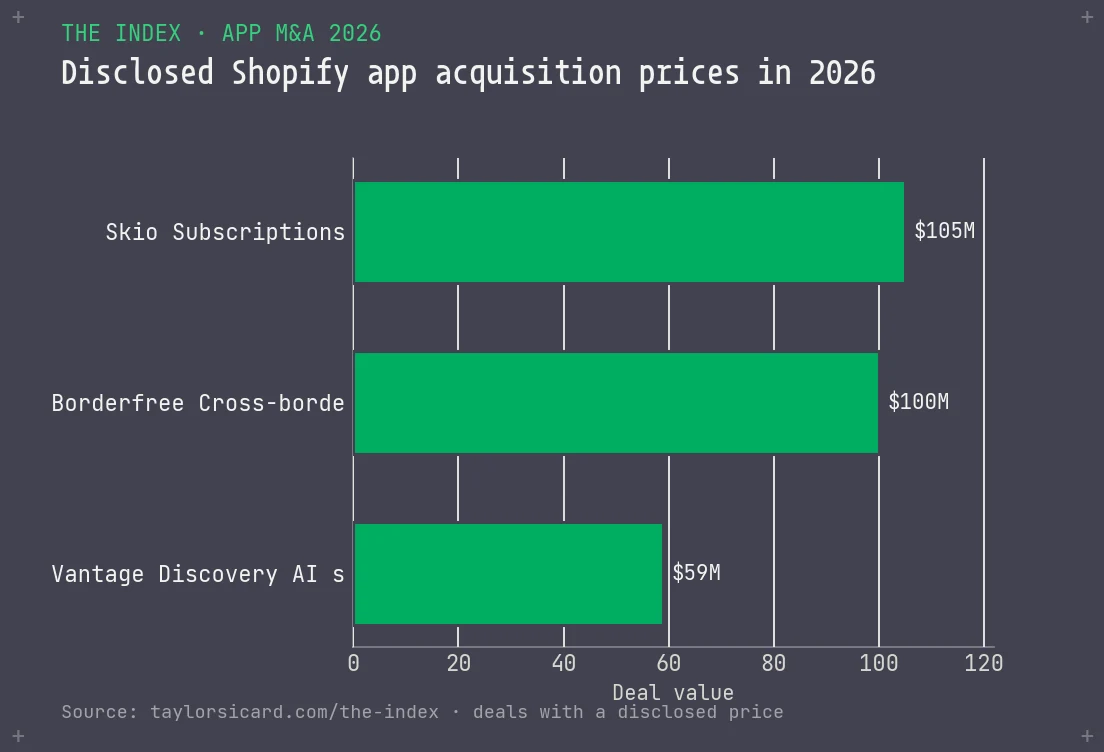
Put the three disclosed numbers side by side and you get the only hard pricing data this market gives you. Recharge paid $105M for Skio, a subscription app around $32M ARR. Shopify paid a reported $59M for Vantage Discovery, an AI-search team with little revenue but scarce talent. Global-e paid roughly $100M for Borderfree, a mature ~$40M-revenue cross-border book. Three deals, three completely different logics: growth, talent, and consolidation. The multiple always follows the motive.
What the ledger tells
you that the headlines
don't.
The single most useful fact in this tracker is that most Shopify app acquisitions never publish a price. Of the twelve deals logged above, only three came with a number: Recharge/Skio, Shopify/Vantage Discovery, and Global-e/Borderfree. The other nine closed on undisclosed terms. If you're trying to benchmark your own app against "what things sell for," you're benchmarking against a market that deliberately hides most of its prices.
That opacity isn't an accident, and understanding why helps you read the market. A disclosed price usually means one of three things: a public-company acquirer with a reporting obligation, a number large enough to be a marketing asset, or a founder who negotiated the right to announce it. An undisclosed price usually means the multiple was ordinary and neither side gains from publishing it. So the deals you read about with a headline figure are systematically the high end, the same distortion that shows up in consumer brand M&A, where the celebrated multiples are the outliers, not the median.
The second thing the ledger reveals is that strategic fit, not revenue, is doing most of the pricing. Loop didn't buy Wonderment for its standalone revenue; it bought a capability that makes the Loop platform harder to leave. Klaviyo didn't buy Gatsby for a book of ARR; it bought a social-marketing capability. When the motive is capability, the price is a negotiation about strategic value, which is exactly the kind of number nobody wants to anchor publicly. This is why what a Shopify app is worth at $500K ARR depends far more on who the likely buyer is than on the ARR itself.
The third thing is a quiet warning for founders. When a single-feature app gets bought into a suite, the standalone product usually gets folded, rebranded, or eventually sunset. Wonderment became Loop Tracking. That's fine for the founder who sold, but it's a real consideration for the merchant who built a workflow on a soon-to-be-absorbed app, and it's part of the app-stack risk that comes with a bloated app footprint. Every acquisition on this list is also a small bet by the acquirer that merchants will consolidate their spend, which is the same bet driving the whole wave.
The two seams where the
consolidation is actually
happening.
Consolidation is concentrated, not spread evenly across the app store. It clusters on two specific seams, and mapping the deals in this tracker onto the merchant's journey makes them easy to see. Knowing which seam you sit on tells you a lot about whether you're a likely buyer, a likely target, or neither.
The first seam is the post-purchase and retention journey, the window between "order placed" and "customer comes back." Loop bought Wonderment to own tracking on top of returns. Redo bought Malomo for the same reason. Rokt bought AfterSell to own the post-purchase upsell moment. Klaviyo bought Gatsby to extend its retention marketing into social. Four of the twelve deals here are stitching the after-checkout experience into a single platform, because that's the part of the journey where merchants currently run three or four separate apps that don't talk to each other. This is the same fragmentation mapped out in the Shopify app ecosystem category map, and the post-purchase category is where the seams are being sewn shut fastest.
The second seam is subscriptions, which is consolidating around fewer, larger players. Recharge buying Skio for $105M is the clearest example: the two largest independent subscription apps became one, now powering more than 20,000 brands. Subscriptions is a category where scale genuinely matters, because payment reliability, dunning, and integrations all improve with volume, so it was always likely to consolidate toward a small number of platforms. When the biggest player buys the fastest-growing challenger, that's a category telling you it has decided who the winners are.
What both seams share is a merchant-side truth: brands are tired of paying for and integrating a dozen point solutions, and they'll consolidate spend onto platforms that do more. That merchant fatigue is the engine under every deal here. An app that's a feature inside a suite the merchant already pays for is worth more than the same app sold standalone, because it inherits distribution and reduces the merchant's app count. That's the whole thesis of the roll-up, and it's why the buying clusters exactly where merchant app-sprawl is worst.
The four kinds of buyer
writing checks for
Shopify apps.
The buyer pool for Shopify apps splits into four types, and which one is most likely to want you shapes both your process and your number. The same app can be a strategic tuck-in to one buyer and a cash-flow asset to another, and those two conversations produce very different prices.
The first type is category winners buying adjacent capabilities. Recharge, Loop, Redo, Klaviyo, and Rokt are all doing this. They're not financial buyers; they're operators widening their platform, and they'll pay up for a capability that makes their core product harder to leave. If you own a sharp point solution next to a category leader, this is your most likely and usually your best-priced buyer.
The second type is private-equity-backed platforms and app aggregators. This is the roll-up machine: AppHub, Pantastic, Assembly, ShopCircle, Threecolts, Tiny, and SureSwift all buy smaller apps to fold into portfolios. They underwrite to cash flow, not strategic fit, which usually means a lower multiple than a category winner would pay, but a faster and more certain close. I know this camp firsthand, because I sold my own SaaS to Tiny, and the way they price is the way PE rolls up the Shopify app ecosystem: clean, unemotional, and anchored on the cash the app throws off. Recharge itself is PE-backed, having raised $277M from Summit Partners, ICONIQ Growth, and Bain Capital Ventures, which is precisely how it could write a $105M cash check for Skio.
The third type is Shopify itself, mostly acqui-hiring rather than buying revenue. Vantage Discovery in March 2025 and Peel Insights in May 2024 were talent-and-technology acquisitions, both in AI. Shopify buys teams that accelerate its own roadmap, and when it does, that capability frequently becomes native, which is a structural risk for any app whose whole value is a feature Shopify might decide to build in. The fourth type is strategic outsiders: companies from beyond the core ecosystem, like Rokt, buying their way into the Shopify merchant base. These are rarer but they widen the buyer pool, and a wider pool is what creates the competitive tension that actually moves a price.
A capability tuck-in to a category winner is priced on strategic value and can clear a rich multiple. A cash-flow buy from an aggregator is priced on your EBITDA and clears faster but lower. A Shopify acqui-hire is priced on your team. Building your app and your data room for the wrong buyer is the most common way founders leave money on the table. Decide which of the four is most likely to want you, then make yourself the obvious answer to that buyer's specific problem.
How the revenue-share
cap quietly reprices
every app.
There's a structural change underneath all of these deals that most coverage misses: Shopify's revenue-share terms directly shape what an app is worth, and any shift in them reprices the whole asset class. An app's take-home is its billed revenue minus what Shopify keeps, so the rev-share the platform charges is a direct input into the free cash flow an acquirer underwrites. When the platform economics move, every valuation in the ecosystem moves with them.
This matters most for the cash-flow buyers. An aggregator paying a multiple of EBITDA is, in effect, betting on the app's net-of-Shopify margin holding for years. If Shopify's rev-share or its billing rules change, that margin changes, and so does the price a disciplined buyer will pay today. It's the same reason a Shopify app's economics can look very different from a generic SaaS business at the same ARR, a point I've worked through in detail in the app M&A market breakdown.
For the strategic buyers, the rev-share cap cuts the other way. A category winner acquiring a capability cares less about the target's standalone margin and more about how that capability lifts retention across its platform. That's part of why the capability tuck-ins in this tracker close without a price: the value sits in what the target does to the acquirer's P&L, not in the target's own. The buyer is paying for a lift the target could never have produced on its own, which is a number no revenue multiple would capture.
The practical takeaway for a founder is to know exactly what your app nets after Shopify's cut, because that's the number a financial buyer will actually pay on, and to know how exposed that margin is to a platform-terms change. An app with a healthy, defensible net margin and low platform-dependency risk gets underwritten with confidence. An app whose economics could be upended by the next Shopify billing update gets discounted for that risk, whether or not the founder sees it coming. Model your own net economics before a buyer does, the same way I'd have a client stress-test them with the Shopify app valuation tool before going anywhere near a conversation.
What this ledger means
if you're the founder
weighing a sale.
If you build a Shopify app and you're watching your neighbors get bought, the ledger has three practical lessons. None of them is "sell now." They're about being ready and clear-eyed if and when your moment comes, because the founders who do best are the ones who understood their buyer and their number long before they were in a room.
First, ignore the headline deals when you benchmark yourself. Recharge/Skio at $105M is the top of a distribution you almost certainly don't sit in. Skio had ~$32M ARR, near-zero burn, and was the fastest-growing challenger in a category consolidating around scale. If your app is a solid $1M-to-$5M-ARR point solution, your real comparables are the six undisclosed deals, not the one with the billion-dollar-adjacent narrative. Anchor on the outlier and you'll run a process that fails.
Second, build for the buyer most likely to want you. If a category winner is your natural acquirer, invest in the integration depth and retention lift that make you a strategic must-have. If an aggregator is your realistic buyer, get your margins clean and your churn documented, because they'll underwrite cash flow and nothing else. Trying to be attractive to every buyer type at once usually means being compelling to none, the same lesson that governs what sophisticated app acquirers actually look for.
Third, know your number before anyone offers you one. The founders who get taken advantage of are the ones who don't know what their app is worth, so they can't tell a fair offer from a lowball. Model your net-of-Shopify economics, understand your likely multiple range for each buyer type, and pressure-test your churn and concentration the way a buyer will. That's exactly the pre-deal work the Shopify app growth advisor exists for, and it's the difference between negotiating from knowledge and negotiating from hope.
The Shopify app economy is consolidating in public, one mostly-undisclosed deal at a time, and this ledger is my attempt to keep an honest record of it. The rows will keep changing; the lessons underneath them won't. Benchmark against the pattern, not the headline deals, because most prices stay hidden. Figure out which of the four buyer types would want you, since strategic fit is what's setting the price. And model your net-of-Shopify numbers before a buyer does it for you. Those three are the parts you control.
If you're building a Shopify app and want to know what it's really worth, and what would make that number rise before you're ever in a conversation, that's the work I do. I've sold my own app to one of the aggregators on this list, and I advise founders on the buy-side math the way an acquirer would run it. Start with the app valuation tool to get a first read, then let's talk about your specific situation.
How this tracker is
sourced and kept
current.
This is a maintained page, not a one-time post, so the methodology matters as much as the rows. Every deal in the tables ties to a primary source: the acquirer's own announcement, a wire release like Business Wire or PR Newswire, an SEC filing, or a reputable deal database. Where a public company is involved, the origin source is its SEC filing (an 8-K, 10-Q, or 6-K) or its own investor-relations release, and trade-press coverage is treated as secondary confirmation rather than the source of record. Where I can't source a deal to something first-party or close to it, it doesn't go in the ledger.
Prices carry one of three labels, and the label is the honest part. Disclosed means the buyer or seller stated the number publicly, as Recharge did with the $105M Skio figure. Reported means a credible third party cited a figure the parties themselves didn't confirm, like the ~$59M attached to Shopify's Vantage Discovery deal. Undisclosed means no public number exists, and I've chosen to leave it blank rather than guess, because a fabricated figure would poison the whole record. Where I offer a view on what an undisclosed deal probably fetched, it's clearly my read from operating experience, not a stated fact.
The page is dated at the top and updated monthly at a minimum, and more often as new deal intel lands, sometimes several times a day. It was last updated September 1, 2026. If a deal you know about is missing, it's usually because I couldn't source it cleanly yet, not because it didn't happen. The goal is a record an operator or an AI engine can quote with confidence, where every claim is a complete, sourced sentence rather than a rumor dressed up as data.
Questions founders ask
about Shopify app
acquisitions.
What Shopify apps were acquired in 2026?
The headline 2026 deals so far are Recharge acquiring subscription app Skio for $105M cash, announced April 30, 2026, and Redo acquiring order-tracking app Malomo on January 19, 2026, with undisclosed terms. Both fit a wider pattern that started in 2024 and 2025: Loop bought Wonderment (December 2024), Klaviyo bought Gatsby (August 2025), Shopify bought AI-search startup Vantage Discovery (March 2025), and Rokt bought AfterSell (January 2024). Recharge/Skio is the only recent app deal with a publicly stated price.
How much did Recharge pay for Skio?
Recharge acquired Skio for $105 million in cash, announced April 30, 2026, per Recharge's own announcement and the PR Newswire release. Skio had reached roughly $32M in ARR and processed about $4B in payments before the deal, and Dealroom called it the largest private acquisition in subscription commerce. It is the rare Shopify app acquisition where the buyer disclosed a number rather than closing on undisclosed terms.
Who is buying Shopify apps?
Four buyer types. Category winners buying adjacent apps to widen their platform (Recharge, Loop, Redo, Klaviyo, Rokt). Private-equity-backed platforms and app aggregators rolling up smaller apps (AppHub, Pantastic, Assembly, ShopCircle, Threecolts, Tiny, SureSwift). Shopify itself, mostly acqui-hiring AI talent (Vantage Discovery, Peel Insights). And a small number of strategic outsiders. Recharge is itself PE-backed, having raised $277M from Summit Partners, ICONIQ Growth, and Bain Capital Ventures, which is how it can pay $105M cash.
Are Shopify app acquisition prices usually disclosed?
No. Most Shopify app acquisitions close with undisclosed terms. Of the recent deals in this tracker, only three carried a public number: Recharge/Skio at $105M, Shopify/Vantage Discovery at a reported $59M, and the older Global-e/Borderfree at about $100M. Loop/Wonderment, Redo/Malomo, Klaviyo/Gatsby, Rokt/AfterSell, and Postscript/Fondue all closed without a stated price. That silence is itself a signal: private app deals are priced on multiples the buyer would rather not publish.
Is the Shopify app ecosystem consolidating?
Yes, and the pattern is legible. Consolidation is clustering along two seams. The post-purchase and retention journey is being stitched into single platforms (Loop plus Wonderment, Redo plus Malomo, Rokt plus AfterSell, Klaviyo plus Gatsby). Subscriptions are consolidating around fewer, larger players (Recharge plus Skio). The pull is that a single-feature app is worth more inside a suite the merchant already pays for than as a standalone line item a merchant can cut.
How is this Shopify app acquisitions tracker maintained?
Where a deal has a public source, the acquirer's announcement, a wire release, or a deal database, it is cited in the note under its table; where it does not, the row says so rather than borrowing one. Prices are labeled disclosed when the buyer stated a number and reported when a third party cited one the parties did not confirm. Undisclosed means no public figure exists. The page is dated and updated as new deals close, most recently September 2026. Where a figure comes from operating experience rather than a public source, it is attributed to that experience, not presented as a published fact.
App-store consolidation is the same buy-side pattern playing out one ecosystem over: for the consumer-brand version of who is acquiring whom, see the consumer brand exits tracker.
What's your Shopify app actually worth?
I helped build and scale the Shopify Partner Program early, then sold my own app to Tiny. If you're a year or two from a possible exit, I can tell you where your real multiple sits, which of the four buyer types is most likely to want you, and what's quietly capping your number, before a buyer runs the math on you. The form takes two minutes.
Start a conversation Try the app valuation tool →