In 2026 most Shopify apps near $500K ARR clear between roughly 3x and 5x ARR, so about $1.5 million to $2.5 million, with realized prices skewing to the lower half. Growth, churn, merchant concentration, and what you keep after Shopify's cut decide where in that range you land. A clean, growing, diversified app can earn an AI-native or quality premium above 5x; a flat, founder-dependent one prices as a profit multiple closer to $1 million.
- The legacy and commodity band for sub-$5M apps in 2026 runs roughly 3x to 7x ARR, with a median near 4.5x, and apps near $500K sit in the lower part of it.
- The 15x to 30x ARR figures quoted for AI-native software are venture growth-round numbers, not acquisition prices for a $500K app. The real premium is roughly 1x to 3x ARR.
- Churn is the single biggest swing factor at this size: strong retention argues for 4x to 5x, hard churn pushes a buyer toward profit-multiple math.
- Buyers underwrite the profit you keep after Shopify's revenue share once the $1M lifetime exemption is used up, not your gross billings.
App founders send me one question more than any other: what is my app actually worth? Usually it arrives with a number attached: half a million in ARR, growing, profitable, built on Shopify, and a founder wondering whether the unsolicited email from a buyer is generous or insulting. This post does one specific thing. The general survey of what Shopify apps sell for in 2026 and the full step-by-step method of how to value a Shopify app live in their own posts. Here you get one worked example, a $500K ARR app valued four different ways, so you can find yourself in it.
I have been the seller in this conversation: I founded getuptime.co and sold it to Tiny. The math in this post is the math I lived through. Along the way the buyer anchored on a multiple, we went back and forth about churn and concentration, and it slowly became clear that the number is your defensible profit times what the buyer believes about your next two years, not your revenue times a magic figure.
One caution up front. Every headline you have read about AI software trading at 30 times revenue is true and almost completely irrelevant to you. Those are venture growth-round valuations for breakout companies raising capital, not the cash price someone pays to own a $500K app outright. Mixing the two is the fastest way to set an expectation that no buyer will ever meet. The bands section separates the two, because at this size the gap between those worlds is enormous.
The one-line answer comes first, then the 2026 multiple bands, the variables that move the number, the same app valued under four scenarios, the rev-share line most founders forget to adjust, and what I would tell you to do. To skip the reading and turn the dials yourself, the app valuation walkthrough runs this same logic.
It comes down to
a range, and it is
narrower than you think.
A typical Shopify app at $500K ARR in 2026 is worth somewhere around $1.5 million to $2.5 million in a real cash acquisition. The range is wide because the variables are wide, but it is also narrower than the internet suggests, because the internet keeps quoting venture multiples at people running cash sales.
The midpoint sits near 3.5x to 4x ARR, which is a fair number for a market that compressed through late 2025 into 2026, where realized prices skew to the lower half of any quoted band and buyers underwrite carefully. The apps that clear above 4x are the clean ones: real growth, low churn, diversified merchant base, and profit that survives the founder stepping away. The apps that clear below 3x are usually fine businesses with one fixable flaw, or one unfixable one. Comparables are thin at this size because most deals close quietly, so rather than work from rumor I log the app deals I can source by date, buyer and price.
When a buyer's first email lands at $1.4 million for your $500K app, your instinct is to be offended. Do the math first: that is 2.8x ARR, a real opening offer in this market. It is also probably below where you should land if your fundamentals are good, and telling those two cases apart comes down to the variables in the next few sections.
The 2026 bands, and
why the AI numbers
do not apply to you.
Three multiple worlds exist in 2026, and founders constantly mix them up. The first is the lower-middle-market private SaaS band. The second is the micro-SaaS and bootstrapped acquisition band, where most $500K apps actually transact. The third is the AI-native venture band, which is loud and real and does not apply to you.
Lower-middle-market private SaaS in 2026 trades at roughly 3x to 7x ARR, with a median around 4.5x, according to Aventis Advisors and similar 2026 benchmark data. Companies with Rule of 40 above 50 and net revenue retention above 120 percent push toward 7x to 9x, and a rare top tier combining 60 percent growth, 130 percent net revenue retention, and competing strategic buyers has closed at 10x to 12x. But fewer than one in twenty private deals lands there, and a $500K app almost never shows those numbers, so it lives in the lower part of this band or in the band below.
Be precise about the direction of travel, because it sets your expectations. The private SaaS median has been compressing through late 2025 into 2026: the SaaS Capital Index, a widely watched benchmark, has the private median drifting toward roughly 3.8x ARR in early 2026, down from the headier numbers of a few years ago. Bootstrapped companies trade at a modest discount to venture-backed peers, on the order of half a turn, which is relevant because most $500K Shopify apps are bootstrapped. When you read a glossy "SaaS sells for 6x" headline, mentally subtract for size, subtract for the bootstrapped discount, and subtract again for the 2026 compression. What is left is the band you actually live in.
The micro-SaaS acquisition band is the realistic one. Across hundreds of live listings tracked on Acquire.com in 2026, bootstrapped SaaS asks roughly 2.6x trailing revenue, and median profit multiples scale by deal size: about 4.5x profit for $250K to $1M deals and 5.5x for $1M to $5M deals. A strong sub-$500K app with low churn and 25 percent-plus growth can command 3x to 5x revenue. Below that, buyers price it as a job on seller discretionary earnings, not as an asset.
"The 30x revenue AI headline and the 4x revenue acquisition reality are not two ends of one spectrum. They are two different planets. You only get to live on one of them."
Now the AI band. Private AI-native SaaS in 2026 prices at 15x to 30x ARR on growth rounds, with 35x to 45x for foundation models, per multiple 2026 reports. Read that sentence carefully: on growth rounds. That is a venture investor buying a slice of a company that is raising capital to grow, betting on a trajectory, not a buyer paying cash to own all of a $500K app. The transferable premium for a real AI-native app over a commodity peer is closer to 1x to 3x ARR. That premium is worth having, and it is a fraction of the headline.
If your app is AI-native, meaning the model does the core work and the workflow would not exist without it, you earn the premium. If your app added an AI feature to its marketing page, you earn nothing extra. Buyers in 2026 have gotten sharp about telling the two apart, and they price the difference, not the claim.
SEG Research and similar 2026 analyses put the durable, transferable AI premium at roughly 1x to 3x ARR over a comparable non-AI peer, and that number behaves like a multiplier on a sensible base, not a teleport to venture math. Take a $500K app a buyer would price at 4x without AI, so $2 million. A real, defensible AI-native edge might earn a 1.5x premium on the multiple, lifting it toward 5x to 6x and the value toward $2.5 million to $3 million. That difference can change your life, and it is still a fraction of the 15x to 30x figure the headlines wave around. Hold both facts at once, that the premium is real and that the headline does not apply to you, and you will price your app correctly.
The harder question is whether your AI edge is actually defensible, because that is what a buyer is paying for. An AI feature that any competitor can replicate by calling the same model API next quarter is a temporary feature, and buyers price it as one. A real moat at this size usually comes from proprietary data, a workflow so embedded in the merchant's operations that switching is painful, or a model fine-tuned on something a competitor cannot easily reproduce. If your AI edge would survive a well-funded competitor copying your marketing page, it earns the premium. If it would not, do not anchor on it.
The multiple is an
output, not a price
you get to choose.
Most founders treat a multiple as a magic number a buyer pulls from the air. A revenue multiple is shorthand for a much older idea: a buyer is paying today for the future cash the business will throw off, and the multiple is just how many years of revenue they are willing to pay up front in exchange for owning all of those future years. A 4x ARR price on a $500K app means the buyer pays $2 million now to own a stream of revenue they believe will keep coming, and likely grow, for many years after.
The ARR-multiple method works in three moves. First, settle the revenue base: not your best month annualized, but your durable, recurring, net-of-refunds run rate that a buyer believes will still be there next year. Second, pick the multiple from the comparable band, which is where the 2026 bands above come in. Third, and this is the part founders skip, adjust the multiple up or down for your specific fundamentals. The band gives you the starting multiple. Your growth, retention, concentration, and margin decide whether you land at the top or the bottom of it.
Mechanically, a buyer builds the number on a spreadsheet like this:
| Step | What the buyer does | Worked at $500K ARR |
|---|---|---|
1. Set the base | Strip the run rate down to durable, net, recurring revenue. One-off setup fees and a churning cohort get discounted. | $500K ARR, adjusted to maybe $470K of revenue they trust |
2. Pick the band multiple | Anchor on the comparable band for an app this size in 2026. | ~3.5x to 4x starting point |
3. Adjust for fundamentals | Move up for growth and retention, down for churn, concentration, founder dependency. | Lands anywhere from 2.5x to 5x |
4. Cross-check on profit | Sanity-check the ARR number against a profit multiple, especially below $1M ARR. | Often 4x to 5x of seller discretionary earnings |
That fourth step is the one most founders never see coming. At $500K ARR you sit right on the line where buyers run both methods and take the lower of the two if they are disciplined. If your app generates $200K of real owner profit, a 4.5x profit multiple is $900K, well under the $2 million the ARR method suggests. A sharp buyer will notice that gap and use it to anchor low. Know your own number on both methods before you walk in, or the buyer frames the negotiation for you. The full step-by-step of this lives in how to value a Shopify app, and the app multiple walkthrough runs exactly this logic on your own inputs.
The profit cross-check pulls the number down at this size, and not at, say, $5M ARR, because small apps are usually run lean by a founder who pays themselves little, so the headline profit looks high relative to revenue, which tempts a profit-multiple buyer to anchor there. A 4.5x profit multiple on a small base produces a smaller number than a 4x revenue multiple, and a disciplined buyer takes the lower one. As an app grows and adds a real team, the relationship inverts: revenue scales, the owner is no longer doing every job for free, and the ARR method becomes the natural basis. This is the mechanical reason the multiple climbs up the ARR ladder, which I work through in its own section below. At $500K you are caught right in the middle, which is exactly why both numbers matter and why a clean, growing app should fight to be valued on ARR.
Step one, the revenue base, is where a surprising amount of value leaks. Buyers do not accept your stated ARR at face value. They will strip out anything that is not durable and recurring: one-time setup or onboarding fees, a promotional cohort that is about to churn, revenue from a single merchant who has signaled they are leaving, trial conversions that have not seasoned. What is left is the number they multiply, and it is often 5 to 15 percent below the ARR on your dashboard. If you present a clean, conservative, defensible base yourself, you control that conversation. If you present an inflated number and let the buyer discover the soft spots, you lose trust and the discount compounds.
The method also makes clear that you do not set the multiple, though you can influence it. I have watched founders walk into a process with a target multiple in their head and treat every offer below it as an insult, which gets it backwards. The buyer derives the multiple from the fundamentals you hand them, so your leverage sits in those fundamentals. Everything after this covers which fundamentals move it and by how much.
Eight value drivers
move the multiple, and
churn moves it most.
A buyer does not value your app on vibes. They run it through a checklist of value drivers, each of which pushes the multiple up or down, and they price the whole picture. I have sat on the seller side of this exact scoring, and I rank the eight drivers here in the order they swing the number at $500K ARR, with the impact in a table. The order matters, because it tells you where to spend your energy if you want a better outcome.
Founders fixate on growth rate, but retention tops the list. Growth tells a buyer how fast you are filling the bucket, while retention tells them whether the bucket leaks. A buyer can always pour more water in after they own it, but they cannot easily patch a leak, so they pay more for the bucket that holds.
| Driver | What strong looks like | Effect on the multiple |
|---|---|---|
1. Net revenue retention The master variable | NRR at or above 100%, low gross churn | +1x to +2x ARR vs a churning peer |
2. Growth rate | 25%+ year over year, steady not spiky | +0.5x to +1.5x ARR |
3. Profitability | Real net margin after Shopify's cut and costs | Sets the profit-multiple floor |
4. Merchant concentration | No single merchant above ~10% of revenue | Concentration is a haircut, −0.5x to −1x |
5. Platform concentration | Revenue not 100% dependent on one platform's terms | Single-platform risk discounts the band |
6. Founder dependency | Support, code, and sales run without the founder | Founder-run apps price as profit, not ARR |
7. Code and technical health | Documented, maintainable, no scary tech debt | Bad code is a diligence-stage discount |
8. AI moat / defensibility | Real model-driven workflow the platform cannot copy | +1x to +3x ARR when genuine |
Walk down that list and notice the pattern. The top three (retention, growth, profit) describe whether the revenue is durable and real. The middle three (merchant concentration, platform concentration, founder dependency) describe how much risk rides along with the revenue. The bottom two (code health, defensibility) are the diligence-stage and premium factors that either protect your number or lift it. A buyer prices all eight, but they weight the durability factors most heavily, because at this size they are buying a stream of cash and the only question that matters is whether it keeps flowing.
Net revenue retention is the master variable at $500K ARR, and I rank it above growth on purpose. An app growing 40 percent a year while losing 4 percent of revenue a month is a treadmill: it looks great on the top line and terrifies a buyer who models out year three. The same app growing a calmer 20 percent with revenue that compounds because it barely leaks is worth more, because the buyer can see the cash three and five years out. That logic also runs through the piece on why churn is a symptom, not the problem: high churn is rarely the disease itself. It is the readout on a deeper product or fit issue, and acquirers read it that way.
Growth comes second, and it earns its place because trajectory is what a buyer is really betting on. But growth without retention is the leaky-bucket trap, which is why I refuse to put it first. Profitability comes third and does double duty: it sets the floor for the profit-multiple cross-check, and it tells the buyer how much of your top line is real. Then the two concentration drivers, which are pure risk, and founder dependency, which decides whether the buyer is purchasing an asset or a job. Code health and the AI moat round it out. I will spend a full section on the AI premium below, because it is the one founders most often overestimate.
"Growth tells a buyer how fast you fill the bucket. Retention tells them whether it leaks. They will always pay more for the bucket that holds."
If you want to lift your number, work these drivers in roughly the table's order. The fastest dollar of valuation gain at $500K ARR almost always comes from shoring up retention, not from squeezing out one more growth point, because retention converts your ARR from fragile to durable in the buyer's model. The acquirers profiled in the 2026 app M&A market price all eight of these explicitly, and the good ones will tell you which driver cost you on the offer if you ask.
The same $500K app,
valued four ways,
so you can find yourself.
To make it concrete, take one app: $500,000 ARR, built on Shopify, profitable. Now change only the fundamentals around it and watch the number move. These four scenarios are the ones I see most often, and almost every founder reading this is a version of one of them.
| Scenario | Profile | Multiple | Indicative value |
|---|---|---|---|
A. Commodity, flat | 0–10% growth, churn high, merchant-concentrated, founder-run support | ~2.5x–3x ARR (often priced on profit) | $1.25M–$1.5M |
B. Clean, steady | 15–25% growth, moderate churn, diversified merchants, some team | ~3.5x–4x ARR | $1.75M–$2.0M |
C. Strong, retentive | 30%+ growth, NRR near or above 100%, no concentration, founder-light | ~4.5x–5x ARR | $2.25M–$2.5M |
D. AI-native, growing | Scenario C plus a real AI moat the platform cannot easily copy | ~5x–7x ARR (premium) | $2.5M–$3.5M |
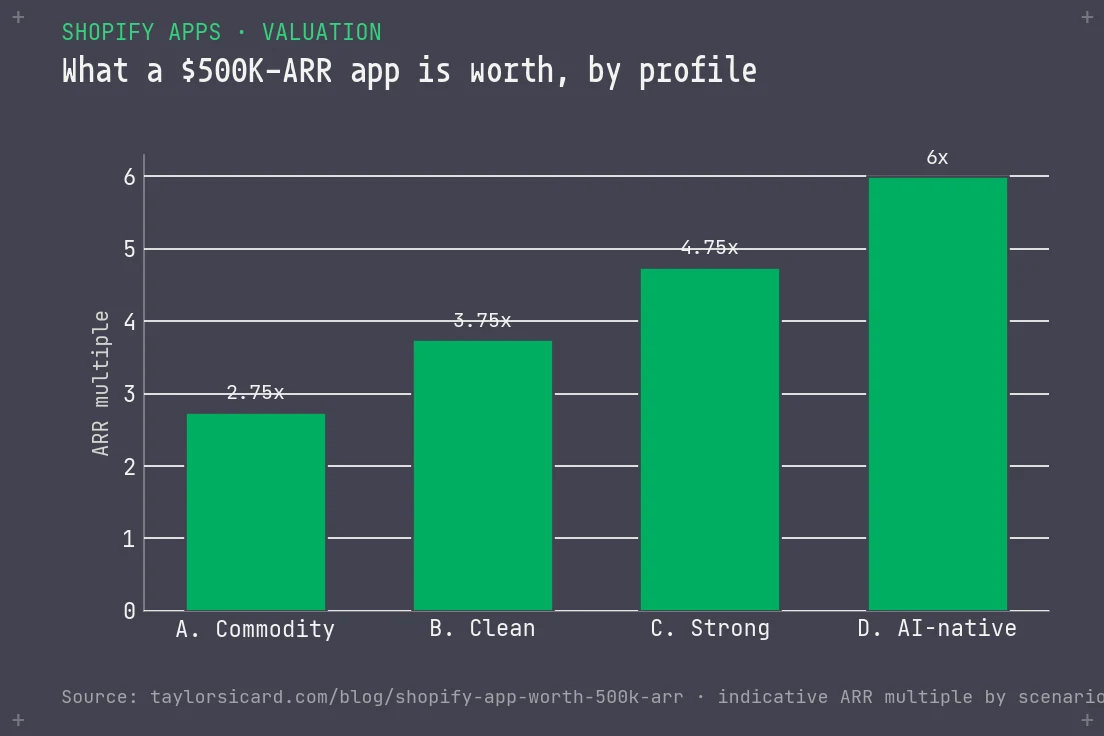
All four rows carry identical revenue. The only thing moving the value from $1.25 million to $3.5 million is the quality of the business underneath the same top-line number, which is why I tell founders the multiple is an output. The buyer derives it from your fundamentals, and your job is to make those fundamentals argue for the high end.
Scenario B is the honest center of gravity for most apps that email me. Real but unremarkable growth, churn that is fine but not great, a business that mostly works without daily heroics. That app is worth somewhere around $1.75 million to $2 million, and a founder who walked in expecting $5 million because they read an AI headline leaves the table angry at a perfectly fair offer. Calibrate to the right planet first.
The gap between Scenario A and Scenario C is the part worth sitting with, because it is almost entirely within a founder's control over time. Both apps bill $500,000 a year. One is worth $1.25 million, the other $2.5 million, a full $1.25 million of difference on identical revenue. That gap comes from retention, growth, concentration, and founder dependency rather than luck or market timing, and a founder can move every one of those levers with focused work in the year before a sale. This table is what I mean when I tell app founders the multiple is earned. The revenue is the easy part, and the quality of the business underneath it sets the price.
One caution on reading the table: do not mix and match the best column from each row. Founders love to claim Scenario C growth, Scenario D defensibility, and then quietly carry Scenario A churn, and assume the strengths cancel the weakness, which they don't. A buyer scores the weakest material factor heavily, because that is the risk they inherit. An app with great growth and a hidden retention problem gets priced on the retention problem, not the growth, once diligence surfaces it. Be honest about your weakest row, because the buyer will find it.
Scenario D deserves a word of caution, because it is where founders lie to themselves. A real AI moat means the model does the core work and the workflow would not exist without it, and the platform cannot trivially copy it into a native feature. Bolting an AI label onto an existing app earns none of that premium. Buyers in 2026 can tell an AI-native product from an AI sticker. If you are not honestly a D, do not anchor on a D number.
The same clean app at
$250K, $500K, $1M, and
$2M, and why it climbs.
The multiple climbs as you grow, and understanding why is worth real money if you are deciding whether to sell now or push another year. Take one clean, well-run app, the Scenario C profile from the table above, and walk it up the ARR ladder. The same business is worth a higher multiple at $2M than at $250K, not because the revenue is better quality but because size itself reduces risk in a buyer's eyes and opens up a wider, deeper pool of buyers.
| ARR | Typical multiple | Indicative value | Why it sits there |
|---|---|---|---|
$250K | ~2.5x–3.5x ARR (often profit-priced) | $625K–$875K | Priced as a job. Mostly individual buyers, thin buyer pool, profit-multiple math dominates. |
$500K | ~3.5x–5x ARR | $1.75M–$2.5M | The crossover. ARR method starts to win for clean apps; aggregators enter the pool. |
$1M | ~4x–6x ARR | $4M–$6M | Institutional buyers take it seriously. Less single-key-person risk, real team, deeper pool. |
$2M | ~4.5x–7x ARR | $9M–$14M | Strategic acquirers and PE compete. Scale itself is a de-risking premium. |
Read down the last column and you see the real driver: risk falls as size rises. A $250K app usually has one founder doing everything, a handful of merchants carrying the revenue, and one channel feeding installs. Every one of those is a concentration risk, so buyers discount and price it on profit as if buying themselves a job. By $1M to $2M the app typically has a small team, diversified revenue, and a track record long enough to trust, and the buyer pool widens from individuals to aggregators to strategic acquirers competing against each other. Competition among buyers is itself worth a turn of multiple.
This is the math behind a question I get constantly: should I sell at $500K or push to $1M first? There is no universal answer, but the ladder frames the trade honestly. Going from $500K to $1M of clean ARR can roughly double the dollar value of the business and lift the multiple at the same time. But it only works if you can add that revenue while holding retention and without burning out, and if the market does not compress under you in the meantime. The same durability that takes an app from MVP to its first million in ARR is what earns the higher multiple at the top of the ladder. If your retention is shaky, another year of chasing top-line growth can leave you with more revenue and a lower multiple.
These ranges assume a clean app and a competitive process. A flat or churning app does not climb the ladder the same way, because the things that earn the premium at $2M, durability and a deep buyer pool, are exactly the things a weak app lacks. Size amplifies good fundamentals and does not rescue bad ones.
Three buyer types,
three different prices
for the same app.
Who you sell to is the single most underused lever at this size, and it is not a fundamental at all. The same $500K app is worth different amounts to different kinds of buyers, because each one is solving a different problem and underwriting on a different basis. Sell to the buyer who values your specific strengths most, and you can capture a turn or two of multiple that has nothing to do with your churn rate. Three buyer types compete for apps at this size, and they price very differently.
| Buyer type | How they underwrite | Typical price | What they pay up for |
|---|---|---|---|
Strategic acquirer App portfolio, adjacent product | On synergy: your app plus their infrastructure and distribution | ~4x–6x ARR (top of band) | Customer overlap, a feature they would otherwise build, cross-sell into their base |
PE / aggregator Roll-up, holding company | On durable profit and a repeatable thesis | ~3.5x–5x ARR | Clean books, low churn, founder-light operations, a fit with their playbook |
Individual buyer Often SBA-financed | On what the loan will service from cash flow | ~2.5x–4x of profit | Simplicity, transferability, a business they can run themselves |
Strategic acquirers pay the most, and the reason is structural. They are buying your cash flow plus the cost of building your app themselves, the time it would take, and the customers they can cross-sell once they own you. A feature you spent three years building might fill a real hole in their roadmap, and the price reflects that gap on top of your ARR. When a strategic buyer competes, the multiple can run well past where a financial buyer would stop. The catch is that strategics are picky and slow, and they only show up when your app really fits their map. To tell if you are a fit, read the post on what buyers actually want in an app acquisition.
Private equity and aggregator buyers are the disciplined middle. They run a repeatable playbook: buy clean, profitable, low-churn apps at a sensible multiple, fold them into shared infrastructure, and improve margin. They will not overpay on synergy, and they underwrite hard on profit and retention, so a churning or messy app gets a quick pass or a low number. But they are reliable, they close, and they pay a fair multiple for a clean asset. The consolidators and sponsors active in 2026 are profiled in the post on private equity in the app ecosystem, and they are the realistic best outcome for most clean $500K apps without an obvious strategic fit. Before you talk to any of them, find out how sale-ready your app actually is.
Individual buyers are the floor, and SBA financing is why. In 2026 the SBA 7(a) program is the primary engine for sub-$5M acquisitions, with around 90 percent financing, ten-year amortization, and a minimum 10 percent buyer equity injection, of which up to half can be a seller note on standby, per 2026 SBA 7(a) acquisition lending guidance. That is real leverage, but it caps the price: the loan has to be serviceable from the app's cash flow, so an individual buyer can only bid what the debt will carry. They also need the business to be simple and transferable, because they are going to run it themselves. That pushes individual-buyer prices toward a profit multiple in the 2.5x to 4x range, below what a strategic or aggregator pays. It also means a churning, founder-dependent, single-platform app is hard for them to finance at all, because lenders scrutinize exactly those risks.
There is a timing element to this too. The three buyer types do not all show up at the same stage of your app's life. Individual SBA buyers are active across the whole range but cap out where the loan stops servicing, so they are most relevant below roughly $1M ARR. Aggregators concentrate on clean, profitable apps from a few hundred thousand ARR up into the millions, which makes them the most likely realistic buyer for a typical $500K app. Strategic acquirers tend to appear when your app has grown enough, or built a specific capability, that buying you is cheaper than building it. Knowing which buyers are even available to you at your size keeps your expectations honest and tells you whether pushing for another year of growth would open up a better class of buyer.
Do not run a one-buyer process. The founder who quietly accepts the first inbound from an individual buyer often leaves a full turn of multiple on the table that a strategic acquirer would have paid happily. A competitive process, even a light one with three or four credible buyers, does two things at once: it surfaces the buyer who values your specific strengths most, and it gives every buyer a reason to bid closer to their real ceiling instead of their opening lowball.
Buyers value what
you keep, not what
you bill.
Founders skip this line, and it is the one most specific to Shopify apps. Two apps at the same $500K ARR can be worth materially different amounts depending on what each keeps after Shopify takes its cut. A buyer does not underwrite your gross billings. They underwrite the profit that actually lands in the business after the platform's revenue share. You can calculate your app's true gross margin after the rev share and see the number a buyer will actually price.
Shopify's marketplace revenue share, and the $1M lifetime exemption in front of it, shape your real margin in ways that change the valuation. If your developer account is still inside the exemption, your margin today is fatter than it will be, and a sharp buyer prices the net after the 15%. If you are already past $1M lifetime, you pay 15% on every new dollar, and that is the margin a buyer underwrites. I break down exactly how the exemption works in the post on the revenue share and lifetime cap.
This is also why off-platform or directly-billed revenue is worth a premium inside the same ARR figure. A dollar you collect directly, that does not route through the marketplace and is not subject to its share or its terms, is a cleaner, higher-margin, more defensible dollar than one that does. When a buyer values your app, they are sorting your revenue into platform-dependent and platform-independent piles and paying more for the second. The platform-dependency dynamics behind that, and why concentration on one platform is itself a discount, are the subject of the platform dependency risk post.
There is a second-order effect here that founders miss entirely. The exemption is one per developer, counted across every app and associated account, and it never resets, so revenue gets more expensive to keep as you grow. A $500K ARR app uses up the $1M in about two years. A buyer with other Shopify apps counts your revenue against their own threshold, and if they are past it they model your revenue at 15% from day one, whatever you pay today. If you are still inside the exemption, show the buyer your margin at the full 15%, because that is the number they will price.
Before you anchor on any multiple, know your net margin after Shopify's cut, not your gross ARR. The multiple gets applied to a business a buyer believes is durable and profitable on a net basis. If you have never separated the two, you are negotiating against a number the buyer has already adjusted and you have not.
The structure decides
the deal more than
the headline price.
Two offers at the same headline number can be wildly different deals once you read the structure. A founder who anchors only on the multiple, and ignores how the money is actually delivered, can sign the bigger-looking offer and walk away with less cash and more risk. At $500K ARR, three structural questions decide what you really get: asset versus equity sale, how much is paid up front versus held back, and whether there is an earnout.
Start with asset versus equity, because almost every app deal at this size is an asset sale. In an asset sale the buyer purchases the app, the code, the customer relationships, the brand, and the contracts, but not the legal entity. They leave your company shell behind, along with most of its historical liabilities. Buyers strongly prefer this: cleaner liability, and in many cases a better tax treatment because they can step up the basis of what they bought and amortize it. For you as the seller it is usually fine, sometimes slightly worse on tax than selling the stock would be, and worth a brief conversation with an advisor. An equity sale, where the buyer takes the whole entity, is rarer at this size and shows up mostly when there is something inside the entity the buyer specifically wants to inherit. Assume an asset sale, and price the tax difference into your thinking before it surprises you at closing.
| Element | Common at $500K ARR | What it means for you |
|---|---|---|
Asset sale | The default structure | Buyer takes the app, not the entity. Cleaner for them, mind the tax treatment. |
Cash at close | Often 70%–90% of the price | The money you actually walk away with on day one. Maximize this. |
Holdback / escrow | ~10%–15%, released in 6–18 months | Buyer's protection against problems surfacing post-close. Normal, but it is money at risk. |
Seller note | Sometimes 5%–15%, esp. with SBA buyers | You finance part of your own sale. On standby with SBA deals, paid over years. |
Earnout | 0%–30%, tied to future performance | Contingent. You only get it if the business hits targets you may not control. |
The earnout is where founders get hurt, so spend a moment here. An earnout ties part of your price to the app hitting revenue or retention targets in the year or two after you sell. On paper it bridges a disagreement: the buyer is nervous the growth will not last, you believe it will, so you agree to get paid more if you are right. The problem is that after closing you usually do not control the business anymore. The buyer sets the roadmap, the support, the pricing, and the marketing spend, and if their choices stall the numbers, your earnout evaporates through no fault of yours. I treat the cash-at-close figure as the real price and an earnout as a maybe. A higher headline with a big earnout is often a worse deal than a lower headline that is all cash. If you must take an earnout, fight for targets you can actually influence and keep the contingent portion small.
One more structural wrinkle specific to a founder selling an app: what the buyer expects from you after closing. Some deals are clean breaks where you hand over the keys and walk. Others ask for a transition period, three to twelve months of you staying on to migrate the app, train the team, and keep merchants from panicking. A transition is normal and often reasonable, but it is part of the deal you are agreeing to, and an unpaid or open-ended one is a hidden cost. If a buyer wants you involved for a year, either that time is compensated or it is a discount you are giving without calling it one. Negotiate the transition with the same care you give the price, because it is part of the price.
The same logic applies to holdbacks and seller notes. A 90 percent cash, 10 percent escrow deal is clean. A 60 percent cash deal with a 25 percent earnout and a 15 percent seller note is mostly a promise. When you compare offers, rebuild each one as cash-at-close plus everything-contingent, and compare the cash columns first. That single discipline has saved sellers I have advised from signing the worse of two deals that looked, on the headline, like the better one.
Diligence is where
a fair multiple
gets repriced down.
Most multiple erosion does not happen in the negotiation. It happens in diligence, after you have agreed on a price, when the buyer opens the books and finds things that do not match the story you told. Every surprise is a reason to chip the number down or add a holdback, and a seller who has not prepared hands the buyer a list of reasons. The fix is to run your own diligence before they run theirs, so there are no surprises left to find. A buyer will work through this checklist on a $500K app.
The psychology of diligence matters as much as the documents. Once a buyer finds one thing you got wrong, even a small one, they stop trusting every other number you gave them and start re-verifying things they would otherwise have accepted. A single sloppy spreadsheet can turn a smooth process into a forensic one, and forensic processes find more to discount. The reverse is also true: a buyer who opens your books and finds them cleaner than expected often stops digging and pays the number, because you have earned the benefit of the doubt. Trust is a real lever on price, and it is built or lost in the first week of diligence.
I learned this the practical way selling getuptime.co: the cleaner your house is before you open the door, the less anyone has to negotiate. A buyer who finds exactly what you described builds trust and pays the agreed number. A buyer who finds gaps starts subtracting, and once the repricing begins it rarely stops at one item. Spend the months before a sale getting these five in order, and you protect the multiple you negotiated instead of watching it bleed out in diligence.
What I would do in the
six to twelve months
before I sold.
If you have a year before you want to sell, you have time to move your number meaningfully. The work is unglamorous: it is the same durability work that makes the app better to own, which is exactly why buyers pay for it. I would run it in this order, drawn from the seller side of this math, and the order tracks the value-driver ranking on purpose.
Fix retention first, because it is the master variable and the highest-return work you can do. A few points of monthly churn recovered does more for your multiple than a quarter of top-line growth, because it converts fragile ARR into durable ARR in the buyer's model. If you do one thing in the runway, do this. The save-and-retain mechanics are in the churn save playbook, and the deeper diagnosis of why churn happens is in churn is a symptom, not the problem.
Then attack concentration. If one merchant or one channel carries too much of your revenue, spend the runway diversifying so no single relationship can sink the business. A buyer reads diversified revenue as lower risk and prices it as such. Next, get yourself out of the critical path: document the support process, the deployment, the vendor relationships, so the app demonstrably runs without you. Founder-light operations are the difference between selling an asset and selling a job, and the gap between those two is often a full turn of multiple.
Then clean the financials, well before the first buyer call. Separate personal from business spending, produce real net-profit numbers after Shopify's cut, and build the cohort and concentration views a buyer will ask for. The goal is that when diligence opens, everything matches what you said. Finally, show steady growth rather than a spiky month. Two or three quarters of calm, compounding growth tells a better story than one explosive month followed by a flat one, because buyers underwrite the trend, not the peak. Pricing also belongs in this window: getting your pricing right before a sale lifts both revenue and margin, and the levers are in the app pricing strategy post.
A $500K app at Scenario B, worth maybe $1.9 million today, that spends a year fixing retention, diversifying concentration, and getting founder-light, can credibly present as a Scenario C the next time a buyer looks. That is the difference between roughly 3.75x and 4.75x ARR, about $500,000 of additional value on the same revenue base, earned with durability work rather than another year of chasing growth.
What I would actually
tell you to do with
this number.
If you are sitting at $500K ARR and weighing a sale, this is the order I would work in, drawn from having been on the seller side of this exact deal. First, calibrate to the right planet. You are in a 3x to 5x ARR cash world, not a 30x venture one. Set that expectation before you take a single call, or you will torpedo a fair process by being anchored to a fantasy.
Second, find your scenario in the table and be honest about it. Most founders are a Scenario B and want to believe they are a Scenario D. Buyers see through that in the first diligence pass. The founders who get the best outcomes are the ones who know precisely which levers are strong and which are weak, and who can defend the strong ones with data rather than hope.
Third, fix the cheapest lever before you sell. If retention is your weak spot, six months of churn work can move your multiple more than another year of top-line growth, because it converts your ARR from fragile to durable in the buyer's eyes. The same thinking that takes an app from MVP to its first million in ARR applies in reverse at exit: durability is the asset, and buyers pay for the durable version.
Fourth, understand what the buyer wants before you walk in, because the best price comes from selling to the acquirer who values your specific strengths most. The consolidators and sponsors buying apps in 2026 each have a thesis, and the post on private equity in Shopify apps and the one on what buyers actually want in an app acquisition lay out who pays for what. Matching your strengths to the right buyer is worth more than another half-turn of multiple negotiated with the wrong one.
Fifth, read the structure, not just the headline. Once you have offers in hand, rebuild each one as cash-at-close versus everything-contingent, and weigh the deals on the cash you are certain to receive. A higher number wrapped in an earnout you do not control is often worth less than a clean all-cash offer a turn below it. The buyer who structures the cleanest deal is frequently the one who will be easiest to work with through closing, which matters more than founders expect when the process gets tense.
And one decision that sits above all five: whether to sell at all, right now. A sale is not the only good outcome for a $500K app. If the business is growing, profitable, and you still enjoy running it, holding and pushing up the ARR ladder can be the better wealth decision, because the multiple climbs with size and you keep the cash flow in the meantime. Sell because the timing is right for you, the market is favorable, or you are ready to move on, not because an unsolicited email made the number feel urgent. The best sellers I have known were never in a hurry, and that calm was itself worth money at the table. If raising is the other branch you are weighing, the metrics change, and what investors actually underwrite in commerce SaaS covers the NRR and Rule of 40 bars they price against.
At $500K ARR, your app is most likely worth $1.5 million to $2.5 million, with the exact number set by churn first, then growth, concentration, and founder dependency, all applied to the profit you keep after Shopify's cut. The range is the headline, and moving yourself up inside it starts long before the first buyer email lands. When I sold getuptime.co, the number was never the mystery. The fundamentals underneath it were the whole negotiation, and they will be yours too.
What founders ask me
about valuing an app
at $500K ARR.
In 2026 most Shopify apps near $500K ARR clear between roughly 3x and 5x ARR, so about $1.5 million to $2.5 million, with realized prices skewing to the lower half. A clean app growing 30 percent or more with low churn and diversified merchants pushes toward 5x or above. A flat, founder-dependent, concentrated app prices closer to 2.5x to 3x net profit, often well under $1.5 million. The full method is in how to value a Shopify app.
Yes, but be careful with the headline numbers. The 15x to 30x ARR figures quoted for AI-native software in 2026 are growth-round venture valuations for breakout companies, not what a $500K ARR app sells for in a cash acquisition. A genuinely AI-native app with real growth can earn a premium of roughly 1x to 3x ARR over a commodity peer. AI in the marketing copy alone earns nothing.
Churn is the single biggest swing factor at this size. An app retaining revenue well, with net revenue retention near or above 100 percent, can command 4x to 5x ARR. The same revenue churning hard signals the growth will not last, and buyers reprice it toward 2.5x to 3.5x or underwrite on profit instead. At $500K ARR, retention often moves the price more than the headline growth rate does. More on that in why churn is a symptom, not the problem.
Buyers value the profit you actually keep after Shopify's cut, not your gross billings. The marketplace revenue share and its lifetime cap shape your real margin, and an acquirer underwrites the net. Two apps at the same $500K ARR can be worth meaningfully different amounts if one keeps a far larger share of each dollar after the platform takes its piece. The mechanics are in the revenue share and lifetime cap post.
At $500K ARR you sit on the line between the two methods. Below roughly $1M ARR many buyers price on seller discretionary earnings, a profit multiple, treating the app as a job. Apps with strong retention and growth get underwritten on ARR instead. A clean, growing $500K app argues for the ARR method and the higher number it usually produces. The full survey of pricing is in 2026 app sale multiples.
Three buyer types compete at this size. Strategic acquirers and app portfolios pay the most, often 4x to 6x ARR, because they fold your app into existing infrastructure. Private equity aggregators pay a disciplined 3.5x to 5x and underwrite on profit and durable retention. Individual buyers using SBA financing usually land at 2.5x to 4x of profit, capped by what a 7(a) loan will service. Matching your strengths to the right buyer is worth more than another half-turn of multiple, and who pays for what is laid out in what buyers want in an app acquisition.
In the six to twelve months before a sale, fix retention first, since it is the master variable at this size. Then diversify merchant and channel concentration, document the business so it runs without you, clean up your books to show real net profit after Shopify's cut, and show two or three quarters of steady growth rather than one spiky month. Each move pushes you up inside the band, and retention work usually returns more multiple than chasing one more growth point. The save mechanics are in the 90-day churn save playbook.
Weighing an offer, or getting your app ready to sell?
I founded and sold a software company to Tiny, so I have negotiated the exact math in this post from the seller's chair. I also helped build and scale the Shopify Partner Program, where the rev-share economics that move these numbers were designed. If you want a clear read on your number and which levers to fix first, that is the conversation I have.
Start a conversation See the case studies →A note on sources: the 2026 SaaS multiple bands (3x to 7x ARR for lower-middle-market private SaaS, with the private median compressing toward roughly 3.8x to 4.5x ARR) are from Aventis Advisors, the SaaS Capital Index, and corroborating 2026 benchmark reports. The micro-SaaS acquisition figures (bootstrapped asks near 2.6x revenue, profit multiples scaling by deal size) are from live-listing data tracked on Acquire.com in 2026. The AI-native 15x to 30x ARR figures are 2026 growth-round venture valuations, while the realistic 1x to 3x ARR acquisition premium for genuinely AI-native software is documented by SEG Research and similar 2026 AI software valuation reporting. The SBA 7(a) acquisition terms (around 90 percent financing, ten-year amortization, 10 percent minimum buyer equity with up to half as a standby seller note) are per 2026 SBA 7(a) acquisition lending guidance. The ARR-multiple method, the eight-driver ranking, the ARR-ladder and buyer-type tables, the deal-structure and diligence detail, the rev-share adjustment, and the seller-side read are mine, from founding and selling getuptime.co to Tiny and from building the Partner Program where the rev-share economics live.