Snapshot taken July 9, 2026, the cleanest way to buy inside an AI assistant is Perplexity's Instant Buy and Google's AI Mode, not ChatGPT. OpenAI pulled its in-chat Instant Checkout around March 5, 2026 after roughly 30 Shopify merchants ever went live, and is rebuilding shopping as retailer-run apps.
- Perplexity checks out in-chat through PayPal (Abercrombie & Fitch, Fabletics, Ashley Furniture, plus 5,000-plus merchants), live since November 25, 2025.
- Google AI Mode runs "Buy for Me" through Google Pay for Wayfair, Chewy, Quince, and select Shopify merchants.
- The model that is winning is rerouting: the assistant sends the shopper to the brand's own site, so you keep the customer, the data, and the tax handling.
- September 2026: a recheck found more buying inside assistants than the July snapshot showed. Target's ChatGPT app takes multi-item orders through a Target account, Copilot Checkout reaches 500,000-plus merchants who stay the merchant of record, and Meta's Muse agent buys through Stripe's Link.
- Sep 2026Meta Muse
- May 2026Alexa for Shopping
- Apr 2026Copilot Checkout
- Mar 2026ChatGPT Instant Checkout
- Mar 2026ChatGPT retailer apps
Every few weeks a founder forwards me a screenshot of their product sitting inside ChatGPT or Perplexity and asks the same thing: can people actually buy this here, or is it just showing up? It is a fair question, because the answer has changed twice in the last nine months, and most of the coverage online is either a launch-day press release or a panic thread. Neither tells you the current state of play.
So this is the tracker I wish existed. A maintained directory of which retailers are genuinely live in AI and agentic checkout, on which platform, using which rails, and since when, with a source for every line. It is deliberately literal. No predictions about where this all goes in three years, just who you can buy from today and how the transaction actually works. I will keep the framing simple and date everything, because in this corner of commerce a fact goes stale in a month.
One note on how I built this. For each entry I anchor to the origin primary source, the official company announcement, the SEC filing, or the investor-relations release where the integration was first disclosed, and I treat trade-press coverage as secondary corroboration layered on top. So for public companies like Walmart, PayPal, Alphabet, and Amazon you will see the newsroom, IR, or 8-K link next to the reporting. Where a status is my read of the situation rather than a stated fact, I say so. Treat this as a snapshot with a date stamp on it, not a permanent record. I update the framing here as the platforms move, and they move often.
Agentic checkout is moving faster than most roadmaps. If you are deciding what to build for it this quarter, I can tell you which of these surfaces will carry real orders and which are still a demo.
The master directory
of who's live in AI
checkout.
Here is the single table most people come for: the most notable named integrations across the major assistants, each with the surface it runs on, how checkout actually works, when it went live, and the source. Read the status word first (the next section defines what each one means), then the "how it works" cell, because those two together tell you whether a shopper can genuinely buy from that retailer inside that assistant today.
| Retailer / brand | Surface | How checkout works | Since | Source |
|---|---|---|---|---|
US Etsy sellers First live merchant type | ChatGPT | Was in-chat via ACP + Stripe; moving to an Etsy app (sunset) | Sep 29, 2025 | OpenAI · CNBC |
~30 Shopify merchants Glossier, SKIMS, Spanx, Vuori named at launch | ChatGPT | Was in-chat via ACP; pulled after low adoption (sunset) | Late 2025 | OpenAI · CNBC |
Walmart Now via its Sparky assistant | ChatGPT + Gemini | Reroutes to Walmart; dropped OpenAI checkout (rerouting) | Oct 14, 2025 | Walmart |
Target Multi-item carts, fresh food, Drive Up and pickup | ChatGPT app | Target's own app; the order goes through the shopper's Target account. Target does not say whether payment finishes in the chat or on Target.com (live) | Nov 25, 2025 | Target · Target launch |
Sephora, Nordstrom, Best Buy, The Home Depot Retailer-app partners named in March | ChatGPT apps | Dedicated in-chat apps (building) | Confirmed Mar 2026 | OpenAI · CNBC |
Abercrombie & Fitch, Fabletics, Ashley Furniture, Adorama, NewEgg Plus 5,000+ PayPal merchants | Perplexity | In-chat via PayPal; retailer is merchant of record (live, in-chat) | Nov 25, 2025 | PayPal |
Wayfair, Chewy, Quince, select Shopify merchants Eligible US merchants | Google AI Mode | "Buy for Me" via Google Pay; completes on retailer site (rerouting) | Nov 13, 2025 | |
Urban Outfitters, Anthropologie, Ashley Furniture, Etsy, Target 500,000+ merchants via PayPal, Shopify and Stripe | Microsoft Copilot | Copilot Checkout, no redirect, merchant stays merchant of record; in the Copilot mobile app since April (live, in-chat) | Jan 8, 2026 | PayPal · Windows Central |
Businesses that accept Link 1M+ per Stripe; a single-use card everywhere else | Meta Muse | Agent pays with the shopper's saved Link method after the shopper approves the total in chat; US only (live, in-chat) | Sep 8, 2026 | Stripe · TechCrunch |
Third-party brand sites When Amazon lacks the item | Amazon Alexa for Shopping | "Buy for Me" agent buys from other retailers' sites; Auto-Buy at a set price; replaced Rufus May 13, 2026 (rerouting) | Apr 2025 | Alexa for Shopping · Amazon · SEC 8-K · PYMNTS |
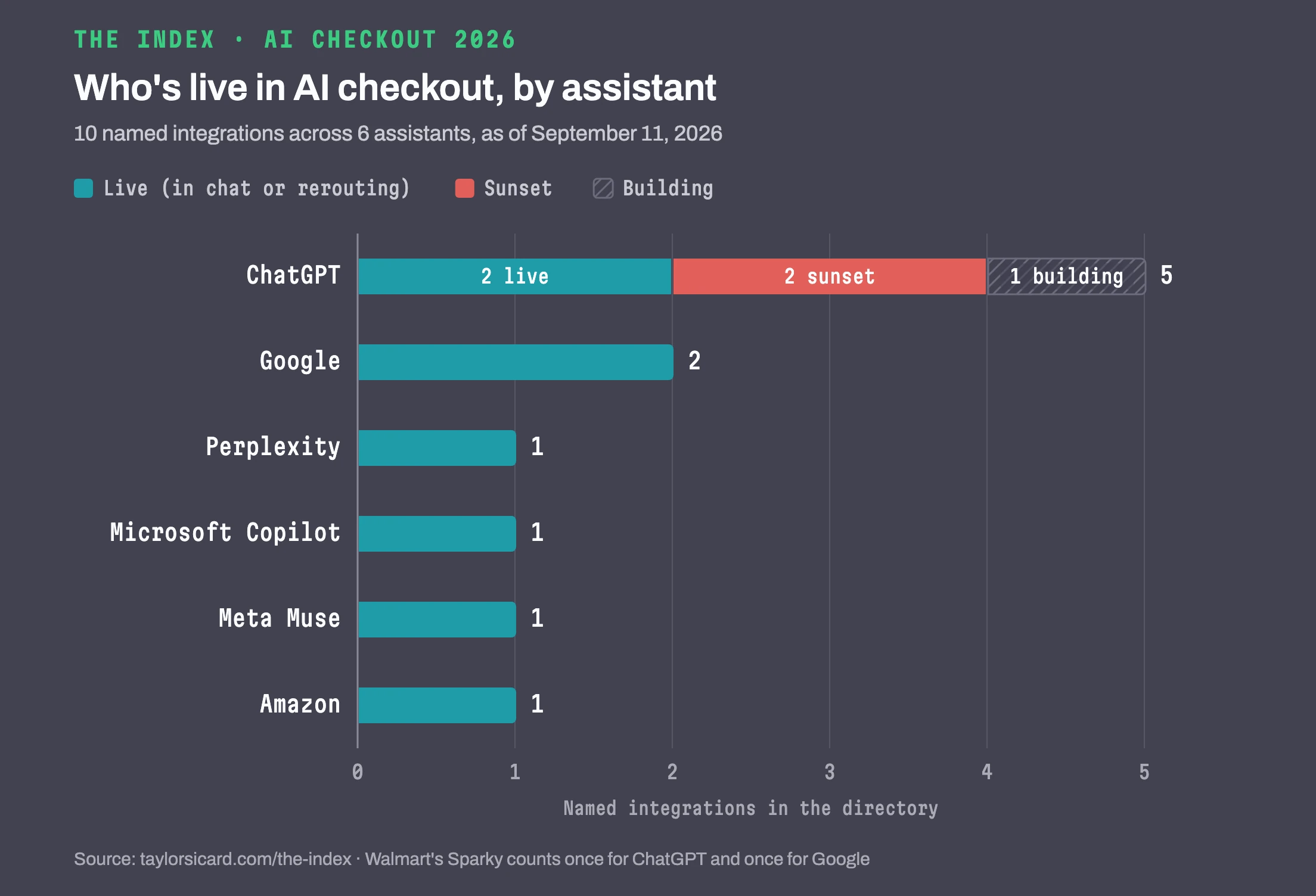
The one row that surprises people every time is Perplexity. The assistant with the smallest shopping profile is the one running the deepest in-chat checkout in July 2026, because it borrowed PayPal's existing merchant network instead of trying to rebuild commerce from scratch the way OpenAI did. That is the lesson of the table: the winners plugged into rails that already worked.
"The assistant everyone assumes owns AI shopping is the one that just pulled its checkout. The quiet ones kept theirs running."
How to read the
status column in
this tracker.
The directory above leans on four status words, because "live in AI checkout" gets used to mean four very different things and the distinction decides whether a listing is worth anything to you. All but one row in the directory carries one of these four states, and here is exactly what each one means. When you scan the directory, the status word is the thing to read first.
Live, in-chat. The shopper completes the whole purchase inside the assistant and never leaves it. The platform effectively becomes the checkout, and the brand often sees the order only after it closes. Perplexity Instant Buy is the clearest working example in July 2026. This is the model brands are most nervous about, because it puts the platform between you and your customer.
Live, rerouting. The assistant does the discovery and the hand-raise, then sends the shopper to the brand's own site to finish the purchase. Google's Buy for Me and Amazon's Buy for Me both work this way. This is the model quietly winning in 2026, and it is the friendlier one for brands because you keep the checkout, the customer data, and the post-sale relationship.
Sunset. The integration was live and has been discontinued. ChatGPT Instant Checkout is the marquee example: real merchants integrated, then the feature was pulled around March 5, 2026. A sunset row is a warning label, a reminder that building your operation around a single platform feature is a bet on that feature surviving.
Building or announced. A partnership or app has been confirmed but is not broadly available to shoppers yet. The ChatGPT retailer apps from Sephora, Nordstrom, and others sit here as of September 2026. Announced is not the same as buyable, and the gap between the two has been measured in quarters, not weeks, throughout this cycle.
Target in ChatGPT is the one row marked plain live. The app takes real orders, but Target has not said whether payment completes inside the chat or on its own site, so it sits outside both live buckets.
ChatGPT: launched,
struggled, and pivoted
to retailer apps.
OpenAI's arc is the most instructive one in the directory, because it is the only major player that tried the hardest version of AI checkout, completing the purchase inside the chat, and it is the one that retreated. The timeline is worth laying out cleanly, because the dates tell the story better than any narrative.
| Date | What happened | Detail |
|---|---|---|
| Sep 29, 2025 | Instant Checkout announced | Live first with US Etsy sellers; single-item, in-chat, on the Agentic Commerce Protocol built with Stripe |
| Oct 14, 2025 | Walmart partnership | Walmart announces shopping through ChatGPT via Instant Checkout |
| Nov 25, 2025 | Target app goes live | Launched in beta; multi-item baskets bought through a Target account, with Drive Up, Order Pickup or shipping |
| Feb 16, 2026 | "Buy it in ChatGPT" expands | Rolled out to free users and additional retail partners |
| ~Mar 5, 2026 | Instant Checkout sunset | Pulled after roughly 30 Shopify merchants ever went live; inventory, pricing, and tax were the breaking points |
| Mar 2026 | Pivot to retailer apps | Etsy, Target, Sephora, Nordstrom, Best Buy, The Home Depot, and Walmart named as dedicated-app partners |
| Aug 6, 2026 | Product carousels in ChatGPT ads | Several items from one retailer in a single ad placement at the foot of an answer, rolled out ahead of the holiday quarter |
The launch was real and the partners were real. US Etsy sellers went live in-chat on day one, and OpenAI named Glossier, SKIMS, Spanx, and Vuori among the Shopify brands slated to follow, per the launch coverage. The technology was open-sourced as the Agentic Commerce Protocol, co-developed with Stripe, which was a genuinely smart move to invite the ecosystem in. On paper it was the most ambitious agentic-checkout launch anyone had attempted.
The problem was operational, not conceptual. Instant Checkout struggled with real-time inventory and pricing, it surfaced stale product data that caused failed orders, and it had no clean answer for collecting and remitting US state sales taxes. Onboarding a merchant was slow and manual. Six months in, product selection was still thin and error-prone, which is how a feature launched with a million-merchant promise ended with about 30 Shopify stores live. None of this means agentic checkout is a bad idea. It means checkout is a hard, boring, regulated system, and a chat interface does not make the hard parts disappear.
The pivot is the interesting part for brands. Rather than fix in-chat checkout, OpenAI is handing the surface back to retailers as dedicated apps inside ChatGPT, which give the retailer more control of the look, the data, and the moment they meet the shopper. Etsy confirmed it is building one. Walmart went a step further and plugged its own Sparky assistant into ChatGPT rather than use OpenAI's checkout at all, per reporting on the update. For a brand, the app model is more work than a catalog feed, but it hands you back control of the customer, which is the trade most operators would take.
Perplexity: the in-chat
checkout that is
quietly running.
Perplexity built the working in-chat checkout of 2026, and it did it by not building most of it. On November 25, 2025, PayPal and Perplexity launched Instant Buy, ahead of Black Friday, letting US shoppers complete a purchase inside the Perplexity chat. PayPal supplies the payment rails and the merchant network, and the retailer stays the merchant of record, which is the detail that matters most, per the PayPal announcement. That is why it works where ChatGPT's version did not.
| Element | Detail |
|---|---|
Named launch brands | Abercrombie & Fitch, Ashley Furniture, Fabletics, Adorama, NewEgg |
Merchant reach | More than 5,000 PayPal merchants made discoverable and buyable |
Who is merchant of record | The retailer, not the assistant, keeps control of the transaction |
Merchant onboarding tools | PayPal "store sync" for catalog data and "agent ready" for fulfillment, with limited engineering work |
Roadmap | Deeper catalog connectivity and more merchant categories through 2026 |
The mechanism is the point. Because the retailer remains the merchant of record, the awkward parts, tax, fulfillment, refunds, chargebacks, stay where they already worked, inside the retailer's existing PayPal relationship. Perplexity did not try to become the store. It became a very good front door to stores that already had checkout figured out. That is a fundamentally more durable design than treating the assistant as the point of sale, and it is why Instant Buy is still processing purchases while Instant Checkout is a memory.
For a brand, the practical read is that if you already run PayPal, a big part of your Perplexity path may be a configuration exercise rather than a rebuild. The heavier your existing payment and fulfillment stack, the less net-new work these agentic surfaces require, which is the opposite of the "rip everything out for AI" narrative that made the rounds in 2025. The brands that got discoverable fastest were the ones already plugged into the rails the assistants borrowed.
Google AI Mode:
agentic checkout
inside Search.
Google's version lives where the most shopping intent already is, inside Search. In November 2025 Google turned on agentic checkout in AI Mode, branded "Buy for Me," per its Shopping announcement. When a merchant supports Google Pay and the checkout flow, the shopper taps Buy for Me and Google adds the item to the cart and completes the purchase on the retailer's own site. It is the rerouting model, executed at the scale of Search.
| Element | Detail |
|---|---|
Named eligible merchants | Wayfair, Chewy, Quince, and select Shopify merchants at launch |
How it completes | Google adds to cart and checks out on the retailer's own site via Google Pay |
Protocol | Universal Commerce Protocol (UCP), launched January 2026, handles discounts, loyalty, and terms |
Walmart | Joined Google's AI discovery-to-shopping flow on January 11, 2026 |
Availability | United States only, as of mid-2026 |
Google's advantage is distribution and its own protocol. It named Wayfair, Chewy, Quince, and select Shopify merchants as eligible at launch, and it published the Universal Commerce Protocol in January 2026 to let an agent handle discount codes, loyalty credentials, and selling terms alongside Google Pay, per its retailer tooling announcement. Walmart, which walked away from OpenAI's checkout, plugged into Google's discovery flow in January 2026. If you want to understand how UCP differs from OpenAI's ACP and why the protocol war matters, I compared them in the UCP versus ACP breakdown.
The strategic read is that Google routes agentic checkout through Google Pay and the retailer's own site, rather than trying to hold the transaction itself. That is the same merchant-of-record logic that made Perplexity's flow durable, and it is a signal about where this whole market is settling: the assistants that will last are the ones that route to the store, not the ones that try to replace it.
Amazon: the walled
garden that skipped the
assistants entirely.
Amazon is in the directory, but on its own terms. It never joined ChatGPT or Perplexity. Instead it built agentic shopping inside its own app, first through the Rufus assistant and, since May 13, 2026, through Alexa for Shopping, which folds Rufus into Alexa+. It also blocked outside agents from crawling its catalog. That is a deliberate walled-garden strategy, and given Amazon's scale it is a viable one in a way it would not be for anyone else. I covered the standoff when it broke in Amazon blocking OpenAI's catalog access.
The numbers explain the confidence. Amazon disclosed that Rufus reached more than 300 million customers by the end of 2025 and was on roughly a $12 billion incremental annualized sales run-rate, per Amazon's own figures. Its Buy for Me feature, launched in April 2025 on Amazon Nova and Anthropic Claude, will buy an item from a brand's own site when Amazon does not stock it, and it grew from about 65,000 SKUs at launch to more than 500,000 by late 2025. Alexa for Shopping added Auto-Buy, which purchases when an item reaches a price the shopper sets. On its Q2 2026 call Amazon said more than 350 million shoppers had used Alexa for Shopping over the past twelve months, and that its users spend about 40% more per order, per Retail Dive's report on the call. Amazon does not need a third-party assistant, because it already has the largest shopping assistant most Americans use.
For a brand, the takeaway is that Amazon remains a separate game with separate rules. You will not reach an Amazon shopper through ChatGPT or Perplexity, you reach them through Alexa for Shopping, through your Amazon listing, or through Buy for Me pointing at your own storefront. If a meaningful share of your demand lives on Amazon, treat it as its own agentic channel, not as something the ChatGPT or Google directories cover.
The rails and protocols
underneath every
AI checkout.
Under every row in the directory is a payment rail and a protocol, and they matter because they decide how much work an integration takes and who controls the transaction. The same pattern shows up here: the assistants that borrowed a working rail shipped durable checkout, and the one that tried to own the rail stumbled. Here is the layer beneath the assistants.
| Rail / protocol | Behind | What it does |
|---|---|---|
Agentic Commerce Protocol (ACP) OpenAI + Stripe, open-sourced Sep 2025 | ChatGPT | The standard behind Instant Checkout; still powers the richer shopping tools after the checkout pivot |
Universal Commerce Protocol (UCP) Google, launched Jan 2026 | Google AI Mode | Lets an agent handle discounts, loyalty, subscriptions, and terms alongside Google Pay |
PayPal agentic commerce "Store sync" + "agent ready" tools | Perplexity | Brings catalog and fulfillment into the assistant; retailer stays merchant of record |
Universal Cart Google, announced at I/O, May 19 2026 | Google Search, Gemini, YouTube, Gmail | One cart across every Google surface, built on Google Wallet, with the brand staying merchant of record. Named checkout merchants include Nike, Sephora, Target, Ulta Beauty, Walmart and Wayfair, plus Shopify merchants Fenty and Steve Madden. Google |
UCP opened to all developers Shopify Catalog, May 19 2026 | Any app, platform or agent | Any developer can reach Shopify merchants and their catalogs through one protocol, with merchants opted in by default. Follows the April UCP Tech Council expansion to Amazon, Meta, Microsoft, Salesforce and Stripe alongside founders Google, Shopify, Etsy, Target and Wayfair. Shopifreaks |
Copilot Checkout and Brand Agents Microsoft with PayPal, Shopify and Stripe, Jan 8 2026 | Microsoft Copilot | In-chat purchase with no redirect and the merchant staying merchant of record. Shopify merchants auto-enrolled with controls in admin. Launch retailers included Urban Outfitters, Anthropologie, Ashley Furniture and select Etsy sellers. Opened to more than 500,000 merchants and the Copilot mobile app on Apr 22, 2026 (Windows Central). PayPal |
Mastercard Agent Pay Full US rollout Nov 2025 | Card network | First major network to enable all US cardholders for agent-initiated payments, via scoped Agentic Tokens |
Visa Intelligent Commerce In production by early 2026 | Card network | Visa's rails for authorizing and settling agent-initiated purchases. Intelligent Commerce Connect, launched Apr 9, 2026, gives merchants one integration that accepts agent payments under the Trusted Agent, Machine Payments, ACP and UCP protocols. TechInformed |
Link by Stripe for agents Stripe with Meta Muse, Sep 8 2026 | Meta Muse | Muse checks out at once at businesses that accept Link; everywhere else Link issues a single-use virtual card scoped to the approved purchase. The shopper approves the total in chat and Muse never sees the card details. Stripe |
Agentic Payments Alliance Rain, Aug 18 2026 | Industry coalition | Founding members include Visa, Mastercard, Fiserv and Circle. Shared research, testing of standards for agent identity and authorization, and advocacy on regulation. Rain |
Know Your Agent framework Ant International, Visa, Mastercard, Sep 10 2026 | Card networks and wallets | A shared way to identify and verify AI agents that pay for users, so networks, wallets and marketplaces can recognise a trusted agent while keeping their own risk checks. No rollout date given. CNBC |
The card networks are the quiet story here. Mastercard became the first major network to enable all of its US cardholders for agent-initiated payments, with a full US rollout in November 2025 built on scoped Agentic Tokens, and Visa's Intelligent Commerce reached production around the same window, per reporting on the networks' agentic moves. That plumbing is what makes any of the assistant-level checkout legal and safe to run at scale, and I dug into the payment side in how Visa and OpenAI wired agentic payments. For a broader map of how these pieces fit together for a Shopify brand, the pillar is what agentic commerce means for brands.
The state of AI
checkout, as of
July 2026.
September 2026 update. This month's sweep turned up more buying inside assistants than the July snapshot showed. Target's app in ChatGPT takes multi-item orders through a Target account. Microsoft opened Copilot Checkout to more than 500,000 merchants and its mobile app in April. Meta launched Muse on Sept 8, an agent that pays through Stripe's Link and asks the shopper to approve each total in the chat. Amazon replaced Rufus with Alexa for Shopping in May. OpenAI's latest shopping change is in ads, where product carousels arrived on Aug 6. Shopify said orders from AI channels tripled year over year in Q2, and that AI search built on its catalog converts at twice the rate of AI search on scraped product data. Google's Universal Cart was due on Search and Gemini this summer; I have not seen it confirmed live, so it stays an announcement here.
August 2026 update. Two things moved since the last sweep. On Aug 4 the Ninth Circuit overturned the preliminary injunction that had blocked Perplexity's Comet shopping agents from Amazon, finding Amazon unlikely to win its Computer Fraud and Abuse Act claim on the reasoning that Perplexity's users, not the company, are the ones accessing the site. Amazon says it is evaluating next steps. That is the first appellate signal on whether a retailer can lock an agent out of its own storefront, and it points toward agents being treated as the user's tool rather than a third-party intruder. Separately, a Productrise study across more than 2 million listings found Google AI Mode surfaces roughly 95% fewer product listings than standard search on identical queries, returning products for 23% of queries against 88%, and averaging 4.3 products per answer against 22.5 per page. Same-day overlap between the two surfaces was 0.8%. If you are optimising for AI Mode, you are competing for a fraction of the shelf.
Start with the reversal, because it reframes everything. ChatGPT was the first big assistant to let you buy in-chat, and it is now the one that walked it back. OpenAI announced Instant Checkout on September 29, 2025, launching first with US Etsy sellers and promising over a million Shopify merchants to follow, per its own launch announcement. Roughly six months later it pulled the feature. As of the sunset, only about 30 Shopify merchants had ever gone live, according to CNBC's reporting on the revamp. That is the full arc, and I wrote the post-mortem on why it happened in what happened to ChatGPT Instant Checkout.
While ChatGPT was struggling, two other players shipped checkout that is still live. Perplexity launched Instant Buy with PayPal on November 25, 2025, and it processes real purchases inside the chat today. Google turned on agentic checkout in AI Mode in November 2025 and kept expanding it into 2026. So the honest ranking of who could actually complete a sale inside an assistant in July ran Perplexity and Google first, Amazon in its own lane, and ChatGPT in transition. That was close to the opposite of what most brands assumed.
The deeper pattern under the directory is a shift in where the transaction happens. The first wave, led by ChatGPT Instant Checkout, tried to complete the purchase inside the assistant, with the platform as the point of sale. That model broke on the boring things: real-time inventory, accurate pricing, and US sales-tax collection. The second wave, which is winning, reroutes the shopper to the brand's own site to finish. Google's Buy for Me completes on the retailer's site. Amazon's Buy for Me sends you to the brand. Even Walmart, after abandoning OpenAI's checkout, plugged its own Sparky assistant into ChatGPT and Gemini to route shoppers back to Walmart. I unpacked why that rerouting model is the better deal for brands in OpenAI's second swing at shopping.
There is a discovery layer sitting above all of this that matters just as much as checkout. In March 2026 Shopify auto-enrolled every merchant catalog into its agentic-commerce network, with no opt-in, which means your products are now surfaced across ChatGPT, Copilot, Google AI Mode, Perplexity, and the Shop app whether or not you did anything. Being surfaced and being buyable are different states, and being buyable is not the same as being chosen. I walk through how to check where you actually stand in whether your products are winning or invisible in AI shopping.
What this directory
means for your
brand right now.
Strip away the platform drama and a brand's job in July 2026 is narrower than it sounds. You do not need to chase every assistant, you need to be discoverable everywhere, buyable where it is easy, and in control of the customer wherever possible. The directory above is really a to-do list once you read it that way.
First, get discoverable, because that layer is already live whether you engaged with it or not. Shopify auto-enrolled catalogs into agentic surfaces in March 2026, so the question is no longer whether you are listed but whether you are chosen when an assistant compares you to three competitors. That comes down to clean, structured product data, honest reviews, and the kind of specifics an assistant can quote. It is closer to SEO than to a checkout project, and it is the highest-leverage work available right now.
Second, favor the rerouting surfaces, because they are both winning and better for you. Google's Buy for Me and Amazon's Buy for Me send the shopper to your site, where you keep the checkout, the data, and the after-sale relationship. If you already run PayPal, Perplexity's in-chat flow is largely a configuration task rather than a rebuild. The heavy lift the headlines warned about mostly is not there if your payment and fulfillment stack is already solid.
Third, do not rebuild your operation around any single platform feature. The clearest lesson in this whole directory is the ChatGPT sunset: the merchants who reorganized around Instant Checkout lost six months when it was pulled, while the ones who invested in owning their storefront and catalog came out fine and simply appeared on the next surface. Build for the durable layer, your own site and your product data, and let the assistants come and go around it.
The AI checkout readiness checklist for a Shopify brand, September 2026
Those three principles turn into nine jobs. Most take an afternoon. None of them requires a new platform, and every one is worth doing whether or not any assistant on this page survives the year.
- Confirm you are listed. Shopify auto-enrolled catalogs into its agentic surfaces in March 2026, so start by checking the enrolment in your admin rather than assuming it happened. Being listed is only the floor; being chosen is the job.
- Ask the assistants for your own category. Put your best-selling product's category into ChatGPT, Perplexity and Google AI Mode as a shopper would, and record whether you appear and who appears instead. That is the whole discovery audit, and it costs nothing.
- Fix the product data before anything else. Assistants read fields, not photography. Every product needs a GTIN where one exists, complete variant and attribute data, live pricing and availability, and shipping and returns terms in text the model can quote. A listing with gaps gets filtered out of the comparison rather than ranked lower in it.
- Give the model something specific to say. Reviews it can cite, a plain-language answer to the top three pre-purchase questions on the product page, and the material, size or ingredient facts a comparison needs. Vague copy loses the comparison to a competitor with a spec.
- Make the rerouting flows work from a cold start. Google's Buy for Me and Amazon's Buy for Me land the shopper on your product page with no session. Test that page on a phone: it loads fast, the variant is pre-selected, checkout works from a deep link, and no account is forced before payment.
- Decide on in-chat checkout deliberately. If you already run PayPal, Perplexity's Instant Buy is largely configuration. Turn it on if you are comfortable seeing the order only after it closes, and leave it off if you are not. Either choice is defensible as long as you make it on purpose rather than drift into it.
- Separate AI-referred traffic in analytics. GA4 now groups this traffic under its own AI Assistant channel; make sure your property is on a version that does, and tag the landing pages assistants send to. Without the split, you cannot tell whether any of this is producing revenue.
- Keep the customer relationship on your side. Whatever surface completes the sale, the post-purchase email, the account and the repeat order should run through your store. The ChatGPT sunset was survivable for every brand that owned its customer and fatal for the ones that did not.
- Re-check against this tracker each quarter. Surfaces launch, sunset and change rails inside a quarter. Read the status column, not the headlines, and move only when a row on this page changes from announced to live.
The map as of July 2026 is not the one the hype drew. ChatGPT, the assistant everyone points to, pulled its checkout and is rebuilding as retailer apps. Perplexity and Google are the ones quietly completing real purchases, both by borrowing rails that already worked. Amazon runs its own walled version at a scale nobody else can match. And underneath all of it, the model that is winning is the humble one: route the shopper to the brand's own store and let the brand keep the customer, which is the same bet I make in DTC growth consultant work. I will keep this tracker current as the surfaces move, because in this part of commerce, the only safe assumption is that today's snapshot expires soon.
If you are not sure whether an AI assistant can even find your products, that is the thing to fix before you worry about which checkout to chase. Being invisible on the discovery layer makes every checkout debate moot. The other half of that first-purchase moment is what greets the shopper once they do land on your own site: the welcome-offer tracker covers what brands actually show a first-time visitor.
This tracker is maintained and updated weekly at a minimum, and more often as new AI-checkout intel lands, sometimes several times a day. It was last updated September 11, 2026. The snapshot here reflects the assistants in the July 9, 2026 snapshot; as surfaces launch, sunset, or change rails, the rows and status words move with them. Every row is anchored to an origin primary source, the official company announcement, SEC filing, or IR release where the integration was disclosed, with trade press cited as secondary corroboration. If an integration is missing, it either closed after the last update or its terms were never sourced, not that it did not matter.
Questions brands ask
about who's live in
AI checkout.
Which retailers can you buy from inside ChatGPT in 2026?
OpenAI's own checkout is gone, but some retailers now sell through apps inside ChatGPT. OpenAI pulled Instant Checkout around March 5, 2026 after roughly 30 Shopify merchants ever went live, plus US Etsy sellers and a Walmart pilot, and rebuilt shopping around retailer-run apps. Target's app is live and takes multi-item carts bought through the shopper's Target account, with Drive Up, Order Pickup or shipping. Sephora, Nordstrom, Best Buy and The Home Depot were named as app partners in March 2026, and Walmart runs its own Sparky assistant in ChatGPT, which sends shoppers back to Walmart.
Can you actually check out inside Perplexity?
Yes. Perplexity Instant Buy, launched with PayPal on November 25, 2025, lets US shoppers complete a purchase inside the Perplexity chat. PayPal supplies the rails and the retailer stays the merchant of record. Named launch brands include Abercrombie & Fitch, Fabletics, Ashley Furniture, Adorama, and NewEgg, on top of more than 5,000 PayPal merchants made discoverable through the integration.
How does Google AI Mode checkout work and who is live?
Google AI Mode uses agentic checkout branded "Buy for Me." When a merchant supports Google Pay and the Universal Commerce Protocol, the shopper taps Buy for Me and Google adds the item to the cart and completes the purchase on the retailer's own site. Google named Wayfair, Chewy, Quince, and select Shopify merchants at launch in November 2025, and Walmart joined the AI discovery flow in January 2026. It is US-only for now.
Is Amazon part of AI checkout?
Yes, but inside its own walls. Amazon folded Rufus into Alexa for Shopping on May 13, 2026 and runs it in its own app and site rather than joining ChatGPT or Perplexity. Buy for Me buys eligible items from other retailers' sites when Amazon does not stock them, and Auto-Buy purchases when an item hits a price the shopper sets. Amazon said on its Q2 2026 call that more than 350 million shoppers had used Alexa for Shopping over the past twelve months. It blocked OpenAI's shopping agents from its catalog, so you reach Amazon shoppers through Alexa for Shopping and your listing, not through a third-party assistant.
What is the difference between in-chat checkout and rerouting?
In-chat checkout completes the purchase inside the assistant, so the platform owns the transaction and the brand sees the order only after the fact. Rerouting hands the shopper to the brand's own site to finish, so the brand keeps the customer, the data, the tax handling, and the post-purchase relationship. After Instant Checkout's failure, rerouting has become the dominant model in 2026, which is a better deal for most brands.
Can an AI assistant even find your products?
Before you chase any one checkout, find out where you actually stand on the discovery layer. My free Store Audit scores your storefront across conversion, SEO, AI search visibility, speed, and trust, and hands you a prioritized fix list. Run it, then let's talk about getting your brand genuinely discoverable in AI shopping, not just enrolled.
Audit my store free Start a conversation →