Shopify Capital makes sense in three narrow situations: bridging inventory you know you will sell through, capturing a supplier discount whose savings beat the fee, or short-term bridge capital while cheaper financing closes. Outside those, the 15 to 35 percent effective APR eats growth margin.
- The dashboard offer is a priced product, designed to reduce friction before you do the math.
- The calculation that decides it takes about an hour, and most merchants skip it entirely.
- It is genuinely useful in defined cases and one of the most expensive forms of working capital otherwise.
Shopify Capital makes sense in three narrow situations: bridging a specific inventory purchase you know you'll sell through, capturing a supplier discount whose savings exceed the financing fee, or short-term bridge capital while cheaper financing closes. Outside those three, the 15-35% effective APR quietly eats margin that could have funded growth. The math you need takes about an hour. Most merchants skip it entirely. Before you take an offer, it is worth knowing how much cash your inventory ties up; my free calculator runs that math, including the runway your next reorder eats.
The number sitting in your Shopify Capital dashboard right now isn't a gift. It's a product Shopify has priced to generate margin. That doesn't make it wrong to accept, but the way Shopify presents it (clean dashboard card, single click, no application, funds in two days) is specifically designed to reduce the friction between you and a decision that warrants a few hours of calculation.
I've evaluated merchant financing across multiple DTC brands as an operator and as an advisor. Shopify Capital is genuinely useful in specific, defined situations. It is also one of the most expensive forms of working capital available to growing merchants. The difference between those two truths is whether you've done the math before clicking Accept. And that math starts with knowing your actual contribution margin LTV, not the number your dashboard shows.
The financing words,
explained like
you're new to it.
Before deciding whether to take the money, the plain-English version. Shopify Capital is a cash advance: Shopify gives you a lump sum now, and you pay it back automatically as a fixed cut of your daily sales until a set total is repaid. It is fast and it does not take equity, but it is not a loan in the normal sense, and the way the cost is quoted hides how expensive it can be.
The financing world has its own vocabulary, and one term in particular, the factor rate, is where brands get fooled. Here it is in plain language.
| Term | What it actually means |
|---|---|
Merchant Cash Advance (MCA) | A lump sum today in exchange for a fixed slice of your future sales until a set amount is repaid. Shopify Capital is essentially this. |
Factor rate | The cost expressed as a multiplier, like 1.1, not a percentage. Borrow $100,000 at a 1.1 factor and you repay $110,000, no matter how fast you pay it back. This is the number to watch. |
APR | Annual Percentage Rate. The true annualized cost of borrowing. A 1.1 factor repaid in six months is a far higher APR than it looks, which is why APR, not factor rate, is the honest comparison. |
Holdback / remittance rate | The percentage of each day's sales automatically taken to repay the advance. A higher rate clears the balance faster but squeezes daily cash flow. |
Total repayment vs principal | Principal is what you receive; total repayment is what you give back. The gap between them is your real cost, and the only thing that matters. |
Revenue-based financing | Repayment that flexes with your sales: you pay more in good months, less in slow ones. Easier on cash flow than a fixed loan. |
Term loan | A traditional loan with a fixed schedule and an interest rate. Usually cheaper than an advance, but slower and harder to qualify for. |
Line of credit | A pool of money you can draw from as needed and only pay for what you use. The most flexible option, if you can get one. |
Dilution | Giving up ownership in exchange for money. Capital advances do not dilute you, which is their genuine advantage over raising equity. |
That is the vocabulary. Now the decision: when Capital is the right call, when it quietly hurts you, and what the real cost works out to.
Fast. Frictionless.
And priced
accordingly.
Shopify Capital offers merchant cash advances to eligible Shopify merchants, currently ranging from $200 to $2 million. There's no application. The offer appears in your dashboard based on Shopify's algorithmic assessment of your sales history. Funds arrive within two business days. No traditional credit check. No collateral.
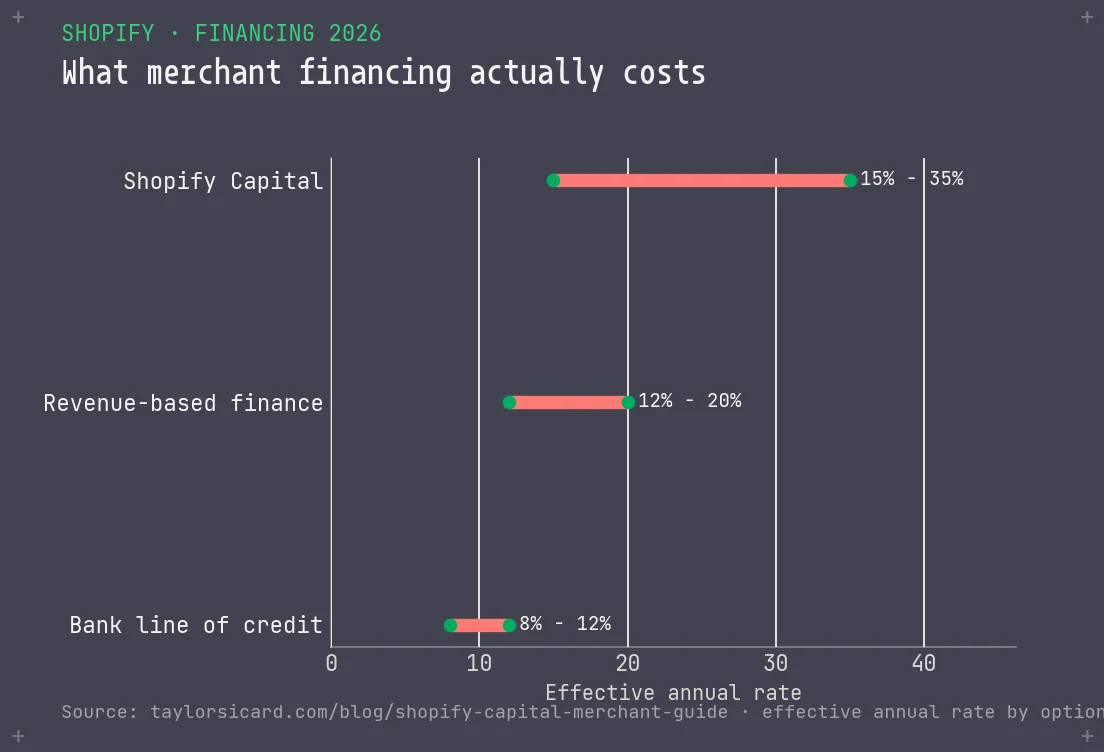
That convenience has a price. The effective APR on Shopify Capital offers typically runs between 15% and 35% annualized, depending on your factor rate and how fast your sales repay the advance. For comparison: a bank business line of credit runs 8–12% if you qualify. Revenue-based financing from dedicated providers like Clearco or Wayflyer runs 12–20%. Shopify Capital is priced at the expensive end of the alternative lending market. For brands already dealing with compressed margins from tariff-driven COGS increases, the calculus is even more demanding, running the tariff impact on your unit economics before evaluating financing is essential.
That doesn't make it wrong. It makes the use case important. There are situations where paying 25–30% annualized for capital is the correct decision because the alternative is worse or the ROI on the deployment is higher. There are many more situations where it isn't.
The comparison that matters: a bank line of credit at 10% APR on the same $50K for six months costs roughly $2,500. Shopify Capital costs $7,000. That $4,500 delta is the price of speed and no underwriting, and paying it makes sense only in specific situations, which most merchants never actually check against the offer they accept. The same cost-benefit framework applies if you're weighing capital alongside an infrastructure upgrade; see the guide on when to move to Shopify Plus for the parallel case.
The mechanics are simple.
The math is
what trips people up.
Shopify Capital merchant cash advances work as follows. Shopify makes you an offer, you cannot proactively apply, only accept or decline what Shopify presents. The offer is structured as a fixed total repayment: borrow $50,000, repay $57,000 total. That $7,000 difference is the fee, expressed as a factor rate of 1.14.
Repayment happens automatically. Shopify deducts a fixed percentage of your daily sales (typically 10% to 17%) until the total is fully repaid. No fixed monthly payments. Slower sales means a longer repayment timeline. Faster sales means faster payoff. There's no early repayment discount: you pay the full $7,000 fee whether you repay in 90 days or 300 days. The fee is fixed. Only the timeline changes.
That last point matters for the APR calculation. If your sales are strong and you repay in three months, the annualized cost on a 1.14 factor rate is approximately 55%. If repayment stretches to 12 months, the same offer annualizes to roughly 14%. Most merchants fall somewhere in the 5–8 month range, which puts the effective APR between 20% and 35%.
The numbers here are illustrative but representative of mid-tier offers. A merchant doing $2,000 in daily sales is about $60K/month, a business at roughly $700K–$800K annualized. That's a size where Shopify Capital offers are common, and where the $7,000 cost of capital is significant relative to monthly profit.
One more mechanic worth understanding: the repayment deduction comes off the top of your Shopify sales, before you see the money. It's not a bill you receive, it's a silent reduction in the cash that hits your bank account every day. Merchants often don't feel the drag acutely until a slow week arrives and they notice how low the daily deposit is. Build the deduction into your cash flow model before you accept, not after. The other quiet drain on daily deposits is how Shopify Payments reserves and payout timing work, which can hold back cash you assumed was yours.
Working through this at a brand past $5M? It's the work I do with DTC operators at that stage, and the form takes two minutes.
The three scenarios
where paying 25%
is the right call.
There are situations where Shopify Capital's cost is justified. Not many, but they're real and specific. The common thread across all three: you have a defined use case with a defined ROI that exceeds the cost of capital, or the alternative is worse than the cost.
Scenario 1: Inventory bridging for a specific, high-confidence purchase. You have a confirmed wholesale order or a season where you know you'll sell through. You need to front the inventory cost 90 days before revenue hits. The alternative (losing the order, missing the season) costs more than the financing. The key is a specific, high-probability use case with a defined repayment timeline. "I need to buy $50K in inventory for Q4, I've done Q4 before and I know the sell-through rate" is a valid reason. "I want to build up inventory" is not.
Scenario 2: Time-sensitive opportunity with explicit ROI. A supplier is offering 15% off for an order 3× your normal size. Borrow $40K at a 14% factor rate ($5,600 fee). The discount saves $6,000 on the order. The savings exceed the cost, the math works. But you have to calculate it. The offer has to save more than it costs. Discount arbitrage via Shopify Capital is legitimate when the numbers pencil out and you can service the repayment without a cash flow problem during slow periods.
Scenario 3: Bridge capital while cheaper financing is in underwriting. Your bank loan is closing in 60–90 days. You need working capital now. Shopify Capital at 25% APR for 90 days costs approximately 6% of the borrowed amount. On $50K, that's $3,000 for a 90-day bridge. If the bank loan closes at 10% and you refinance, the total cost of the bridge is manageable. Use it as short-term bridge, not long-term working capital.
The pattern across all three: you can write down the ROI before accepting. You know what the money is buying, you know what it will return, and the return exceeds the cost. If you can't complete that sentence specifically, the offer isn't ready to accept.
When it feels
convenient and
is actually expensive.
The same characteristics that make Shopify Capital frictionless (no application, dashboard delivery, two-day funding) are exactly what make it easy to accept for the wrong reasons. These are the three situations where the math doesn't work, even when accepting feels logical in the moment.
Scenario 1: Funding General Operations or Plugging a Cash Flow Gap
If you're borrowing against future Shopify revenue to cover current operating costs (payroll, rent, software, agency fees) you're not investing the capital, you're consuming it. The advance gets repaid out of future sales that would otherwise land in your bank account, which means you're pulling forward revenue at a 14–17% fee to cover expenses that don't generate incremental return.
This is the most common misuse of Shopify Capital. It feels like a solution to a cash flow problem. It is actually a deferral of the same problem, now with a fee attached. The underlying operating cost structure doesn't change. You just paid $7,000 to delay the conversation you actually need to have about your unit economics.
Scenario 2: Funding Paid Acquisition Without a Clear ROAS Model
At 25% effective APR, paid acquisition funded by Shopify Capital needs to generate significantly more than 25% incremental return on the deployed capital. Here's the math: borrow $30K for paid acquisition. Your blended ROAS is 2.5×. Gross margin is 50%. Contribution on the ad spend: $30K × 2.5 ROAS = $75K revenue × 50% GM = $37,500 gross profit. Net contribution on the $30K spend: $7,500. Cost of capital on the $30K (approximately $4,200 at 14% factor rate): you've made $3,300 net. Before fulfillment, overhead allocation, and customer service. The margin on this is thin enough that it doesn't take much deviation from your assumed ROAS to go negative.
This math improves significantly if you have strong LTV data and are acquiring customers who repurchase. If customer two and customer three are in your model, the contribution calculation changes. But most merchants running this math are looking at a single-purchase ROAS, not a lifetime-adjusted return. Know which one you're using. If you're not tracking CM-LTV at the cohort level, you're making this decision with incomplete information.
Scenario 3: Accepting Because the Offer Appeared
The single most dangerous thing about Shopify Capital is how easy it is to accept. The offer is already in your dashboard. It's pre-approved. The amount looks reasonable. You've been thinking about needing working capital. Accepting takes about four clicks.
Frictionless access to capital is precisely when the due diligence needs to happen. Every traditional lender that makes you submit two years of financials, wait for underwriting, and sign a stack of documents is also giving you four weeks to think about whether you actually need the money and what you'll do with it. Shopify Capital removes that pause on purpose. The product is designed for conversion, not deliberation.
The rule: if you're accepting a Shopify Capital offer and you can't write down a specific use case and a specific expected return in one sentence before clicking, close the tab and come back in 48 hours after you've built the model.
The market for
merchant financing is
wider than your dashboard.
Shopify Capital is the option you see because it's inside the platform you already use. That visibility advantage is not the same thing as it being the best-priced option for your situation. Before accepting a Shopify Capital offer, it takes roughly two to three hours to check at least one or two alternatives. For most merchants, that time is worth the $2,000–$5,000 it might save.
| Option | Effective Rate | Speed | Best For | Catch |
|---|---|---|---|---|
Bank Business Line of Credit |
8–12% APR |
2–6 weeks underwriting |
Established brands with 2+ years financials, clean credit, strong cash flow |
Hard to qualify at early stage. Requires documentation. Worth pursuing at $3M+ revenue. |
Revenue-Based Financing Clearco, Wayflyer, Onramp |
12–20% effective rate |
3–7 days with data access |
Growing DTC brands with clean Shopify/ad platform data and positive revenue trajectory |
Require data sharing, growth trajectory. Not for businesses with declining or volatile revenue. |
Inventory-Specific Financing Kickfurther, Settle |
Variable, often lower |
1–2 weeks setup |
Inventory purchases specifically. Kickfurther funds go direct to manufacturer. No payments until you receive inventory. |
Only for inventory. Kickfurther charges a fixed fee regardless of repayment speed. Settle offers lower rates with simpler interest. Minimum revenue thresholds apply. |
Shopify Capital |
15–35%+ effective APR |
2 business days |
Specific, defined use cases with clear ROI. Bridge financing. Inventory for high-confidence purchase orders. |
Most expensive option listed. No early repayment discount. Easy to accept without doing the math. |
Supplier Payment Terms Net 30 / Net 60 / Net 90 |
0%, the cheapest capital |
Negotiate before you need it |
Inventory purchasing. Every day of extended supplier terms is free working capital. |
Requires supplier relationship and negotiation. Many early-stage brands don't ask for it and leave significant free capital on the table. |
"The most consistently overlooked working capital solution across every brand I've worked with is supplier payment terms. Net-60 with your manufacturer is free capital. Most founders never ask for it because they're used to paying on order."
On the revenue-based financing providers specifically: Clearco has been through significant restructuring since 2022–2023, but remains active and relevant in the space. Wayflyer has grown as a Clearco alternative, focused on DTC and ecommerce with strong data integration. Onramp Funds specializes in Shopify merchants specifically. Capchase and Pipe lean more toward subscription and SaaS businesses. For inventory-specific needs, the Kickfurther and Settle comparison is worth the afternoon, both are structurally designed for the inventory purchase use case in a way that general working capital providers aren't. The right financing option also depends on where you are in your growth trajectory, the operational complexity of your Shopify stack changes the data you can offer lenders to qualify for better rates.
None of these options are better in every situation. They're all better than Shopify Capital on price. The question is whether you qualify and whether the use case fits. For a merchant at $1M–$3M revenue with clear Shopify data and a specific inventory need, spending three hours checking one or two revenue-based financing providers before accepting a Shopify Capital offer is almost always worth it.
The four-step
evaluation before
you click Accept.
When a Shopify Capital offer appears in your dashboard, the instinct is to evaluate it against what you need, not against what it costs. That instinct is backward. Here is the correct order of operations.
The decision rule that follows from all four steps: if the effective APR is justified by a specific ROI, if no cheaper alternative is available or accessible in your timeframe, and if you can service the daily repayment even in a slow period, accept. If any of those conditions fails, don't.
One final note on how I think about this from the operator side. Scaling brand portfolios to nine-figure revenue, we evaluated financing structures constantly. The decisions that compounded well were the ones where we knew exactly what capital was buying and exactly what it would return. The decisions that created problems were the ones where "we need working capital" was the analysis, and we used the most convenient option rather than the most cost-effective one. The $5M inflection is when most DTC founders first face serious capital decisions, and when the wrong structure has the most long-term damage.
Shopify Capital is a good product for what it is. It's an expensive, fast, no-friction advance against future revenue. That profile has real value in specific situations. It's worth nothing (and costs something) when you haven't defined the situation.
Whether Shopify Capital fits your plan comes down to your unit economics, not the offer sitting in your admin. The fractional DTC growth consultant helps you make that call clearly. When you want to talk it through, start here.
Scaling a consumer brand?
I take on one or two new clients a quarter and do the work myself, drawing on brands I've run from $5M past $100M. If you're in that range, the form takes two minutes.
Start a conversation More about Taylor →Common questions
on Shopify Capital
and merchant financing.
Is Shopify Capital worth it for DTC brands?
Worth it in specific, defined situations: bridging inventory for a high-confidence purchase order, capturing a supplier discount whose savings exceed the financing fee, or short-term bridge while cheaper financing closes. Not worth it for funding general operations, paid acquisition without a ROAS model that clears the effective APR, or accepting simply because the offer appeared. The cost (15-35% effective APR depending on repayment speed) has to be justified by a specific use case with a documented return. Most merchants who run the full evaluation in advance decide not to take it. That is not a failure. That is what the math is for.
What is the effective APR on a Shopify Capital advance?
It depends on how fast you repay. The fee is fixed (factor rate of 1.10-1.17x) regardless of repayment speed, but the annualized cost changes as your repayment timeline shortens or extends. A 1.14 factor rate repaid in 3 months annualizes to roughly 55%; the same advance repaid in 12 months is about 14%. Most merchants repay in 5-8 months, which puts the effective APR between 20% and 35%. The comparison that matters: a bank line of credit runs 8-12% APR; revenue-based financing from Wayflyer or Onramp Funds runs 12-20%. Shopify Capital is priced at the expensive end. Understanding your contribution margin before accepting is essential because the cost of capital has to be weighed against your actual margin, not just your revenue.
Can you pay off Shopify Capital early to reduce your cost?
No. Shopify Capital uses a fixed factor rate, not an interest rate. The total repayment amount is set at acceptance. Whether you repay in 90 days or 300 days, you owe the same total. There is no early repayment discount. This is a fundamental structural difference from a traditional loan. If your sales accelerate after accepting, you repay faster but save nothing on the fee. This matters for the APR calculation: faster repayment actually produces a higher annualized cost on the same fee, even though the repayment timeline is shorter. It also matters for the "bridge financing" use case in Section 03: if you're using Shopify Capital as a bridge while a cheaper loan closes, the speed benefit is real, but you're not saving fee by closing the bridge early.
What are the best alternatives to Shopify Capital?
In order of cost, cheapest first. Supplier payment terms (Net 30/60/90) cost nothing and are the most consistently overlooked option across every brand I've worked with. Bank business lines of credit run 8-12% APR but require 2+ years of financials and established credit history. Revenue-based financing providers (Wayflyer, Onramp Funds, Clearco) run 12-20% effective rate with 3-7 day approval once you grant data access. Inventory-specific financing from Kickfurther or Settle works well for pure inventory purchases. For the full comparison table, see Section 05. For merchants at $1M-$3M revenue, spending two to three hours checking one alternative before accepting Shopify Capital typically saves $2,000-$5,000 on a typical $50K advance. Your category's unit economics will also shape which financing structure fits best.
How does the Shopify Capital daily repayment deduction work in practice?
Shopify deducts a fixed percentage of your daily Shopify sales, typically 10-17%, and applies it to the advance balance automatically. The deduction comes off the top before the deposit hits your bank account, so you don't receive a bill. In strong sales periods you repay faster and the timeline shortens. In slow periods you repay less per day and the timeline extends. There are no fixed monthly minimums and no penalties for slow repayment. The deduction rate and total repayment amount are fixed at acceptance. The practical implication: model the deduction against your slowest month before accepting. If your worst week of the year would leave you short on operating expenses with 15% of daily sales removed, the advance will make that week structurally worse. Also relevant if you're tracking CAC payback benchmarks by vertical: the repayment drag should be visible in your cash flow model, not discovered after a slow Q1.