A 25 percent tariff on $8 COGS adds $2 a unit. On a $40 product running thin, that $2 can flip a positive contribution margin into a loss on every order. Tariffs look manageable at the gross-margin line and brutal at contribution margin, which most brands are not watching.
- The headline COGS increase looks small; the downstream contribution-margin math is the real damage.
- Most brands run their tariff analysis at the wrong level of the P&L.
- Contribution margin, not gross margin, is where tariffs actually kill DTC economics.
The direct answer: a 25% tariff on $8 COGS adds $2 per unit. On a $40 product already running thin, that $2 is the difference between a positive contribution margin and a loss on every order. Most brands see the tariff hit gross margin and think it looks manageable. It is not. Contribution margin is where tariffs actually kill DTC economics, and it is the number most brands are not watching.
The most common thing I hear from DTC founders when I bring up tariffs: "Our COGS went up $2 a unit. That's not a big deal." Nine times out of ten, they have not run the full contribution margin math. When they do, they realize they have a much larger problem than a $2 COGS increase suggests.
That is the tariff deception. The headline number looks small. The downstream math is brutal. And most brands are running their tariff exposure analysis at the wrong level of the P&L (gross margin) instead of where the real problem lives: contribution margin. For the full mechanics of how contribution margin works and why it matters more than gross margin, see contribution margin math.
The customs words,
explained like
you're new to it.
Before the model, the plain-English version. A tariff is a tax your own government charges you when your product crosses the border into the country, calculated as a percentage of the declared value. You, the importer of record, pay it. Not the factory, not the customer. It lands directly on your cost of goods, which is why a tariff hike quietly eats margin you already counted on.
The paperwork has its own vocabulary, and getting a term wrong can cost real money at the port. Here are the ones that matter, in plain language.
| Term | What it actually means |
|---|---|
Tariff / Duty | The tax charged when goods enter the country, set as a percentage of declared value. Duty is the amount you pay; tariff is the rate or the policy behind it. |
Importer of record | The party legally responsible for clearing customs and paying the duty. Usually you, the brand, even when a freight forwarder handles the logistics. |
HTS code | Harmonized Tariff Schedule. The 10-digit code that classifies your product and sets its duty rate. The right code can be the difference between 0% and 30%, so classify carefully. |
Landed cost | The true all-in cost of a unit on your shelf: product, freight, insurance, duty, and fees. The number your margins should actually be built on. |
De minimis | The value threshold below which a shipment enters duty-free. The rules here have tightened, so the old trick of shipping small parcels duty-free is far less reliable. |
Section 301 tariffs | The specific extra tariffs on many goods from China. Often the line item doing the real damage to brands sourcing there. |
MPF | Merchandise Processing Fee. A small percentage fee customs charges on top of duty to process the entry. Minor per shipment, but real. |
Customs bond | A required insurance policy guaranteeing you will pay your duties. Mandatory for commercial imports above a low threshold. |
Country of origin | Where the product was substantially made, which determines the tariff rate that applies. Not always where it shipped from. |
Contribution margin | What is left of a sale after the costs that scale with it, including the duty. The number a tariff hike directly compresses. |
That is the vocabulary. Now the model: exactly how a tariff moves through your P&L, and the levers that claw the margin back.
The $2 COGS increase
that turns a brand
unprofitable.
Let's work through the actual math on a $40 DTC product. This is a real-world example that's representative of thousands of brands in beauty, wellness, and home categories.
Pre-tariff unit economics: COGS of $8, product price of $40. Gross margin of $32, that's 80%, which looks healthy. But gross margin isn't the number that tells you if you're building a business. Strip out the costs that exist for every order shipped: outbound shipping ($4), returns allowance ($3), payment processing ($1.20), fulfillment and pick/pack ($4). Now subtract your blended customer acquisition cost, $22 across Meta, Google, and other channels is representative for a mid-stage DTC brand. You're left with $0.80 of contribution margin per order. That's 2%. You are barely alive.
Now apply a 25% tariff on your $8 COGS. Your cost of goods becomes $10. You now have negative $1.20 per order. Every order you ship loses money. You've turned a marginally profitable business into a loss-generating one with a $2 cost increase.
That's what I mean by the deception. A 25% tariff rate sounds like a policy issue. "We're monitoring the situation." When you put it through a contribution margin model, it's an existential problem for any brand running under a 5% CM cushion, which is more brands than want to admit it.
The reason most founders miss this is that they're managing their business off gross margin, not contribution margin. Gross margin absorbed the COGS increase and still looks reasonable. Contribution margin (which reflects the actual economics of acquiring and serving a customer) tells a completely different story.
Every brand should have
a tariff scenario model.
Most don't.
Before you can make any of the decisions in the next three sections, you need a model. It doesn't need to be complex. It needs four inputs: your actual COGS by SKU (what you pay the supplier, ex-tariff); your HTS tariff classification code and current rate; your landed cost breakdown including freight, tariff, and customs (my free landed cost calculator stacks those into a true per-unit number); and your current contribution margin per order, including CAC.
If you don't have that fourth number (contribution margin including CAC) stop reading this post and go build that first. Everything else is academic without it.
| Base COGS | 10% Tariff | 15% Tariff | 25% Tariff | 35% Tariff |
|---|---|---|---|---|
|
$5.00 COGS
Entry-level consumables, accessories
|
+$0.50 |
+$0.75 |
+$1.25 |
+$1.75 |
|
$8.00 COGS
Mid-range skincare, home goods
|
+$0.80 |
+$1.20 |
+$2.00 |
+$2.80 |
|
$12.00 COGS
Premium apparel, supplements
|
+$1.20 |
+$1.80 |
+$3.00 |
+$4.20 |
|
$20.00 COGS
Higher-end goods, electronics accessories
|
+$2.00 |
+$3.00 |
+$5.00 |
+$7.00 |
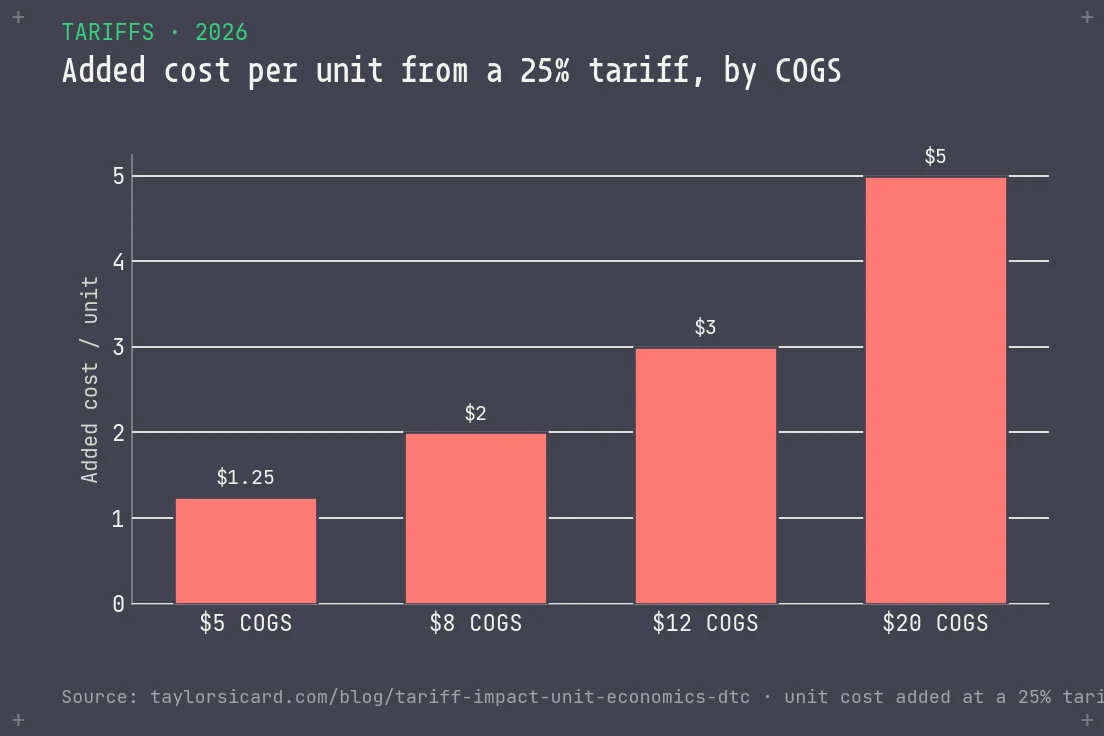
These numbers don't mean much in isolation. The question is how each of these COGS increases maps against your current contribution margin percentage. If you're running a 15% CM and your tariff impact adds $2 to a $12 COGS product, you've absorbed 16% of your contribution margin. If you were running a 5% CM, you're underwater.
Map your numbers. Then decide which of the three levers below you need to pull, and in what order.
Working through this at a brand past $5M? It's the work I do with DTC operators at that stage, and the form takes two minutes.
Three levers. Different timelines.
Most brands start with
the slowest one.
When COGS rises and contribution margin compresses, you have exactly three categories of lever to pull: raise price, reduce cost, or change sourcing. Here's the honest ranking by speed, and by what most brands actually do, which is the wrong order.
Lever 1, Price Increase (0–30 Days)
A 5% price increase on a $40 product adds $2.00 per unit, which fully offsets a 25% tariff on an $8 COGS base. It's the fastest lever and the most underused. Most founders resist it based on instinct ("our customers will notice") rather than data.
The elasticity question is real, but it's answerable with a test. Raise price on your top three SKUs for two weeks. If you raise from $40 to $42 and order volume drops 5%, you're ahead. If it drops 12%, you're behind. Run the math on your specific conversion data before assuming the worst.
Raise price on your top 3 SKUs for 14 days. Measure order volume change. Multiply the volume change percentage by your average order value to see the net revenue impact. Compare it to the COGS savings from holding price. This is a 30-minute analysis that most founders are skipping in favor of gut instinct, which is reliably pessimistic about price sensitivity.
Most DTC brands have more pricing power than they think. Your customers are buying from you because they trust you, not because you're the cheapest option. If you were the cheapest option, you'd already be dead from Amazon competition.
Lever 2, COGS Reduction via Volume Consolidation (30–90 Days)
Consolidating three monthly purchase orders into one quarterly order typically reduces per-unit COGS by 8–12% through MOQ advantages. You're buying the same units; you're just batching them more efficiently. The catch: it requires working capital to front the larger order, and Shopify Capital is worth evaluating as a vehicle for exactly this kind of inventory consolidation. If your inventory turns in 60 days and your terms with the supplier are net-30, the math usually works.
A 10% COGS reduction on an $8 product saves $0.80 per unit, which partially offsets the $2.00 tariff impact but doesn't eliminate it. This lever rarely solves the problem alone, but it buys back meaningful margin while you work on the others.
Lever 3, Sourcing Shift (6–18 Months)
Moving manufacturing from China to Mexico (USMCA), Vietnam (lower tariff rates), or India is the most permanent fix and the slowest to execute. New tooling, quality procedures, supplier development, and the transition period itself typically add a 15% cost premium before you see savings. Brands that started this process in 2024 are seeing the benefits now. Brands starting in mid-2026 won't see relief until 2027 at the earliest.
The tariff rate differentials between manufacturing locations are real, but they're not static. Vietnam has seen tariff scrutiny increase as it emerged as a major China-alternative. A sourcing shift that made financial sense at today's rates may look different if rates change. Build the business case on the landed cost delta, not just the tariff rate, and include a scenario where the destination country's rate changes by 10 percentage points.
Tariffs and rising CAC are hitting
the same margin line
at the same time.
Most brands are modeling tariffs in isolation. The real problem is that every other cost line is moving at the same time. Meta CPMs are up. Google CPCs are up. Attribution has gotten noisier since iOS changes, making blended CAC harder to optimize. And now COGS are up on top of that.
"Most brands are modeling tariffs in isolation. The real problem is that every other cost line is moving at the same time."
Run the compound scenario. Take our $40 product. Pre-tariff, pre-CAC-increase: $8 COGS, $22 blended CAC, contribution margin of $0.80. Now run both increases simultaneously: $10 COGS (post-tariff), $25 CAC (up 14% from realistic platform cost increases). Holding price at $40, contribution margin is now negative $4.20 per order. You're not slightly underwater, you're deeply negative on every order.
The decision framework is simple: if both COGS and CAC are rising, price increases are almost certainly the right move. The only questions are how much, on which SKUs, and whether you have the data to test the elasticity before you commit. Waiting to see "if tariffs get resolved" while both cost lines trend upward is not a strategy, it's deferred math.
Channel diversification is also relevant here. A brand that reduces its dependence on paid Meta acquisition (through email retention, loyalty programs, or organic channels) structurally lowers its blended CAC. For more on channel strategy under cost pressure, see our piece on TikTok Shop and what it means for social commerce in 2026.
Know your break-even price
before you're standing on it.
Every DTC brand should be able to answer one question on demand: at what price do we break even on contribution margin, given current COGS, CAC, and operational costs? If you can't answer that question in five minutes, you don't have enough financial visibility to make tariff decisions confidently.
The calculation: Break-even price = COGS (post-tariff) + fulfillment + outbound shipping + payment processing + blended CAC + overhead allocation per order. If your current price is less than 20% above that break-even, you have almost no buffer. A tariff increase, a CAC spike, or a returns rate bump can wipe out your margin entirely.
Here's the simplified CM audit process. Run this quarterly at minimum, monthly if you're under active cost pressure.
Common
questions
answered.
How do tariffs affect DTC contribution margin?
Tariffs raise COGS, which directly compresses contribution margin because contribution margin is calculated after all variable costs including duty. On a $40 product with $8 COGS, a 25% tariff adds $2 to COGS. If contribution margin was $0.80 before the tariff, it becomes negative $1.20 after. The gross margin still looks healthy, which is why founders who manage off gross margin miss the problem until it is severe. See the DTC unit economics by category breakdown for how your category benchmarks compare.
What is the fastest way to recover contribution margin after a tariff increase?
A price increase is the fastest lever. A 5% price increase on a $40 product adds $2 per unit, which fully offsets a 25% tariff on an $8 COGS base. Most founders resist price increases based on instinct rather than data. The elasticity question is answerable with a 14-day test on your top three SKUs before committing across the catalog. COGS reduction through volume consolidation is the second lever and typically takes 30 to 90 days to execute.
How long does a sourcing shift take to reduce tariff exposure?
Moving manufacturing from China to Mexico, Vietnam, or India typically takes 6 to 18 months. New tooling, quality procedures, supplier development, and the transition period itself usually add a 15% cost premium before savings appear. Brands that started this process in 2024 are seeing benefits now. Brands starting in mid-2026 will not see relief until 2027 at the earliest. For the operational side of that transition, see tariff-proofing your Shopify brand.
Should I model tariffs and rising CAC together or separately?
Together, always. Modeling tariffs in isolation understates the problem. If COGS are rising because of tariffs while Meta and Google CPMs are also rising, both costs hit the same contribution margin line simultaneously. Run a compound scenario with your current tariff-adjusted COGS and your current blended CAC. If both are trending upward, price increases are almost certainly justified. For CAC benchmarks by vertical, see how CAC payback varies by vertical.
How do I know if my price point gives me enough tariff buffer?
Calculate your break-even price: COGS (post-tariff) plus fulfillment plus outbound shipping plus payment processing plus blended CAC. If your current price is less than 20% above that break-even, you have almost no buffer. A single tariff increase, a CAC spike, or a higher returns rate can wipe your margin. That 20% is the minimum cushion that gives you room to absorb one variable moving against you without going negative.
The brands that handle tariff pressure well are not necessarily in better categories or have more margin to absorb. They are the ones who ran the math before it became urgent, and who had the pricing discipline to act on what the math told them.
A $2 COGS increase on an $8 product is not a rounding error. It is a contribution margin event. Treat it like one. Then read the brand profitability teardown and max allowable CAC, explained to make sure the rest of your unit economics are equally clear before you make pricing decisions.
Modeling tariff impact on your unit economics before it lands on your P&L is the difference between adjusting and reacting. The DTC growth consulting practice does that work alongside operators. The form takes two minutes: start the conversation.
Scaling a consumer brand?
I take on one or two new clients a quarter and do the work myself, drawing on brands I've run from $5M past $100M. If you're in that range, the form takes two minutes.
Start a conversation More about Taylor →