TikTok Shop is projected to hit $23.4 billion in US sales in 2026, roughly the size of Target's US digital business, and now accounts for nearly 20 percent of US social commerce. For brands moving real volume the question has shifted from whether to test it to what the strategy is.
- Social commerce overall is expected to cross $100 billion this year, and TikTok Shop drives most of it.
- Genuine regulatory risk means anyone with serious inventory or creator spend needs a hedge.
- The channel is worth taking seriously now, but plan for both the upside and the downside.
Put the number next to something merchants actually know. Target's US digital business does roughly $20 billion a year. TikTok Shop is projected to hit $23.4 billion in 2026. That gap used to run the other way.
For brands moving real volume, the question has shifted from "should we test it?" to "what's our strategy?" The platform now accounts for nearly 20% of all US social commerce, and social commerce as a whole is expected to cross $100 billion this year. TikTok Shop is the biggest reason for that number.
But the situation is complicated. There's genuine regulatory risk that anyone with serious inventory or creator spend needs to account for. This post covers both sides, why the channel is worth taking seriously right now, and exactly how much you should hedge.
$23.4 billion.
Bigger than Target.
TikTok Shop's $23.4 billion US projection for 2026 represents 48% year-over-year growth. The US buyer base expanded from roughly 35 million to over 65 million active shoppers in a single year, a near-doubling that no other retail channel matched in the same period. These figures come out of TikTok's own commercial reporting, Shopify partner data, and the retail channel analysis that's been building across both organizations since US Shop launched at scale.
The Target comparison isn't rhetorical, it's arithmetic. TikTok Shop's projected 2026 sales would also put it ahead of Costco's digital revenue, Best Buy's total ecommerce business, and Kroger's online sales. The platform went from zero US presence to a top-five digital retailer in less time than most brands need to execute a platform rebrand.
What makes that pace unusual is that TikTok Shop isn't competing on price or Prime-like logistics. It's converting buyers through content. That distinction matters more than the headline number.
Why TikTok Shop converts
at more than double
Instagram Shopping.
Social commerce has a reputation problem: high traffic, low checkout rates. Instagram Shopping, live since 2017, still converts at around 2.1%. Facebook Shops sits at 1.8%. TikTok Shop converts at 4.7%.
| Platform | Conv. Rate |
|---|---|
|
TikTok Shop
Native checkout · no redirect · in-feed purchase
|
4.7% |
|
Instagram Shopping
Redirects to site or in-app checkout
|
2.1% |
|
Facebook Shops
Catalog-based · lower intent traffic
|
1.8% |
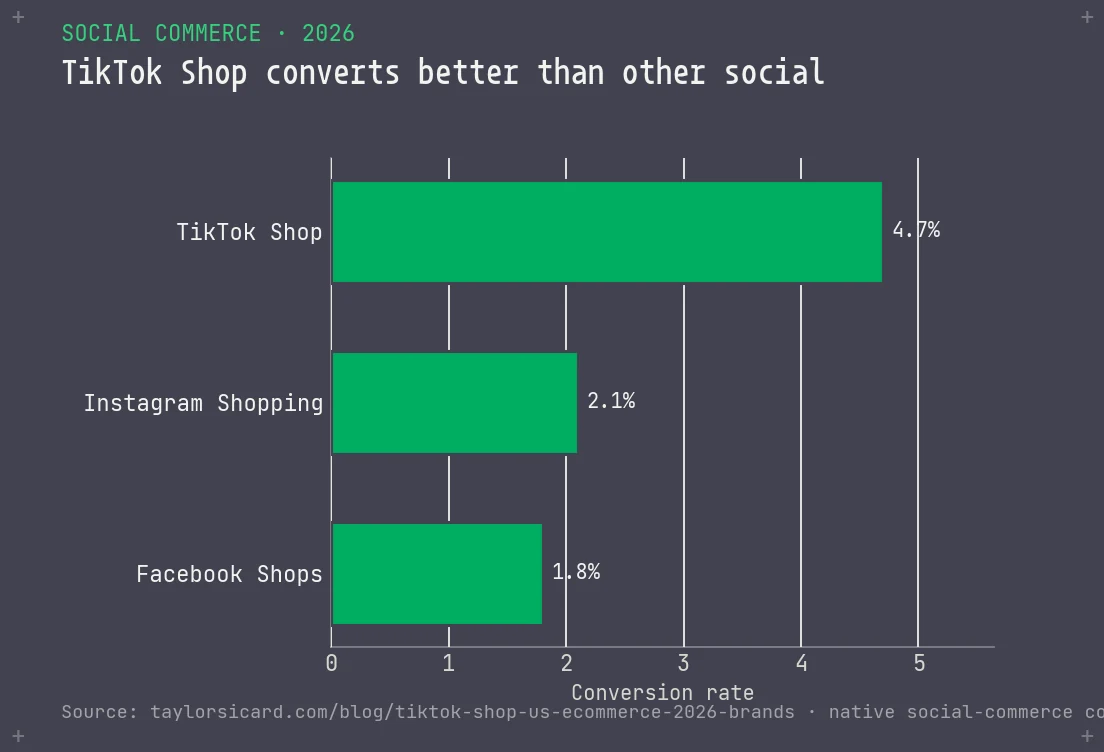
Instagram Shopping typically pulls a buyer out of the content experience and redirects them to your website, or routes them through an in-app checkout that still feels like a separate transaction. Every redirect is a drop point. TikTok Shop's native checkout keeps the buyer inside the app, inside the content, without a context switch.
This is the same friction argument that drove Shopify's one-page checkout rollout. Remove steps, conversion goes up. TikTok applied that logic at the platform level before most brands had to think about it.
This is the work I do, with DTC brand operators scaling past $5M. If it's landing, the form takes two minutes.
Selling through entertainment
is not the same as
running ads.
When a paid ad runs on Meta, the viewer knows they're being sold to. They either scroll past or click with a level of skepticism already priced in. On TikTok, the most effective selling happens through content that doesn't feel like an ad at all, a creator doing a skincare routine, showing a before-and-after, reacting to a product they actually use. The purchase happens because the viewer trusts the person, not the brand.
TikTok Live shopping sessions convert at three to five times the rate of standard product pages. A high-performing Shopify product page at 3% is considered strong. TikTok Live sessions regularly hit 9–15% for the right product with the right host.
The implication for merchant strategy is that content calendar and creator relationships are now part of your media mix, not marketing extras. Brands running TikTok Shop well aren't just listing products, they're building a pipeline of creator-generated content that keeps product pages in-feed and purchase intent warm between campaigns.
What's actually
moving.
TikTok's algorithm rewards content that demonstrates transformation or shows clear before-and-after results. That dynamic advantages certain categories more than others.
The Q1 2026 top-seller on TikTok Shop US was the Dr. Melaxin Gifted Collagen Boost Set, $11.1 million in revenue across roughly 170,000 orders in a single quarter. The top 10 sellers that quarter were almost entirely in skincare, health, and oral care, with three Korean skincare bundles combined generating over $22 million.
If your category is harder to demo (B2B accessories, industrial goods, age-restricted products) TikTok Shop is probably not your primary bet. For DTC brands in beauty, wellness, home, or apparel with products in the $25–$80 price range, the channel case is real.
How Shopify merchants
actually get started.
Shopify merchants add the TikTok Sales Channel from the Shopify App Store, connect their TikTok for Business account, and sync their catalog. Orders placed through TikTok Shop route back through Shopify for fulfillment, your existing 3PL, warehouse, or self-fulfillment setup doesn't change. TikTok Shop is effectively a second storefront on top of your existing infrastructure.
The regulatory risk,
and how to size your
exposure to it.
TikTok was under a de jure US ban from January 19–22, 2025. The ban was resolved when TikTok's US operations were divested into a new entity (TikTok USDS Joint Venture LLC) with Oracle and investment firms Silver Lake and MGX as managing partners.
The platform is operational. But the underlying legal question isn't fully closed. ByteDance still owns the recommendation algorithm. Oracle can audit what it does but cannot change how it works. The intellectual property remains in Beijing. Whether that arrangement satisfies the original law's requirements is still being worked through in Washington.
A second ban isn't the base case (the current structure was designed to make one harder) but dismissing it as impossible would be overconfident given how the last two years went.
The right frame isn't "should I be on TikTok Shop" vs. "should I avoid it." It's: how much fixed cost am I willing to put against this channel relative to how much of my revenue it represents? Creator commission spend is variable, you pay on conversion. TikTok-specific ad spend, video production infrastructure, and full-time headcount dedicated to the channel are less flexible if the platform changes.
The merchants who got hurt most during the January 2025 disruption were the ones who had let TikTok become 40–60% of their revenue without building out email lists, Shopify-native marketing, or alternative paid channels in parallel. Run the channel aggressively. Don't let it become a single point of failure.
$23.4 billion is a real number on a channel that didn't exist in the US three years ago. The conversion data is real. The creator affiliate model gives most brands a low-friction way to test distribution before committing serious budget. And the Shopify integration is solid enough that adding TikTok Shop as a sales channel is a day's work, not a project.
Most brands sitting on the sidelines are not waiting on data. They are waiting for someone to tell them it is safe. It is not fully safe. But neither is ceding a $23 billion channel to competitors who decided to move while you deliberated.
The channel mix question matters here. TikTok Shop works best as a discovery and first-purchase surface, not as a customer-ownership channel. Use it to find buyers, then move them into email, SMS, and your Shopify-native retention flows where you own the relationship long term. I laid out the full framework in the 2026 channel mix strategy breakdown and covered the practical TikTok risk calculus in is TikTok Shop safe in 2026.
On the LTV side: the brands winning on TikTok Shop over time are the ones who treat it as top-of-funnel acquisition, not standalone profit. The first order economics are often thin after commission fees and fulfillment. The second and third orders, which happen on your own channels, are where the margin lives. If you have not thought through how TikTok-acquired customers perform at 90 and 180 days, that is the right next question. The LTV math most brands are getting wrong goes directly into that calculation.
What brands
keep asking.
How big is TikTok Shop in the US in 2026?
Projected at $23.4 billion in US ecommerce sales, up 48% year over year, based on TikTok's own commercial reporting and Shopify partner data on channel growth. That would put it larger than Target's US digital business and ahead of Costco, Best Buy, and Kroger's online revenues. The active buyer base expanded from roughly 35 million to over 65 million in a single year.
Why does it convert so much better than Instagram Shopping?
TikTok Shop converts at roughly 4.7% versus Instagram Shopping at 2.1% and Facebook Shops at 1.8%. The primary driver is native checkout: the buyer completes the purchase inside TikTok without a redirect. Every redirect loses conversion. TikTok eliminated the redirects.
Is it safe to invest in given the regulatory situation?
The January 2025 ban resolved into a joint venture structure with Oracle, Silver Lake, and MGX. A second ban is not the base case, but the legal questions are not fully closed. Run it aggressively for variable cost plays like creator commissions. Limit your fixed-cost exposure and build parallel channels so TikTok is never a single point of failure.
Which product categories work best?
Beauty and personal care is the largest category by GMV. Health and supplements, home gadgets, and fashion also perform well. Products priced $25 to $80 that show a clear transformation in 30 seconds tend to convert best. Hard-to-demo or age-restricted categories are poor fits for the format.
What should I track to know if it is actually working?
Track first-order contribution margin after TikTok commission, not just revenue. Then track 90-day and 180-day repurchase rate for TikTok-acquired customers versus your overall average. If the repurchase rate is low, you are paying acquisition costs without capturing lifetime value. That is the sign to invest more in post-purchase retention flows, not to abandon the channel.
Where TikTok Shop fits in a US brand's 2026 mix is worth answering deliberately rather than by reflex. That is the kind of call the DTC brand consulting practice is built for. Start a conversation; the form takes two minutes.
Scaling a consumer brand?
I work with a deliberately small number of DTC operators. I've run brands at this scale myself, from $5M past $100M. Not theory. If you're in that range, the form takes two minutes.
Start a conversation More about Taylor →