Expect $65,000 to $75,000 of net revenue per $100,000 of TikTok Shop GMV before COGS and fulfilment: platform fees take 5 to 6%, creator commissions 10 to 20%, and returns run higher than on your own store.
- Model TikTok Shop on its own margin structure, not your DTC P&L.
- Creator commission is the largest variable line, so negotiate it deliberately.
- Returns run 8 to 12% versus 5 to 8% on your own store.
On margin, plan for $65,000 to $75,000 in net revenue on every $100,000 of TikTok Shop GMV, before COGS and fulfillment. Platform fees take 5 to 6%, creator commissions another 10 to 20%, and returns run 8 to 12% versus 5 to 7% on a typical DTC Shopify channel. If your COGS and fulfillment add up to 50% of net, you are looking at 15 to 25 points of contribution margin. That is workable if your AOV and LTV support it, and it is a different business from your DTC channel.
Getting-started guides are everywhere: connect your Shopify catalog, set a commission rate, post some videos. What they don't cover is what happens after, when your TikTok Shop GMV is growing and your bank account isn't keeping pace.
This post is about the operations and finances of running TikTok Shop at scale. TikTok Shop is projected to reach $23.4 billion in US sales in 2026, up 48% on the year, according to TikTok's own commercial reporting. That is roughly the size of Target's US digital business. Why it converts is covered near the end of this page.
Your TikTok Shop gross revenue
looks good. Your net
looks different.
TikTok Shop's cost structure is different from your DTC Shopify channel's, though not necessarily worse. The differences surprise brands that model it like a second Shopify storefront.
That $65–75K is before COGS and fulfillment. At the operational level, creator commissions run 10–20% of GMV, with beauty and wellness trending 15–18% because creators in high-competition categories know their leverage. TikTok's transaction fee runs 2–8% of GMV depending on category, and most brands land at 5–6%. Your fulfillment costs are the same as DTC. Return rates on TikTok Shop run 8–12% on industry average, against 5–7% for most DTC Shopify stores.
Don't skip the returns gap. TikTok Shop buyers are discovery-driven: they bought on a creator's recommendation without doing their own research, and impulse purchases have higher return rates. Build that into your model before you scale.
Before increasing your TikTok Shop ad spend or creator commissions, run the full unit economics on your current orders. TikTok GMV ÷ by (1 + return rate) = adjusted GMV. Subtract platform fee, creator commission, COGS, and fulfillment. If the resulting margin is below your DTC channel contribution margin, you need to either raise AOV on TikTok, reduce commissions for lower-performing creators, or accept that TikTok is a volume channel with lower per-order economics than DTC.
Any of the three can be the right answer, but each is a different strategic choice with different operational decisions behind it, so know which one you're making.
The affiliate model is brilliant
until you have to run it.
The open-catalog affiliate model is a real innovation. You set a commission rate, open your catalog, let creators find your products, and pay only on conversion, with no upfront spend and no production cost. On paper it is pure performance marketing. The practice is where the affiliate economics actually shake out once you account for the commission rate that gets creators to post and the long tail that never does.
Operationally, the top 5% of your affiliates will generate 80% of your sales. The other 95% will sign up, never post, and create administrative overhead: inactive affiliates who occasionally surface with questions, requests, or compliance issues. A long tail of 500 affiliates who each generate two orders in a given month turns into a customer service function you didn't plan for.
What experienced brands do differently
Successful TikTok Shop brands stop treating all affiliates equally. They build tiered creator programs that concentrate resources on the creators who actually drive volume. A creator program is the economics of a brand partnership run at the influencer tier, and the same rule applies: fit first, then economics.
| Tier | Commission | Qualification | Benefits |
|---|---|---|---|
Standard Default open catalog |
12% |
Any affiliate who applies |
Catalog access, standard product materials |
Active Proven converters |
18% |
Minimum 10 orders/month for 2 consecutive months |
Free product, priority seeding, brand brief, early access to new SKUs |
Partner Top performers |
22% |
Top 10 by monthly GMV |
Monthly check-in, custom bundles, brand ambassador positioning, earliest product access |
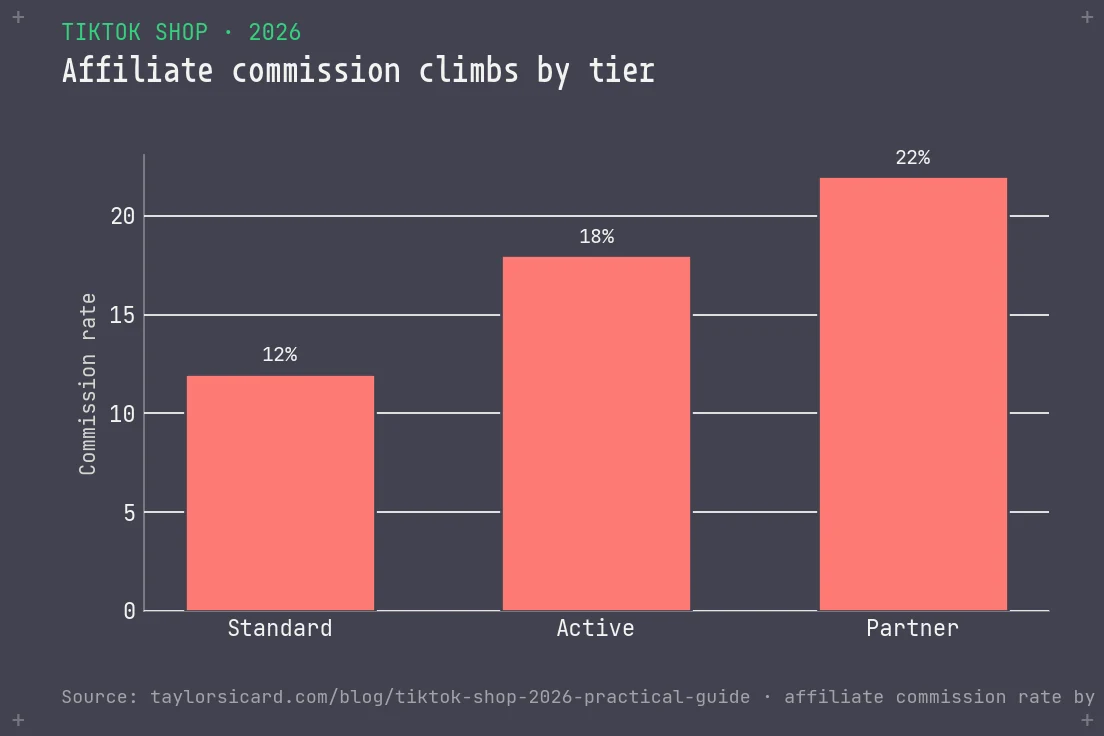
The tiered approach concentrates your highest commissions where they have the most impact (on creators who are already converting) while maintaining the open catalog for discovery. Send product to Active and Partner creators before they ask for it. In practice, a creator who has your product in hand posts more.
Write a creator brief that sets guardrails instead of a script: messaging dos and don'ts, and the claims your product can and cannot make. The FTC rules on endorsements apply to TikTok affiliate creators, and you're responsible for policing claims made about your product even when you didn't produce the content. A brief with explicit prohibited claims (unverified health claims, before/after comparisons for regulated categories) is basic risk management.
Working through this at a brand past $5M? It's the work I do with DTC operators at that stage, and the form takes two minutes.
Live shopping works.
The math on whether
it works for you.
TikTok LIVE sessions convert at 3–5x standard product pages. That number is documented and consistent across categories. The question is whether the economics work at your current scale, and whether you have the operational capacity to run them sustainably.
A realistic model for a mid-stage brand running their first intentional LIVE sessions: 2-hour session, 5,000 concurrent viewers at peak. 3% conversion rate (conservative for a competent host with a well-fitting product). 150 orders at $45 AOV = $6,750 GMV. Subtract the 6% platform fee ($405) and your fulfillment costs. Host cost for a solid 2-hour show: $200–$500 for a paid creator, or internal staff time. Net: real money, but not yet a primary revenue driver at this scale.
The math improves dramatically with audience size: the same 3% conversion rate on a 20,000-viewer session generates $27,000 GMV in two hours. At that scale, LIVE becomes a scheduled revenue event you plan inventory around.
Brands running 3+ LIVE sessions per week need dedicated staff. A solo founder running LIVE sessions while also managing DTC operations and an affiliate creator network typically burns out within 60–90 days. The best sessions are run by people who have done enough of them to be comfortable on camera, who know the product cold, and who can handle live Q&A fluently.
Build the team before you scale the live program. Prove that one LIVE session per week works economically, then hire to support two sessions, then scale. One person running four sessions a week while doing everything else gets you worse content and a burned-out founder at the same time.
These are not
the same customer.
The TikTok Shop buyer and the Shopify DTC buyer behave differently in ways that matter for your retention strategy, your inventory planning, and your brand building. Treating them as interchangeable is one of the most common mistakes brands make when they start generating meaningful TikTok volume.
TikTok buyer profile: discovery-driven, converted by a creator recommendation, often first exposure to the brand, lower brand loyalty before purchase, higher impulse decision speed, higher return rate, less likely to give email address at checkout.
DTC buyer profile: search or referral-driven, higher brand awareness before purchase, more deliberate purchase decision, higher repeat purchase rate, lower return rate, email address collected at checkout.
"Your DTC email list is your most valuable asset. TikTok Shop customers don't give you their email address by default. Building the bridge between the two channels is one of the most important things a growing brand can do."
The bridge is the post-purchase insert. Every TikTok Shop order you fulfill should include a physical card driving to your DTC site for loyalty signup, subscription, or preferred customer program. If 15% of TikTok buyers convert to email subscribers who then repeat-purchase through your DTC channel, the lifetime value of a TikTok acquisition looks dramatically better. Without the bridge, TikTok generates first-order volume; with it, TikTok becomes a top-of-funnel customer acquisition channel for your core DTC business.
Inventory planning is different too
TikTok Shop demand is less predictable than DTC demand. A creator post can go viral at 2am and put hundreds of orders into your queue before you wake up. That is a good problem when you have the inventory; it is a brand-damaging problem when you do not. TikTok's fulfillment window expectations are tight, and a flood of orders you cannot fill on time will tank your seller rating and suppress future distribution.
The operating fix is a dedicated TikTok buffer. Hold 2 to 3 weeks of additional inventory for your top-selling TikTok SKUs, separate from your DTC fulfillment buffer. Review your affiliate program weekly and use creator posting activity as a leading indicator of likely demand spikes. When a Partner-tier creator tells you they are posting about your product on Thursday, move inventory to your fulfillment partner on Monday.
How TikTok Shop fits into your full channel strategy is covered in the broader DTC acquisition playbook. The same logic that applies to DTC brand partnerships and economics applies here: model the unit economics before you commit to a channel at scale.
What TikTok does next
matters less than
what you've built.
For the regulatory background on TikTok's current US legal structure, read is TikTok Shop safe in 2026. Whether TikTok gets banned matters less to your operating model than how quickly you could adjust your business if TikTok is disrupted.
That depends entirely on what you've built. Variable costs (creator commissions, LIVE sessions, short-term ad spend) can be turned off within days. Fixed costs (a dedicated TikTok content team, video production infrastructure built specifically for the platform, inventory purchased to support TikTok-specific launch timing) take weeks or months to unwind.
Treat TikTok Shop the same way you'd treat any single channel in a diversified media mix. The logic of why your channel mix is your strategy decides how much weight any one channel should carry. TikTok Shop can be your fastest-growing, highest-volume, most exciting channel without becoming the one whose disruption would threaten the business. If it exceeds 30% of your total revenue, build and maintain a 90-day contingency plan that answers what you do with the inventory, which channels absorb the redirected spend, and where email acquisition comes from instead.
The brands that came through the January 2025 three-day US disruption best had already built the contingency. They hadn't predicted anything; a contingency is good business practice at any level of channel concentration.
The 90-day optimization
checklist.
Common
questions.
What is the true margin on TikTok Shop after all fees?
On $100K in GMV, most brands net $65,000 to $75,000 before COGS and fulfillment. Key deductions: platform fee (5 to 6%), creator commissions (10 to 20% depending on category, with beauty and wellness running 15 to 18%), and returns (8 to 12% versus 5 to 7% for standard DTC). Model these numbers before scaling spend. If your COGS and fulfillment combined run 50% of net, you are looking at 15 to 25 points of contribution margin, which can work, but requires a different AOV and LTV than your DTC channel assumptions.
How should I structure creator commissions?
Build a tiered program. Standard catalog access at 10 to 12%. Active creators who hit minimum monthly order thresholds move to 15 to 18% plus product seeding. Top performers by GMV get 20 to 22% plus early product access and co-branded positioning. Concentrate your highest commissions on the creators who are already converting, not on the ones with the largest follower counts. The top 5% of creators typically generate 80% of sales.
Does TikTok LIVE actually work for smaller brands?
It works, but the math only becomes compelling at audience scale. A 5,000 concurrent viewer session at 3% conversion and $45 AOV generates roughly $6,750 GMV in two hours, real money but not yet a primary driver. The same conversion on 20,000 viewers generates $27,000. Prove one weekly session works first, then hire to support more. Running multiple LIVE sessions with one person handling everything usually leads to burnout within 60 to 90 days.
How do I convert TikTok customers to my DTC channel?
TikTok Shop buyers do not give you their email address by default. Every order needs a post-purchase physical insert in the box, driving to a DTC landing page with a loyalty offer, subscription, or preferred customer discount. If 15% of TikTok buyers convert to email subscribers who then repeat through DTC, the lifetime value of the TikTok acquisition looks materially better than a first-order-only model. Without this bridge, TikTok stays a top-of-funnel volume channel. With it, TikTok feeds your highest-LTV base.
How much of my revenue should TikTok Shop represent?
Treat it like any single channel. When TikTok Shop crosses 30% of total revenue, build a 90-day contingency: what happens to inventory, which channels absorb redirected spend, where does email acquisition come from instead. The brands that handled the January 2025 US disruption best had the contingency already built. They hadn't predicted the event; managing concentration risk is standard practice at any scale. The same logic applies to how you think about TikTok Shop's broader market position.
TikTok Shop works. The GMV and the conversion rates are real, and the creator affiliate model is unlike anything else in social commerce in 2026. Brands that struggle with it did not model the economics accurately before scaling, or built their operations entirely around one channel with no flexibility left to pivot.
Model it right, build the bridge to DTC, concentrate resources on your top creators, and build the contingency before you need it.
Standing up TikTok Shop properly is a channel decision with real operational weight behind it. Working with a DTC growth consultant helps you do it without the expensive false starts. The form takes two minutes: start the conversation.
Why TikTok Shop converts, and what the creator model costs
The case for the channel rests on native checkout. The buyer pays inside the app, inside the content, with no redirect, and every redirect is a drop point. That's why TikTok Shop converts at about 4.7%, against roughly 2.1% for Instagram Shopping and 1.8% for Facebook Shops, which send buyers to a site or a separate checkout. Live shopping is the extreme case: a strong host on the right product converts at three to five times the rate of a standard product page.
On the affiliate side you set a commission, 10 to 20% is standard in most categories, and creators earn only on converted sales. The organic side carries no upfront spend, which is a different risk profile from paid social.
Scaling a consumer brand?
I work with a deliberately small number of DTC operators. I've run brands at this scale myself, from $5M past $100M. If you're in that range, the form takes two minutes.
Start a conversation More about Taylor →