Wellness and supplement M&A stayed hot through the first half of 2026. The disclosed anchors: Unilever paid about $1.2B for greens brand Grüns, Prestige paid $1.045B for Breathe Right at 11x EBITDA, and Thorne agreed to be acquired by P&G for $3.8B, pending close. Supplements trade at a premium to broad consumer M&A, near 11x EBITDA, because replenishment revenue is sticky.
- The vitamins and supplements sector averaged about 10.7x EV to EBITDA across 2024 to mid-2025, versus roughly 9.7x for consumer overall.
- Unilever is assembling a wellbeing platform (Grüns, Nutrafol, Olly, SmartyPants, Liquid I.V.) and was a reported bidder for Thorne before P&G signed.
- Replenishment retention, clean claims hygiene, and margin set the multiple. Founder dependency and regulatory risk cap it.
Three headlines from 2026 explain why supplement founders keep asking the same question. Unilever paid roughly $1.2 billion for Grüns, a greens gummy brand barely two years old. Prestige paid more than a billion for Breathe Right nasal strips. L Catterton put Thorne on the market with an ask near $4 billion, and P&G agreed to pay $3.8 billion. Set those numbers against your own reorder rate and your own margin, and the question that matters is what a buyer would pay for your brand specifically, and what moves that number.
The honest read is narrower than those three headlines suggest. Wellness and supplement brands trade at a real premium to the broad consumer market, and the reason is boring and durable: people finish a bottle and buy another one. That replenishment turns into subscription and repeat revenue a buyer can underwrite, which is why the sector cleared about 10.7x EV to EBITDA across 2024 to mid-2025, versus roughly 9.7x for consumer overall, per Capstone Partners' vitamins and supplements coverage. The disclosed 2026 deals sat right on top of that: Prestige paid 11.0x EBITDA for Breathe Right, and Essity paid 12.1x for a feminine-care portfolio. The premium is real, but it attaches to specific things, and the gap between the headline deals and the median brand is wider than founders assume.
Wellness diligence carries a line most consumer categories skip entirely: the claims and regulatory review, where a buyer prices the risk that a marketing claim or a supplier shortcut turns into a liability after close. I've watched that review move a multiple as much as the growth rate does, from the buy side at WIN Brands Group, where we both built consumer brands and bought them to fold into the portfolio, doing the quality-of-earnings work that takes a founder's reported numbers apart line by line.
What follows starts with the full 2026 deal ledger, the multiples that actually applied, and the four buyer camps and how each one prices you. Then it covers why Unilever is building the category's dominant platform, why supplements price differently than beauty, the venture money predicting the next M&A wave, and what makes a wellness brand worth a premium in the first place.
Every figure here is grounded in a real, reported deal or a published benchmark, and each source is named in the text; where a price is reported but not officially disclosed, I say so. An implied multiple in this piece is my own estimate, since exact enterprise value and revenue timing rarely get published cleanly, so read these ranges as a map of where the market sits rather than an appraisal of your brand.
The 2026 wellness and
supplement deal
ledger.
The first half of 2026 produced a dense run of wellness and supplement transactions, and three of them cleared a billion dollars in headline or ask. Unilever agreed to buy Grüns for about $1.2 billion in April and closed on June 1, per Unilever's release and reporting from Forbes and Axios. Prestige Consumer Healthcare agreed to buy Breathe Right and a set of related OTC brands for $1.045 billion in March, closing in mid-June, per Prestige's SEC filing. And L Catterton kicked off a sale of Thorne at up to $4 billion, drawing reported interest from Unilever and Haleon, per the Financial Times via Axios. That process resolved on August 4, when Procter & Gamble agreed to buy Thorne for $3.8 billion, about 5.8x revenue, with closing expected in P&G's fiscal second quarter of 2027, subject to regulatory approval. The summer added three more billion-plus supplement deals behind it: Bain Capital agreed to buy Vitabiotics for a reported ~$1.2B on July 24, Kirin agreed to take Jamieson Wellness private at about C$2.5B enterprise value on August 6, and on September 1 Yellow Wood Partners agreed to buy Nestle's Holistic Health VMS platform for US$1.0B, about 0.83x on US$1.2B of 2025 sales. The deal-by-deal record sits in the consumer brand exits tracker.
Those are the anchors. Underneath them sits a longer list of disclosed and reported deals across supplements, OTC wellness, self-care, and adjacent categories. The table below is the ledger, newest anchors first, with the buyer, the price where it was reported, and the multiple or note where one exists.
| Brand | Buyer (from) | Price | Multiple / note |
|---|---|---|---|
Grüns Greens / VMS gummy, founded 2023 | Unilever | ~$1.2B | Priced on revenue; closed Jun 1 |
Breathe Right (+ OTC) Nasal strips, from Foundation Consumer Healthcare | Prestige Consumer Healthcare | $1.045B | 11.0x EBITDA / 5.2x sales |
Nestle Holistic Health VMS platform Vitamins, minerals and supplements carve-out, Sep 1 | Yellow Wood Partners (from Nestle) | US$1.0B | ~0.83x on US$1.2B 2025 sales |
Jamieson Wellness (TSX: JWEL) Canada's leading VMS brand, all-cash take-private, Aug 6 | Kirin Holdings | About C$2.5B enterprise value | About C$2.0B fully diluted equity; closing targeted for Q4 2026 |
Thorne Science-backed supplements, definitive agreement, Aug 4 | Procter & Gamble (from L Catterton) | $3.8B | ~5.8x revenue on revenue running near $650M; just under the reported up-to-$4B ask |
Vitabiotics Group UK No. 1 vitamins and supplements (Pregnacare, Wellman), announced Jul 24 | Bain Capital | ~$1.2B (~£900M reported) | Announced, terms reported rather than disclosed |
Nutrabolt (C4, XTEND, Cellucor) Sports nutrition, US IPO prep | Public markets (JPM, Goldman, BofA) | Up to $1B raise | KDP bought 30% at $2.88B (2022) |
Edgewell feminine-care portfolio Feminine / personal care | Essity | $340M | 12.1x EBITDA / 1.30x sales |
So Good So You Wellness shots, majority stake | Bansk Group (Prelude Growth exit) | Undisclosed | Top US wellness-shot brand |
Wonderbelly Modern OTC antacids | Procter & Gamble | Undisclosed | OTC wellness bolt-on |
Aura Cacia Aromatherapy / essential oils, from Frontier Co-op | Country Life LLC | Undisclosed | No. 1 brick-and-mortar aromatherapy |
VKTRY Gear Performance insoles | Dr. Scholl's (Yellow Wood Partners) | Undisclosed | Self-care add-on |
It Works! Supplement direct-selling, merger | Zinzino | $30M + up to $4M earnout | Direct-sales consolidation |
Terrasoul Superfoods Superfoods, ~$65.8M net sales | Laird Superfood | $48M + $5M earnout | Public strategic add-on |
Bag Balm Legacy skin-salve | Birchwell Consumer Health | Undisclosed | Heritage self-care brand |
A few patterns jump out of the ledger. The billion-dollar deals went to category leaders with real scale: a nasal-strip franchise doing roughly $200 million in revenue, a greens brand with more than a million customers, a supplement house on track for $650 million. The mid-market deals, the wellness shots, the antacids, the insoles, mostly went undisclosed, which is normal, because the quiet transactions in the middle of the distribution rarely publish a price. And the buyer names repeat: Unilever, Prestige, a cluster of private equity platforms, and public strategics buying an adjacent line. This is a category being consolidated by a small set of repeat acquirers, which is the same dynamic reshaping the broader consumer M&A window that reopened in 2026.
Sports nutrition deserves its own line, because Nutrabolt is taking a different exit door. Rather than sell, the maker of C4, XTEND, and Cellucor picked JPMorgan, Goldman Sachs, and Bank of America to lead a US IPO that could raise up to $1 billion, per Reuters, on a business tracking above $1 billion in consolidated revenue. Keurig Dr Pepper bought 30% of it in 2022 at a $2.88 billion valuation, so a public listing is the natural next step. When a category leader can credibly IPO, it raises the floor for everyone else's private sale, because a public alternative gives the seller leverage.
What wellness and
supplement brands
sell for.
The vitamins, minerals, and supplements sector averaged about 10.7x EV to EBITDA across 2024 to mid-2025, above the roughly 9.7x for the broader consumer industry, per Capstone Partners. That is your anchor for a healthy, profitable supplement brand sold to a buyer running EBITDA math. The disclosed 2026 leaders landed right there or above: Prestige paid 11.0x EBITDA for Breathe Right, and Essity paid 12.1x EBITDA for Edgewell's feminine-care portfolio. Category leadership plus durable cash flow is what earns the double-digit number.
But an average hides a wide spread, and which multiple a buyer reaches for tells you how they see the brand. A fast-growing brand gets priced on revenue instead of EBITDA, because the buyer is paying for a curve rather than current profit. Unilever's roughly $1.2 billion for Grüns is a revenue conversation: the brand is barely two years old, so there isn't a long profit history to underwrite, only a steep growth line and a category thesis. Thorne's $3.8 billion price against roughly $650 million of revenue works the same way, near 6x sales, justified by compounded growth above 30% since L Catterton took it private at about $680 million in 2023.
| Brand profile | Likely basis | Rough range |
|---|---|---|
Category leader, disclosed Scaled, durable, profitable | EBITDA | 11–12x (Breathe Right, Edgewell) |
VMS sector average, 2024–25 Healthy, profitable brand | EV / EBITDA | ~10.7x (vs ~9.7x consumer) |
Fast-growth VMS / greens Steep curve, short history | Revenue | ~4x to 6x (Grüns, Thorne) |
Steady, profitable, unsexy Reliable cash, modest growth | EBITDA | ~4x to 6x (PE floor) |
Sports nutrition, public comps Energy / performance | Revenue | Monster ~9.5x, Celsius ~3x |
Founders fall into one trap here. A supplement brand doing $15 million at a 12% EBITDA margin dreams of the 4x-sales number it read about, which would be $60 million. But if growth has cooled and a financial sponsor is the realistic buyer, the conversation is 5x EBITDA on about $1.8 million of profit, which is closer to $9 million. The gap between those two numbers is enormous, and it comes down entirely to which multiple gets applied. The revenue multiple only attaches to a fast-growing, scarce brand. For everyone else, EBITDA is the conversation, and that is the same discipline that decides the EBITDA line that makes a brand sellable.
Read the headline numbers carefully, too, because a chunk of a celebrated price is often money you have to go earn. Deals like It Works! into Zinzino carry an earnout, cash at close plus more if the brand hits targets. That structure is how a buyer bridges the gap between what a founder believes and what the buyer will commit to today. For a fuller picture of how these ranges compare across categories, the companion breakdown of consumer brand multiples by category lays the sectors side by side.
"Supplements clear a premium because people finish the bottle and reorder. A buyer is really paying for the replenishment, not the label."
The four camps buying
wellness, and how each
one prices you.
The 2026 buyer pool splits into four camps, and the camp that buys you shapes your multiple more than almost anything about the brand. The same $30 million supplement brand can be worth 5x EBITDA to one buyer and a revenue premium to another, because they underwrite different things. Knowing which camp you're built for tells you which process to run.
The first camp is the consumer strategics building a wellbeing arm, and they write the biggest checks. Unilever is the clearest example, with Grüns, Nutrafol, Olly, SmartyPants, and Liquid I.V. already inside a dedicated Wellbeing unit, and a reported bid in for Thorne before P&G agreed to buy it. Procter & Gamble bought Wonderbelly to modernize its OTC shelf. These buyers pay up when a brand fills a portfolio gap and reaches a consumer they've aged out of, because they can underwrite distribution and manufacturing a spreadsheet can't capture.
The second camp is the consumer-health and OTC specialists, and they are the disciplined check-writers. Prestige Consumer Healthcare buys durable, cash-generating OTC brands and paid a clean 11.0x EBITDA for Breathe Right. Haleon, the consumer-health company spun out of GSK, joined the Thorne process. These buyers know the regulatory terrain cold, so they don't flinch at the claims-and-compliance line the way a non-specialist buyer might, but they also won't overpay for a momentum story. They price on defensible cash flow.
| Buyer camp | Examples | How they pay |
|---|---|---|
Consumer strategics (wellbeing arm) Buying portfolio gaps and growth | Unilever, P&G | Top of the range, often on revenue |
Consumer-health / OTC specialists Buying durable OTC cash flow | Prestige, Haleon | Disciplined, ~11x EBITDA |
PE platforms & sponsors Roll-ups and second acts | L Catterton, Bansk, Yellow Wood | Lower multiple, EBITDA-anchored floor |
Adjacent & direct-selling strategics Category adjacency | Essity, Laird, Zinzino, Country Life | Opportunistic, deal-specific |
The third camp is private equity platforms and sponsors, and they set the floor. L Catterton is the category's most active sponsor, seller of Thorne and backer of a string of wellness brands. Bansk Group took a majority stake in So Good So You as Prelude Growth exited. Yellow Wood Partners owns Dr. Scholl's, which picked up VKTRY. These buyers underwrite EBITDA and free cash flow, not the distribution a strategic already owns, so their headline multiple is usually lower than a strategic's. The structure can be better, though: rollover equity and a second bite when the platform sells to a strategic later. The institutions doing this work are the same ones mapped in the rundown of the institutional acquirers rolling up consumer brands.
The fourth camp is the adjacent public strategics and direct-sellers, and they are the wildcard that widens your buyer pool. Essity, a hygiene major, bought Edgewell's feminine-care line. Laird Superfood, a public brand, added Terrasoul. Zinzino, a direct-selling company, merged with It Works!. Country Life bought Aura Cacia. None of these is an obvious wellness acquirer, and that is why they matter: an unexpected bidder turns a quiet process into a real auction, and competitive tension moves a price.
Unilever is
building the category's
dominant platform.
If you want to understand where wellness M&A is heading, watch Unilever. Its Wellbeing arm already holds Liquid I.V., Nutrafol, Olly, and SmartyPants, and in 2026 it added Grüns for about $1.2 billion and put in a reported bid for Thorne, which P&G agreed to buy in August for $3.8 billion. No other buyer is assembling a supplement and wellness platform this deliberately, and a repeat acquirer with a clear thesis changes the math for every founder in the category.
The logic is the one strategics always run: it's cheaper and faster to buy proven growth than to build it. Unilever has the distribution, the manufacturing, and the retail relationships, but it can't manufacture the cultural pull of a greens gummy that reached a million customers in under three years, so it buys one. Grüns closed on June 1 and slotted straight into the Wellbeing unit. Thorne would have added a clinical, practitioner-trusted supplement house at the top end of the category, but P&G agreed to buy it in August, pending close. Without it, Unilever still holds positions in greens, hair wellness, kids' vitamins, and hydration.
For a founder, a repeat buyer with a stated appetite is both an opportunity and a warning. The opportunity is a clear, motivated acquirer you can build toward: if your brand plausibly fills a gap in the Wellbeing portfolio, you have a credible premium buyer in mind years before a process. The warning is that these buyers get more selective as the platform fills in. Once a strategic owns the greens slot and the hair-wellness slot, it stops paying up for a second one. Timing your process to when a specific buyer's portfolio still has your gap open is worth real money.
I watched this play out from the buy side more than once. The brands that drew real competitive tension were obviously the missing piece in a specific acquirer's portfolio, the position a strategic would rather buy than spend three years trying to build, and they weren't always the biggest or fastest growing. When two strategics both see you as that piece, the multiple takes care of itself. When nobody does, you're negotiating against a discounted-cash-flow model, and that's a colder room.
Why supplements price
differently than
beauty.
Supplements and beauty both clear premiums, but for different reasons, and the difference matters when you're building toward a sale. Beauty's premium comes from gross margin, roughly a 69% median across public beauty, which funds heavy marketing. Supplements earn their premium from replenishment: the product gets consumed and rebought on a cycle, so a healthy brand carries subscription and repeat revenue that reads as durable to a buyer. A capsule or a gummy is a habit, and habits are worth more per dollar of profit than a one-time purchase.
That replenishment is why so many supplement brands run on subscription, and why a buyer digs hard into the retention curve rather than the last quarter's new-customer number. A brand that acquires well but leaks subscribers is buying its growth over and over, and a buyer prices that fragility in. A brand with a durable reorder rate is a flywheel, and it commands the durable multiple. This is the same retention math that governs subscription churn and replenishment retention across DTC, and it's the single number I'd protect above all others in this category.
Then there's the line no beauty brand carries the same way: regulatory and claims risk. Supplements sit under the FDA's dietary-supplement framework and the FTC's rules on health claims. A buyer's diligence team reads every product claim, every ingredient sourcing arrangement, and every piece of marketing copy, pricing the risk that a claim invites a warning letter or a class action after close. A brand that markets aggressive efficacy it can't substantiate is worth less than a slightly slower brand with clean, defensible claims, because the buyer is inheriting the liability. In beauty that risk exists; in supplements it's front and center.
Margin still matters, but its shape is different. Supplement gross margins are healthy, though usually below prestige beauty, and a buyer cares more about whether the margin survives a switch from a contract manufacturer to a scaled supply chain, and whether it depends on a single hero SKU. The strongest supplement brands look like the strongest brands in any category on the fundamentals. A premium has to show up in those numbers to survive diligence, so map the category-specific unit economics honestly before you market the business.
The venture money
flooding wellness
in 2026.
The 2026 funding rounds are a preview of the 2027 and 2028 acquisition targets, and the money is pouring in. In the first half of 2026, wellness and supplement brands raised across gut health, adaptogens, peptides, hormone health, and women's health, the exact adjacencies the strategics are chasing. Nourish, a nutrition-counseling company, raised $100 million at a $1.75 billion valuation. WHOOP raised $575 million at a $10.1 billion valuation on a roughly $1.1 billion revenue run rate. When the venture pipeline funds a theme, the strategics come shopping in it a year or two later.
| Brand | Category | Round | Lead / note |
|---|---|---|---|
WHOOP Wearable / wellness | $575M | $10.1B valuation | |
Nourish Nutrition counseling | $100M (Series C) | $1.75B valuation | |
Mars Natural hormone | $27.5M (Series A) | L Catterton | |
Create Wellness Creatine gummies | $20M | After a 320% sales jump | |
Apothekary Adaptogens | $16M (Series A) | Herbal wellness | |
Clair Health Women's health | $11.6M | Khosla Ventures, a16z speedrun | |
Protocole Clinical peptides | $6M (Seed) | Rare Capital | |
Supply6 Supplements (India) | $5.7M | Unilever Ventures | |
myota Gut health | $4.5M (Series A) | PeakBridge | |
Feel Peptides Consumer peptides | $3M (Seed) | Sugar Capital |
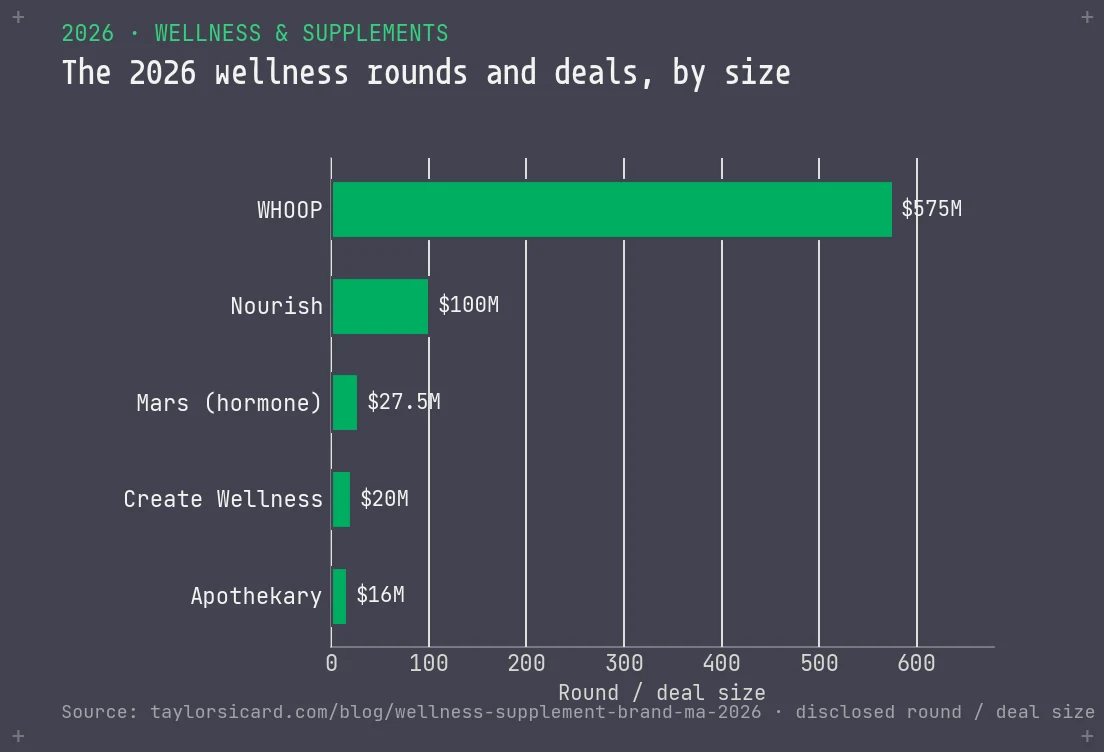
Two signals in that table are worth calling out. First, Unilever Ventures led a round in Supply6, an Indian supplement company, which is the strategic scouting future targets through its venture arm. When a corporate venture fund backs an emerging brand, it's building an option to acquire. Second, L Catterton, the sponsor that agreed to sell Thorne to P&G, also led the hormone brand Mars, which is how a platform sponsor keeps a pipeline of the next thing while it exits the last one.
The themes are as informative as the dollars. Peptides showed up twice (Protocole and Feel Peptides), gut health and women's health each drew institutional leads, and creatine went mainstream enough for a gummy brand to raise on a 320% jump. If you're operating a brand in one of these lanes, the venture money is validating your category and, indirectly, funding the competitors a strategic might buy instead of you. That's a reason to start building for durability now. Wellness is only one lane of a much wider flow, and the full consumer funding table tracks the rest of it, because the categories getting funded now are the ones getting bought two years out.
What makes a wellness
brand worth a premium
multiple.
Beyond the deal math, a buyer is asking a simpler question: is this a brand I'd want to own and run? Five things answer it, and they're the same five whether the buyer is a strategic, a sponsor, or an OTC specialist. A brand strong on all five draws a competitive process. A brand weak on two of them gets one interested buyer and a take-it-or-leave-it offer, no matter how good the last quarter looked.
One: replenishment you can prove. This is the category's foundation. A supplement is a habit, so the reorder rate and the subscription curve are the numbers a buyer trusts most. Show durable repeat behavior in the cohort data, not just a strong new-customer number, and you're telling a durability story a buyer will pay the double-digit EBITDA multiple for. A leaky subscriber base caps the multiple even when acquisition looks great.
Two: clean claims and regulatory hygiene. This is the supplement-specific lever, and it's the one founders underrate. Every product claim needs substantiation, every supplier needs documentation, and every piece of marketing copy needs to survive an FTC read. A buyer discounts a brand whose growth was bought with claims it can't defend, because that risk transfers at close. Running your own claims review before a buyer runs theirs is one of the highest-leverage things you can do.
Three: margin that survives scale. Healthy gross margin matters, but a buyer cares whether it holds when the brand moves from a contract manufacturer to a scaled supply chain, and whether it leans on one hero SKU. A margin that depends on a single supplier or a fragile freight arrangement is worth less than a slightly lower margin that's rock solid, the same way durable DTC contribution margin beats a flattering headline number.
Four: a category a strategic is actively chasing. Position matters more in wellness than almost anywhere, because the strategics are shopping by theme. Greens, peptides, gut health, hormone health, and women's health are hot lanes in 2026, funded by venture and hunted by acquirers. A brand that credibly owns one of those positions is a brand a strategic would rather buy than build. A me-too brand in a crowded lane, however well run, stays near the sector floor.
Five: financials that run without the founder. Founder dependency caps a lot of supplement multiples. A brand where the founder is the face of every claim, the closer on every retailer, and the final word on formulation is hard to value, because the buyer can see the asset walking out at close. Clean, accrual-based books, twelve-plus months of contribution margin by channel, and a team that runs the business are what let you keep your leverage in the data room. That visibility is the same financial stack a brand needs to run well in the first place.
Before you imagine your multiple, run the test a buyer will run. Is your reorder rate durable and visible in the cohort data, or does subscription churn quietly reset your base each year? Can every efficacy claim on your label and your ads survive an FTC read, with substantiation on file? Does your margin hold when you leave the contract manufacturer, and does it lean on one SKU? A brand that's clean on all three lives in the right tail. A brand shaky on claims or founder-bound is a sector-average brand with a good story, and the story doesn't survive the data room.
The runway to a
sellable wellness
brand.
If you intend to sell, the quarter before you go to market is the worst time to start engineering your multiple, because every shortcut shows up in the data room. The right runway is roughly 12 to 18 months, long enough for retention, clean claims, and a defensible financial story to look like the natural state of the business rather than a pre-sale dress-up. That work breaks into three phases below.
Why first: Replenishment is the whole premium in this category. Everything else is built on proof that customers come back, so the retention data comes first.
Why it matters: The claims-and-compliance line is the supplement-specific discount. Closing it before diligence is the difference between defending your number and watching it get reset.
The payoff: When the buyer's diligence matches the number you marketed, you keep your leverage, your price, and the buyer's trust. A defensible number negotiated from strength beats a soft one defended from the back foot.
Not every brand should be engineered for a sale, and a business built only to flip tends to be brittle. This runway builds a better company whether or not you ever sell: stronger retention, clean claims, durable margin, and a brand that runs without its founder. Run the 12 to 18 months and decide to keep operating anyway, and you've still ended up with a healthier, cash-generating brand.
There's a second payoff, separate from the multiple itself. A brand that's retention-strong, compliant, and clean can credibly run a process with strategics, OTC specialists, and sponsors all at the table, and that competitive tension moves a multiple. A brand attractive to only one type of buyer has no leverage. The work above lifts your number and widens the room, which is how a fair price becomes a premium one.
A wellness multiple traces back to a handful of things a buyer can actually underwrite: replenishment, clean claims, durable margin, a category thesis a strategic wants, and a business that runs without its founder. The billion-dollar 2026 deals, Grüns and Breathe Right, attached to brands that delivered on those, which is why they cleared double digits. The sector average near 10.7x EBITDA is where the healthy middle lives, and below it is where the claims-shaky, founder-bound, single-SKU brands end up no matter how good the product is. Knowing which part of that distribution you're building toward, and building for the buyer most likely to want you, is what decides the outcome. For the fuller picture of where 2026's exits landed, the running consumer brand exits tracker keeps score, and the parallel food and beverage DTC deal flow shows the same buyers hunting an adjacent shelf.
If you're building a wellness or supplement brand toward a sale and want to know what an acquirer will actually pay, and what's capping your multiple, that's the buy-side work I've run, applied to your brand before a buyer applies it to you. The DTC growth consultant exists for this kind of pre-deal work, and the profitability teardown is a good place to see how the real numbers tend to diverge from the deck.
Questions from founders
building toward a
wellness exit.
What multiple do supplement brands sell for in 2026?
The vitamins, minerals, and supplements sector averaged roughly 10.7x EV to EBITDA across 2024 to mid-2025, versus about 9.7x for consumer overall, per Capstone Partners. Disclosed category leaders cleared that: Prestige paid 11.0x EBITDA for Breathe Right, and Essity paid 12.1x EBITDA for Edgewell's feminine-care portfolio. Fast-growing brands get priced on revenue instead, closer to 4x or more, the way Unilever paid about $1.2B for Grüns. Steady, profitable brands sold to a financial sponsor land nearer 4x to 6x EBITDA.
Who is buying wellness and supplement brands right now?
Four camps. Consumer strategics building a wellbeing arm write the biggest checks, led by Unilever (Grüns, Nutrafol, Olly, SmartyPants, Liquid I.V.) and P&G (Wonderbelly). Consumer-health and OTC specialists like Prestige Consumer Healthcare and Haleon buy durable cash flow. Private equity platforms including L Catterton, Bansk Group, and Yellow Wood Partners roll up sub-scale brands. Adjacent public strategics and direct-sellers, from Essity to Laird Superfood to Zinzino, buy on category adjacency.
Why did Unilever buy Grüns and bid on Thorne?
Unilever is assembling a wellbeing platform and buying proven growth it cannot build organically. It paid about $1.2B for Grüns, a greens-gummy brand founded in 2023 with more than a million customers, and closed the deal on June 1, 2026. It was also one of the reported bidders for Thorne, which L Catterton put up for sale at up to $4B against roughly $650M of revenue, but on August 4, 2026 Thorne agreed to be acquired by P&G for $3.8B instead, pending close. Grüns joins Nutrafol, Olly, SmartyPants, and Liquid I.V. in the same portfolio.
Do supplements sell for higher multiples than other consumer brands?
Yes, on average. The vitamins and supplements sector cleared about 10.7x EV to EBITDA across 2024 to mid-2025, above the roughly 9.7x for the broader consumer industry, per Capstone Partners. The premium comes from replenishment: a supplement is consumed and rebought, so a healthy brand carries subscription and repeat revenue that a buyer can underwrite as durable. That sticky demand is worth more per dollar of profit than a one-time purchase category.
What makes a supplement brand acquirable at a premium?
Five things stack the multiple: replenishment and subscription retention, clean regulatory and claims hygiene (the supplement-specific diligence line), defensible gross margin, a category thesis a strategic is actively chasing (greens, peptides, gut health, hormone, women's health), and financials that run without the founder. A brand strong on all five draws a competitive process. Weakness on claims or founder dependency is the quiet cap, because a buyer prices the risk it inherits.
What would an acquirer actually pay for your wellness brand?
I've run buy-side diligence and quality-of-earnings work on consumer brands, and I've built brands sold into a nine-figure portfolio. If you're a year or two from a potential exit, I can tell you where your real multiple sits and what's quietly capping it, before a buyer does. The form takes two minutes.
Start a conversation More about Taylor →