Subscription churn is two things wearing one name. Passive churn is a failed payment the customer never chose. Active churn is a deliberate cancel. Same lost revenue, completely different causes and fixes, and you cannot fix churn you have not separated.
- Passive churn runs 20 to 40 percent of total subscription churn across the industry.
- Founders pour energy into win-back campaigns while a quieter, cheaper-to-solve problem drains the same revenue.
- Split the two first, put real numbers on each, then pull the levers in the order that recovers revenue.
When a founder tells me their subscription churn is too high, my first question is always the same: how much of it is passive. Most of the time they look at me blankly, because they have never split it. They have one churn number, they treat it as one problem, and they pour energy into win-back campaigns and exit surveys while a quieter, cheaper-to-solve problem drains the same revenue from a different hole.
Subscription churn is two things wearing one name. Passive churn, also called involuntary churn, is when a payment simply fails: an expired card, an insufficient balance, a bank decline. The customer did not decide to leave. The transaction just did not go through. Active churn is when a customer makes a deliberate choice to cancel. Same lost revenue, completely different causes, completely different fixes. And the split is bigger than most operators guess. Across the industry, passive churn runs 20 to 40 percent of total subscription churn (Finsi, Involuntary Churn, 2026), which means up to four of every ten customers you are "losing" never chose to go.
If you only take one idea from this piece, take this: you cannot fix churn you have not separated. Lumping the two together guarantees you spend your effort in the wrong place. So let us separate them properly, put real numbers on each, and pull the levers in the order that actually recovers revenue.
- Churn is two problems. Passive (failed payments) runs 20-40% of total subscription churn; active (deliberate cancels) is the rest (Finsi, 2026).
- Passive is the cheap win. The median brand recovers just 47.6% of failed payments, yet a real dunning program reaches 70-80% (Recurly via Slicker, 2025).
- Most brands fix the wrong one first. Active churn is loud, so it gets the budget; passive churn is silent, so it gets ignored.
- The math compounds. 8% monthly churn is 63% a year; annual billing cuts monthly churn 60-80% (Eightx, 2026).
- Split the number before you spend a dollar fixing it.
Two churns, one
name, two very
different fixes.
Start with the only number that matters here: roughly a third of your churn is mechanical, not emotional. Involuntary churn accounts for 20 to 40 percent of total subscription churn, and as much as half at low-priced brands (Eightx, Churn Benchmarks, 2026). Those are customers the billing system dropped, not customers who decided you were not worth it.
Picture two customers who both stopped paying you this month. The first one loves your product, uses it weekly, and would happily keep subscribing, but their card expired and the renewal silently failed. The second one decided your product was not worth it and clicked cancel. Your churn report counts them identically. Your response should not.
The first customer is a recovery problem. They want to stay; you just need to get a working payment through. That is mostly a systems job, and it is cheap to solve. The second customer is a value problem. They are gone for a reason, and getting them back means changing something about the product, the experience, or the price. That is expensive and slow.
Here is the part that surprises people. For a lot of subscription brands, passive churn is the single largest recoverable line in the business, and almost nobody is looking at it as a separate group. About 10 to 15 percent of recurring payments fail on the first attempt (Finsi, 2026), and a meaningful share of those are good customers you can win back with a working charge, not a discount.
Passive churn:
the leak you
can plug cheaply.
Passive churn comes from payment mechanics, not customer intent, and the median brand is terrible at recovering it. Across subscription businesses, the median failed-payment recovery rate is just 47.6 percent (Recurly via Slicker, 2025). For every hundred failed charges, the typical brand wins back fewer than half and writes off the rest as churn it never had to take.
The causes are boring and predictable, which is exactly why they are fixable. Cards expire on a schedule, and roughly a quarter of cards on file expire every year. Accounts run short on billing day. Banks decline charges for fraud flags, velocity limits, and cross-border rules that have nothing to do with your product. Expired cards alone drive 25 to 30 percent of failures, and insufficient funds another 20 to 25 percent (Finsi, 2026). Every one of these loses you a customer who wanted to keep paying.
| Dimension | Passive churn | Active churn |
|---|---|---|
Cause | Payment failed | Customer chose to leave |
Customer intent | Wants to stay | Decided to go |
Primary fix | Dunning, card updater, tokens | Product, value, experience |
Cost to solve | Low, mostly systems | High, mostly product |
Speed of payoff | Weeks | Quarters |
What makes passive churn the best opportunity in retention is the math. These customers already chose you. You are not persuading anyone, you are just getting the plumbing right. The return on a few weeks of dunning work routinely beats the return on a quarter of clever win-back campaigns, and it is the rare retention lever that does not depend on creative or discounting. It is also 5 to 7 times cheaper to save an existing subscriber than to acquire a new one (Slicker, 2025), and a recovered failed payment is the cheapest save you will ever make.
Dunning, done
right: the stack
that recovers cash.
Dunning is the process of recovering failed payments, and the gap between doing it badly and doing it well is enormous. Brands with no real dunning recover only 20 to 31 percent of failed payments. Basic retries plus a reminder email reach 45 to 55 percent. A smart, multi-channel program recovers 70 to 80 percent (Slicker, 2025). That spread is pure revenue, and it is yours to take.
Think of dunning as three layers, not one rejected charge and a goodbye. Get all three working together and you recover a large share of payments that would otherwise count as churn.
Layer one: prevention
The best failed payment is the one that never happens. Pre-dunning notices that warn a customer 7 to 14 days before a card expires recover 5 to 15 percent of would-be failures before they hit. Card updater services (Visa Account Updater, Mastercard ABU) silently refresh 15 to 25 percent of expiration-driven failures (Finsi, 2026). And network tokenization, which stores credentials as tokens that auto-update when a card reissues, lifts authorization rates by about 2.1 percent on Mastercard and up to 4.6 percent on Visa. Roughly half of Visa e-commerce volume is already tokenized, so this is table stakes, not an edge.
Layer two: smart retries
Not all declines are equal, so a single fixed retry schedule leaves money on the table. A payment that fails on the 28th often clears on the 1st once a paycheck lands. Network errors recover above 90 percent on a quick retry; hard declines should skip retries entirely and go straight to outreach. Decline-code-aware, payday-timed retry logic recovers 2 to 3 times more than a fixed schedule (Finsi, 2026). More retries are not better, though: hammer an issuer and you trip velocity limits and make recovery harder.
Layer three: communication
For the failures retries cannot clear on their own, the customer has to act, so make it effortless. A short, calm dunning sequence with a one-click update link does most of the work. Add SMS for higher-value customers, where open rates run 30 to 45 percent versus 15 to 20 percent for email (Finsi, 2026). Keep the update page mobile-first and frictionless. Every extra field costs you recoveries.
Put all three layers together and the payoff is fast: a comprehensive dunning program typically cuts involuntary churn 30 to 50 percent within the first quarter (Finsi, 2026). That is the highest-ROI retention work most brands are not doing.
If you have one churn number and no split, that is the first thing to fix, and it is usually a quick win. The form takes two minutes.
Active churn: the
harder, slower,
realer problem.
Active churn is the honest one, and no retry schedule fixes it. A customer weighed your product against its price and their need and chose to stop. The hardest part comes early: across nearly every DTC category, 60 to 70 percent of subscribers are lost between order one and order three, and 44 percent of all cancellations happen in the first 90 days (SUBTA and Recharge via Eightx, 2026). The third order is where someone decides whether your subscription has earned a place in their life.
The levers here are slower and they live in the product, not the billing system. Did the customer get to a result fast enough. Is the cadence right, or are you shipping them more than they can use. Is the price aligned with the value they feel. Active churn responds to making the subscription genuinely worth keeping, and that is real work that compounds slowly. It is also where the intervention timing matters most: proactive outreach 30 to 45 days before a likely churn event saves 3.4 times more subscribers than a save attempt at the cancel page (McKinsey via Recharge and Eightx, 2026). By the time they reach the cancel button, you have mostly already lost.
This is also where the gap between good and average brands lives. The spread between top-quartile and bottom-quartile net revenue retention has widened to 34 percentage points, and the differentiator is not product quality or price. It is the sophistication of the lifecycle and retention machinery running underneath (Recharge, State of Subscription Commerce, 2025).
"You cannot fix churn you have not separated. Lump passive and active together and you guarantee you will spend your effort on the expensive problem while the cheap one keeps bleeding."
Give them a
smaller exit
than the door.
Most would-be cancels are not "I am done forever," they are "I have too much of this right now," and the data backs it up. Among subscribers making a change, 39 percent choose to skip an order rather than cancel, and 38 percent of consumers say they would rather pause than quit outright (Recharge, State of Subscription Commerce, 2025). If the only button you offer is cancel, that is the button they press.
The brands that win build the cancel flow as a product surface, not an afterthought. Offer skip, pause, swap a product, change cadence, or drop to a smaller plan before the final cancel. The demand is real and growing: pause usage is up 337 percent year over year among merchants who offer it (Recharge, 2025). A paused subscriber is a quiet return waiting to happen. A cancelled one is a full customer-acquisition cost to win back.
Done well, the intercept is one of the highest-leverage surfaces you own. Recharge's cancellation-prevention flow has been credited with a 44 percent reduction in churn, and Stay AI claims about 28 percent through similar intercepts (Eightx, 2026). The trick is segmentation: a one-purchase tourist needs a different offer than a loyal six-month subscriber whose card just expired. Sending both the same 20-percent-off email wastes margin on one and insults the other.
Offer the exit ramp before the exit. A customer overwhelmed by product they have not used does not want to cancel, they want to slow down. Give them skip, pause, swap, and cadence changes, and a large share of would-be active churn turns into a pause and a later return. Reserve discounts for the segments that actually need them, and never make pausing harder than cancelling.
What good looks
like, and what
churn does to LTV.
Before you judge your own number, know your category, because monthly churn varies roughly threefold across the subscription map. Replenishment categories like consumables and pet sit at 5 to 8 percent, while curation boxes like beauty and apparel run 10 to 15 percent, with a cross-category average around 5.3 percent (Eightx, Churn Benchmarks, 2026). Replenishment churns less because the value is habitual. Curation churns more because it depends on novelty, and novelty fades.
| Category | Monthly churn | Why it lands there |
|---|---|---|
Consumables, household | 5-8% | Habitual repurchase, lowest variance |
Supplements | 5-8% / 0.5-1.5% annual | Habit-forming, annual plans lock in |
Pet food and treats | 6-10% | Replenishment necessity |
Coffee, beverage | 5-12% | Skip-a-month flexibility lifts retention |
Beauty boxes | 8-14% | Curation dependent, novelty fatigue |
Meal kits, apparel | 8-15% | Subscription fatigue, decision overhead |
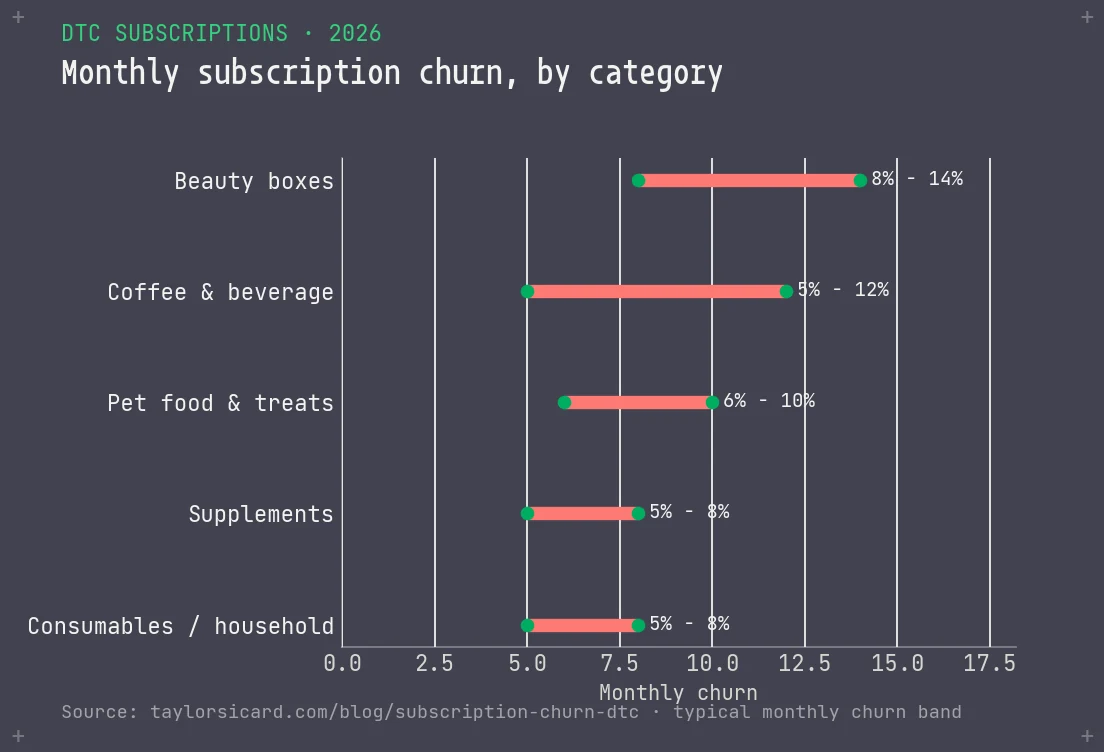
Now the part that should keep you up at night. Churn compounds, and the curve is not linear. A 5 percent monthly churn rate compounds to about 46 percent a year; 8 percent compounds to 63 percent (Eightx, 2026). That three-point gap is enormous over a year, which is why the single highest-leverage retention move is converting customers to annual billing. Annual plans churn 0.5 to 1.5 percent monthly versus 5 to 8 percent on monthly billing, a 60 to 80 percent cut, because annual eliminates eleven of twelve cancellation decisions and eleven of twelve chances for a payment to fail.
Passive churn poisons your LTV math in a specific, dangerous way. The lower your price, the bigger the leak: Stripe's data shows products under $10 AOV lose about 14 percent to failed payments, versus roughly 4 percent above $1,000 (Stripe via Eightx, 2026). If you have not separated passive from active, your churn rate is inflated by recoverable failures, and your lifetime value is quietly understated. You end up capping acquisition spend against a number that is partly fixable plumbing, a trap I dig into in the LTV math most brands get wrong and the broader CAC payback by vertical.
Why most brands
fix exactly the
wrong one first.
Active churn is loud. The customer clicks cancel, maybe fills out a survey, sometimes emails you. It feels like the problem because it is visible and emotional. So brands pour their energy into win-back flows, cancellation offers, and exit surveys, chasing the customers who already decided to leave.
Passive churn is silent. Nobody clicks anything. A charge fails at two in the morning and the customer never even knows, and neither does the founder unless they are looking. So the cheaper, more recoverable problem gets ignored precisely because it does not make noise. Brands optimize the hard problem and neglect the easy one, which is exactly backwards.
The right order is almost always passive first. Plug the involuntary leak, recover the customers who never meant to go, and you buy back revenue fast and cheap. Then turn to the harder active-churn work with a clearer picture of what your real, intent-driven churn actually is. Most brands cannot even tell you their split, because their billing system buckets every lost subscriber together. If your subscription team cannot show you passive versus active this week, that is the first place to look.
The tell I look for first
When I audit a subscription brand, I ask for two numbers: failed-payment recovery rate and the share of cancels that came through a save flow. When the response is a shrug, I already know where the money is. A brand recovering below the 47.6 percent median is leaving real revenue on the table before we touch the product at all.
The tooling, and
the cancel law
that just shifted.
You do not need to build any of this from scratch, because the ecosystem is mature. On Shopify, the subscription layer itself is usually Recharge, Smartrr, Stay AI, or Loop, and each now ships cancellation-prevention flows, skip and pause, and dunning out of the box. For recovery specifically, dedicated tools like Churnkey, Butter, and Stripe's smart retries push recovery well past the median. The lift is real: brands pairing an external recovery tool with Recharge recover 55 to 65 percent of failed payments versus around 28 percent on built-in dunning alone (Eightx, 2026).
Pick tools by the job, not the logo. The subscription-management platform owns billing, cadence, and the cancel flow. A specialist dunning tool owns recovery. A specialist cancel-flow tool owns the save intercept. Plenty of brands run one platform for all three and leave money on the table at each layer, because a generalist rarely beats a specialist on recovery rate or save rate. Match this to your retention flows in Klaviyo so the dunning emails and lifecycle messaging speak with one voice.
The click-to-cancel rule changed in 2025
If you have been designing around the FTC's click-to-cancel rule, the ground moved. In July 2025 the Eighth Circuit vacated the rule on a procedural failure, so there is no nationwide click-to-cancel rule in force today (Cooley, Eighth Circuit Vacates Negative Option Rule, 2025). That is not a license to make cancelling hard.
The FTC still pursues deceptive cancellation practices under ROSCA and Section 5, restarted rulemaking in January 2026, and several states (California among them) keep their own easy-cancel laws on the books (Holland & Knight, 2025). My operator take is simpler than the legal one: a dark-pattern cancel flow buys you a few weeks of retained revenue and a customer who will never return, leave a good review, or recommend you. Make cancelling easy, and put your effort into the save offer and the pause option instead. That is the version that survives both the regulator and the next renewal.
The real levers,
in the order I
would pull them.
Start by separating your churn into passive and active. You cannot manage what you have not measured, and this single split changes where you spend every retention dollar. Pull both numbers, by acquisition channel and billing interval, and report them weekly. The discipline of looking at the cohort table is rarer than the math, which is straightforward. If you have not built this reporting yet, the starting point is the same place as your LTV cohort model: same data, different lens. You can also put your repeat rate and retention through the LTV math in about a minute.
Then attack passive churn with dunning: prevention (pre-dunning, card updater, network tokens), smart decline-code-aware retries timed to paydays, and a clean multi-channel sequence to update payment details. This is the fastest, cheapest revenue recovery available to a subscription brand, and it should be running before you touch anything else. Aim for the 70 to 80 percent recovery band, not the 47.6 percent median.
With the leak plugged, move to active churn. Make the subscription worth keeping. Get customers to value faster, get the cadence right, and build the cancel flow as a real save surface with skip, pause, swap, and cadence changes before the final exit. Intervene 30 to 45 days early, not at the cancel page. A lot of that lives in your email and SMS flows, which is why your retention flows are part of the churn fight, not separate from it. It also connects directly to your CAC payback math: every point of churn you recover extends the effective payback window on every acquisition dollar you spent.
One last operator note. Watch the two numbers separately forever, not just once. Passive churn creeps back the moment your dunning logic goes stale or your card-updater coverage slips. Active churn moves when your product or your competitive position moves. Two different dashboards, two different owners, two different cadences. The brands that win subscription do not have a lower churn number by luck. They have two churn numbers, they know which one each fix touches, and they never confuse the leak they can plug with the value they have to earn. This is one of the binding constraints at the $5M to $10M DTC inflection, where subscription economics become a make-or-break factor in whether the business compounds or stalls.
Split your churn before you spend another dollar trying to fix it. If you want help separating the two and pulling the levers in order, start with the LTV math, your retention flows, and the benchmark card to see where your churn rate sits against category medians. Then tell me where your subscription is leaking.
Passive churn, also called involuntary churn, is when a payment fails: an expired card, insufficient funds, a bank decline. The customer never chose to leave. Active churn is a deliberate cancel. Passive churn runs 20 to 40 percent of total subscription churn, and it is far cheaper to recover because those customers still want your product.
Involuntary churn runs 20 to 40 percent of total churn, and as high as 50 percent for low-priced products. Stripe billing data shows products under $10 AOV lose about 14 percent to failed payments versus roughly 4 percent above $1,000. The lower your price point, the bigger your passive-churn leak tends to be.
The median brand recovers only 47.6 percent of failed payments, per Recurly's benchmark study. Brands with no real dunning recover 20 to 31 percent. Basic retries plus email reach 45 to 55 percent. A smart, multi-channel dunning program recovers 70 to 80 percent, which is the band to aim for.
Fix passive first. It is the cheapest, fastest revenue in retention because those customers already wanted to stay, and a dunning program can cut involuntary churn 30 to 50 percent in a quarter. Active churn is slower product, pricing, and experience work, so tackle it once the involuntary leak is plugged.
The federal click-to-cancel rule was vacated by the Eighth Circuit in July 2025, so there is no nationwide rule in force. The FTC still enforces deceptive cancellation under ROSCA and Section 5, restarted rulemaking in January 2026, and several states impose their own easy-cancel laws. Design easy cancellation anyway: dark patterns cost more than they save.
Fix the churn you can actually win.
I help subscription brands separate the churn they can recover from the churn they have to earn back. Co-founded WIN Brands Group with subscription lines, sold getuptime.co to Tiny. I have watched dunning quietly outperform a quarter of retention campaigns.
Start a conversation How I work with DTC brands →