Food and beverage brands trade at a discount to beauty and most premium consumer categories. The sector benchmark sat near 3.1x enterprise value to sales and about 14.7x EV to EBITDA entering 2026, per Investec, and EBITDA multiples compressed toward 10 to 11x through 2025. The 2026 deals bear that out: Smithfield paid 2.9x sales for Nathan's Famous, Marzetti paid about 4.6x for Bachan's, and Danone paid roughly 3.4x sales for Huel.
- Food majors (Danone, Nestle, Lactalis, Ferrero) and beverage majors (Gallo, Constellation, Molson Coors) are the biggest buyers; PE platforms roll up the smaller end.
- Protein, functional beverages, and better-for-you snacks are where both the acquisitions and the venture money concentrated.
- A single-digit-to-low-teens EBITDA multiple is the base case; revenue multiples only attach to fast-growing, high-velocity brands.
Every food and beverage founder I talk to has one of two numbers stuck in their head, and they're wildly far apart. One group read that Danone paid over a billion dollars for Huel and Smithfield paid $450M for Nathan's Famous, and they've decided the category is printing money. The other group watched a friend sell a real, profitable snack brand for a low single-digit multiple of EBITDA and walk away underwhelmed. Both numbers are real, and they belong to different brands.
The gap between those two experiences comes down to one structural fact: food and beverage trades at a discount to beauty and most premium consumer categories, because gross margin sets the ceiling on the multiple long before growth or brand story enter the conversation. The sector benchmark sat near 3.1x enterprise value to sales and roughly 14.7x EV to EBITDA entering Q1 2026, per Investec's food and beverage valuation work. EBITDA multiples had already compressed toward 10 to 11x through 2025 as cost pressure and softer volumes bit, per Baker Tilly's coverage of the category. Every 2026 deal below sits on top of that anchor.
My own read on this category comes from having priced it from both chairs at WIN Brands Group: building consumer brands, then buying them and running the quality-of-earnings work that takes a founder's reported numbers apart line by line. Food and beverage punishes that process more than any category I've worked in, because the co-packer contracts, the trade-spend accruals, and the working capital are usually where a clean-looking deck starts to unravel.
This page covers every named 2026 food and beverage acquisition worth knowing, the three camps of buyer writing the checks, and the revenue and EBITDA multiples that get applied. It also tracks where venture money is flowing ahead of the next wave of deals, and what separates a brand that clears the sector average from one that gets repriced down. New deals get folded in as they close; the figures below hold through July 2026.
A caveat on the numbers themselves. Food and beverage deals rarely disclose enterprise value and revenue timing cleanly, so a number of the multiples here are approximations built from reported deal values and trailing sales, marked as reported wherever the source is trade press rather than a filing. Use them to read the market; a banker will price your brand off your actual numbers.
The multiple food and
beverage brands
actually sell for.
Food and beverage brands sold for a median of roughly 10 to 11x EBITDA through 2025, down from the low-to-mid teens a couple of years earlier, per Baker Tilly. The EV to sales benchmark was near 3.1x, per Investec's Q1 2026 update. That's the anchor, but it hides a wide spread. Branded, scaled assets still clear 12 to 16x EBITDA when a strategic wants them. Sub-scale and commodity-adjacent brands change hands at 6 to 10x, and distressed assets go for less than a single turn of revenue.
Look at the 2026 deals with disclosed math and the pattern holds. Smithfield paid $450M for Nathan's Famous at $102 a share, an implied 2.9x sales and about 12x EBITDA, per the company's filing. Marzetti paid $400M for Bachan's on roughly $87M of trailing net sales, an implied 4.6x sales, a rich number that reflects how fast Bachan's was growing. Danone paid about $1.15B for Huel on £214M of FY24 revenue, an implied 3.4x sales. B&G Foods bought the College Inn and Kitchen Basics broths for $110M at a reported 5.5x adjusted EBITDA. The four numbers differ widely, and each maps to how fast the brand was growing and how much profit it threw off.
The range exists because food and beverage isn't one category. A fast-growing functional-beverage brand and a steady pantry-staple brand live in different valuation universes at the same revenue. RTD and better-for-you brands with real velocity get a growth conversation, while mature, low-growth grocery brands get a cash-flow conversation. Both are legitimate and produce very different checks, and anchoring on the wrong one is how founder expectations get set up to fail.
The category also sits structurally below beauty. Beauty brands cleared roughly 3.6x revenue on average from 2022 to 2025, and the breakout names went far higher, because a 65 to 75% gross margin funds the marketing engine a buyer is really paying for. Food and beverage runs a much thinner gross margin, often 25 to 45%, so every dollar of revenue converts to far less profit and commands far less per dollar at exit. I broke down why the beauty category clears a richer multiple in a separate piece, and the reason is the same one driving this page: margin sets the multiple, and food margin runs thin by comparison.
"Food and beverage isn't one category. A functional-drink brand and a pantry-staple brand get different checks at the same revenue, and picking the wrong anchor is how a sale goes sideways."
The 2026 food and
beverage deal
board.
The 2026 deal calendar has been busy, with strategics doing most of the buying and a handful of large disclosed prices setting the reference points. The table lists the named deals worth knowing, with the buyer, the price, and the implied multiple where it's calculable. Amounts come from company filings and releases where disclosed, and are labeled reported where the figure traces to trade press rather than an official disclosure. Three deals since the July pass sit at the top of the table. Intersnack agreed to take Utz Brands private for $2.9B on July 21. On August 14, Saputo agreed to sell its entire UK dairy operation to Lactalis at a GBP 988M enterprise value, about 0.8x trailing revenue. And on September 1 Keurig Dr Pepper sold its full equity stake in Chobani back to the company for $800M, with Chobani also taking KDP's Allentown plant for about $125M. Two figures are in circulation on that last one: $800M is the stake alone, $925M is stake plus plant. The full ledger is the consumer brand exits tracker.
| Brand | Buyer | Price | Multiple |
|---|---|---|---|
Chobani (KDP equity stake) plus KDP's Allentown, PA plant Stake buyback plus asset purchase · from Keurig Dr Pepper · Sep 2026 | Chobani | $800M stake + ~$125M plant (~$925M combined proceeds to KDP) | n/a |
Saputo UK dairy operation Cathedral City, Wensleydale, Davidstow, Clover, Country Life · Aug 2026 | B.S.A. SAS (Lactalis) | GBP 988M EV (about C$1.86B) | ~0.8x trailing revenue |
Utz Brands (UTZ) Snacks · take-private, ~91% premium · Jul 2026 | Intersnack Group | $2.9B ($14.25/share) | n/a |
Huel Meal replacement · Mar 2026 | Danone | ~$1.15B (EUR 1B) | ~3.4x FY24 sales |
Four Roses Bourbon · from Kirin · Feb 2026 | E&J Gallo | Up to $775M (incl. $50M earn-out) | n/a |
Nathan's Famous Hot dogs / licensing · Jan 2026 | Smithfield Foods | $450M ($102/share) | 2.9x sales / ~12x EBITDA |
Bachan's Japanese BBQ sauce · Feb 2026 | The Marzetti Company | $400M | ~4.6x sales (~$87M TTM) |
The Finnish Long Drink RTD · Apr 2026 | Mark Anthony Group | $325M | n/a |
Made Group High-protein / coconut · Jun 2026 | Danone | Undisclosed (reported ~$1.4B) | on EUR 300M+ sales |
Plasmon Italia Baby food · from Kraft Heinz · Jan 2026 | Princes Group | $145M | n/a |
Hain N.A. snacks (Terra, Garden of Eatin') Divestiture · Feb 2026 | Snackruptors | $115M | 0.34x revenue (~$343M) |
College Inn + Kitchen Basics Broth · from Del Monte · Jan 2026 | B&G Foods | $110M | 5.5x adj EBITDA (reported) |
Terrasoul Superfoods Superfoods · Apr 2026 | Laird Superfood | $48M + $5M earnout | on ~$66M net sales |
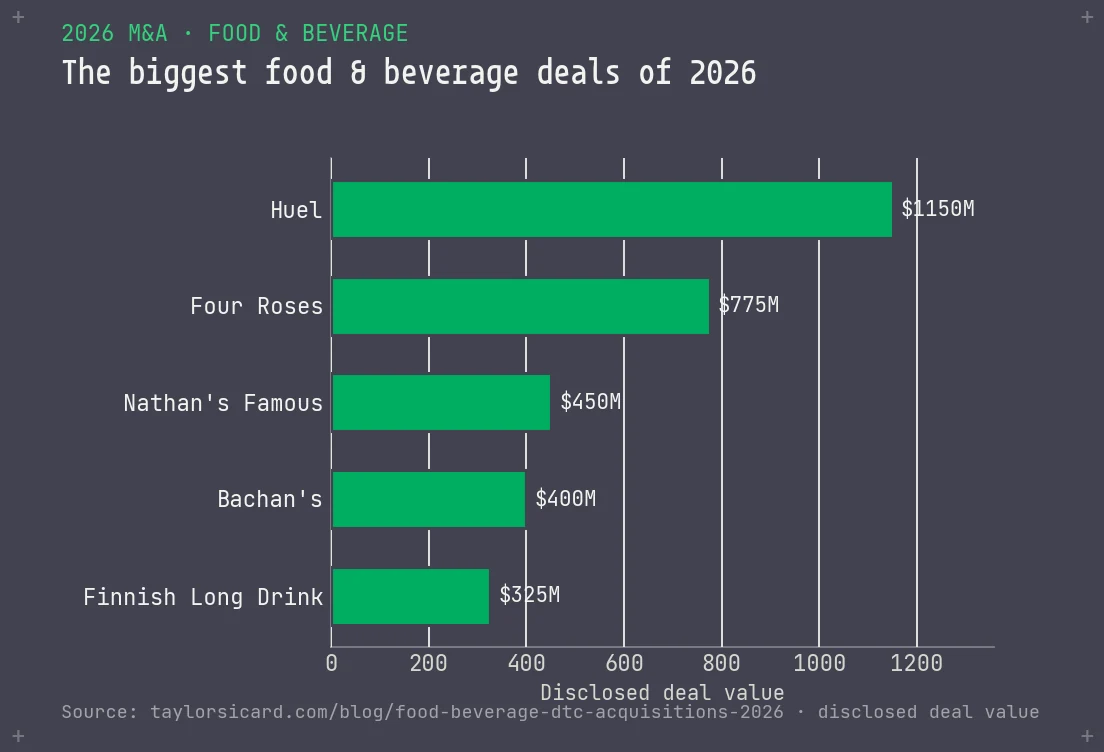
A few of these deserve a sentence on their own. Danone's $1.15B move for Huel was the category's marquee DTC deal of the year, and the logic was explicit. Huel runs a 59% gross margin across roughly 25,000 retail doors, but its 8.5% EBITDA margin sits well below Danone's, per reporting on the deal. Danone is buying a high-gross-margin brand with a DTC engine and a credible path to a mid-teens EBITDA margin over three to five years. That's a strategic paying ahead of current profit for growth and capability it can't build fast enough itself.
Danone kept going. In June it agreed to acquire Australia's Made Group, best known for Cocobella coconut water and Rokeby protein smoothies, adding a business with more than EUR 300M in annual sales to push high-protein and gut-health products across Asia-Pacific, per Danone's newsroom. Nestle, meanwhile, moved the other way on some assets, taking full ownership of German meal-replacement brand yfood while exploring a sale of its roughly $1.3B ice-cream business. When the majors trim in one place to buy in another, that reshuffling is exactly what reopens the window for sellers, the same dynamic running through the broader consumer M&A market in 2026.
The spirits and RTD shelf consolidated hard. E&J Gallo bought Four Roses bourbon back from Japan's Kirin for up to $775M including a $50M earn-out, returning an iconic distillery to US ownership after 83 years, per Gallo. Mark Anthony Group paid $325M for The Finnish Long Drink, Molson Coors picked up Monaco Cocktails through Atomic Brands, Bacardi bought out the rest of Teeling Whiskey, and Constellation took full control of non-alcoholic HOPWTR. The biggest beverage owners are buying growth and format optionality, from craft spirits to zero-proof, instead of building it. I keep that shelf on its own board, because functional and non-alcoholic beverage deals in 2026 are moving faster than anything else in consumer.
The three camps
buying food and
beverage brands.
Three types of buyer wrote checks for food and beverage brands in 2026, and which one calls determines your multiple more than your growth chart does. Food and beverage majors pay the biggest prices for proven, on-trend assets. Beverage and spirits majors buy for shelf reach and format coverage. Private-equity platforms take the smaller end and price off cash flow rather than story. Which camp you're built for decides which process you should run and which number to expect walking in, and the same three-camp split governs pet and petcare brand M&A in 2026 too.
The first camp is the global food majors: Danone, Nestle, Lactalis, Ferrero, Bel, and packaged-food strategics like Smithfield, Marzetti, and B&G Foods. They buy brands that fill a portfolio gap or ride a trend they're behind on, and in 2026 that trend was overwhelmingly protein and functional nutrition. Danone bought Huel and Made Group, Lactalis bought UK sports-nutrition brand Protein Works, Ferrero grabbed Brazilian protein-snack maker Bold Snacks, and Bel picked up functional fruit-snack brand Brainiac. A major that needs your position and can run your brand through its distribution will pay above what a spreadsheet alone justifies.
The second camp is the beverage and spirits majors, and they were the most acquisitive of all in 2026. E&J Gallo, Constellation Brands, Molson Coors, Bacardi, Sazerac, and Mark Anthony spent the year consolidating RTD cocktails, craft spirits, and non-alcoholic formats. This camp buys distribution reach and format coverage: a big beverage owner would rather buy a fast-moving RTD or zero-proof brand than lose a decade trying to build relevance in a format that's already selling. If you're building a beverage brand with real velocity, this is often your most motivated buyer.
The third camp is private equity and platform aggregators: L Catterton, Bansk Group, Trek One Capital, ACON Investments, Highlander Partners, and the roll-up platforms. They're active mostly at the smaller end, assembling portfolios of sub-scale brands and centralizing the unglamorous functions. L Catterton took a majority of cottage-cheese maker Good Culture, Bansk took wellness-shot brand So Good So You, Trek One bought Good Karma and No Cow on the same day, and ACON took control of organic-candy maker YumEarth. This camp underwrites to EBITDA and free cash flow, which usually means a lower revenue multiple than a strategic would pay for the identical brand.
| Buyer camp | Who they are | What they pay |
|---|---|---|
Global food majors Buying trend and portfolio gaps | Danone, Nestle, Lactalis, Ferrero, Bel, Smithfield, Marzetti | Big checks for scaled, on-trend brands |
Beverage & spirits majors Consolidating RTD, spirits, zero-proof | E&J Gallo, Constellation, Molson Coors, Bacardi, Mark Anthony | Pay up for velocity and format reach |
PE & platform aggregators Rolling up sub-scale brands | L Catterton, Bansk, Trek One, ACON, Highlander | Lower multiple, EBITDA-anchored |
For a founder, that argues for building toward one camp on purpose rather than trying to appeal broadly. A brand engineered for a food major needs a defensible position in a category the major is behind on. One built for a beverage major needs velocity and a format a big owner covets, and one aimed at a PE platform needs clean, durable cash flow more than a growth story. Trying to appeal to all three usually leaves no camp strongly interested, a pattern that also shows up in how consolidation is playing out in the home category and beyond.
Why the strategics
are buying protein
and function.
Strategics are buying for one reason above all in 2026: they're behind on protein, functional nutrition, and better-for-you formats, and it's faster to buy proven demand than to build it. Danone's Huel and Made deals, Nestle's yfood buyout, Lactalis buying Protein Works, and Ferrero buying Bold Snacks are all the same move: a legacy owner acquiring a position in a high-growth, on-trend category it couldn't manufacture organically fast enough.
Look at what each major is actually solving. Danone is repositioning around functional and protein-forward nutrition, so it paid up for Huel's DTC-native, high-gross-margin meal-replacement business and Made Group's high-protein RTD and gut-health lineup. Its own framing on Huel was explicit: the high gross margin gives a credible path to a mid-teens EBITDA margin, and the DTC experience was a capability Danone wanted in-house. The revenue was only part of the thesis. Danone was buying a growth engine and a channel it didn't already have.
The DTC-capability angle changes who buys food and beverage brands. Legacy food companies grew up in wholesale and retail, so a brand that has cracked direct-to-consumer subscription, retention, and first-party data brings something the major lacks. A food or beverage brand with real DTC economics, the kind built on disciplined contribution margin math, is more valuable to a wholesale-native acquirer precisely because it's the piece they can't easily replicate.
There's a timing lesson here too. Strategics buy in waves, driven by where their portfolio is weak and what their last earnings call promised. When Nestle signals it's shedding a $1.3B ice-cream business to focus on coffee, pet care, and nutrition, it is also freeing up capital to chase the categories it actually wants. Reading those signals tells you when your category's window is open, and a process run into a hungry strategic clears a meaningfully higher number than the same brand sold into a quiet stretch. Those signals show up on the tape first, which is why I keep a running tracker of public-company earnings for consumer brands.
Revenue multiple or
EBITDA multiple: which
you actually get.
Food and beverage brands get valued two ways, and which one a buyer reaches for tells you how they see you. High-velocity, fast-growing brands can command a revenue multiple, roughly 3 to 5x sales and occasionally higher. Everyone else lands in an EBITDA conversation instead, running 12 to 16x for a scaled, on-trend brand a strategic covets, or 6 to 10x for a steady, profitable, more commodity-like business. The weakest and distressed assets get repriced below a single turn of revenue.
The revenue-multiple conversation belongs to brands where the buyer is paying for future revenue, not current profit. Bachan's landed in that zone. Marzetti's $400M on about $87M of sales works out to 4.6x, a number that only makes sense against a steep growth curve and a category the buyer wanted to own. Huel's 3.4x sat in the same zone, carried by a high gross margin and a DTC engine. This is the momentum conversation, and it produces the headline numbers, but it only applies if your growth and margin justify paying ahead of the cash flow.
The EBITDA conversation belongs to the steady, profitable middle, which is where most food and beverage brands actually live. Nathan's Famous sold at about 12x EBITDA because it's an iconic, durable brand with a licensing model Smithfield already knew intimately. College Inn's broths went at a reported 5.5x adjusted EBITDA, a mature-grocery number. The same brand can look very different depending on whether the buyer applies an on-trend strategic multiple or a generic packaged-food one, which is another reason the buyer's identity matters as much as the P&L.
| Brand profile | Likely basis | Rough range |
|---|---|---|
High-velocity, fast-growing, scarce Steep curve, category a buyer wants | Revenue | 3–5x+ revenue |
Scaled, profitable, on-trend Strategic covets the position | EBITDA | 12–16x EBITDA |
Steady, profitable, commodity-ish Reliable cash, modest growth | EBITDA | 6–10x EBITDA |
Unprofitable / distressed Divestiture or fire sale | Distressed | <1x revenue |
This is the trap I watch founders fall into. A brand doing $30M at a 10% EBITDA margin dreams of 4x revenue, which pencils to $120M. But if growth has cooled and a PE platform is the realistic buyer, the conversation is 7 to 9x EBITDA on $3M of profit, which is $21M to $27M. The gap between those two numbers is enormous, and it comes entirely from which multiple gets applied. In food and beverage, where margins are thin, the EBITDA conversation is the base case for most brands, so real profit is what you're building toward, more than raw sales. The EBITDA line that makes a brand sellable is the number that decides the outcome.
What actually moves a
food and beverage
multiple.
A food and beverage multiple is a proxy for four things a buyer can underwrite: growth rate, gross margin, retail velocity, and how much of the business survives diligence. Deliver strongly on all four and you're in the revenue-multiple conversation. Miss two and you're a below-average EBITDA case no matter how good the product tastes.
The first is growth rate, and in food and beverage it moves the number more than anything. A brand growing 40% gets a very different conversation than one growing 5%, because a buyer is paying for the trajectory, not for what already happened. Bachan's earned its 4.6x by being one of the fastest-growing sauce brands in the country. The growth has to be real and repeatable, though, not bought with deep trade spend and promotion, because a buyer rebuilds your growth net of the discounting and prices the fragile version down.
The second is gross margin, which sets the ceiling on everything. Food and beverage runs thin, often 25 to 45%, so every point of durable gross margin matters more here than almost anywhere. Huel's near-60% gross margin is exactly why Danone could pay a revenue multiple and still see a path to a healthy EBITDA margin. A brand carrying a fragile margin, propped up by a single co-packer, a favorable freight arrangement, or optimistic slotting assumptions, gets that margin normalized down in diligence. The same discipline that governs category-specific unit economics is what a buyer stress-tests first.
The third is retail velocity and distribution quality. In food and beverage, the number a buyer trusts most is velocity: units per store per week. A brand that turns fast on shelf and holds its retail placements is proving durable demand, which is worth more than raw revenue that leans on a handful of accounts. Concentration is the flip side. A brand where one retailer or one club channel holds the whole P&L hostage carries a discount, because the buyer is pricing the risk that the account walks. Diversified, high-velocity distribution gets the high end of the range.
The fourth is what survives the data room. This is where food and beverage brands lose the most value, because the category has heavy working capital, trade-spend accounting that's easy to get wrong, and co-manufacturing arrangements that can hide risk. Clean, accrual-based books, honest trade-spend accruals, and funded working capital protect your multiple. A surprise in diligence costs you more than the specific problem: it makes the buyer question everything else and reprices the whole deal. Running your own quality-of-earnings review before a buyer runs theirs is the single highest-return pre-sale move. The accruals and the co-man contracts that decide the outcome, though, get fixed in the operating year before that review, not during it.
Run the four-lever test honestly before you imagine a multiple. Is your growth above 30% and real, or is it high single digits propped up by trade spend? Is your gross margin durable, or does it lean on one co-packer and a favorable freight lane? Does your product turn fast on shelf across diversified accounts, or does one retailer hold the P&L? And would your books survive a buyer's quality-of-earnings review today? A brand strong on all four is in the revenue conversation. A brand weak on two is a below-average EBITDA case with a good story, and the story doesn't survive the data room.
If a sale is on a two-year horizon, the four-lever test is worth running now. I help food and beverage founders run it on their own books, and fix trade-spend accruals and working capital before a buyer's diligence finds them.
Where the venture
money is flowing in
2026.
The funding side is the leading indicator for the next wave of acquisitions, and in 2026 the money concentrated in exactly the categories the strategics were buying: protein, functional beverages, and better-for-you snacks. Follow the venture checks and you can watch the acquisition pipeline forming a couple of years early.
Functional and better-for-you beverages drew the biggest rounds. OLIPOP, the prebiotic-soda leader that reached a $1.85B valuation in its early-2025 Series C and surpassed $400M in annual sales, per CNBC, reportedly raised fresh capital in 2026 after passing on acquisition interest from Coca-Cola and Red Bull. The Ryl Company raised a $20M Series C for RTD tea, and a wave of smaller functional-drink brands, from Neutonic to Throne Sport Coffee to Just Ice Tea, took growth capital. When a category is both consolidating at the top and raising aggressively underneath, that's a category with real momentum.
Protein and better-for-you food was the other magnet. Brami raised a $33M Series B for high-protein lupini pasta, Mosh raised $13M for brain-health protein bars, and Khloe Kardashian's Khloud raised $15M for protein popcorn. Evergreen Waffles, Maxine's Heavenly, and Jesse & Ben's all took rounds for better-for-you takes on familiar formats. And Nutrabolt, maker of C4 Energy, tapped JPMorgan, Goldman Sachs, and Bank of America for a US IPO that could raise up to $1B on a roughly $1B revenue run rate, per Reuters, a reminder that the biggest functional-nutrition brands now have a public exit path too.
| Brand | Round | Category |
|---|---|---|
OLIPOP $1.85B valuation ('25), 2026 raise reported | Series C+ | Functional soda |
Nutrabolt (C4 Energy) IPO up to $1B; ~$1B revenue run rate | IPO prep | Energy / sports nutrition |
Brami VMG Partners led | $33M Series B | High-protein pasta |
The Ryl Company Purchase Capital led | $20M Series C | RTD tea |
Evergreen Waffles Melitas Ventures, Terpsi Capital | $15.2M Series A | Better-for-you frozen |
Khloud Founded by Khloe Kardashian | $15M | Protein popcorn |
Mosh Main Street Advisors led | $13M Series A | Protein bars |
Neutonic $60M valuation | $6M growth | Nootropic drink |
For an operator, the funding map is a heat map of buyer intent. The categories raising the most today are the ones the strategics will be shopping in 18 to 36 months, because venture-funded growth is what creates the scaled, on-trend targets a major eventually wants. If you're building in protein or functional beverage, you're in a hot lane. If you're in a category the venture money has left, plan for a patient, EBITDA-led process rather than a competitive auction. That pattern holds across every consumer category, food and beverage included, and the board of named consumer raises tracks it as it happens.
The low end, distress,
and what a weak
brand fetches.
The low end of the 2026 market shows what a weak or sub-scale food or beverage brand actually fetches, and it's sobering. Hain Celestial sold its North American snacks business, including Terra chips and Garden of Eatin', to Snackruptors for $115M on roughly $343M of sales, an implied 0.34x revenue, because the unit carried negligible EBITDA and Hain was simplifying a struggling portfolio, per the company's filing.
That sub-1x-revenue outcome is what happens when a brand is scaled but unprofitable, or when a corporate seller needs to shed a non-core unit to fix its balance sheet. It's a divestiture, and a real part of the market. Several 2026 deals were out-of-bankruptcy or distressed sales at the smaller end, from Kombucha Town's bankruptcy sale to a string of quiet asset deals that never generated a press release. The floor under food and beverage is much lower than the floor under beauty, because thin margins mean a brand can be doing real revenue and still be worth very little if it doesn't convert to profit.
The category also carries real cyclical risk, and 2026 showed it. Kirin sold Four Roses as the US whiskey market cooled, and the broader spirits shelf softened after years of premiumization. A brand riding a trend that turns can go from a competitive auction to a distressed sale faster than founders expect. The buyers know this, which is why durability, real repeat purchase, and diversified distribution get paid for and momentum alone does not. The gap between a trend and a moat shows up hardest at the low end of the market.
For a founder, the distressed end is a warning about sequence. The worst position is scaling revenue without scaling profit, because it leaves you dependent on the next raise and vulnerable to a down round or a fire sale if capital tightens or the trend cools. Durable gross margin and real profitability are what earns a premium multiple, and they're also what keeps you off the 0.34x line in someone else's deal board. The diligence red flags that make a buyer walk are almost always the same ones that push a brand toward the low end in the first place.
The runway to a
food brand worth a
premium.
Waiting until you're a quarter from market to start engineering the multiple is the most common mistake I see founders make, because every shortcut taken under time pressure shows up in the data room. Give yourself something closer to 12 to 18 months, long enough that the margin, the velocity, and the clean financial story stop looking staged and start looking like how the business actually runs. The timeline below is the order that compounds in food and beverage specifically.
Why first: In a thin-margin category, gross margin sets the ceiling on everything else, and it's the number a buyer stress-tests first. Build the engine before you build anything on top of it.
Why it matters: Velocity and diversification are what convert a revenue number into the durability signal a strategic pays a premium for.
The payoff: When the buyer's diligence matches the number you marketed, you keep your leverage, your price, and the buyer's trust.
None of this means every brand should be engineered for a sale. A multiple built only to flip a business tends to be brittle, and food and beverage buyers are practiced at smelling that kind of staging in diligence. This runway works because it builds a better business either way. Higher durable margin, faster velocity, diversified distribution, and clean books are good for the company whether or not you ever sell. Do the 12 to 18 months and decide to keep operating, and you've still got a healthier, more cash-generative brand.
The food and beverage multiple is a proxy for growth, margin, velocity, and durability, and the 2026 deals map cleanly onto those levers. The premium exits (Danone's Huel and Marzetti's Bachan's) went to brands that delivered on all of them. The sector-average and below is where the thin-margin, slow-growth, single-account brands end up, and the 0.34x floor is where the unprofitable ones land. Your job is to know which part of that distribution you're building toward, and to build deliberately for the buyer most likely to want you. For the cross-category view, the multiples across every consumer category, the running tracker of consumer exits, and the map of who owns which consumer brand put food and beverage in context.
If you're building a food or beverage brand toward a sale and you want to know what an acquirer will actually pay, and what's capping your multiple, that's exactly the buy-side work I've run, applied to your brand before a buyer applies it to you. The DTC growth consultant exists for this pre-deal work, and the DTC Growth Scorecard is a fast first read on where your brand sits.
Questions founders
ask about a food and
beverage exit.
What multiple do food and beverage brands sell for in 2026?
The sector benchmark sat near 3.1x EV to sales and roughly 14.7x EV to EBITDA entering 2026, per Investec, with EBITDA multiples compressing toward 10 to 11x through 2025. In practice, scaled on-trend brands a strategic wants clear 12 to 16x EBITDA, steadier brands trade at 6 to 10x, fast-growing high-velocity brands can command 3 to 5x revenue, and distressed assets go for under one turn of sales. Smithfield paid 2.9x sales for Nathan's Famous and Marzetti paid about 4.6x for Bachan's.
Who is buying food and beverage brands in 2026?
Three camps. Global food majors (Danone, Nestle, Lactalis, Ferrero, Smithfield, Marzetti) write the biggest checks for scaled, on-trend brands. Beverage and spirits majors (E&J Gallo, Constellation, Molson Coors, Bacardi, Mark Anthony) consolidated RTD, spirits, and non-alcoholic formats all year. Private-equity platforms (L Catterton, Bansk, Trek One, ACON) roll up the smaller end and underwrite to EBITDA, which means a lower multiple than a strategic pays for the same brand.
Why do food and beverage brands sell for lower multiples than beauty?
Gross margin. Food and beverage runs a 25 to 45% gross margin, versus roughly 65 to 75% for beauty, so every dollar of revenue converts to far less profit and commands far less per dollar at exit. Beauty averaged about 3.6x revenue from 2022 to 2025, while food and beverage sits closer to 3.1x EV to sales and is mostly an EBITDA conversation. The thin margin also means a food brand can be doing real revenue and still sell for under one turn of sales if it doesn't convert to profit.
What food and beverage categories are getting acquired and funded in 2026?
Protein and functional nutrition led both. Danone bought Huel and Made Group, Lactalis bought Protein Works, and Ferrero bought Bold Snacks, all protein-forward. On the funding side, Brami raised $33M for high-protein pasta, Mosh $13M for protein bars, and OLIPOP sat on a $1.85B valuation in functional soda. Better-for-you snacks and non-alcoholic and RTD beverages were the other hot lanes, and the categories raising the most now tend to be the acquisition targets of the next 18 to 36 months.
What makes a food and beverage brand acquirable at a premium?
Four levers stack the multiple: a growth rate above roughly 30% that's real and not bought with trade spend, a durable gross margin that survives diligence, strong retail velocity across diversified accounts rather than one concentrated retailer, and clean, accrual-based books that survive a quality-of-earnings review. A brand strong on all four gets a revenue-multiple, competitive process. A brand weak on two gets a single EBITDA-anchored offer, no matter how good the product is.
What would an acquirer actually pay for your food brand?
I've run buy-side diligence and quality-of-earnings work on consumer brands, and I've built brands sold into a nine-figure portfolio. If you're a year or two from a potential exit, I can tell you where your real multiple sits and what's capping it, before a buyer does. The form takes two minutes.
Start a conversation More about Taylor →