Shopify Plus costs $2,300/mo on a three-year term or $2,500/mo on one year, shifting to about 0.25% of GMV above roughly $920K/mo and capped at $40,000/mo. All-in, with processing, apps, and services, a Plus brand typically runs 3% to 6% of GMV.
- The platform fee is the smallest line; processing overtakes it past about $115K/mo in GMV and only grows from there.
- Shopify does not publish the revenue-share rate; its own pricing page data shows 0.25% D2C and 0.18% B2B, and the rate, term, and processing fees are all negotiable at scale.
- A third-party gateway adds a 0.20% Plus transaction fee; Shopify Payments has none.
- A mid-market replatform onto Plus runs roughly $60K to $180K one time, on top of the monthly run-rate.
- The value case is the checkout: Shopify reports its checkout converts about 15% higher on average, and a lift that size on real GMV can cover the fee by itself.
Shopify Plus costs $2,300 a month on a three-year term, or $2,500 on a one-year term, until your monthly GMV crosses roughly $920,000, at which point you pay about 0.25% of revenue instead, capped at $40,000 a month. That platform fee is also the smallest line on the invoice. The number to budget is the all-in cost: platform plus payment processing, apps, and services, which across the brands I have operated and advised lands around 3% to 6% of GMV, roughly $5,000 to $8,000 a month at $1M a year and $15,000 to $25,000 a month at $10M a year.
I have paid these invoices. As an early Shopify employee I watched the Plus product get built and priced, and as an operator I signed the contracts and approved the app bills across brand portfolios that scaled past $100M on Shopify. Most of the "Shopify Plus pricing" content online is written by agencies quoting the sticker, and this version comes from someone who has run the P&L underneath it.
If all you need is your own number, the Shopify Plus pricing calculator builds it from your GMV, term, processing rate, and app spend in about a minute. To understand what drives that number, keep reading.
The sticker is one line.
The invoice has five.
Every "how much does Shopify Plus cost" headline answers with the subscription: $2,300 a month. That number is correct and almost useless, because the platform fee is rarely the biggest thing you pay Shopify, and it is never the biggest thing you pay to run on Shopify.
A real Plus invoice has five moving parts: the platform fee, payment processing, a third-party transaction fee if you do not use Shopify Payments, your app and software stack, and any agency or development. Processing alone, at roughly 2.4% of GMV, is bigger than the platform fee for any brand past about $115,000 a month in sales. Apps creep past it not long after. By the time you are at real scale, the $2,300 is a rounding error on your own bill. The same is true one tier down, where the monthly price is only part of the story; I broke out what Basic, Grow, and Advanced actually cost separately.
The honest way to evaluate Plus is total cost of ownership, not the subscription line. This whole post uses that lens, and so does the cost calculator.
Flat fee, then a slice
of revenue, then a cap.
The platform fee has three regimes, and you are always in exactly one of them. Below the crossover you pay the flat fee. Above it you pay a percentage of revenue. Past a certain size that percentage stops climbing because it hits a cap.
On the three-year term at $2,300 a month, the crossover is about $920,000 in monthly GMV, the point where 0.25% of revenue equals the flat fee. Below that, you pay $2,300 no matter how small you are. Above it, you pay roughly 0.25% of monthly revenue, which keeps rising with sales until it reaches the $40,000 a month cap at around $16M in monthly GMV. After the cap, every additional dollar of GMV costs you nothing more in platform fees, which is exactly why the platform line shrinks as a percentage of revenue the larger you get.
There is also a payments wrinkle that catches people. If you process on Shopify Payments, there is no extra Shopify transaction fee. If you use a third-party gateway, Shopify adds a 0.20% transaction fee on Plus (lower than the 0.5% to 2% on standard plans) on top of whatever your gateway charges to actually process the card. On eight or nine figures of GMV, that 0.20% is a five-figure annual line by itself, and it is the single easiest cost to remove.
Estimate your real all-in Plus cost
Enter your monthly GMV, contract term, processing rate, and app spend. The calculator returns your all-in monthly cost, what it works out to as a share of GMV, and which regime your platform fee is in.
Open the Shopify Plus cost calculator →What it really runs,
tier by tier.
The table runs the all-in math at five revenue tiers. Processing is modeled at 2.4% of GMV (a typical blended card rate on Shopify Payments), apps at a normal-to-disciplined stack for each size, and platform fee per the structure above. Agency and one-time implementation are excluded so you are comparing run-rate to run-rate. The figures are directional, built from the structure Shopify publishes and the stacks I have seen across the brands I have operated and advised.
| Annual Revenue | Platform Fee | Processing (~2.4%) | Apps | All-In / mo | % of GMV |
|---|---|---|---|---|---|
$1M / year ~$83K/mo GMV |
$2,300 (flat) |
~$2,000 |
~$1,500 |
~$5,800 |
~7.0% |
$5M / year ~$417K/mo GMV |
$2,300 (flat) |
~$10,000 |
~$3,000 |
~$15,300 |
~3.7% |
$12M / year ~$1M/mo GMV |
~$2,500 (0.25%) |
~$24,000 |
~$5,000 |
~$31,500 |
~3.2% |
$30M / year ~$2.5M/mo GMV |
~$6,250 (0.25%) |
~$60,000 |
~$8,000 |
~$74,250 |
~3.0% |
$120M / year ~$10M/mo GMV |
~$25,000 (0.25%) |
~$230,000 |
~$20,000 |
~$275,000 |
~2.8% |
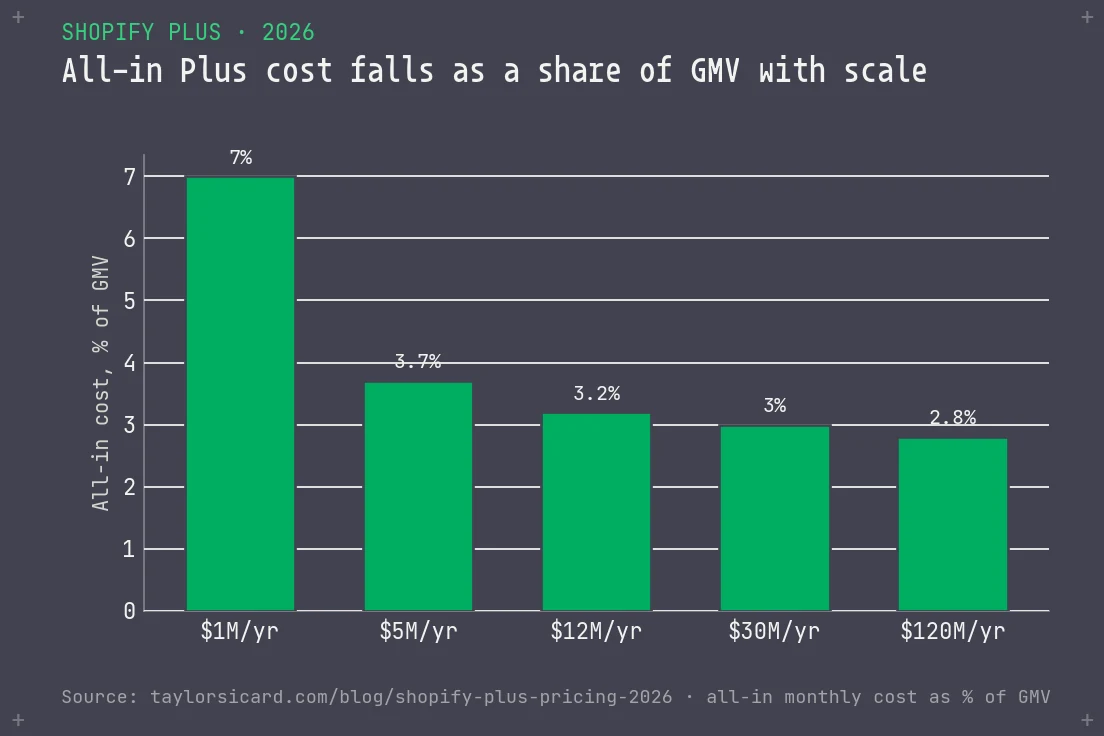
Read the last column first. The all-in cost is heaviest as a share of revenue when you are small, where the flat fee dominates a tiny GMV, and it settles toward 3% at scale where processing becomes the biggest line and the platform fee fades. That is the single best argument against moving to Plus too early: at $1M a year you are paying around 7% of GMV to run the same store a leaner plan would run for a fraction of that. When the move is actually worth it is a separate question, and I cover the triggers in Shopify Plus upgrade timing.
The table understates one thing. That 2.4% is a default, and while the published Shopify Payments rates are real, at scale they are negotiable. A brand pushing nine figures of mostly domestic volume, with low chargebacks, a low-risk product, a long processing history, and a light Amex mix, has real leverage to pull the rate down, often by enough to dwarf anything you would save on the platform line. Since processing is your largest line past roughly $115K a month, it is also the one most worth a hard renegotiation. I have sat on both sides of that conversation.
Processing is the line
that actually scales.
For most Plus brands, payment processing is the single largest cost of being on Shopify, and unlike the platform fee it grows with every dollar you sell. There is no cap and no crossover. Two points of processing on $30M is $600,000 a year, every year. That is why it deserves more attention than the platform fee everyone obsesses over.
Shopify does not publish Plus card rates. Its pricing page only says Plus has "the lowest rates of any plan" and points you to sales, so any specific Plus rate you read online is a third-party estimate, not a Shopify figure. For context, Shopify's published Advanced-plan rate is 2.5% plus 30 cents online, and Plus sits below that. The blended rate most brands actually pay lands somewhere around 2.2% to 2.5% once you mix in the cards your customers really use, which is why the table above models 2.4%. Your true number depends entirely on your card mix.
That word, blended, is where the money hides. The headline Visa and Mastercard rate is not what you pay across a real order book. American Express runs roughly a point higher per transaction, so a heavy Amex share lifts your effective rate. International cards carry higher interchange, and when Shopify Payments converts a foreign sale into your payout currency there is a currency-conversion fee of about 1.5% in the US and 2% elsewhere. Refunds and chargebacks add their own drag: the average ecommerce chargeback rate sits near 0.6% (Chargeflow industry data), the card networks start penalty programs at 0.9% for Visa and 1.5% for Mastercard, and the all-in cost of a single dispute runs well past the order value once you count the fee plus the lost goods.
- +Amex share, roughly a point higher per transaction than Visa or Mastercard
- +International cards plus the 1.5% to 2% currency-conversion fee on cross-border sales
- +Refunds and chargebacks, averaging ~0.6% of orders, with network penalties past 0.9%
- +A third-party gateway instead of Shopify Payments, which adds 0.20% on Plus
The gateway choice is the cleanest lever. If you process on Shopify Payments, there is no extra Shopify transaction fee, and on Plus that waiver covers Shop Pay, PayPal Express, and the rest. If you run a third-party gateway as your primary processor, Shopify adds 0.20% on Plus, confirmed on its pricing page, on top of whatever the gateway charges to move the card. That is far below the standard-plan third-party fee, which runs from about 2% on Basic down to 0.6% on Advanced, but 0.20% of nine-figure GMV is still a five-figure line you can often delete by consolidating onto Shopify Payments.
Then there is cross-border. A domestic brand and an international brand at the same GMV do not pay the same processing rate. If you sell abroad through Managed Markets, Shopify's duties-and-landed-cost service, the fee structure is higher again, in the low-3% range plus the currency conversion, in exchange for handling duties and local payment methods. The full picture is in Shopify Markets explained. That can be worth it for international conversion, but it is a real line, and it belongs in your model before it turns up on a statement. Model processing on your actual card mix instead of the headline rate, and treat it as the line most worth a hard look; negotiating it comes a few sections down.
Where the budget
slowly leaks.
The table above covers the run-rate. Budgets get wrecked by the lines that never show up in the sticker comparison: the third-party gateway fee, implementation, and app creep.
Implementation is a one-time cost, and it is real money that lands in year one. A straightforward Plus setup on an existing Shopify store can be cheap, because you are upgrading a store you already run instead of migrating one. A mid-market build is a different animal: once you add data migration, custom integrations, and bespoke design and functionality, $60K to $180K is the normal range, and a heavy replatform off another system runs higher. Where you land inside that range depends on how much custom work the store actually needs. Budget it separately and amortize it across the first year when you compare options.
What you are migrating from drives most of that number. Coming off WooCommerce or BigCommerce is usually the light end. Agency quotes climb into the low six figures for brands leaving Magento, Adobe Commerce, or Salesforce Commerce Cloud, because the data is messier and the integration surface is wider. The two line items that reliably blow up a budget are ERP and B2B: a custom NetSuite or SAP connector and a real wholesale build each add meaningfully to the bill on their own. None of that is the platform fee; it is the cost of getting onto the platform, and it is the single most under-budgeted number when brands compare options on subscription price alone.
App creep is the slow leak. The Shopify app stack is the fastest-growing cost on Plus, and it grows by accretion: a tool added for one campaign, a usage-based bill that scaled with your GMV and never got renegotiated, two apps doing one job, seats nobody uses. I have walked into brands paying more per month in overlapping apps than their entire platform fee. Audit the stack quarterly. The Shopify tech stack by revenue tier post is the map for what actually belongs in the stack at each stage, and what to cut when you move up.
As a rough shape, app spend tracks revenue: a disciplined $1M to $5M brand runs maybe $1,000 to $3,500 a month across six to nine apps, a $5M to $20M brand lands closer to $5,000 to $15,000, and a $20M to $100M brand can run $20,000 to $80,000 once subscriptions, search, loyalty, and a real email and SMS program are all in. The reason it scales faster than you expect is that the heaviest apps are usage-based, not flat-fee. A subscriptions app takes a cut of subscription revenue, your email platform bills on active profiles, your help desk bills per ticket. As GMV grows, those bills grow with it whether or not anyone renegotiates, which is exactly why the line creeps. When it creeps past what you can defend, the guide to Shopify app bloat is the framework for auditing every app against its true cost.
The last recurring line is people. Most Plus brands run a development partner, and a Plus agency retainer typically lands in the $8,000 to $30,000 a month range depending on scope, with headless, international, and B2B work at the top of that band. Bringing it in-house is not automatically cheaper once you load salaries, benefits, and the cost of a thin bus factor. Whichever way you go, it is a fixed monthly line that belongs in the all-in number, not a footnote.
"The platform fee is the line everyone negotiates and the smallest line on the invoice. Processing and apps are the lines nobody negotiates and the largest. That is backwards, and it is where the money is."
The fee buys features.
The checkout buys it back.
Cost is only half the equation. The other half is what Plus does that lower plans cannot, and whether that capability earns the fee back. In 2026 the Plus-exclusive list is shorter than it used to be, because Shopify keeps pushing features down-market, but the items that remain are the ones that touch revenue directly.
What is still Plus-only, per Shopify's plan documentation: full checkout extensibility (the Checkout Branding API, checkout UI extensions, and custom checkout logic through Functions in custom apps), Launchpad for scheduled drops and flash sales, unlimited staff accounts with custom roles, organization-level admin and cross-store analytics, nine expansion stores, higher API limits, and round-the-clock priority support.
Just as important is what is no longer Plus-only, because the old sales pitch is out of date. Native B2B came to every paid plan in April 2026, capped at three catalogs, with unlimited catalogs, partial payments, and deposits staying on Plus. Shopify Flow automation is on all plans now. Headless storefronts through Hydrogen and Oxygen are too. If someone tells you that you "need Plus for B2B" or "need Plus to go headless," that stopped being true in 2026. You need Plus for those things at scale, which is a narrower and more honest claim. The one time-bound item is the Scripts-to-Functions transition, which I cover in the Shopify Scripts sunset post.
The feature that actually pays for itself is the checkout. A customizable, extensible checkout has always been the headline reason to be on Plus, and it still is, because the checkout is where conversion is won or lost. The independently documented average cart-abandonment rate is about 70% (Baymard Institute), and Baymard estimates that a large share of those lost orders is recoverable through checkout flow and design alone. The checkout is the highest-leverage surface you own.
Shopify's own numbers on this are strong but should be discounted, because they are Shopify's. The company reports its checkout converts up to 36% better and about 15% better on average than competing platforms, and that Shop Pay lifts conversion as much as 50% versus guest checkout (Shopify). Those come from a Shopify-commissioned study and are "up to" ceilings, so treat them as directional. The math still works even if you halve the claim.
Take a brand doing $10M a year at a 2.5% conversion rate. The incremental cost of Plus over a standard plan is on the order of $25,000 to $30,000 a year at the base. A relative conversion lift of just a few percent, well under Shopify's claimed average, adds six figures of GMV on that revenue. Even a modestly better checkout (faster, more trusted, better optimized) can cover the Plus premium several times over. At the margin, the case for Plus comes down to whether the checkout and merchandising tools move your conversion rate enough to outrun the fee. If they do, the fee is cheap. If your store would convert identically on a lower plan, you are paying for headroom you are not using, which is exactly why moving too early is a mistake. To work out which kind of brand you are, the when to move to Shopify Plus post has the triggers.
Almost everything
on the contract moves.
Plus is a sales-led, contract-based product, which means more is negotiable than the pricing page lets on. The flat fee, the revenue-share percentage, the processing rate, and the extra-store fees are all on the table at volume. Treat the published numbers as the opening position.
Term length is the documented lever. The three-year commitment is what earns the $2,300 base and the lower variable rate, versus $2,500 on a one-year term; Shopify itself states the three-year plan carries a discount and lower online variable fees. A multi-year commitment is the cleanest, most reliable discount on the platform line, and it comes with a second benefit: you can usually lock the rate for the term, which protects you from the next pricing reset. Shopify reset Plus pricing in 2024, and the merchants who had locked multi-year terms were insulated.
On the rate itself, the levers are your GMV and growth trajectory, a multi-year or annual-prepay commitment, operating more than one brand, and a credible competitive alternative in the room. BigCommerce, Adobe Commerce, and commercetools are the names that count as real leverage in an enterprise evaluation. Processing is where the largest dollars sit, so a clean risk profile is leverage in its own right: mostly domestic volume, high average order value, consumer cards rather than heavy Amex, and low refunds and chargebacks all strengthen an ask on the card rate specifically. The brand that walks in with a real alternative and a clean processing profile gets a better number than the one that takes the first proposal.
Timing matters too. Your leverage is strongest at two moments, the initial enterprise deal and the renewal, and it is amplified near Shopify's quarter and fiscal-year end when sales targets are live. Renegotiate before the contract auto-renews, not after it has rolled over. Actual negotiated outcomes are confidential, so be skeptical of anyone quoting a specific "they got X percent" figure, including the agencies that publish ranges. The structure is reliable: term, volume, prepayment, competition, and timing are the levers. Bring the output of the cost calculator into that conversation so you are negotiating against your real all-in number, not the sticker.
The number to
judge yourself against.
Forget the dollar figure for a second. The cleaner test is platform plus processing plus software as a share of GMV, because that scales with your business and strips out the noise of size.
Across the brands I have operated and advised, the healthy band is this: under 4% of GMV is lean, usually a disciplined app stack on Shopify Payments. 4% to 6.5% is typical for a Plus brand and not worth losing sleep over, though it is worth a periodic audit. Over 6.5% means overhead is eating margin you could redeploy into acquisition or product, and the first two places to look are the app stack and the gateway choice. The smallest brands run hot on this metric by structure, not by waste, which is the point of section three.
Whatever your number, judge it against contribution margin, not revenue. A cost that looks small as a percentage of GMV can still be large against the margin you actually keep. If you have not built the per-order P&L underneath your store, the contribution margin for DTC post is where to start, and the DTC margin calculator will rebuild the whole P&L so you can see where platform cost actually lands.
Cost is not the same
question as worth it.
This post answers what Plus costs. Whether it is worth that cost is a different question, and it turns on what specific thing you cannot do on your current plan. Below roughly $8M to $10M a year, the fee math alone does not justify Plus: the feature value has to carry it, usually checkout extensibility, multi-store, or high-volume B2B. Above that, the platform increasingly pays for itself on processing and the cap. Which capability you are actually buying, and whether you will use it in year one, is the decision a Plus roadmap turns on.
If you are weighing the move, read when to move to Shopify Plus for the actual triggers, and the ecommerce platform comparison for 2026 if you are still deciding whether Shopify is the right foundation at all. If you already know you are moving and just need the number to budget against, run the cost calculator and bring the output to the negotiation.
Timing and structuring the move to Plus, and trimming the lines that creep once you are on it, is part of the work I do with operators. The DTC growth consulting practice is where we work it through: start the conversation.
Scaling a consumer brand?
I work with a deliberately small number of DTC operators. I have run brands at this scale myself, from $5M past $100M, and signed these contracts with real money on the line. If you are in that range, the form takes two minutes.
Start a conversation More about Taylor →