The platform sticker price is the smallest number in an enterprise commerce budget. Modeled at $50M in annual GMV for 2026, recurring cost (platform fees, apps, and engineering, excluding payment processing) runs roughly $200K to $400K a year on Shopify Plus, versus $525K to $1.15M on commercetools and $790K to $1.55M on Salesforce Commerce Cloud, where a 1% to 3% revenue share scales with your sales.
- Shopify Plus and BigCommerce charge a capped or flat platform fee. Salesforce takes 1% to 3% of GMV, so its cost rises as you grow.
- commercetools and Salesforce spend most of their total cost on implementation and a standing engineering team, not license fees.
- Payment processing (about 2.2% to 2.9% of GMV) is the largest cash line on every platform and is close to constant, so it is not what separates them.
Every enterprise commerce evaluation I get pulled into starts in the same wrong place: a spreadsheet comparing monthly platform fees. Shopify Plus at $2,300 a month next to a Salesforce quote next to a commercetools license, as if those numbers decide anything. They do not. The platform fee is usually the smallest line in the whole budget, and the numbers that actually determine what you pay, payment processing, apps, implementation, and the engineers you have to hire, rarely make it onto the same page.
This post puts all of them on the same page. I have taken the real, published 2026 pricing for the four platforms an enterprise brand actually shortlists, Shopify Plus, commercetools, BigCommerce Enterprise, and Salesforce Commerce Cloud, and modeled total cost of ownership across four GMV bands: $5M, $20M, $50M, and $100M a year. Where a figure is a real vendor rate, it is sourced. Where it is a scenario I have modeled from those rates, it is labeled as an estimate, because enterprise deals are negotiated and no two contracts are identical.
These four platforms are not four prices for the same thing, they are four pricing philosophies. Shopify Plus and BigCommerce charge you to use the software and let an app ecosystem do the heavy lifting. Salesforce charges you a slice of every dollar you sell. commercetools charges you a license and then hands you a box of parts to assemble with your own engineering team. Once you see which model you are actually buying, the comparison stops being about the sticker and starts being about how the cost behaves as you grow. Most evaluations never get that far.
If you want the feature-level view rather than the money view, I have written a separate feature-by-feature platform comparison and a strategy piece on choosing an enterprise ecommerce platform. This one is purely about the money: what each platform costs, why, and how that cost moves against your revenue.
The platform fee is the
smallest number in
the budget.
Start with the arithmetic. A brand doing $50M a year in GMV pays somewhere between $1.1M and $1.45M in payment processing alone, at a blended rate of roughly 2.2% to 2.9%. That single line dwarfs every platform fee on this page. Against a number that large, the difference between a $30,000 platform contract and a $150,000 one is real money, but it is not the decision. The decision is which model keeps your total cost from ballooning as that $50M becomes $100M.
Total cost of ownership has six components, and only one of them is the platform fee. The platform or license fee is the first. On top of it sits any percentage of GMV the platform takes. Then payment processing, almost always the biggest cash line. After that, apps and integrations, the one-time implementation, and the ongoing engineering and maintenance that quietly runs for years after launch. A comparison that only weighs the first line is looking at the tip of four very different icebergs.
In practice this splits the field. The platforms with the lowest or flattest platform fees, Shopify Plus and BigCommerce, tend to push functionality into a paid app ecosystem, so their apps line is higher and their engineering line is lower. The ones with higher license fees, commercetools and Salesforce, hand you more raw capability and expect you to build and maintain the last mile, so their implementation and engineering lines are far higher. You are not choosing a price. You are choosing where the cost lives, and how much of it recurs.
The recurring part is the trap. Implementation is a one-time shock you can see coming and budget for. Engineering headcount is a cost that compounds silently for the life of the platform, and it is the single most underestimated number in every composable pitch I have watched land. A two-person storefront team at a loaded cost of $200,000 each is $400,000 a year, every year, forever. That does not appear in the sales deck, but it is the largest ongoing line on a composable build, and it is the reason the sticker price is the least useful number in the room.
"You are not choosing a price. You are choosing where the cost lives, and how much of it recurs after the launch party."
Four platforms priced
four completely
different ways.
Before the numbers, understand the four models, because the model is what predicts your cost curve. Shopify Plus runs a capped fee: a flat base until you are large, then a small slice of GMV that stops climbing at a ceiling. BigCommerce Enterprise keeps it flat, with no percentage of GMV at all. Salesforce Commerce Cloud takes a revenue share, a percentage of everything you sell, on top of a license. commercetools charges a modest license and then leans on the engineering you supply to do the rest. Same category, four fundamentally different bills.
| Platform | Fee structure | GMV / revenue cut | Payments |
|---|---|---|---|
Shopify Plus SaaS, app ecosystem | $2,300/mo (3-yr) or $2,500/mo (1-yr), up to roughly $800K/mo GMV | Variable fee set by contract, 0.25% to 0.40% of monthly GMV in 2026 guides, reportedly capped at $40,000/mo | Shopify Payments ~2.15% + 30¢; 0.20% fee on third-party gateways |
BigCommerce Enterprise Renamed "Performance", Jun 2026 | Custom flat fee from ~$1,499/mo | None on Performance: no BigCommerce transaction fee, no Open Payment Provider fee | Bring your own gateway at its own rate |
Salesforce Commerce Cloud License + revenue share | Annual license $60K–$500K+/yr | 1%–3% of GMV (B2B Growth ~1%, Advanced ~2%); rate declines as GMV rises | Bring your own gateway; revenue share is separate |
commercetools Composable / API-first | Annual license ~$40K–$300K+/yr by edition | Usage-based (API calls, orders) inside the tier | Bring your own gateway at its own rate |
Read that table as four cost curves, not four prices. Shopify Plus and BigCommerce flatten out: past a point, selling more does not meaningfully raise the platform bill. Salesforce does the opposite: every extra dollar of GMV carries a 1% to 3% tax, so the platform cost is designed to grow with you. commercetools sits apart: its license is the small part, and the cost that matters is a build and a team that scale with the ambition of what you are constructing, not directly with revenue. Vendor rates here are drawn from published 2026 pricing pages and third-party procurement analyses; the modeled scenarios that follow build on them.
Shopify Plus: a capped
fee and an ecosystem
that does the work.
Shopify Plus in 2026 starts at a platform fee of $2,300 per month on a three-year term, or $2,500 per month on a one-year term. Above roughly $800,000 in monthly GMV, the fee switches to a variable rate on that month's GMV, set in the contract and charged on a "greater of" basis against the base. Shopify does not publish the rate; 2026 guides put it at 0.25% to 0.40%. It is reportedly capped at $40,000 per month, a ceiling you reach between about $10M and $16M in monthly GMV, roughly $120M to $192M a year. That cap is the defining feature: past a point, your platform fee simply stops growing.
Payments are where Shopify Plus has a structural edge the others lack. Shopify Payments runs at about 2.15% plus 30 cents per online transaction at the Plus tier, and if you insist on an outside gateway you pay a 0.20% Shopify fee on top of that gateway's own rate. The other three platforms all make you bring your own processor, so their processing cost is whatever you negotiate with Stripe, Adyen, or PayPal. Shopify's advantage is that payments are native, the rate is competitive, and at scale it is negotiable, so you avoid the friction and the extra fee that a third-party gateway carries here.
The real Shopify Plus cost lives in two other lines. Apps: a mature Plus stack, search, personalization, subscriptions, reviews, loyalty, commonly runs $2,000 to $15,000 a month, because Shopify's model deliberately pushes advanced functionality into third-party apps rather than the core. Implementation: an agency-led launch runs $50,000 to $150,000 for a straightforward build, $150,000 to $500,000 for a serious DTC rebuild, and $500,000 to $2M or more once you add ERP, OMS, PIM, and international storefronts. The through-line is that the platform is cheap and predictable, and the ecosystem is where you spend. For the standalone view, see the full Shopify Plus pricing breakdown.
commercetools: a modest
license and a very
large build.
commercetools is the platform where the license is the smallest part of the story. Its annual license runs from roughly $40,000 to $300,000-plus depending on edition and usage, with public third-party pricing pointing to tiers near $40,000 for a core mid-market deployment, around $100,000 for a scaling enterprise, $150,000 for a large one, and $300,000 for a global retailer past $200M in GMV. That number is negotiable and quote-based, but even the top of it is not what makes commercetools expensive.
What makes it expensive is that commercetools is composable and API-first, which means it does not ship a storefront. You build the front end, and you integrate the microservices, the search, the CMS, the checkout, the payment provider, yourself. Implementation timelines run from 3 to 6 months for a straightforward direct-to-consumer storefront to 9 to 18 months for a multi-market build with B2B workflows and ERP integrations. First-year total cost of ownership realistically lands between $200,000 and well over $1M, and partner add-on bundles alone can add $75,000 to $200,000 a year.
Then there is the line that never leaves. A composable build requires a standing engineering team to maintain and extend it, typically two to five people at a loaded cost of $150,000 to $250,000 each. That is $300,000 to $800,000 a year in headcount that recurs for the life of the platform, and it is the single largest ongoing cost of a commercetools deployment. commercetools is the right answer when a brand genuinely needs deep customization and integrations the packaged platforms cannot support, which is exactly the build-versus-buy question every enterprise has to answer honestly before it signs.
BigCommerce: the flattest
fee, and no cut of
your revenue.
BigCommerce Enterprise, renamed Performance as of June 1, 2026, is the platform that takes the smallest and flattest cut. Its enterprise pricing is custom, starting around $1,499 per month, with most mid-market brands landing between $1,500 and $3,000-plus a month depending on GMV, storefront count, and add-ons like the B2B edition. Contracted enterprise stores were not repriced by the June 2026 changes beyond the rename.
The defining feature is what BigCommerce does not charge. It takes no transaction fee on any plan, and the new Open Payment Provider fee introduced in June 2026, which charges 2.0%, 1.0%, or 0.6% on GMV settled through non-embedded providers on the lower Core, Growth, and Scale tiers, is 0% on Performance. So an enterprise BigCommerce brand pays a flat platform fee, brings its own payment gateway at whatever rate it negotiates, and hands over no percentage of GMV to the platform at all. There is no hard GMV cap on Performance, so the fee stays flat as you scale.
The trade-off is ecosystem depth. BigCommerce has a smaller app marketplace and a smaller partner network than Shopify, which means more of the advanced functionality that a Shopify brand would buy as an app has to be built or sourced elsewhere. That pushes cost from the apps line back toward implementation and engineering. For a brand whose requirements sit inside what BigCommerce does natively, it is often the lowest total cost on this list. Push into the long tail of specialized apps, though, and the savings on platform fee can get eaten by custom development, which is the same dynamic that shows up whenever the platform itself becomes the bottleneck.
Salesforce: a license
plus a tax on every
dollar you sell.
Salesforce Commerce Cloud is the platform whose cost is designed to grow with you, and that is the whole point of understanding it. It combines an annual license, roughly $60,000 to $500,000-plus per year, with a revenue share of 1% to 3% of GMV, where GMV is merchandise revenue net of tax and shipping. The B2C editions run from about 1% at the entry tier to 3% at the top; the B2B editions are cleaner, with Growth around 1% and Advanced around 2%. Salesforce does not publish fixed rates, so every quote is negotiated, and the percentage typically declines as GMV climbs.
But declining rate is not the same as declining cost. At a 1.5% blended rate, a $50M GMV brand hands Salesforce $750,000 a year in revenue share alone, before the license, before implementation, before the engineers. At $100M, even if the rate compresses toward 1%, the revenue share is $1M-plus a year. This is the model where selling more is a cost, not just a revenue event, and it is why Salesforce tends to be the most expensive option on this page for a high-GMV brand. The revenue share is the platform participating in your growth, whether or not it did anything to create it.
On top of that sits the implementation, and Salesforce is at the heavy end. These are system-integrator-led builds, typically $500,000 to $2M or more, with the platform's real strength being complex B2B, multi-region, and deep enterprise integration. For a large, complex enterprise with SAP or Oracle in the back office and genuine multi-country requirements, that capability can justify the cost. Take a mid-market DTC brand that just needs to sell product well, though, and the revenue share is a levy that compounds every year without a matching benefit, the number that most often makes the Salesforce math fall apart on a spreadsheet.
Any platform that charges a percentage of GMV is making a bet that your growth pays for itself. To sanity-check it, take the revenue share you would owe at your target GMV three years out and ask whether the platform delivers that much incremental value versus a capped or flat fee. At 1.5% on $50M, Salesforce collects $750,000 a year. Shopify Plus caps its GMV fee at $480,000 a year and BigCommerce takes nothing. If the revenue-share platform cannot point to more than a quarter-million dollars a year of value the others lack, the percentage is just a tax you agreed to pay.
What the platform fee
does as you grow
from $5M to $100M.
Here is the platform-and-GMV fee for each platform across four annual GMV bands. This is the platform's own take only: it excludes payment processing, apps, implementation, and engineering, which the next section adds back. Shopify Plus figures use the 0.25% to 0.40% variable rate that 2026 guides report (Shopify does not publish it) and the reported cap. Salesforce figures assume a representative 1.5% blended revenue share plus a mid-range license and are estimates, because Salesforce rates are negotiated. commercetools reflects its license tiers, and BigCommerce its flat custom fee. All non-published figures are modeled estimates.
| Platform | $5M GMV | $20M GMV | $50M GMV | $100M GMV |
|---|---|---|---|---|
Shopify Plus Base, then 0.25%–0.40%, capped | ~$28K–$30K | ~$50K–$80K | ~$125K–$200K | ~$250K–$400K |
BigCommerce Performance Flat, no GMV cut | ~$18K–$30K | ~$24K–$42K | ~$36K–$60K | ~$48K–$90K |
commercetools License by edition | ~$40K–$100K | ~$100K | ~$150K | ~$150K–$300K |
Salesforce Commerce Cloud License + ~1.5% GMV | ~$135K | ~$400K | ~$900K | ~$1.45M |
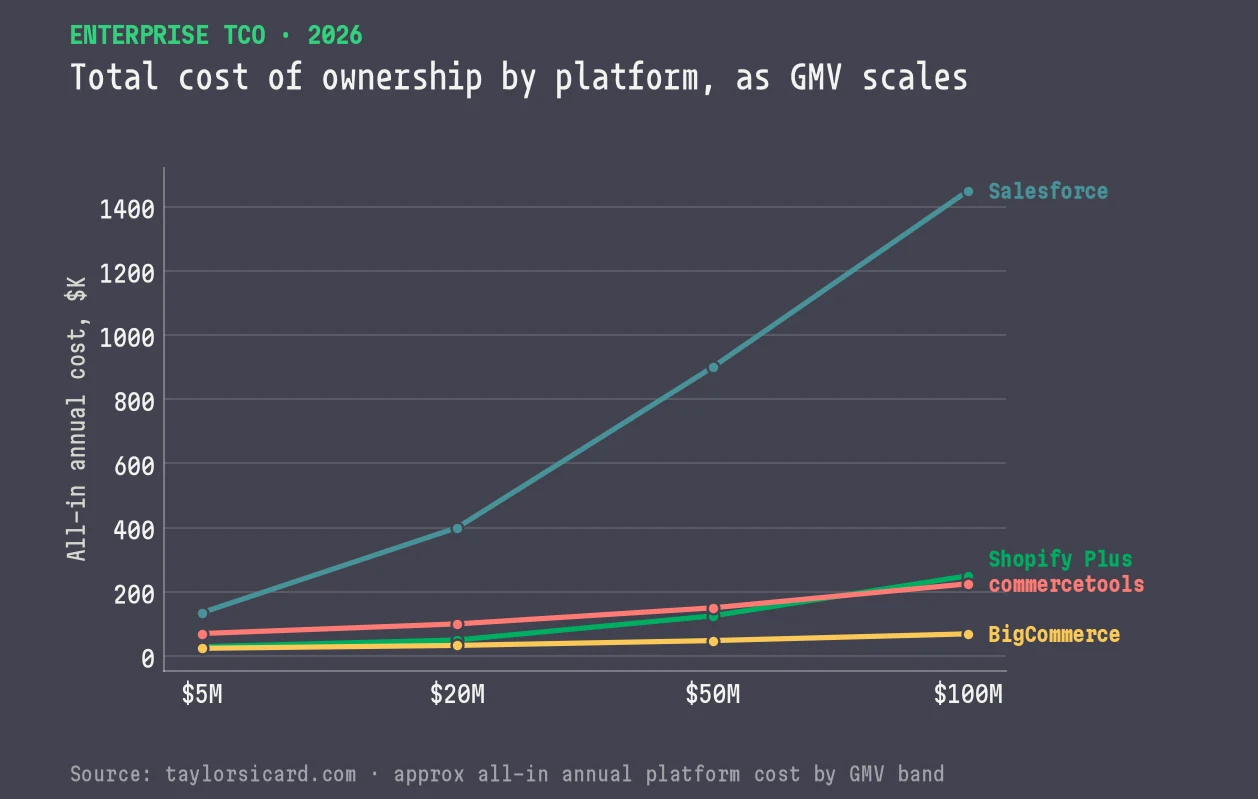
The shape of this table is the entire argument. Shopify Plus rises modestly, then flattens against its cap. BigCommerce barely moves, because it takes no cut of GMV. commercetools steps up by license tier but stays well under $300,000 even at $100M, because its cost is not in the license. Salesforce climbs steeply and never stops, because the revenue share is the fee. At $5M, the four platforms are within a few tens of thousands of dollars of one another on platform fee. At $100M, Salesforce's platform take is roughly four to six times Shopify Plus's and more than fifteen times BigCommerce's. Growth is exactly when the model you chose starts to matter, which is also why the timing of when a brand is ready for Plus is as much a cost decision as a capability one.
The modeled all-in cost
for a $50M brand
in 2026.
Now the full picture, modeled for a single, concrete scenario: a brand doing $50M a year in GMV. This adds apps, integrations, and ongoing engineering to the platform fee, and lists one-time implementation separately because it is a shock rather than a recurring cost. Payment processing is excluded because it runs roughly 2.2% to 2.9% on every platform and is close to constant, so it does not separate them. Every figure below is a modeled estimate built on the sourced rates above, not a quote for a specific brand.
| Platform | Platform + GMV fee | Apps / add-ons | Engineering + maint. | Recurring/yr |
|---|---|---|---|---|
BigCommerce Performance One-time build $75K–$300K | ~$36K–$60K | ~$30K–$100K | ~$50K–$150K | ~$120K–$310K |
Shopify Plus One-time build $150K–$500K | ~$125K–$200K | ~$60K–$120K | ~$50K–$150K | ~$235K–$470K |
commercetools One-time build $400K–$1M+ | ~$150K | ~$75K–$200K | ~$300K–$800K | ~$525K–$1.15M+ |
Salesforce Commerce Cloud One-time build $500K–$1.5M+ | ~$600K–$1.15M | ~$40K–$120K | ~$150K–$400K | ~$790K–$1.55M+ |
At $50M in GMV, the recurring order is clear and wide. BigCommerce Performance is the leanest at roughly $120,000 to $310,000 a year, because it takes no GMV cut and its ecosystem cost is modest. Shopify Plus is next at roughly $235,000 to $470,000, with its capped variable fee and a mature app stack doing the heavy lifting instead of engineers. commercetools jumps to $525,000 to $1.15M-plus, almost all of it the standing engineering team. Salesforce tops the list at $790,000 to $1.55M-plus, driven by the revenue share. The gap between the leanest and the heaviest option is more than a million dollars a year, on the identical $50M of sales, and none of it is payment processing.
Two caveats keep this honest. First, these are recurring numbers; add amortized implementation and the composable and Salesforce builds pull even further ahead in year one. Second, a lower number is not automatically the right answer. A brand with genuinely complex requirements might get less from BigCommerce's lean stack and have to rebuild functionality that Shopify buys off the shelf, narrowing the real gap. The point of the table is not to crown a winner. It is to show that the platform decision is a six-figure-to-seven-figure annual choice, and that the fee on the contract is the part that matters least.
The four hidden lines
that decide the
real number.
If you only stress-test four things in an enterprise commerce budget, make it these, because they move the total far more than the platform fee. Get them right and the sticker price is a rounding error. Get them wrong and a "cheaper" platform quietly becomes the expensive one over a three-year horizon.
One: the GMV or revenue share. Any percentage of GMV is a cost that compounds with your success. Model it at your target GMV three years out, not today's, because that is when it bites. Shopify Plus's variable fee is reportedly capped at $40,000 a month; Salesforce's 1% to 3% has no cap and grows with every sale. On a brand scaling from $20M to $100M, that difference alone is hundreds of thousands of dollars a year by the end of the plan.
Two: implementation. The one-time build ranges from $50,000 on a simple Shopify Plus launch to $2M-plus on a complex Salesforce or composable enterprise implementation. It is the most negotiable line and the one where scope discipline pays off most. Amortized over a realistic three-year platform life, a $1M implementation is $330,000 a year, which reframes it from a one-time cost into a recurring one you should compare like any other.
Three: engineering and maintenance. This is the silent killer of composable TCO. A packaged platform lets a small team plus an agency retainer keep the lights on. A composable build needs a standing engineering team, two to five people, $300,000 to $800,000 a year, indefinitely. That headcount rarely appears in the sales comparison and is almost always the largest ongoing line on a build-it-yourself platform. If you cannot fund and retain that team, you cannot afford composable, full stop.
Four: apps and payment processing. Apps are where Shopify recovers its low platform fee, so budget $2,000 to $15,000 a month for a serious Plus stack. Payment processing is the largest cash line on every platform, roughly 2.2% to 2.9% of GMV, and it is the same order of magnitude everywhere, which is why it does not separate the options, but it is also negotiable at scale and worth a hard look. Shopify Payments being native and competitive is a genuine edge; on the other three you own the gateway relationship and the rate you can win.
Before you sign an enterprise platform contract, price the four hidden lines for your business. The Read prices them for a fixed fee, in two weeks.
Which platform is
right, by the cost
you can carry.
The right platform is the one whose cost model matches how your business actually behaves, not the one with the lowest headline fee. Read as cost curves rather than price tags, the four sort out like this.
One platform is missing from this list on purpose. Adobe Commerce does not publish pricing, so it cannot be modeled the way the four above can, and its cost sits in operating lines rather than a fee. If that is the platform you are actually leaving, the numbers on this page plug straight into the Adobe Commerce replatform case.
The honest summary is that for most brands reading this, Shopify Plus is the default because its cost is capped, predictable, and mostly borne by an ecosystem rather than a payroll. BigCommerce beats it on pure platform fee when the requirements are lean. commercetools and Salesforce win when the complexity is genuinely there, and lose badly when it is not, because you pay for the capability whether or not you use it. Match the model to the business, run the three-year numbers rather than the monthly ones, and the choice usually makes itself. The harder version of the question arrives after the contract, when the same three-year lens has to be pointed at the roadmap and someone has to settle which capabilities get funded, and in what order.
If you want to put your own numbers against this, the Shopify Plus Cost calculator models the Plus side of the comparison from your revenue and app stack in about a minute, so you can see where your brand actually lands on the fee curve before you take a single sales call.
Which platform does your brand actually need?
I have owned the platform, app-stack, and payments decisions across a nine-figure DTC portfolio, and I have sat through the Plus-versus-composable pitch from both sides. If you are weighing an enterprise platform move, I can pressure-test the real three-year cost against what your business genuinely needs, before a sales team frames it for you. The form takes two minutes.
Start a conversation More about Taylor →Questions brands ask
before they sign a
platform contract.
How much does Shopify Plus cost versus commercetools or Salesforce in 2026?
Shopify Plus starts at a platform fee of $2,300 per month on a three-year term (or $2,500 on one year), then switches to a contract-set variable fee, 0.25% to 0.40% of monthly GMV in 2026 guides, once you pass roughly $800,000 in a month, reportedly capped at $40,000 per month. commercetools charges an annual license, roughly $40,000 to $300,000 by edition, plus a composable build that pushes first-year cost past $1M. Salesforce Commerce Cloud layers a license of $60,000 to $500,000 a year on top of a 1% to 3% revenue share on GMV. Modeled at $50M in annual GMV, recurring platform, apps, and engineering (excluding payment processing) runs roughly $200,000 to $400,000 a year on Shopify Plus, versus $525,000 to $1.15M on commercetools and $790,000 to $1.55M on Salesforce.
What is the total cost of ownership of an enterprise ecommerce platform?
Total cost of ownership is the platform or license fee, plus any percentage of GMV, plus payment processing (roughly 2.2% to 2.9% and usually the largest cash line), plus apps and integrations, plus one-time implementation, plus ongoing engineering and maintenance. The platform fee is usually the smallest of these. For a $50M GMV brand in 2026, a modeled all-in figure lands anywhere from about $130,000 a year on the leanest setup to well over $1.5M on a heavy composable or revenue-share platform, before payment processing.
Does Salesforce Commerce Cloud really charge a percentage of revenue?
Yes. Salesforce Commerce Cloud combines an annual license with a revenue share on gross merchandise value, typically 1% to 3% for B2C editions (B2B Growth is about 1%, B2B Advanced about 2%), where GMV is merchandise revenue net of tax and shipping. The percentage usually declines as GMV rises, but the dollar figure grows with your sales, so at $50M in GMV the revenue share alone can run $500,000 to $1M a year. Shopify Plus's variable fee (0.25% to 0.40% of GMV) is reportedly capped at $40,000 per month, and BigCommerce Performance takes no percentage of GMV at all.
What is the total cost of ownership for Salesforce Commerce Cloud versus BigCommerce?
BigCommerce Performance (formerly Enterprise) charges a flat custom platform fee from about $1,499 per month, with no revenue share and no transaction fees, so its platform line stays close to flat as GMV grows. Salesforce Commerce Cloud combines a $60,000 to $500,000 annual license with a 1% to 3% revenue share on GMV, so at $50M in GMV the share alone can run $500,000 to $1M a year before implementation and engineering. On the platform line at scale, BigCommerce is cheaper by a wide margin. The tradeoff is a smaller app ecosystem, which can push more work into custom development. Payment processing, roughly 2.2% to 2.9% of GMV on either, is close to constant and does not separate them.
Which enterprise commerce platform is cheapest at scale?
On platform fee alone, BigCommerce Enterprise (renamed Performance in June 2026) is usually the cheapest at scale, because it charges a flat custom fee from about $1,499 per month with no revenue share and no transaction fees. Shopify Plus is next, with its GMV fee reportedly capped at $40,000 per month. Salesforce Commerce Cloud and commercetools cost the most at scale, Salesforce because its 1% to 3% revenue share rises with sales, and commercetools because the composable build demands a standing engineering team. Cheapest platform fee does not mean cheapest total cost, since a smaller app ecosystem can push more work into custom development.
Is Shopify Plus cheaper than a composable or headless build?
For most brands under roughly $100M in GMV, yes. A composable build on commercetools or a headless Salesforce implementation carries $400,000 to $1.5M or more in one-time implementation and a standing engineering team of two to five people to maintain the storefront and integrations, which the app ecosystem largely replaces on Shopify Plus. Composable earns its cost only when a brand needs deep customization, complex multi-region logic, or integrations the packaged platforms genuinely cannot support. Below that threshold, you are paying for flexibility you will not use.