The real all-in cost of a DTC return, to take a unit back, process it, and decide what to do with it, commonly runs $10 to $65 per return depending on category and channel. That is far more than the refund-plus-shipping most founders assume, and for many brands it is a bigger line than they have ever built.
- A return is a margin event wearing an ops costume, not a logistics chore.
- It reverses recognized revenue, adds unplanned cost, and hands back a unit worth less.
- Brands that file returns under operations never actually fix the cost.
Ask most DTC founders what a return costs them and you'll get the wrong answer. They'll say "the refund," or "shipping both ways," and move on. That's the visible part. The real number, the all-in cost to take a unit back, process it, and figure out what to do with it, commonly runs from $10 to $65 per return depending on category and channel. For a lot of brands, that's a bigger line than they think and one they've never actually built.
The reason returns get under-managed is that they're filed in the wrong place. They sit in operations, treated as a logistics chore handled by whoever runs fulfillment. But a return is really a margin event wearing an ops costume. It reverses revenue you already recognized, adds cost you didn't plan for, and hands you back a unit worth less than it was when it left. That's a P&L problem, and the brands that file it under ops never fix it.
Here's the line that reframes the whole thing: only about 48% of returned items are resold at full price. The rest get discounted, liquidated, or written off. The processing fee is only half the bill. The other half is an asset that has, on average, lost a big chunk of its value in the round trip. Both halves of that, the processing cost and the recovery loss, belong on the P&L, and most brands track neither.
I've built the reverse-logistics and margin models that decide whether a brand is actually profitable, and returns are one of the most consistently under-counted lines I see. This is the full teardown: every cost in a return, what you really recover, and the three levers that turn a bleeding line into a managed one. I also built the model as a free returns cost calculator, so you can see your own annual P&L hit while you read.
Returns belong on the
P&L, not buried in
operations.
The single most expensive mistake brands make with returns is treating them as a fixed cost of doing business rather than a managed line with real levers. When a cost is seen as unavoidable, nobody owns reducing it. It just sits there, growing with revenue, quietly compressing the margin that funds everything else.
Put a return where it actually belongs and the incentives change. A return reverses a sale, so it should reduce net revenue, not hide in a fulfillment cost center. It then adds processing cost and recovery loss, which should land in contribution margin alongside COGS and shipping. Modeled that way, a 20% return rate stops looking like a logistics statistic and starts looking like what it is: a direct hit to the gross profit that pays for customer acquisition.
This matters because of where the money goes next. Contribution margin is what funds your acquisition spend. If returns are silently taking points out of contribution that your model doesn't capture, then your maximum allowable CAC is lower than you think, and you're probably overspending to acquire customers on the belief that each order is more profitable than it actually is. The return you didn't model is funding an ad you couldn't afford.
"A return isn't a logistics chore. It reverses revenue, adds cost, and hands you back a depreciated asset. That's three P&L lines pretending to be one ops ticket."
The anatomy of a
return cost, line
by line.
The reason a single return can cost anywhere from $10 to $65 is that it's a stack of costs rather than one, and most brands only ever see the top one. Reverse-logistics shipping alone often runs 20% to 30% of the product's value, and that's before a human has touched the package. Here's the full stack on a representative mid-value unit.
| Cost line | Typical range | What it is |
|---|---|---|
Reverse shipping | 20–30% of value | The return label, often subsidized to keep the customer happy |
Receive & inspect | $8–$15 | Labor to check the item back in and assess condition |
Restock / refurbish | $2–$10 | Repackaging, cleaning, or light refurb to make it sellable |
Refund processing fee | $1–$3 | The payment fee on the original sale you don't get back |
Customer-service time | $2–$5 | Handling the request, the exchange, the follow-up |
All-in processing | $10–$65 | Before you account for what the unit is now worth |
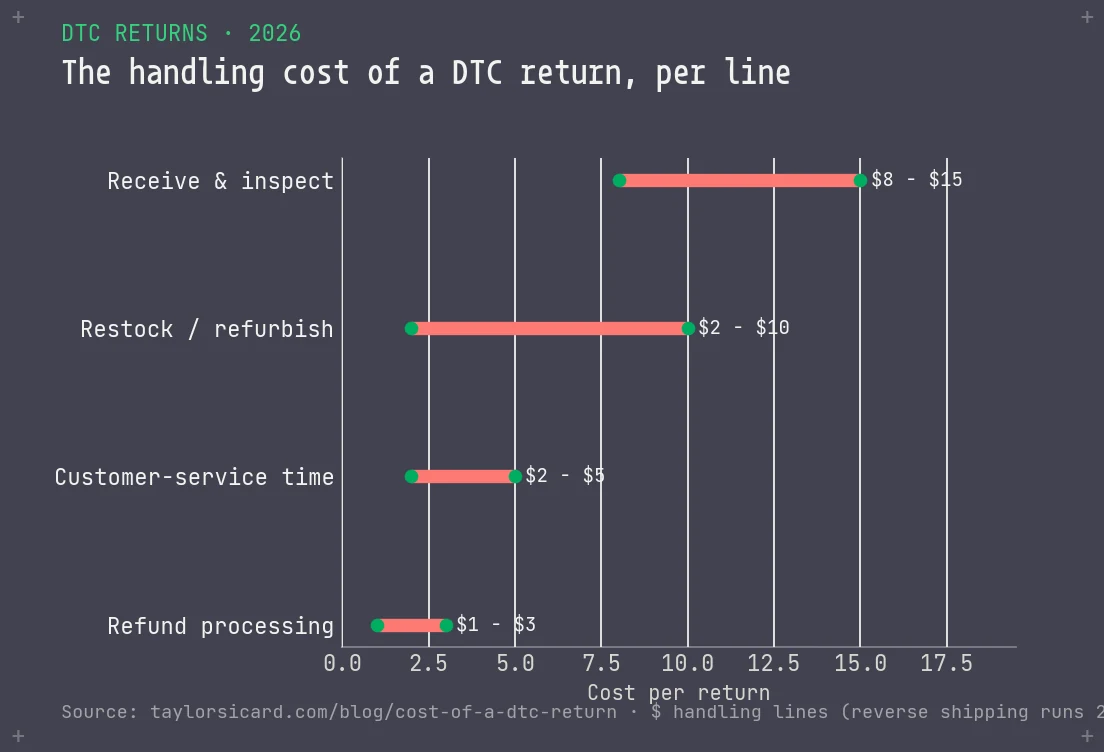
Notice what's on this table and what isn't. Every line here is processing cost, the price of moving the unit backward through your system. None of it includes the recovery loss, the gap between what the unit was worth when it shipped and what it's worth now. That comes next, and it's the line that turns an expensive return into a losing one.
Notice also which lines you control. The refund processing fee is fixed. But reverse shipping, inspection labor, and refurbishment are all operational, and they're where a good reverse-logistics setup or 3PL partner earns its keep. The brands that get this right don't just accept the $10 to $65. They attack the controllable lines and shrink the stack.
The 48% problem: you
don't get the unit
back at full value.
Here's the line that breaks most return math. When a unit comes back, you don't recover its full value. Only about 48% of returned items are resold at full price. The other half are discounted, sold through liquidation channels at cents on the dollar, donated, or written off entirely. So even a perfectly efficient returns process is handing you back an asset that has, on average, lost a meaningful share of its worth.
Think about what that does to the unit economics. You sold a $40 item, recognized the revenue, and paid to acquire that customer. The item comes back. You refund the $40, pay $15 to process the return, and then, more than half the time, you can't resell it at $40. Maybe you recover $20 on markdown, maybe $4 on liquidation, maybe nothing. The "lost sale" framing badly understates it. You didn't just lose the sale. You paid to lose it.
This is why returns are so much more dangerous for some catalogs than others. A durable, easily resold item with a long shelf life recovers most of its value, so the return is "just" the processing cost. A perishable, seasonal, fashion, or hygiene-sensitive item recovers very little, so the recovery loss dwarfs the processing cost. Two brands with the same return rate and the same processing efficiency can have wildly different return economics purely because of what their product is worth on the way back. Recovery value is the variable nobody models, and it's often the biggest one.
Most return calculators stop at processing cost. Add a recovery-rate line: for each returned unit, what do you actually resell it for, on average, across full-price resale, markdown, liquidation, and write-off? If you're recovering well under your selling price, the recovery loss may be larger than the entire processing stack. Until that line is in your model, you're flattering your return economics by exactly the amount you can't resell, which for a lot of catalogs is the difference between a profitable order and an unprofitable one.
Why the blended return
rate is the wrong
number to watch.
Blended ecommerce return rates now sit around 19% to 20% across categories, roughly two to three times the brick-and-mortar rate. That's a useful headline and a useless operating number, because it averages together businesses with completely different return realities. The blended figure is where return strategy goes to die.
The spread underneath the average is enormous. Apparel and footwear run far higher than the blend, often into the 30s and beyond, because fit and sizing drive returns no amount of process can fully fix. Consumables, beauty, and supplements run well below it, because nobody returns a half-used jar of moisturizer. So a 20% blended rate might describe a fashion brand at 35% sitting next to a supplement brand at 5%, and a strategy built on the average would be wrong for both. The 2026 return rate benchmarks by category lay out where each lane actually sits, from apparel in the 20 to 40% band down to beauty under 12%.
The operating move is to throw out the industry average and build from your own category, your own SKUs, and ideally your own customers. Some products return at three times the rate of others in the same catalog. Some customers, the serial bracketers who order five sizes intending to keep one, return at many times the rate of the median buyer. Until you can see returns at the SKU and customer level, you're managing a blur. The brands that win on returns manage the specifics, because that's where the cost actually lives.
Returnless refunds: when
keeping the product
beats taking it back.
Once you've got the real cost stack and the recovery rate in front of you, one counterintuitive move becomes obvious: sometimes the cheapest thing to do is refund the customer and let them keep the item. This is the returnless refund, also called a green return, and generosity has nothing to do with it. It's math.
The logic is simple. If the all-in cost to process a return is close to or above the recovery value of the item, taking it back destroys value. Picture a $12 item where shipping, inspecting, and restocking costs $14, and you'll recover maybe $4 reselling it as an open-box unit. Taking it back costs you $14 to recover $4. Letting the customer keep it costs you the $12 refund and nothing more, and it's faster, generates goodwill, and saves a shipping leg and its carbon. On that unit, the return itself is the expensive option.
The trap is applying it as a blanket policy, which invites abuse and trains customers to over-order. The right version is rules-based: returnless refunds triggered automatically when the item's cost-to-process exceeds its recovery value, scoped to low-value or hard-to-resell SKUs, and gated by customer history so your best customers get the frictionless experience while serial abusers don't. Done that way, returnless refunds cut reverse-logistics cost and improve the customer experience at the same time, which is a rare combination in this part of the P&L.
Turning returns into a
profit center: the
coverage math.
The most interesting recent shift in returns is brands flipping the cost onto an opt-in revenue line. The mechanism is paid returns coverage: a small fee at checkout, on the order of a few dollars, that gives the customer premium returns benefits like free or extended returns. It sounds minor. The math behind it is not.
The mechanics are simple. The customers who pay the coverage fee vastly outnumber the ones who actually file a return. So a $3 charge that replaces a $10 return label collects revenue from the many to fund the cost of the few. If enough customers opt in, the pool of fees can offset most or all of your return shipping and even your returns software cost. You've taken a line that used to be pure expense and turned it toward break-even, sometimes better, without raising your product price.
I want to be precise about the claim, because it's easy to oversell. Paid coverage doesn't make returns profitable on its own, and a brand that frames it that way will be disappointed. What it does is neutralize a line that used to just bleed. Stack it with returnless logic on low-recovery items and behavior-based policies on serial returners, and the combination can take returns from a quiet margin drain to a roughly managed, sometimes self-funding line. That's the realistic goal: not profit from returns, but returns that stop quietly funding your competitors' growth instead of yours.
One more move belongs in the same family: pushing exchanges over refunds. When a customer wants a different size or color, an exchange keeps the revenue on your books instead of reversing it, and it keeps the customer in your world instead of sending the cash back to go shop elsewhere. A returns flow that defaults to "here's your refund" leaks revenue that a flow defaulting to "let's find the right one" would have kept. It won't fit every case, and forcing it feels hostile, but for the fit and sizing returns that make up a huge share of the total, a well-designed exchange path quietly protects both the sale and the relationship at the same time.
The three levers that
turn returns from a
leak into a line.
Pull these in order. The first costs nothing but attention, the second is a policy and tooling change, and the third is the structural fix to the cost stack itself. Most brands skip straight to "make the policy stricter," which is the bluntest and most customer-hostile option, when the higher-leverage moves come first.
Why it's first: A return you prevent costs zero to process and loses zero recovery value. This is where a strong product page pays back twice, once in conversion and once in fewer returns. The cheapest return is the one that never ships.
Why it matters: A blanket policy either over-pays good customers or punishes them to stop the few abusers. Behavior-based policy targets the cost where it actually concentrates, which is a small slice of customers and SKUs, without taxing the customers you want to keep.
Why it's last but not least: This is the durable fix to the $10-to-$65 stack itself. It's the most operational and the slowest, but it's what permanently lowers the per-return cost rather than just routing fewer returns through it. The first two levers reduce volume. This one reduces unit cost.
Returns are one of the last big un-modeled lines in DTC. Most brands have squeezed their CAC, scrutinized their COGS, and benchmarked their conversion rate, while a 20% return rate quietly carries a $10-to-$65 processing cost and a recovery loss that nobody booked. Put the real number on the P&L and the whole thing becomes manageable: prevent what you can, target the policy where the cost concentrates, and re-engineer the stack underneath. None of it is glamorous. All of it is margin sitting on the floor unclaimed.
If you suspect returns are bigger than your model says, that's exactly the kind of hidden-margin question the DTC growth consultant exists to surface. Pair this with the full profitability teardown to see where else the real numbers differ from the deck.
Questions from founders
finally putting returns
on the P&L.
The all-in cost to process a single return commonly runs from $10 to $65 depending on category and channel. It stacks up across reverse shipping (often 20-30% of the product's value), receiving and inspection labor, restocking or refurbishment, the payment fee that isn't refunded, and customer-service time. And that's only the processing cost. It doesn't include the recovery loss from the fact that under half of returned items resell at full price, which is frequently the larger number.
Only about 48% on average. The rest get discounted, liquidated, or written off. This is the line most return models miss entirely: you don't get the unit back at full value, you get back a unit worth materially less than it was when it shipped. For durable, easily resold products the recovery rate is higher; for fashion, seasonal, perishable, or hygiene-sensitive items it can be very low, which is why two brands with the same return rate can have completely different return economics.
When the all-in cost to process the return is close to or above the item's recovery value, which is common for low-value, bulky, or hard-to-resell products. If shipping, inspecting, and restocking a $12 item costs $14 and you'll only recover a few dollars reselling it, taking it back destroys value. Keeping it with the customer is cheaper, faster, and usually better received. Apply it as a rules-based trigger scoped to low-recovery SKUs and gated by customer history, never as a blanket policy that invites abuse.
Start at the source, not the policy. The least customer-hostile lever is preventing the returns that shouldn't happen: better sizing guidance, sharper photography, accurate descriptions, and fit tools that set correct expectations before purchase. Then make the policy behavior-based so good customers keep a frictionless experience while serial abusers and low-recovery items get tighter terms. Tightening the policy on everyone is the bluntest tool and usually the last resort, because it taxes the customers you most want to keep.
Are returns bigger than your model says?
I build the reverse-logistics and contribution models that show what a return actually costs, processing plus recovery loss, and which lever to pull first. If your margin keeps coming in below plan and you can't find where it's going, returns are a common place to look. The form takes two minutes.
Start a conversation More about Taylor →