A fractional Shopify advisor gives you senior operator judgment part-time: embedded enough to know your business, independent enough to keep perspective, at a fraction of a full-time leader's cost. The model works because it matches senior judgment to the moments that actually need it, on a regular cadence plus on-call access, with the advisor owning priorities and your team owning execution.
- Fractional means part-time senior judgment on a retainer, not a full-time hire and not an agency.
- The engagement is a regular cadence plus on-call access, with the advisor owning priorities and the team owning execution.
- It costs a fraction of a loaded full-time leader, which is why more brands are choosing it over a hire.
"Fractional" used to sound like a euphemism for freelance. It is not. A fractional Shopify advisor is a senior operator who works with your business part-time on a retainer, giving you the kind of judgment you would get from a full-time leader, applied only where it matters, at a fraction of the cost. The model has quietly gone mainstream, and for good reason.
If you are considering it, the useful thing is to understand exactly how the engagement works: what it is, why it has taken off, how the cadence and access are structured, what the advisor owns versus your team, and what it costs. I work this way with Shopify brands, as one of six advisory tracks I run, so here is the honest mechanics of it.
What "fractional"
actually means.
Fractional means part of a senior person's time, on an ongoing basis, rather than all of it. A fractional advisor is not a one-off consultant who hands you a deck and leaves, and not a full-time executive on your payroll. They sit somewhere in between, embedded enough to know your business, your numbers, and your team, and retained regularly enough to be there for the decisions as they come, without the cost and commitment of a full-time hire.
The distinction from a project consultant matters. A project consultant is bought for a specific question and a defined end. A fractional advisor is an ongoing relationship, which means they carry context from week to week and can catch problems early rather than being called in after they have grown. That continuity is a lot of the value.
Why fractional
went mainstream.
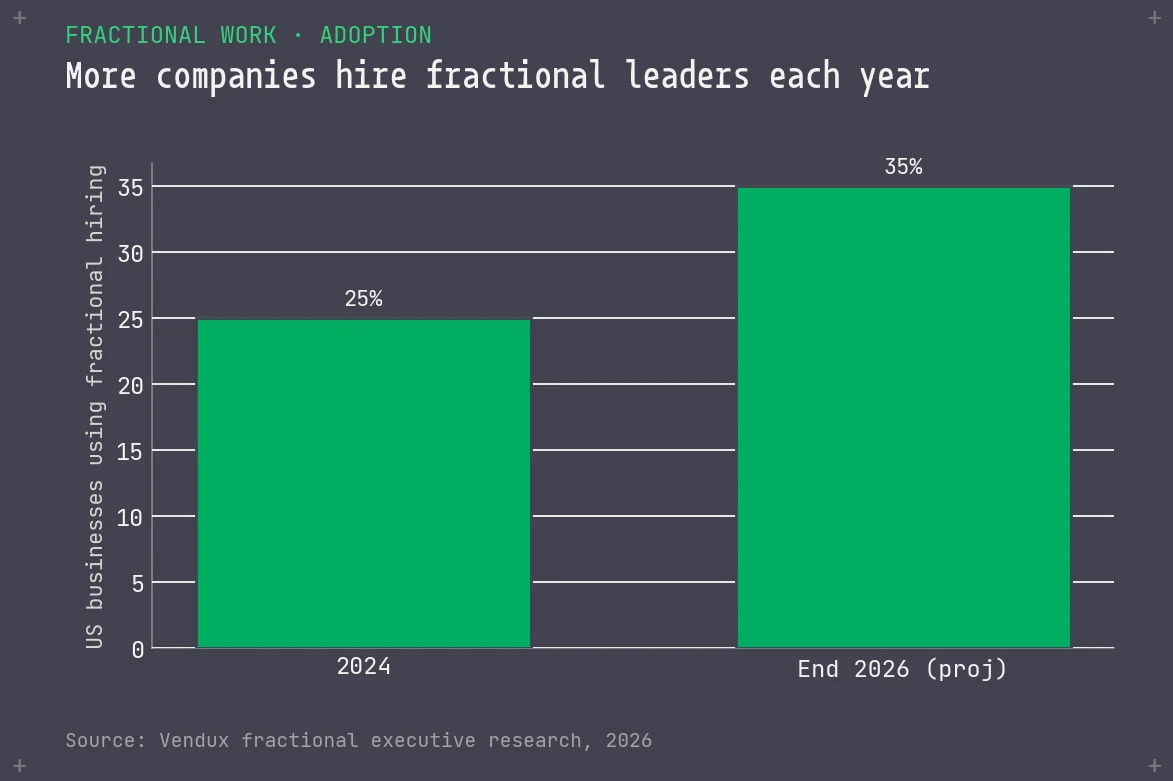
Fractional leadership has moved from novelty to normal in a few years. Roughly a quarter of US businesses now use some form of fractional hiring, with projections pushing toward a third or more by the end of 2026, and the global fractional executive market has reached several billion dollars growing around 14 percent a year, per Vendux's 2026 fractional-executive research. In the UK, fractional roles have grown several-fold since 2019 (Vendux). This is a structural shift, not a fad.
The reason is simple economics. A scaling brand needs senior experience but often cannot justify, or afford, a full-time leader for every function. Fractional matches the experience to the moments that need it and stops paying for it when they do not. For Shopify brands in the messy middle, past the founder-does-everything stage but before a full executive bench, it fits the need almost exactly.
How the engagement
actually runs.
The typical shape is a regular working cadence plus on-call access. Often that is a weekly session where you work through the priorities together, backed by availability between sessions for the decisions that cannot wait a week. The advisor gets read access to what they need to be useful, your analytics, your financials, the key tools, so the advice is grounded in your real numbers rather than generic best practice.
The first few weeks go to diagnosis, understanding the business well enough to find the real constraint. After that, it settles into a rhythm of working the prioritized list, adjusting as results come in. The best engagements feel less like consulting and more like having a seasoned operator on the team who happens to be there two days a month instead of five days a week. I describe the broader scope of that work in what a Shopify consultant does.
What the advisor
owns, and
what you do.
The clean division is that the advisor owns the direction and your team owns the execution. The advisor sets and defends the priorities, brings the outside judgment, and pressure-tests the big calls. Your team, or your agencies, build and run. A fractional advisor who drifts into doing the execution has stopped being an advisor and become an underpaid, part-time employee, which helps no one.
This is the same judgment-versus-hands line that separates an advisor from an agency, and getting it explicit at the start is what keeps the engagement healthy. If you are weighing which shape of help you need in the first place, the fractional operator vs CMO vs COO breakdown is a good place to start.
What it costs,
and why the
math works.
The retainer is priced on the seniority of the judgment rather than the hours logged. Scope drives the number, and most fractional executives in this range land somewhere between the low thousands and around twenty thousand dollars a month, well under the fully loaded cost of a full-time senior leader once salary, benefits, and equity push that number into the mid six figures a year. You get the experience without carrying the full-time overhead.
The ROI is easiest to see through the lens of avoided mistakes. One well-timed decision, not over-hiring, not mis-timing a raise or a retail push, not funding the wrong channel for two quarters, pays for a year of the retainer many times over. I put concrete numbers on the comparison in what a growth consultant costs.
Whether fractional
fits your team.
Fractional fits best when the gap is judgment, not capacity. If you have a capable team that executes well but keeps hitting decisions above their experience level, a fractional advisor slots in perfectly. If instead you need more hands to get work done, that is an agency or a hire, and a fractional advisor will not fill it. The model is about experience, not throughput.
It also fits the in-between stage particularly well: past the point where the founder can hold everything, before the point where you can justify a full executive team. Many brands use a fractional advisor precisely to figure out what their first senior hire should be, so the retainer pays for itself twice, once in the decisions it improves and once in the expensive mis-hire it prevents. If that sounds like where you are, that is exactly what I do as a Shopify growth consultant.
What the first
90 days look like.
A good fractional engagement has a shape you can see from the start. The first few weeks are diagnosis: the advisor gets into your numbers, your channels, your stack, and your team, and comes back with a clear read on the one or two constraints that actually matter. You should end month one knowing what the real problem is, which is often not the problem you thought you had going in.
Month two turns diagnosis into motion. The priorities are set, the team knows what it owns, and the weekly cadence is about working the list and adjusting as early results come in. This is where a fractional advisor earns trust, not with a strategy deck, but by helping the team ship the few things that matter and stop the ones that do not. By month three you should be able to point at concrete decisions that went differently because the advisor was in the room.
Ninety days is also the right first checkpoint to ask whether the fit is working. A fractional relationship is ongoing by design, but it should prove itself quickly. If, after a quarter, you cannot name specific calls that improved because of the outside judgment, the engagement is not working and you should say so. When it is working, it usually becomes one of the highest-return line items on the whole P&L, for the reasons I lay out in is a growth consultant worth it.
Before the ninety days start, the engagement is scoped through The Read, scoped as a fixed fee, credited against whichever tier follows, Consulting, the first rung, Advisory, or Partner; the pricing and terms for each are there.
If you want senior Shopify judgment without a full-time hire, the fractional model is built for exactly that. Let's talk about whether it fits where you are. If you want to test the fit first, The Read takes two weeks at a fixed fee, credited if you sign a tier.
What is a fractional Shopify advisor?
A fractional Shopify advisor is a senior operator who works with your business part-time on a retainer, giving you leadership-level judgment without a full-time hire. They embed enough to understand your store, numbers, and team, and stay independent enough to keep the outside perspective you hired them for. It sits between a one-off consultant and a full-time executive.
How does a fractional advisor engagement work?
Most engagements run on a regular cadence, often a weekly working session, plus on-call access between sessions for the decisions that cannot wait. The advisor gets read access to your analytics, financials, and key tools, works through a prioritized set of moves with your team, and owns the direction while your team owns execution. The structure is flexible and set at the start.
How much does a fractional Shopify advisor cost?
Fractional advisors typically work on a monthly retainer priced on the seniority of the judgment, not billable hours. For context, comparable fractional executives commonly run in the low thousands to twenty thousand dollars a month depending on scope, well below a full-time leader whose loaded cost runs into the mid six figures a year. You pay for judgment applied where it matters, not a full-time seat.
Why is fractional leadership growing so fast?
Because it matches senior judgment to the moments that actually need it, at a fraction of the cost of a full-time hire. Roughly a quarter of US businesses now use fractional hiring, with projections toward a third or more by the end of 2026, per Vendux's 2026 research. For scaling brands that need experience but not a full-time salary, the economics are hard to argue with.
Is a fractional advisor better than an agency or a full-time hire?
It depends on the gap. An agency is best when you need execution hands at volume. A full-time hire is right when the role is a whole function the business cannot run without. A fractional advisor is best when the constraint is judgment: you need senior experience on the key decisions, but not forty hours a week of it. Many brands use a fractional advisor precisely to figure out what to hire for next.