A fractional CMO owns marketing, a fractional COO owns operations, and a fractional operator or advisor works across the whole P&L on the few decisions that move it. The right one depends on whether your gap is a specific function or general judgment. Fractional leadership has boomed, with sub-markets like the fractional CFO and CMO now worth billions, because it matches senior experience to the moments that need it.
- A fractional CMO fills a marketing-leadership gap; a fractional COO fills an operations one.
- A fractional operator or advisor is cross-functional: bought for judgment across the whole business, not one department.
- Pick by the gap: a function needs a functional fractional exec; a prioritization problem needs an operator's judgment.
Fractional leadership has gone from novelty to normal, and with the boom has come a pile of titles that blur together: fractional CMO, fractional COO, fractional operator, fractional advisor, fractional growth lead. They are not interchangeable. Each fills a different gap, and hiring the wrong one is a way to spend real money solving a problem you do not have.
I work as a fractional operator, across the whole P&L rather than a single function, so I see where these roles overlap and where they genuinely differ. Here is what a fractional CMO, a fractional COO, and a fractional operator each actually do, and a simple way to pick the one your brand needs.
Fractional went
from fringe to billions.
The fractional model is not a fad, it is a structural shift with real money behind it. Industry research puts the global fractional executive market in the billions, growing around 14 percent a year, with individual sub-markets now sizeable in their own right: the fractional CFO market near 3.2 billion dollars and the fractional CMO market around 1.27 billion in 2026, per Vendux's 2026 fractional-executive research. Roughly a quarter of US businesses already use some form of fractional hiring.
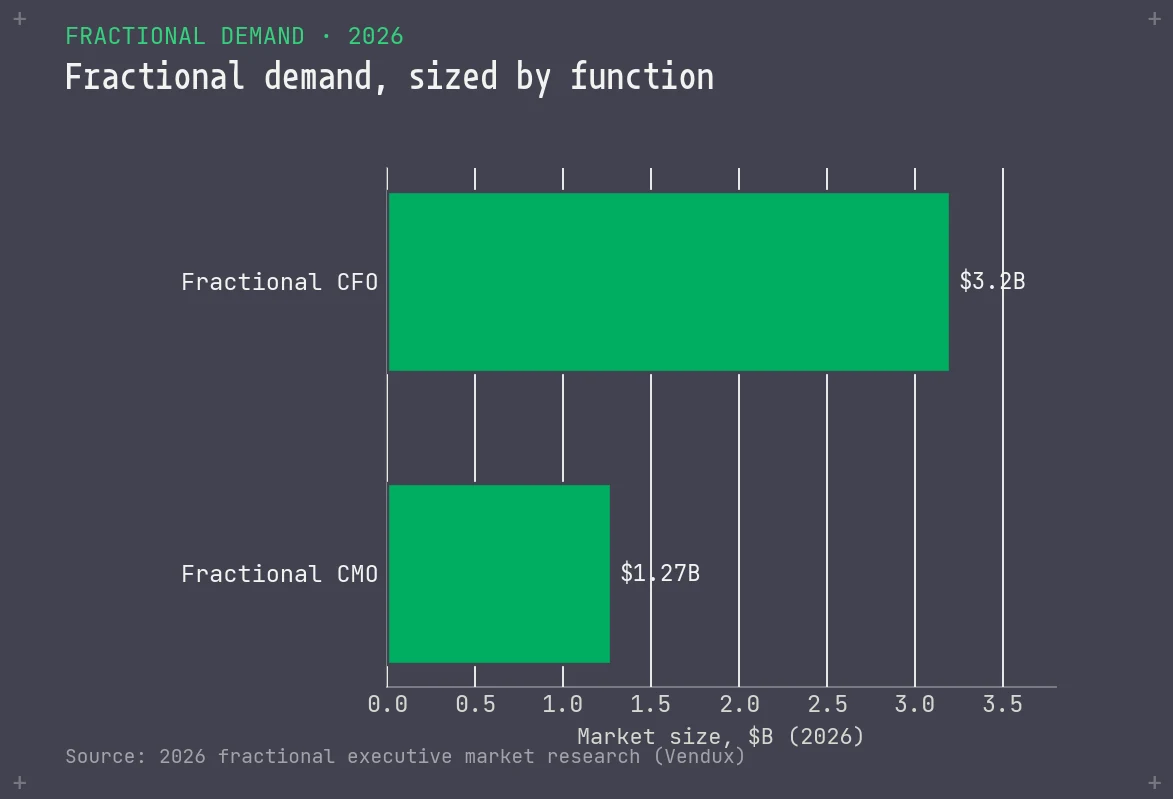
The reason for the boom is simple: it matches senior experience to the moments that need it, at a fraction of a full-time salary. That logic applies to every function, which is why fractional versions of nearly every executive role now exist. The question for you is not whether fractional works, it clearly does, but which fractional role fits your actual gap.
The fractional
CMO.
A fractional CMO is a part-time marketing leader. They own the marketing function: the strategy, the channel mix, the brand, the budget, and often the marketing team and agencies. You hire one when you have a genuine marketing-leadership gap, marketing that lacks senior direction, a team that needs a leader, or a channel strategy that has stalled, but not enough scale or need to justify a full-time CMO whose loaded cost runs into the mid six figures.
The fit is a specific one. A fractional CMO is the right hire when marketing, specifically, is the thing that needs senior ownership. Where brands go wrong is hiring a fractional CMO for a problem that only looks like marketing. Flat growth is often not a marketing gap at all but a retention or margin problem, and a CMO brought in to fix "marketing" will optimize the wrong thing well.
The fractional
COO.
A fractional COO is a part-time operations leader. They own execution, systems, and process: fulfillment, supply chain, the operational backbone, and the discipline that keeps a growing business from breaking under its own weight. You hire one when the business is scaling faster than its operations can handle, when work is manual and ownership is unclear, when things keep breaking as volume rises.
The fractional COO is the right call when the constraint is execution and operations, not direction. A brand that knows where it is going but cannot reliably deliver, whose growth is capped by operational strain rather than demand, needs operational leadership more than another strategy. The failure mode, again, is a mismatch: hiring a COO to fix operations when the real problem is that the brand has not decided which direction to grow.
Operations and strategy are different jobs, and a scaling brand often needs both. But they are rarely the same hire, and being clear about which is binding you now saves an expensive mis-hire.
The fractional
operator or advisor.
A fractional operator, or growth advisor, is the cross-functional one. Rather than owning a single department, they work across the whole P&L on the few decisions that actually move the business: which levers matter, in what order, whether a big move is timed right, where growth is leaking. They bring general operating judgment rather than functional depth in one area, and they are bought precisely when the problem spans functions.
This is the right role when your gap is not "marketing" or "operations" but "which of these ten things should we actually do, and what will each do to the P&L." That is a prioritization and judgment problem, not a functional one, and it is the most common real problem a scaling brand has. The operator's cross-functional view is exactly what a single-function fractional exec cannot provide, because each of them is measured on their own department. It is the role I describe in how a fractional advisor engagement works.
A fractional operator is also often the right first hire, because they can diagnose which functional gap to fill next. Bring in the cross-functional judgment first, and you may find the specific fractional CMO or COO you thought you needed is either urgent or not needed at all. Naming the binding constraint is where the early weeks of an operator-advisor engagement usually go.
Which one fits
your gap.
The choice comes down to naming your gap honestly. If marketing specifically lacks senior leadership, a fractional CMO. If operations are breaking under growth, a fractional COO. If the problem is deciding what matters most across the whole business, a fractional operator or advisor. The mistake is reaching for a functional role when the real gap is cross-functional judgment, which is the most common misdiagnosis I see.
| Your gap | Role that fits | What they own |
|---|---|---|
Marketing lacks a leader | Fractional CMO | Strategy, channels, team |
Operations keep breaking | Fractional COO | Systems, process, execution |
Unclear what to prioritize | Fractional operator | The whole P&L, sequencing |
Need hands, not judgment | Agency or hire | Execution at volume |
If you genuinely cannot tell which gap is binding, that uncertainty itself points to the operator, because diagnosing the real constraint is exactly their job. Start cross-functional, and let the diagnosis tell you what to hire next.
What does a fractional CMO cost
for an ecommerce brand?
An ecommerce fractional CMO costs about $5,000 to $8,000 a month under $2M in revenue, rising to $18,000 to $30,000 or more past $30M, per MarketerHire's July 2026 rate table. The experienced end of the market sits at $12,000 to $22,000 a month. A full-time marketing leader runs $30,000 to $45,000 or more a month, fully loaded.
| Annual revenue | Fractional CMO, per month | Hours a week | Fractional CMO or full-time VP of Marketing? |
|---|---|---|---|
Under $2M | $5,000 to $8,000 | About 10 | Fractional, or neither. A VP of Marketing package runs about $325,000 a year before benefits and payroll tax. |
$2M to $10M | $7,000 to $15,000 | 15 to 20 | Fractional CMO to set the plan, with a marketing manager or agency doing the work under it. |
$10M to $30M | $12,000 to $22,000 | 20 to 25 | The crossover. A full-time VP of Marketing to run the team starts to pay, with CMO-level judgment from a fractional leader or the founder. |
$30M and up | $18,000 to $30,000 or more | About 25 | Full-time leadership. A CMO package runs $400,000 or more before benefits; fractional fits between hires. |
The prices and hours come from MarketerHire's July 2026 table for ecommerce brands; the last column is my read. Revenue is a proxy for what actually sets the price, which is scope and hours. A $15M brand that wants board reporting and a team to hire pays the next band's rate. Across industries, Fractionus's April 2026 US guide puts most retainers at $8,000 to $22,000 a month, which matches the middle of this table.
The CMO and the VP of Marketing are different jobs, so the comparison is more than a price check. A CMO sits on the executive team and owns strategy, brand, budget and the board conversation. A VP of Marketing runs the team and the channel plan, and reports to a CMO or, at most ecommerce brands under $30M, to the CEO. That's why a fractional CMO and a full-time VP pair well: one sets direction a day or two a week, the other runs it every day. Who sits where at that stage is covered in the $10M DTC org chart.
Against a full-time hire, the fractional math is simple. A full-time executive runs $30,000 to $45,000 or more a month fully loaded, before the recruiter fee and a ramp of several months. An experienced fractional CMO runs about $12,000 to $22,000. The same holds for a COO or a general operating leader, with the full rate comparison in what a growth consultant costs.
Cost still shouldn't decide between the three roles in this post, because they solve different problems, and the cheapest role that solves the wrong problem is the expensive one. Choose the role by the gap first, then weigh the cost. A fractional operator and a fractional CMO priced the same are still no substitute for each other if your gap is operational.
One practical note: because a fractional operator is cross-functional, they can sometimes reduce the need for several functional hires, which changes the total cost picture in their favor when the underlying problem is really prioritization.
How to actually
choose.
To choose, answer one question honestly: is the binding constraint a specific function, or the prioritization across all of them? If you can point cleanly at marketing or operations as the thing that lacks leadership, hire the matching functional fractional exec. If you're left thinking "we are not sure what to focus on," or "everything feels urgent," you have a judgment gap, and a fractional operator is the fit, often as the first move.
And keep the fourth option in view: if you do not need judgment at all, just more hands to execute a known plan, none of these roles is right, and an agency or a hire is the answer. That distinction, judgment versus hands, is the one that decides all of this, and it runs through fractional advisor vs agency vs hire.
If you want help naming which gap is actually binding you, that is a short conversation and exactly the kind of diagnosis an operator does. Tell me where the business is stuck, and I will tell you which fractional role, if any, fits.
On my own roster those roles map to named tiers rather than titles: Advisory is the fractional-operator seat, Consulting, the diagnosis-led tier, is the lighter version, and Partner is the deepest. The published tiers have the scope for each, and The Read, an optional fixed-fee first step, is one way to test the fit before any of them.
If you are not sure whether the gap is a function or general judgment, that is worth ten minutes. Tell me where you're stuck and I'll tell you which role fits. If you want to test the fit first, The Read takes two weeks at a fixed fee, credited if you sign a tier.
What is the difference between a fractional CMO, COO, and operator?
A fractional CMO is a part-time marketing leader who owns the marketing function. A fractional COO is a part-time operations leader who owns execution, systems, and process. A fractional operator or advisor is cross-functional, working across the whole P&L on the few decisions that move it rather than running one department. The first two fill a functional gap; the third fills a judgment-and-prioritization gap.
Do I need a fractional CMO or a consultant?
If your gap is specifically marketing leadership, someone to own strategy, channels, and the marketing team, a fractional CMO fits. If your gap is broader, deciding which few things across the whole business matter most, a cross-functional operator or advisor fits better. Many scaling brands actually have a prioritization problem that looks like a marketing problem, which is why the cross-functional lens is often the more useful hire.
How much does a fractional CMO cost for an ecommerce brand?
Most ecommerce brands pay $5,000 to $30,000 a month, and revenue band explains most of the spread. MarketerHire's July 2026 table puts brands under $2M at $5,000 to $8,000, $10M to $30M at $12,000 to $22,000, and $30M and up at $18,000 to $30,000 or more. A full-time CMO package starts around $400,000 a year before benefits.
Is a VP of Marketing higher than a CMO?
No. The CMO is the senior role: a member of the executive team who owns marketing strategy, brand and budget, usually reporting to the CEO. A VP of Marketing runs the team and the channel plan and reports to the CMO, or to the CEO where there is no CMO. Many ecommerce brands have one of the two, not both.
When should I hire a fractional COO?
A fractional COO makes sense when the business is growing faster than its systems and processes can handle: fulfillment strain, unclear ownership, manual work everywhere, and execution that keeps breaking as you scale. The COO's job is to build the operational backbone so growth does not collapse under its own weight. If the problem is more about which direction to grow than how to execute, that is operator or advisor work instead.
How big is the fractional executive market?
It has grown into a multi-billion-dollar market. Industry research puts the global fractional executive market at several billion dollars growing around 14 percent a year, with sub-markets like the fractional CFO near 3.2 billion dollars and the fractional CMO around 1.27 billion in 2026, per Vendux's 2026 fractional-executive research. Roughly a quarter of US businesses now use some form of fractional hiring, with projections toward a third or more.
Which fractional role is right for a scaling ecommerce brand?
It depends on the binding constraint. If marketing leadership is the gap, a fractional CMO. If the business is breaking operationally, a fractional COO. If the real problem is deciding what to prioritize across acquisition, retention, margin, and expansion, a fractional operator or growth advisor who sees the whole P&L is the better fit, and often the one to start with, because they can tell you which functional gap to fill next.