Hiring an ecommerce consultant in the UK is not the same as hiring one in the US. The UK is the third-largest ecommerce market in the world and one of the most online-heavy anywhere, with around 27.5% of retail happening online (ONS). VAT, duties, cross-border rules, and a distinct market all change the playbook, so the advisor you want has operated across markets, not just read about them.
- The UK is the world's third-largest ecommerce market and unusually online-heavy, around 27.5% of retail (ONS, 2025).
- VAT, duties, and post-Brexit cross-border rules change the economics, so US-centric advice does not port cleanly.
- Fractional and remote engagements work well across time zones, so the right advisor matters more than their postcode.
Most ecommerce advice online is written for the US market, and it quietly assumes a US brand, US shipping, US tax, and a US shopper. If you are building in the UK or Europe, a lot of that advice does not port cleanly, and following it can cost you. The UK is not a smaller version of the US market. It is one of the most online-heavy markets on earth, with its own rules and its own playbook.
I have advised and operated brands with a client base that was never US-only, so this is a distinction I take seriously. Here is what actually changes when you hire an ecommerce consultant for a UK or European brand, and what to look for, so you get advice built for the market you actually sell in.
The UK is more
online than
almost anywhere.
Start with the size of the prize. The UK is the third-largest ecommerce market in the world, behind only China and the US, and it is unusually online-heavy: around 27.5% of all retail happens online (ONS, 2025), well above the US figure of around 16% (US Census Bureau). British shoppers buy online more readily, expect faster delivery, and are more comfortable with newer channels than most markets.
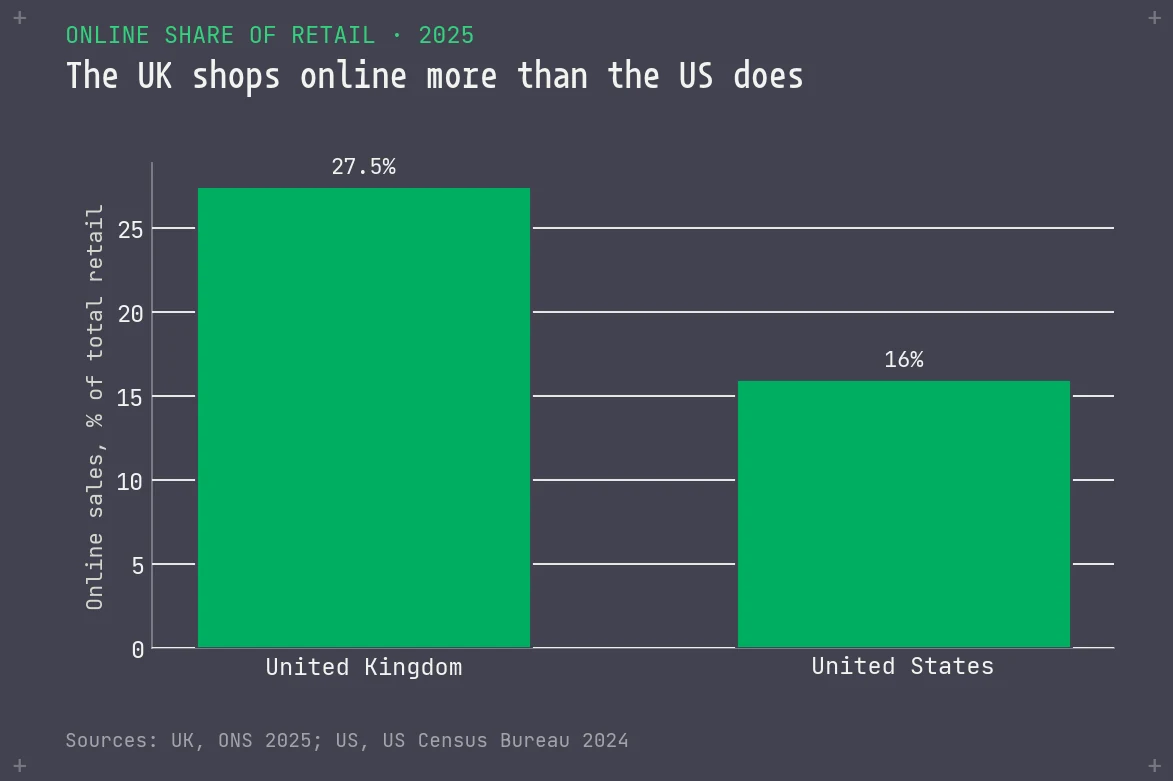
That maturity cuts both ways. The opportunity is large and the shopper is ready, but the market is competitive and expectations are high, so the sloppy execution a newer market might forgive gets punished here. An advisor working with a UK brand has to plan for a demanding, online-first customer from day one, not treat digital as a channel the brand is still growing into.
VAT and duties
change the economics.
The biggest practical difference is tax and cross-border. UK prices include VAT, which shapes how you present pricing and what your real margin is, and getting VAT registration and treatment right is not optional. Since Brexit, selling between the UK and the EU carries more customs and duty complexity than it used to, and a brand that ignores it can watch a profitable order turn into a loss once fees and returns are counted.
None of this is exotic once you have lived it, but it is exactly the kind of thing a US-centric playbook skips. A consultant working with a UK or European brand has to build the plan around VAT-inclusive pricing, cross-border duty, and the fulfillment reality of shipping into multiple tax regimes. Those are P&L decisions, not admin, and they change which markets and channels are actually worth pursuing.
This is why "just copy what the big US DTC brands do" is bad advice across the Atlantic. The tax and logistics substrate is different, so the same tactic can have very different economics. The job is to build the plan on the real, local numbers.
A mature market
rewards discipline.
Because the UK market is mature, the easy growth is mostly gone, and the brands that win tend to be the ones with real discipline on economics and retention rather than the ones spending fastest. Paid acquisition is competitive and not cheap, so a plan that leans entirely on buying new customers is fragile. The advisor's job is often to shift the centre of gravity toward retention, owned channels, and margin, which is where durable growth in a mature market actually comes from.
The channel mix also differs from the US in the details: which marketplaces matter, how retail and wholesale fit, how shoppers discover brands. A good consultant knows the local landscape rather than assuming the US one. If your growth has plateaued in a competitive market, the fix is usually sharper priorities, not more spend, which is the same lesson in the stages where DTC growth breaks.
The upside of a demanding market is that discipline compounds. Brands that get retention and margin right in the UK are hard to dislodge, because the same maturity that makes entry hard makes an established position defensible.
The advisor's
postcode barely matters.
Here is the reassuring part. The working model for advisory has gone remote and fractional almost everywhere, and it works well across time zones. A UK brand does not need an advisor sitting in London any more than it needs its accountant in the next room. What it needs is an advisor who understands the UK and European market and its economics, and who can be genuinely present on a regular cadence.
Fractional engagements in particular travel well, because the model is built around focused, regular sessions plus availability between them rather than a physical desk. I describe exactly how that works in how a fractional advisor engagement runs. The upshot is that you should optimize for the right operator and the right market knowledge, not for proximity.
What you should not compromise on is genuine understanding of your market. A remote advisor who knows UK and EU economics beats a local one who only knows a single tactic. Location is a convenience. Judgment and market fluency are the product.
What to look for
in a UK advisor.
Look for three things. First, operating experience across markets: someone who has actually scaled brands and dealt with cross-border reality, not just consulted on it. Second, a P&L lens rather than a single-channel focus, because the biggest UK-specific decisions, VAT-inclusive pricing, which markets to enter, how to structure fulfillment, are economic decisions. Third, honesty about when an advisor is not the answer, which is the surest sign of one worth hiring.
Be wary of the opposite: a one-size template lifted from US DTC, a single-tactic specialist selling their one trick, or anyone who cannot speak fluently about VAT and cross-border. Those are signs the advice will not survive contact with the local market. The broader vetting checklist in what to look for in a consultant applies here too, with the market fluency layered on top.
Above all, make sure the advisor plans from your real numbers in your real market, not from a generic playbook. That is the whole point of hiring judgment rather than a template.
Advice from
operating across markets.
The most useful advisor for a UK or European brand is one who has operated across markets and paid for the lessons directly. Growing consumer-brand portfolios across DTC, marketplace, and retail into the mid nine figures, with a footprint that was never confined to one country. That means the cross-border decisions, the tax reality, the channel differences, are things I have navigated with real money at stake, not studied from the outside.
That operating background is the difference between advice that sounds right and advice that survives contact with a real market. When the question is whether a market is worth entering, or how to price with VAT, or where the margin actually is once duties and returns are counted, the answer should come from someone who has run those numbers before.
If you are building in the UK or Europe and want that kind of advisor, that is exactly what I do as an ecommerce growth consultant, with a plan built on your market, not a US template.
When a UK brand
should bring one in.
The triggers are the same as anywhere, sharpened by the market. Bring in an advisor when growth has stalled and the team cannot agree why, when an expensive decision like entering the EU or launching retail is on the table, or when rising acquisition costs are quietly eroding margin. In a mature market like the UK, that margin erosion tends to arrive sooner, which makes the retention-and-economics work more urgent, not less.
The counter-signal is the same too: if you already know the plan and just need execution, hire an agency or a specialist, not a consultant. The honest test of whether it is worth it is in is a growth consultant worth it, and it applies just as well on either side of the Atlantic.
Wherever you land, the principle holds: get advice built for the market you actually sell in. For a UK or European brand, that means an advisor fluent in cross-border economics and disciplined about the P&L, working from your numbers rather than someone else's.
If you are building in the UK or Europe and want an advisor who has actually operated across markets, that is exactly the gap I fill. Let's talk about your market, not a US template. If you want to test the fit first, The Read takes two weeks at a fixed fee, credited if you sign a tier.
Do I need a UK-based ecommerce consultant?
You need an advisor who understands the UK and European market and its rules, which is not the same as one who happens to live in London. VAT, duties, cross-border logistics, and the local channel mix all matter, and a US-centric playbook does not port cleanly. But fractional and remote engagements work well across time zones, so operating experience across markets matters more than a postcode.
What's different about ecommerce in the UK?
The UK is unusually online-heavy: around 27.5% of retail is online, and it is the third-largest ecommerce market in the world after China and the US, per ONS and industry data. That means high online expectations, a mature and competitive market, and a shopper used to fast, cheap delivery. It also means VAT and, since Brexit, more complex cross-border rules into and out of the EU.
How much does an ecommerce consultant cost in the UK?
UK ecommerce consultants price much like their US peers: project audits, fixed-scope sprints, or a monthly retainer for an embedded advisor, with the retainer priced on the seniority of the judgment rather than hours. Currency and local market rates vary, but the right comparison is the same everywhere: the cost of the advice against the cost of the decision it helps you get right.
Can a US-based consultant help a UK brand?
Yes, if they genuinely understand the UK and European market and have operated across borders, rather than applying a US template. Remote and fractional models make the working relationship straightforward across time zones. What matters is whether the advisor has real experience with cross-border economics, VAT, and the local channel landscape, not which country they sit in.
What should a UK ecommerce brand look for in a consultant?
Look for operating experience across markets, a clear grasp of cross-border economics and VAT, and judgment that reads every decision through the P&L rather than a single channel. Avoid anyone selling a one-size template or a single tactic. The best advisor for a UK brand has scaled real brands, understands the local and cross-border realities, and will tell you honestly when an advisor is not what you need.