Hiya · Subscription · Cold / prospecting · August 2026 · Handoff: Partial · By Taylor Sicard
Hiya ad teardown: We warned you nights would get easier
Hiya sells a bedtime chewable by refusing to mention sleep quality and selling the parent's evening back instead.
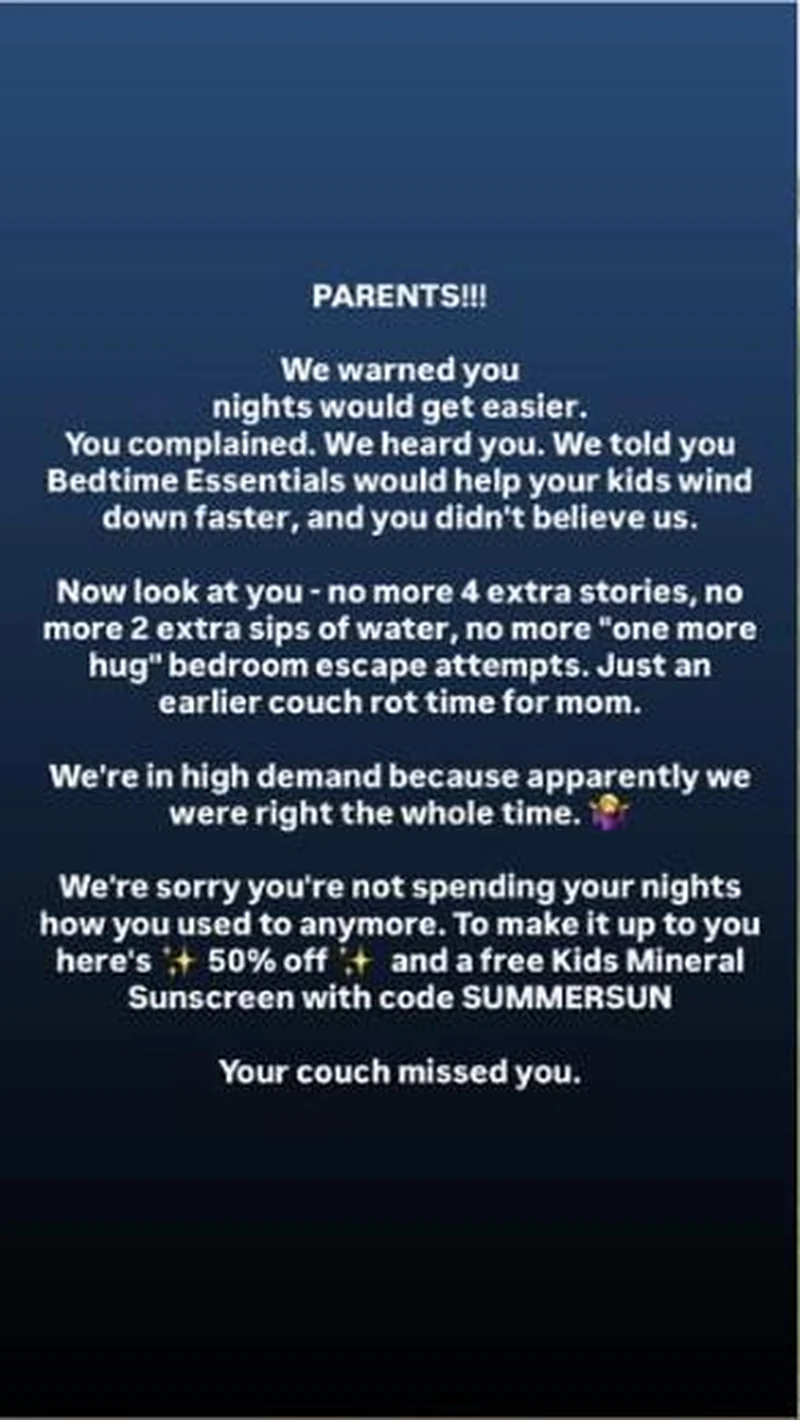
“We warned you nights would get easier.”
Handoff: Partial
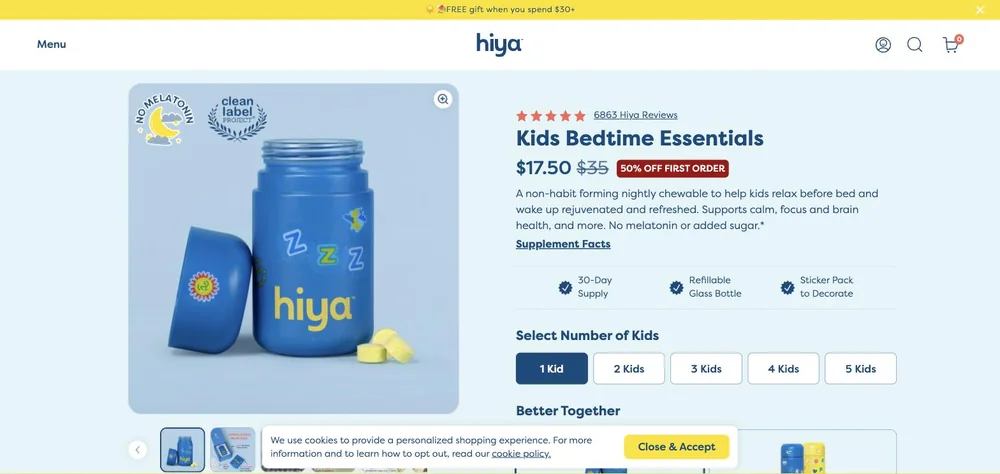
The ad closes on "50% off and a free Kids Mineral Sunscreen with code SUMMERSUN" and the page pays out only half of that: $17.50 with $35 struck through and a red "50% OFF FIRST ORDER" chip, while SUMMERSUN and the sunscreen appear nowhere, replaced by a yellow site bar reading "FREE gift when you spend $30+" that a one-kid order at $17.50 does not reach as of the 2026-08-20 capture. Product and audience hold, since the page leads "Kids Bedtime Essentials" over "A non-habit forming nightly chewable to help kids relax before bed". The NO MELATONIN roundel and "No melatonin or added sugar" sit above the fold, which is more melatonin handling than the ad does, because the ad never says the word and sells "an earlier couch rot time for mom" instead. The register cools too, from the ad's teasing "Your couch missed you." to supplement-buyer trust marks about a 30-Day Supply, a refillable glass bottle and a sticker pack.
The read
An all-text vertical on a navy-to-black gradient with no product and no photography, written as a mock apology from the brand to its own customers. It opens "PARENTS!!!" then "We warned you nights would get easier.", accuses the reader of not believing the brand, and lists what they have lost: "no more 4 extra stories, no more 2 extra sips of water, no more 'one more hug' bedroom escape attempts. Just an earlier couch rot time for mom." The offer arrives as reparation, "here's 50% off and a free Kids Mineral Sunscreen with code SUMMERSUN", and it signs off "Your couch missed you." The rest of the bedtime set stays in the same lane by different means: a four-panel stick-figure comic that puts the objection in panel one as "How can I get my son to get restful sleep without melatonin?" and answers it in panel two, and a run of dim-bedroom creator stills captioned "if you want your nights back, this is what i use to put my toddler to bed".
What the ad does
- The promise is the parent's evening, itemised. Nothing on the tile claims better sleep. It claims what stops: "no more 4 extra stories, no more 2 extra sips of water, no more 'one more hug' bedroom escape attempts. Just an earlier couch rot time for mom." The child is the mechanism, the parent is the buyer, and only the buyer is addressed.
- The objection is the product. Every cut leads on the absence of melatonin rather than on an active. The comic scripts the search query in panel one, "How can I get my son to get restful sleep without melatonin?", and answers it in panel two. For a kids sleep product the fear of sedating a child is the purchase barrier, so removing it is the pitch.
- An apology is a permission structure for a discount. "here's 50% off and a free Kids Mineral Sunscreen with code SUMMERSUN" arrives as reparation for an outcome that has already happened, which lets a hard promotional offer run without reading as a fire sale, and slips a second SKU inside a bedtime ad while nobody is looking at the price.
Objective fit
Subscription. The bedtime chewable is a monthly refill product and the incentive is a first-order discount plus a bonus SKU, which is acquisition pricing into a recurring plan rather than a one-off purchase push. The promise itself is repetitive by construction: a predictable bedtime only exists if the product is taken nightly.
Hiya ran this subscription creative to the landing page it clicked through to, both captured August 2026. Hiya sells a bedtime chewable by refusing to mention sleep quality and selling the parent's evening back instead. Read as a pair, the handoff rates partial.
- The promise is the parent's evening, itemised. Nothing on the tile claims better sleep. It claims what stops: "no more 4 extra stories, no more 2 extra sips of water, no more 'one more hug' bedroom escape attempts.
- The objection is the product. Every cut leads on the absence of melatonin rather than on an active. The comic scripts the search query in panel one, "How can I get my son to get restful sleep without melatonin?", and answers it in panel two.
- An apology is a permission structure for a discount.
- What to fix: Honour the code on arrival or stop printing it.
Ad captured by Taylor Sicard 2026-08-20, landing page 2026-08-20. Screenshots reproduced for commentary and criticism.
Tagged
- Objective
- Subscription
- Funnel
- Cold / prospecting
- Format
- Static imageUGC videoMeme / low-fiTalking head
- Placement
- Meta feedMeta reelsInstagram stories
- Category
- Baby & Kids
- Mechanic
- Problem agitationObjection handlingHumourPattern interrupt
- Handoff
- Partial
- Brand
- Hiya
Pattern interrupt is #5 of 21 ranked mechanics, on 41 pairs. See where pattern interrupt ranks
How this was evidenced
- Evidence
- Pair captured The ad and the page it clicked through to were both captured first-hand, and the destination recorded is the page the ad pointed at.
- Ad creative
- Captured August 2026
- Destination
- https://hiyahealth.com/products/kids-bedtime-essentials Captured August 2026. Advertisers change their ads and pages continuously, so the live page may differ from the capture above. That is expected, and the capture is the record.
- Region
- Routes non-US readers to /en-ca, which drops the product page entirely.
- Ad Library
- Ad ID 1625418578934362
Variants of the same system (2)
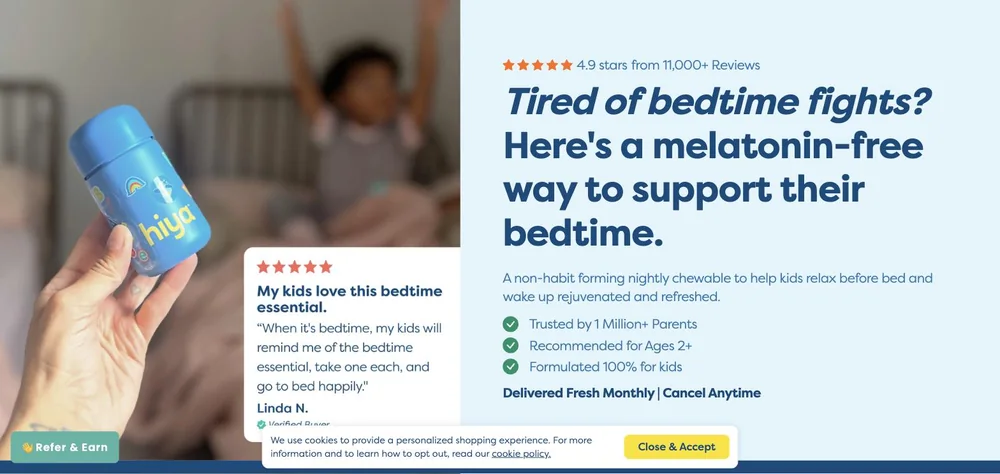
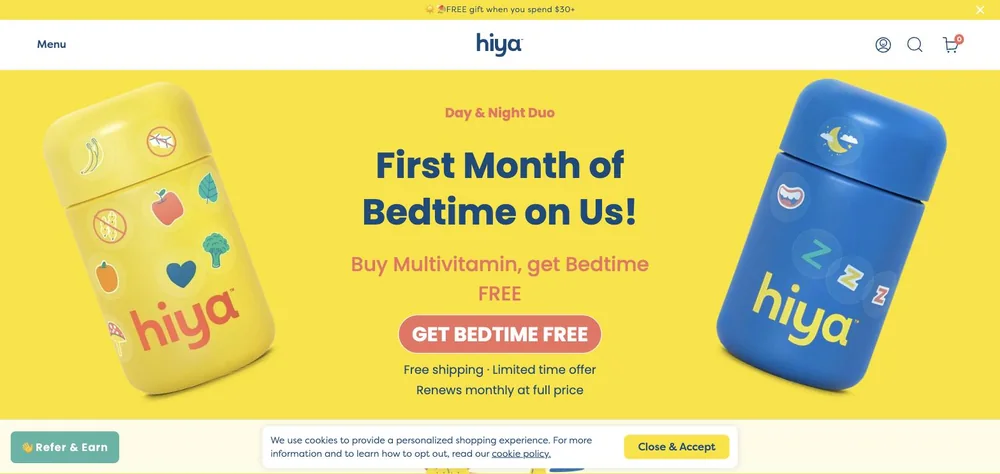
The bedtime argument runs to two destinations. Brand-authored statics and the pediatrician cut go straight to the Bedtime Essentials PDP, while the creator UGC stills, all shot as a hand holding the blue NiGHT bottle in a dim bedroom, route instead to a dedicated bedtime landing page. Same product, same objection, different amount of convincing assumed. Observed 2026-08-20.
What to fix
Honour the code on arrival or stop printing it. The ad closes on "50% off and a free Kids Mineral Sunscreen with code SUMMERSUN" and the page pays half of it: $17.50 against $35 struck through, with SUMMERSUN and the sunscreen absent and a bar reading "FREE gift when you spend $30+" that a one child order at $17.50 cannot reach. Keep the joke over a modest claim, too: port it onto sedating language and the funny ad becomes a regulatory problem.
One of 25 pairs where the offer on the page is not the offer in the ad. See the pattern · See all 25
Sources
More from Hiya (2)
The same play elsewhere
Same humour, different brands.
 French Bandit A French break the glass poster for the sage fountain lands on an English, dollar priced cat grid that opens with a 12 dollar filter subscription.
 Grüns A blunt gut health static that says the word nobody else in the feed will say, then hands the claim to one fibre number.
 O Positiv A pineapple joke about flavour hands off to a page that answers on flavour once, then argues clinical science for the rest of the fold.
 biom A phone clip of a big box aisle with no product in frame lands on a wipes page whose default option is a monthly AutoShip order.
Does your own handoff survive the click?
This is the same read I run on live funnels: the ad, the page, and the gap between them. Scored, free, no call required.
Audit my store freeNew teardowns as they land, in Commerce Dispatch: the ad, the page it clicked to, and what the gap cost. Same free newsletter as the footer, no separate list.
Back to The Handoff, the full library of 253 teardowns, 226 of them ad and page pairs, filterable by objective, funnel stage, format, placement, category and persuasion mechanic.
Read next: what breaks, across every rated pair, drawn from every pair in this library.
Hiya is named here solely to identify the advertising being analysed. Brand names and marks are the property of their respective owners. No brand shown has any affiliation with, or has endorsed, Taylor Sicard Consulting.