Shopify apps in 2026 price six different ways, and the sticker number is the smallest part. Flat-fee apps like Judge.me ($15) and PageFly ($0 to $99 for unlimited pages) stay cheap. The bill comes from apps that scale with your orders, list size, or a percentage of the sales they touch, so a $99 sticker can become a four-figure line as you grow.
- Reviews run $0 to about $300, loyalty $15 to $999, both stepped by monthly order volume.
- Subscriptions add a 1.0% to 1.5% cut of every recurring order on top of a monthly fee (Recharge, Skio).
- A full DTC app stack commonly runs $300 to $800 a month near $1M in revenue and $2,500 to $6,000 near $10M.
Every merchant I talk to underestimates their app bill, and it is usually the same mistake. They add up the sticker prices on the pricing pages, get a number they can live with, and install. Then twelve months and a lot of order growth later, the monthly total has quietly doubled, because most of the apps that matter don't charge a flat fee. They charge on something that grows: your orders, your list, or a slice of the money they move.
This post is the price data, laid out category by category, with named apps and their real 2026 tiers pulled from their own pricing pages. If you want the strategy of how to price your own Shopify app, that is a separate piece. This one answers a narrower question a merchant or a competing founder actually types into a search bar: what do these apps charge, and which model am I signing up for?
I have seen this from three seats. I helped build and scale the Shopify Partner Program as an early employee, so I watched app pricing take shape on the platform. I co-founded WIN Brands Group, where the app stack was a real line on the P&L and I audited every renewal. And I founded a Shopify-ecosystem SaaS company that Tiny acquired, so I have set these prices from the other side of the table. The prices below are current as of mid-2026 and sourced to each app's own pricing page. Treat them as the shape of the market, because tiers and rates change, and the app you install today may reprice next quarter.
One framing before the tables. The most useful thing you can know about an app is its billing model, not its entry price: whether it charges a flat fee, steps up with your orders, scales with your email list, meters every message, or takes a percentage of the sales it touches. That one attribute predicts your bill at scale far better than the sticker does, so the post starts there, then walks the categories.
A quick aside on "Shopify mobile app pricing," because people search it two ways. If you mean Shopify's own mobile admin app, the one you run your store from, it costs nothing extra: it is included with every Shopify plan. If you mean the app-builder category, the platforms that turn your store into a native iOS or Android shopping app, that is a premium SaaS category of its own, usually sold on custom or high flat tiers rather than the order-stepped pricing below. The billing-model rule in this post still applies to them: ask what the bill scales with before you sign, not what the entry tier costs.
The sticker price is
the smallest number
on the page.
Start with the headline number. A single Shopify app in 2026 costs anywhere from free to a few hundred dollars a month at the sticker level, and the marquee apps in most categories cluster between $15 and $500. That range sounds manageable, and for the flat-fee apps it stays that way. The catch is that the apps a growing brand actually needs are rarely flat-fee.
Zoom out to the whole store and that range has a clear center of gravity. Across every live app, the median entry price is $9.99, which is also the single most common price point, with more than 1,400 apps leading with exactly that number (RevenueHunt, June 2026). Nearly half the store, about 45 percent, offers a permanent free tier, and only around 1 in 20 apps asks for money before you install. On the Shopify App Store, free entry is the default and charging before install is the rare exception. That is the backdrop for everything below: getting in the door is cheap or free almost everywhere, so the sticker was never going to be where your bill comes from.
Across the DTC brands I have operated and advised, a working app stack tends to cost 1% to 3% of revenue once you count the order-tiered, contact-based, and revenue-share tools together. At $1M in annual revenue that is roughly $300 to $800 a month for a lean stack. At $10M it is commonly $2,500 to $6,000 a month for the same categories on higher tiers, and the single biggest line is often a subscription app taking a percentage of every recurring order rather than any monthly sticker. The stack does not get more expensive because you added apps. It gets more expensive because the apps you already have are metered to your growth.
That's the whole reason a benchmark like this is useful. If you know a category leader charges $199 at 2,500 orders and $999 at 7,500 orders, you can model your real bill at the scale you are heading toward, not the scale you are at. And you can spot the quiet killers early: the tools whose cost rises faster than the value they add, which is exactly where app bloat turns from an annoyance into a margin problem. The App Store keeps expanding, and so does the temptation to solve every problem with one more install.
"The stack does not get more expensive because you added apps. It gets more expensive because the apps you already have are metered to your growth."
The six models every
app bill is built
from.
Almost every Shopify app prices in one of six ways. Learn the six and you can predict any app's cost curve before you install it, because the model tells you what your bill is indexed to. Here they are, in rough order of how gently or steeply they scale with a growing business.
| Model | Example apps | What it costs as you grow |
|---|---|---|
Flat monthly tiers Fixed price per feature tier | Judge.me, PageFly | Predictable. Stays flat regardless of volume |
Order-volume tiers Price steps up with monthly orders | Smile.io, Okendo, Loox, ReConvert, Gorgias (tickets) | Rises in visible steps as orders climb |
Contact / profile-based Price scales with list size | Klaviyo (email) | Rises with every profile you store, emailed or not |
Usage / per-message Pay per send plus a minimum | Postscript, Klaviyo (SMS) | Rises with volume; carrier fees stack on top |
Revenue-share / per-transaction Percentage of order value plus a monthly fee | Recharge, Skio, Loop Returns | The steepest. Scales with the money it touches |
Custom / "contact us" Sales-quoted, usually annual | LoyaltyLion (Advanced), Okendo (Platform), Triple Whale (all paid tiers) | Opaque. You negotiate, and the floor is high |
The two models to respect most are the last two before "custom": usage and revenue-share. A flat tier caps your downside. An order-tiered app rises in steps you can see coming. But a per-message or percentage-of-sales app grows in lockstep with your success, which feels fair at first and then becomes the biggest number on the invoice. When a subscription app takes 1.5% of every recurring order, that is 1.5% of your best, most durable revenue, forever, and it's worth deciding on purpose rather than by default.
Reviews apps: from
free to $300, and the
flat one wins.
Reviews is the category where the pricing model matters most, because the leaders split cleanly between flat-fee and order-tiered, and over a few years of growth that split adds up to real money. Judge.me is the value outlier: a genuinely usable free tier with unlimited reviews and light branding, or a flat $15 per month for the Awesome plan with AI replies, Google Shopping stars, and 130-plus integrations, at any order volume. It doesn't step up with your orders, which is why it wins on cost at almost every scale.
The others price on monthly order volume. Loox is free up to 500 orders, then $49.99 (Convert) and $299.99 (Unlimited). Read the Convert tier carefully: the $49.99 covers 300 orders and adds $50 for every additional 300, so the flat Unlimited plan starts winning the per-order math well before you reach high volume. Okendo starts at $19 for up to 200 orders, then $119 at 1,500 and $299 at 3,500, with the Klaviyo sync most merchants want gated to that Power tier. Above 3,500 orders Okendo no longer publishes a number at all: its Platform and Platform Scale plans are quoted by sales. Yotpo Reviews keeps a free tier capped at 50 orders, then Starter and Pro, and its two published surfaces disagree in a way worth knowing before you negotiate. The Shopify listing shows Starter at $15 and Pro at $119; Yotpo's own pricing page shows $89 and $169 at its default order volume. Note also that Yotpo discontinued its Email and SMS products at the end of 2025, so it is a reviews-and-loyalty company again, not a full suite.
| App | Model | Published 2026 pricing |
|---|---|---|
Judge.me The flat-fee value leader | Flat | Free (unlimited, branded) · Awesome $15/mo flat |
Loox Visual reviews | Order-tiered | Free $0 (500 orders) · Convert $49.99 (300 orders, then $50 per 300) · Unlimited $299.99 |
Okendo Reviews, loyalty, quizzes | Order-tiered | Free (50 orders) · Essential $19 (200) · Growth $119 (1,500) · Power $299 (3,500) · above that custom |
Yotpo Reviews Email/SMS discontinued Dec 2025 | Order-tiered | Free (50 orders) · Starter $15 · Pro $119 · Premium and Enterprise custom |
My read on reviews is simple. Unless you specifically need Okendo's quiz-and-loyalty depth or Loox's visual-first widgets, Judge.me's flat $15 is the number to beat, and most brands never find a reason to move off it. Paying more in this category does not reliably buy more conversion, which matters when you weigh it against a tool whose listing conversion rate justifies a premium. The four-way price comparison, and which one fits at each store stage, is in the cheapest way to add reviews to Shopify.
Loyalty apps: $49 to
$999-plus, all stepped
by orders.
Loyalty is uniformly order-tiered, and the steps are steep. Smile.io, the category default, runs a free plan capped at 200 orders, then Essential at $15 (500 orders), Standard at $79 (1,000 orders), Growth at $199 (2,500 orders), and Plus at $999 on annual billing (7,500 orders), with overage fees of $5 to $20 per 100 orders once you exceed the cap. Smile cut its entry tier hard during 2026, from $49 to $15, and added the $79 step in between, so the bottom of this category is cheaper than it was. The jump from Growth to Plus is still the one that surprises brands: crossing into the Plus tier can quintuple your loyalty bill overnight.
LoyaltyLion now publishes less than it used to. There is a free tier up to 400 monthly orders and a Classic tier at $199 a month for 500 orders, and that is where the published numbers stop: the $549 figure at 4,000 orders it listed earlier in 2026 is gone, and Advanced and Plus are quoted by sales on annual contracts. Yotpo Loyalty is free under 100 orders and jumps to roughly $199 a month for its Growth plan. The pattern across all three is the same: a modest entry price, then a hard step every time your order volume clears a threshold. If you run a loyalty program, model the $999 tier before you launch, because a program that works will push you into it.
| App | Model | Published 2026 pricing |
|---|---|---|
Smile.io The category default | Order-tiered | Free (200 orders) · Essential $15 (500) · Standard $79 (1,000) · Growth $199 (2,500) · Plus $999 (7,500) |
LoyaltyLion Mid-market and up | Order-tiered + custom | Free (400 orders) · Classic $199 (500 orders) · Advanced/Plus custom |
Yotpo Loyalty Pairs with Yotpo Reviews | Order-tiered | Free (<100 orders) · Growth ~$199/mo |
Loyalty is also the category where I most often see the value question go unanswered. A $199-a-month program has to drive meaningfully more than $199 of incremental repeat revenue to earn its place, and at the $999 tier the bar is much higher. It is worth tracking against your own contribution margin math, not just gross revenue, because rewards liability eats into the same margin the app fee does.
Subscriptions: the
monthly fee is not
the real cost.
Subscription apps are the clearest case of the sticker misleading you, because the monthly fee is a rounding error next to the per-transaction cut. Recharge, the category leader, charges $99 a month plus 1.49% and $0.19 per transaction on its Starter plan, and $499 a month plus 1.34% and $0.19 on Pro. (A new-merchant Starter plan at $25 a month covers up to 50 active subscribers for stores that installed after February 2026.) The 1.49% is the 2026 rate; older write-ups still quote the pre-2026 1.25%, so check the current number.
Skio, which Recharge acquired in April 2026 for a reported $105M, has narrowed to a single published tier: Scale at $599 a month, or $499 on annual billing, plus 1.0% and $0.20 per order, with Enterprise quoted. The $399 Growth tier it published earlier in 2026 is no longer listed, which raises the published entry price for a small subscription brand by $200 a month. The lower percentage is Skio's pitch, and it matters: on a brand doing meaningful subscription volume, half a point of rev-share can outweigh the monthly-fee difference entirely. Do the math on your actual recurring GMV, not the headline monthly price. On a $40 subscription order, Recharge's Starter takes about $0.79 and Skio takes about $0.60, every single reorder, which compounds into a large annual number as the subscriber base grows.
| App | Model | Published 2026 pricing |
|---|---|---|
Recharge The category leader | Monthly + rev-share | Starter $99/mo + 1.49% + $0.19 · Pro $499/mo + 1.34% + $0.19 |
Skio (a Recharge company) Acquired by Recharge, Apr 2026 | Monthly + rev-share | Scale $599/mo ($499 annual) + 1.0% + $0.20/order · Enterprise custom |
Watch the consolidation, too. With Recharge owning Skio, the two loudest names in Shopify subscriptions now sit under one roof, which tends to firm up pricing over time rather than soften it. If subscriptions are core to your model, the rev-share line is one of the most important numbers in your whole stack, and it belongs in the same conversation as your payment processing rate. It is exactly the kind of platform-dependency cost mapped in the broader Shopify ecosystem value map. For the full tier-by-tier breakdown, see what Recharge subscriptions actually cost in 2026.
Support: priced on
tickets, not seats,
and AI is metered.
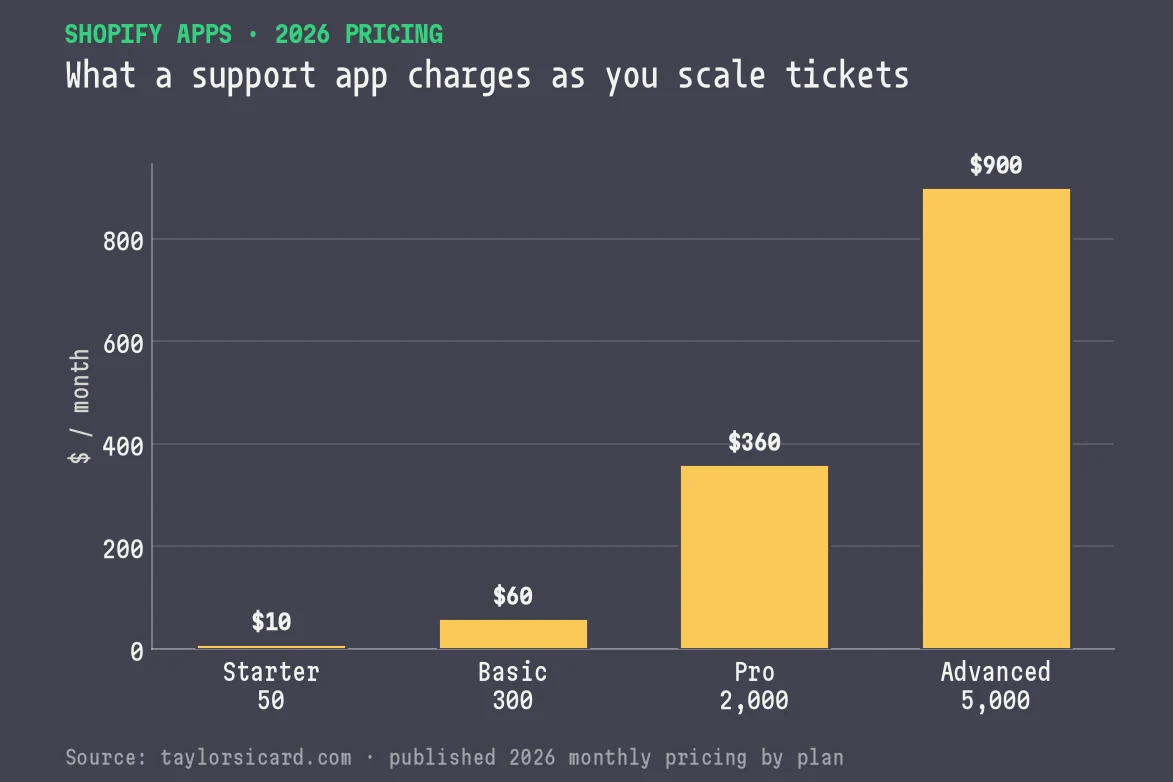
Gorgias is the Shopify-native helpdesk, and its pricing is unusual in a good way: it charges on ticket volume, not per agent, so unlimited seats come on every paid plan. The tiers run Starter at $10 a month (50 tickets), Basic at $60 (300 tickets), Pro at $360 (2,000 tickets), and Advanced at $900 (5,000 tickets), with Enterprise custom. Annual billing trims each by roughly 16%. The catch is the overage: once you exceed your ticket allotment, you pay per additional ticket, at a rate that varies by tier: about $0.40 on Starter and Basic, about $0.25 on Pro. That is how a $360 plan quietly becomes a larger bill in a busy month.
The 2026 wrinkle is AI, and Gorgias is telling two different stories about it. Its pricing page says AI Agent is included on every plan and that you pay only when it resolves a conversation. Its own plan guide says something else: that conversations fully resolved by AI Agent do not count as billable tickets, and that AI Agent starts at $250 a month as an add-on rather than a pure per-resolution meter. Those two surfaces cannot both be right, and the gap between them is real money on a busy desk. Treat the AI line as a number to get in writing before you sign rather than one to model off a published rate, and model it both ways: AI support can lower your cost per contact and raise your app bill at the same time. If you want the full tier-by-tier breakdown, we keep a dedicated Gorgias pricing decoder current.
| Plan | Monthly ticket allotment | Published 2026 pricing |
|---|---|---|
Starter | 50 tickets | $10/mo |
Basic | 300 tickets | $60/mo ($50 annual) |
Pro | 2,000 tickets | $360/mo ($300 annual) |
Advanced | 5,000 tickets | $900/mo ($750 annual) |
Overage / AI Agent Above allotment; AI billed on resolution | Per ticket / per resolution | Overage ~$0.40 (Starter, Basic), ~$0.25 (Pro) · AI Agent rate disputed across Gorgias sources, confirm in writing |
Email and SMS: you
pay for your list,
then every send.
Klaviyo is the DTC email default, and it prices on active profiles, a model it moved to fully in 2025. A profile is any contact stored in your account that could receive email, whether you emailed it or not, which is why the bill climbs faster than your send volume. The free plan covers 250 profiles. Paid email starts around $20 a month at 500 profiles, is roughly $100 at 5,000, about $400 at 25,000, and scales toward $2,300 at 250,000. SMS is layered on top as a credit model, with US messages settling near $0.009 per credit at volume, so a large list plus active SMS can double the Klaviyo line.
Postscript, the Shopify-focused SMS specialist, is pure usage with a floor: a $49 monthly minimum, then $0.007 to $0.009 per SMS depending on tier, plus pass-through US carrier fees of roughly $0.004 per message that Postscript bills at cost without markup. The honest planning number is that real SMS spend lands about 2.5 to 3.4 times the advertised base once per-message and carrier fees stack, so budget the full cost, not the entry minimum. Klaviyo's full tier ladder is in our Klaviyo pricing decoder, and the head-to-head on what SMS marketing costs with Attentive versus Postscript covers the quote-based side of the market. What Attentive costs takes a single quote apart.
| App | Model | Published 2026 pricing |
|---|---|---|
Klaviyo Email + SMS | Contact-based + usage | Free (250) · ~$20 (500) · ~$100 (5k) · ~$400 (25k) · ~$2,300 (250k) · SMS ~$0.009/credit |
Postscript SMS specialist | Usage + minimum | $49/mo min · $0.007–$0.009/SMS + carrier ~$0.004 |
Upsell and page
builders: flat, tiered,
and rev-share mixed.
This is the category with the widest spread of models, so read the fine print. Rebuy, the personalization and upsell engine, has thrown out its tier card. The Starter, Scale and Pro plans at $99, $249 and $499 are gone from its published pricing, replaced by a build-your-own plan that starts as low as $25 a month and scales with monthly orders, plus a free Rebuy Monetize tier that pays the merchant $0.20 to $0.35 or more per order for running offers on the thank-you page. Rebuy's own site shows a Platform One rate of $534 a month for the bundled package. The practical effect is that you can no longer look up what Rebuy will cost you, you have to configure it. ReConvert (now Upsell.com) has rebuilt its card too, in the opposite direction: free up to 50 orders, then $9.99 to 2,000 orders, $199 to 10,000, and $499 to 20,000, with no revenue-share percentage published at any tier. The 0.75% cut on app-generated revenue it used to take on its top plan is no longer listed.
PageFly, the leading page builder, is still refreshingly flat, with no order-based metering at all, but the ladder got longer during 2026: free for one slot, then Builder at $24, Optimize at $39, Accelerate at $99 for unlimited pages, Power at $199, and multi-store enterprise plans at $299, $499 and $999. The entry price moved from $19 to $24, and $99 still buys unlimited pages, which is the number most merchants care about. That flatness is the exception in this category, and it is why a page builder is one of the few tools whose cost you can set and forget. When you weigh an upsell app, the number that matters is whether the incremental AOV it drives clears its cost, not the sticker, especially for the ones with a percentage cut, because a rev-share upsell only pays for itself if the lift is real.
| App | Model | Published 2026 pricing |
|---|---|---|
Rebuy Personalization & upsell | Order-tiered, configured | Monetize free (earns $0.20–$0.35/order) · build your own from $25/mo, scales on orders · Platform One $534/mo |
ReConvert (Upsell.com) Post-purchase upsell | Order-tiered | Free (50 orders) · Growth $9.99 (2,000) · Scale $199 (10,000) · Elite $499 (20,000) |
PageFly Page builder | Flat tiers | Free · Builder $24 · Optimize $39 · Accelerate $99 (unlimited pages) · Power $199 · Enterprise $299–$999 |
Returns and
attribution: the
usage lines hide here.
Loop Returns, the returns-management leader, publishes Essential from $155 a month and Advanced from $340, alongside a free Loop Core tier and a free Checkout+ tier. That $340 is worth flagging: it was a third-party estimate earlier in 2026 against a published $272, and it is now Loop's own published number, so the Advanced tier is about 25 percent more expensive than this page previously recorded. The lines to watch are that the paid plans run on annual contracts, and there is a per-return usage component Loop does not publish, described by third parties as roughly a small percentage of processed-return value or a flat per-return fee above an included band. So the sticker understates the true cost the way subscription stickers do.
Triple Whale, the attribution and analytics dashboard, has stopped publishing prices altogether. Its plans are now Free, Foundation, Automate and Enterprise, and every paid tier routes to a walkthrough or to sales. Pricing is still described as a function of annual GMV plus the package you choose, but the $149 and $219 tiers this page used to carry are no longer listed anywhere on the site. If you are budgeting attribution for next year, that is a quote now, not a lookup. Attribution is a category where brands frequently stack two or three overlapping tools, which is a classic bloat trap; one good dashboard usually beats three partial ones, and the second one you install rarely earns its line. Both of these categories are the kind of platform cost worth mapping against the wider ecosystem, which the batch companion post, the 2026 Shopify app category map, lays out end to end.
| App | Model | Published 2026 pricing |
|---|---|---|
Loop Returns Returns management | Monthly + usage | Loop Core free · Checkout+ free · Essential from $155/mo · Advanced from $340/mo · Enterprise custom |
Triple Whale Attribution & analytics | GMV-tiered, quote-only | Free · Foundation, Automate and Enterprise all quoted by sales |
What the whole stack
costs, by store
size.
A full DTC app stack runs roughly $300 to $800 a month near $1M in annual revenue, $2,500 to $6,000 near $10M, and $10,000 to $25,000-plus once you pass $50M, based on the brands I have operated and advised. Individual prices are only half the story. What a founder actually needs to know is what the whole stack costs at their scale, and how that number moves as they grow. The bands below use the published tiers above for a typical DTC stack (reviews, email, a page builder, an upsell app, and, at scale, loyalty, helpdesk, subscriptions, and attribution). They are directional, not a quote, because your exact mix and volumes decide the real figure.
Why it stays low: at this scale you're mostly paying stickers, and the order-tiered and rev-share meters have barely started running. This is the cheapest the stack will ever be relative to revenue.
What changed: the meters are now running hard. The single biggest line is often the subscription rev-share, not any monthly sticker, because it scales with your most durable revenue.
The shift: app spend becomes a real margin conversation and a procurement one. At this scale you negotiate the percentages, consolidate overlapping tools, and question whether a rev-share app should be rebuilt in-house.
Twice a year, list every app, its monthly cost, and its billing model, then divide the total by your contribution margin, not your revenue. Flag every rev-share and usage line and ask one question of each: is the value it adds still growing as fast as its cost? Kill any tool that fails that test, and consolidate overlaps (two review apps, three dashboards). The apps that survive that test are your real stack. The rest are the App Store's growth showing up as your margin leak.
The pattern across every category is the same. Sticker prices cluster in a narrow, comfortable band, and the real cost of an app stack is decided by billing models, not entry prices. The flat-fee tools (Judge.me, PageFly) stay cheap forever. The order-tiered tools (Smile.io, Okendo, Gorgias) rise in visible steps you can plan for. The contact and usage tools (Klaviyo, Postscript) climb with your list and your sends. And the revenue-share tools (Recharge, Skio, Loop) take a slice of the exact money that is growing your business, which makes them the biggest and least visible line at scale. Know which model you're signing up for, and the whole stack stops surprising you.
If you're an app founder deciding how to price your own product, the model you pick shapes your growth as much as your feature set does, so pressure-test it before you launch. If you're a merchant trying to right-size a stack that grew by accident, the audit above is the fastest way to find the leaks. Either way, the price data here is the starting point, not the answer, because the right number is always relative to the value and the margin underneath it.
Measured. Published price tiers for 17 apps, the billing models they use, the store-wide median entry price, and total app-stack cost by revenue band.
Period. Vendor pricing pages retrieved September 20, 2026. The store-wide median is RevenueHunt's June 2026 figure.
Sources. Each app's own pricing page or App Store listing, and RevenueHunt's State of the Shopify App Economy.
Basis. The stack-cost bands and the 1% to 3% of revenue figure come from the brands I've operated and advised.
Limits. App prices change often. Check the vendor's page before you commit.
Disclosure. I'm an advisor to Recharge and Postscript.
If your app stack costs more than 3% of revenue, some of it can go. Cutting and renegotiating that stack is part of the work I do with merchants past $5M.
Questions founders and
merchants ask about
app pricing.
Q: How much do Shopify apps cost per month in 2026?
Individual apps range from free to a few hundred dollars a month at the sticker level. Flat-fee apps like Judge.me ($15) and PageFly ($0 to $99 for unlimited pages) stay cheap and predictable. But most category leaders price on order volume, list size, or a percentage of the sales they touch, so the bill climbs as you grow. A full DTC app stack commonly runs $300 to $800 a month around $1M in annual revenue and $2,500 to $6,000 a month around $10M, based on the brands I have operated and advised. The revenue-share and usage-priced apps, not the flat ones, drive most of that increase.
Q: Which Shopify apps charge a percentage of your sales?
Subscription apps are the clearest example. Recharge charges a monthly fee plus 1.49% and $0.19 per subscription transaction on Starter (1.34% on Pro), and Skio charges its monthly fee plus 1.0% and $0.20 per order. Post-purchase upsell app ReConvert no longer publishes the 0.75% revenue share it charged on its top tier and now prices on order bands alone. Returns and attribution tools such as Loop Returns and Triple Whale also scale with return value or GMV. These percentage-of-money models usually become the largest single line in a stack at scale, because they grow with the exact number that is growing your business.
Q: What is the cheapest Shopify reviews app in 2026?
Judge.me is the value leader: a free tier with unlimited reviews and light branding, or the Awesome plan at a flat $15 per month with AI features, Google Shopping stars, and 130-plus integrations, regardless of order volume. Loox is free up to 500 orders and moves to $49.99 (Convert) and $299.99 (Unlimited). Okendo starts at $19 for up to 200 orders and publishes tiers to $299 at 3,500 orders, with anything above that quoted by sales. Yotpo Reviews has a free tier capped at 50 orders. Judge.me stays flat while the order-tiered apps rise, which is why it wins on cost at almost every scale.
Q: Why do some Shopify apps cost so much more as you grow?
Because most category leaders do not price on a flat fee. They price on a variable that grows with your business: monthly orders (Smile.io, Okendo, Loox, Gorgias tickets), stored contacts (Klaviyo email), messages sent (Postscript, Klaviyo SMS), or a percentage of GMV or order value (Recharge, Skio, Rebuy, Triple Whale). A $99 sticker at 1,000 orders a month can become a four-figure line at 10,000 orders under the same plan structure. The sticker price is the smallest and least useful number. The billing model is what decides your real cost.
Q: How much should app spend be as a percentage of revenue?
Across the DTC brands I have operated and advised, a healthy app and software stack tends to land around 1% to 3% of revenue once you include the order-tiered, contact-based, and revenue-share tools. It creeps higher when overlapping tools stack up, which is the app-bloat problem: two review apps, three analytics dashboards, or an upsell app whose incremental revenue no longer clears its percentage cut. The number to watch is not the monthly total in isolation, it is app spend as a share of contribution margin, because that is the money the stack is actually eating.
Five of the seventeen apps on this page withdrew a published price between July and September 2026
The refresh on 20 September 2026 moved twelve of the seventeen vendors above. Ordinary repricing accounts for some of it. What is not ordinary is the direction: five vendors now publish less than they did in July, and in every case the tier they removed sits at the top of the ladder. Five others went the other way, cutting an entry price or writing down a fee they used to leave vague.
| App | Published in July 2026 | Published on 20 September 2026 |
|---|---|---|
Triple Whale | Starter $149, Advanced $219 | Foundation, Automate and Enterprise, every paid tier quoted |
Rebuy | Starter $99, Scale $249, Pro $499 | Build your own from $25, scaling on orders |
Okendo | Tiers to about $499 at 10,000 orders | Published to $299 at 3,500 orders, then Platform quoted |
LoyaltyLion | Classic $199 at 500 orders to $549 at 4,000 | Classic $199 at 500 orders, then Advanced and Plus quoted |
Skio | Growth $399 and Scale $599 | Scale only, $599 monthly or $499 annual |
The split is not company size and it is not the billing model. Okendo and ReConvert are both order-tiered, and in the same sixty days Okendo stopped publishing above 3,500 orders while ReConvert published a clean ladder to 20,000. The difference is what sits at the top: Okendo's top tier bundles five products into a platform, ReConvert's is the same app with a larger cap. An app keeps publishing while its top tier is one product, and stops when it becomes a suite.
Thirteen of the seventeen now run a free tier, including four of the five that went quiet, so the shape of the category is free at the bottom, quoted at the top, and a thinning published middle. The threshold where you meet a salesperson has come down with it: LoyaltyLion routes to a quote above 500 monthly orders. The full reading, and what it means whether you are budgeting a stack or setting your own price, is in five of seventeen Shopify apps stopped publishing prices.
Pricing your own Shopify app?
I have set app pricing from the founder side (a Shopify-ecosystem SaaS that Tiny acquired) and audited it from the merchant side at a nine-figure DTC operator. If you are choosing a model or repricing, the free Shopify App Pricing Model tool is a fast first pass, and I am happy to go deeper on your specific numbers. The form takes two minutes.
Try the App Pricing Model tool How I work with Shopify apps →