In early 2026 Shopify extended its B2B feature set, previously locked to Plus at $2,000-plus a month, to Basic, Grow, and Advanced at no extra cost: net terms, company accounts, custom price lists, minimum orders, draft orders, tax-exempt purchasing. Most merchants missed it.
- For DTC brands at $5M-plus, this is a higher-margin growth channel that needs no extra paid media.
- Shopify reports B2B orders see 4.1x higher reorder frequency than DTC orders.
- Wholesale buyers reorder on a schedule; DTC buyers reorder when they feel like it.
In early 2026, Shopify extended its B2B feature set, previously locked to Shopify Plus at $2,000/month and up, to Basic, Grow, and Advanced plans at no additional cost. Net payment terms, company accounts, custom price lists, minimum order quantities, draft orders, tax-exempt purchasing. All of it, now available to any Shopify merchant regardless of plan. The full breakdown of what changed, and what's still Plus-only, is in Shopify B2B Without Plus: What the 2026 Expansion Changes.
Most merchants missed this. The announcement was buried in a product update, not headlined at a Unite keynote. But for DTC brands at $5M+ looking for a higher-margin growth channel that doesn't require more paid media spend, this is one of the most meaningful feature expansions Shopify has shipped in years. Wholesale is one of the channels that quietly shows up in almost every omnichannel path to $100M I have seen, precisely because it adds revenue without adding acquisition cost.
The data point that puts the opportunity in context: per Shopify's earnings reporting, merchants using Shopify B2B see 4.1x higher reorder frequency compared to DTC orders. Not 4.1x higher first-order AOV, 4.1x higher repeat purchase rate. That's the compound effect of B2B buying behavior. Wholesale buyers reorder on a schedule. DTC buyers reorder when they feel like it.
The announcement most
merchants missed.
Company accounts with multiple buyer seats and role-based permissions. B2B-specific price lists and quantity breaks (different pricing tiers for different wholesale buyers). Net payment terms (Net 15, 30, and 60) with automatic payment reminders. Purchase order and draft order workflow for large or custom orders. Tax-exempt designation for wholesale buyers and businesses with resale certificates. B2B-specific collections and dedicated storefronts that DTC customers can't access. Minimum order quantity requirements by product or collection.
The practical implication: you can now run a complete wholesale operation through Shopify without a separate platform, without Plus pricing, and without a developer to build custom B2B flows. The infrastructure that was previously only accessible to seven-figure ARR merchants is available to every merchant on the platform. What you do with it depends entirely on whether there's a genuine B2B buyer segment for your products.
| Feature | All Plans (Basic, Grow, Advanced) | Shopify Plus Only |
|---|---|---|
Company accounts | Yes, with multiple buyer seats and role-based permissions | Yes, with expanded org hierarchy support |
B2B price lists | Yes, tiered pricing per account or company group | Unlimited price lists; API-driven pricing for complex catalogs |
Net payment terms | Net 15, 30, 60 with automatic reminders | Same, plus additional customization via API |
Tax-exempt purchasing | Yes, by company account | Yes, same |
Draft orders / PO workflow | Yes, standard draft order flow | Yes, with expanded automation via Flow |
B2B storefront | Password-protected B2B collections in main store | Fully headless, dedicated B2B storefront with separate URL |
Checkout customization | Standard checkout only | Dedicated B2B checkout with custom extensions; PO number field |
Minimum order quantities | Yes, by product or collection | Yes, same |
Shopify Flow automation | Limited | Full Flow access, including B2B-specific triggers and actions |
The detail that matters: the all-plans version runs your B2B operation through your existing DTC storefront with password-protected collections. It is functional but not smooth for high-volume buyers who expect a dedicated wholesale portal. The Plus headless storefront solves this, which is why the upgrade to Plus often makes sense once B2B revenue is a real part of the business. The full breakdown of what changed in 2026 and the exact feature cutoffs is in the Shopify B2B without Plus post, and if you want the comprehensive B2B feature set (including the June 2026 all-plans update), the all-plans feature guide covers it.
Before you set up B2B pricing,
answer this question: why would
a buyer order from you wholesale?
The mistake most DTC brands make when they open a wholesale channel: they do it because they can, not because there's a buyer segment that would meaningfully use it. The B2B infrastructure is table stakes. The strategic question is whether your products, your margins, and your brand positioning create a real proposition for wholesale buyers.
Three B2B buyer segments are actually worth pursuing for most DTC brands:
| Segment | Margin Requirement | Reorder Frequency | Relationship Investment | Best Categories |
|---|---|---|---|---|
Retail Buyers Boutiques, specialty retailers, gift shops |
40–50% margin expectation for the buyer |
Seasonal, 4–6× per year |
High, requires line sheets, samples, buyer relationships |
Lifestyle, beauty, home, food/beverage, apparel |
Corporate Gifting HR teams, event coordinators, procurement |
25–35% margin expectation, less price-sensitive |
Event-driven, 2–4× per year but high AOV |
Low once established, repeatable with good account notes |
Wellness, food, home, personal care, branded lifestyle |
Professional Resellers Salons, clinics, hotels, specialty professionals |
30–45% margin expectation |
Regular, weekly or monthly for consumables |
Medium, requires professional certification proof, compliance docs |
Skincare, wellness, supplements, professional tools |
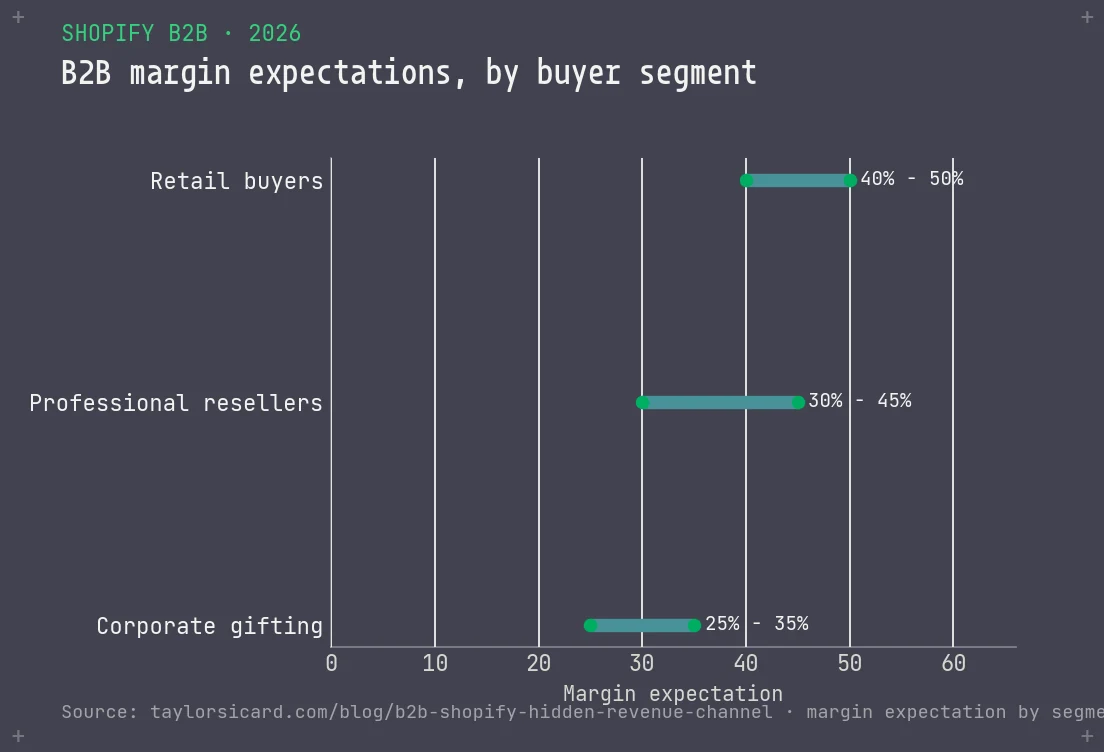
Corporate gifting is often the most overlooked and most accessible entry point for DTC brands. You don't need a buyer relationship with a retail chain. You need to find the HR or procurement lead at 5–10 companies where your DTC customers work, and make a compelling case for gifting. High AOV, low relationship maintenance once you've established the account, and repeat behavior at company milestones (holiday gifts, onboarding kits, milestone awards).
This is the work I do, with DTC brand operators scaling past $5M. If it's landing, the form takes two minutes.
The pricing structure
that works for both channels.
The fundamental B2B pricing equation: your wholesale price needs to leave the buyer enough margin to sell profitably, while leaving you enough margin to run the channel profitably. Most DTC founders assume wholesale is a margin compression story. It's often the opposite, once you remove the customer acquisition cost from the equation. I worked through the full wholesale margin math so you can see why a 50-point wholesale discount can still beat a paid-acquisition DTC order on contribution.
COGS: $8 · DTC price: $40 · DTC contribution margin: ~60% after blended marketing costs (~$10 CAC)
Wholesale price (50% of MSRP): $20 · Wholesale gross margin: $12 ($20 - $8) = 60%
The insight: your B2B gross margin on a per-unit basis is the same as your DTC gross margin, but you're eliminating $8–15 in CAC. At volume, the B2B channel can actually deliver better contribution margin than DTC, even at lower selling prices. The cost structure is completely different.
B2B orders also run significantly larger than DTC orders. The typical B2B order is 8–12x the DTC average order value. A DTC customer who orders one unit generates $40 in revenue. A wholesale buyer who orders a case of 24 generates $480 in revenue at the same unit economics. The concentration of revenue per relationship is a meaningful operational simplification, fewer transactions, fewer fulfillment events, fewer customer service interactions, for the same revenue.
The operational side most DTC
founders underestimate.
Net terms are not a nice-to-have. For most B2B relationships, they're required. Net 30 is the minimum a wholesale buyer expects. If you can't extend credit, you'll lose accounts to competitors who can. This is a cash flow decision, not just a pricing decision. You need to model how much working capital you'll have tied up in receivables at steady state before you commit to net terms at scale.
Minimum order quantities matter more than you think. Too low (under 6–12 units for most categories) and you get small orders that don't justify the account management overhead. The fulfillment cost and account management time on a 3-unit wholesale order isn't meaningfully different from a DTC order, but the margin dollars aren't there to support it. Too high and you exclude the boutique buyers who would carry you but can't commit to large initial orders.
B2B customer success is a different discipline than DTC customer service. Wholesale buyers need product training so they can sell effectively. They need sell-through data so they know when to reorder. They need marketing assets so they can feature your product appropriately. If you treat B2B support like DTC support, you'll have high buyer churn after the first order.
The most common B2B mistake for DTC brands: opening wholesale without MSRP enforcement in the buyer agreement. If your wholesale buyers are selling at prices that compete with your own DTC store (or worse, undercutting your DTC price on Amazon or their own website) you have a channel conflict problem that erodes DTC conversion rates and brand positioning simultaneously.
Build explicit MSRP requirements into your wholesale terms before you take your first order. Include minimum advertised price (MAP) language and enforcement clauses. A buyer who won't agree to MSRP protection isn't a buyer you want, they're a competitor using your margin to undercut you.
The first 90 days of B2B
on Shopify.
B2B on Shopify,
questions answered
directly.
What B2B features are available without Shopify Plus?
Since 2026, every Shopify merchant gets company accounts, B2B price lists, net payment terms (Net 15/30/60), draft orders, tax-exempt purchasing, and B2B-specific collections. Shopify Plus adds the headless B2B storefront, dedicated B2B checkout, custom checkout extensions, and unlimited price lists. The functional gap matters more at scale; for your first 10-20 wholesale accounts, the all-plans version is sufficient.
Is the B2B channel worth pursuing below $5M DTC revenue?
Yes, if a buyer segment exists for your products and your margins can support it. The $5M threshold is about operational bandwidth, not prerequisite. A $2M brand in wellness or lifestyle with boutique retail interest and healthy unit economics can run a profitable small wholesale program. The question is whether you can add the account management overhead without pulling focus from DTC growth. The $5M inflection post covers the focus tradeoffs at that stage.
How do I handle net terms without hurting cash flow?
Model your receivables balance before committing. Net 30 on 5 accounts at $2,000 per order is $10,000 tied up in receivables, manageable. Net 30 on 50 accounts is a different problem. Start with Net 30 as default, reserve Net 60 for high-volume accounts, and review your working capital position against your contribution margin targets before scaling. Some brands use Shopify Capital or a short-term line of credit to bridge the receivables timing gap while B2B scales.
What is MAP policy and why does it matter for B2B?
MAP (Minimum Advertised Price) is a policy in your wholesale agreement that prevents buyers from advertising your product below a set floor price. Without it, a wholesale buyer can list your product on their website or Amazon at a price that undercuts your own DTC store, which creates channel conflict and damages conversion rates for your own brand. Always include MAP language before taking your first B2B order. An attorney review of your wholesale agreement template is worth the cost.
When should B2B revenue push me to Shopify Plus?
When B2B revenue crosses roughly $400K-$500K annually, the Plus feature set (especially the headless B2B storefront and checkout customizations) creates enough operational efficiency and buyer experience improvement to close the upgrade math. Below that level, the all-plans B2B infrastructure is functional. Above it, the dedicated storefront becomes important for buyer retention. The when to move to Plus post walks through the full upgrade calculus.
B2B is not a strategy for every DTC brand. If your product is highly personal, doesn't have obvious resale channels, or your COGS don't allow a 40–50% margin at wholesale, the math doesn't work. But for brands in lifestyle, beauty, wellness, home, food and beverage, or personal care at $5M+ DTC revenue with healthy unit economics, the B2B channel has just become meaningfully more accessible. The 4.1x higher reorder frequency Shopify reported in earnings is the number worth taking seriously. That's not a channel uplift. That's a different kind of customer relationship entirely. When B2B revenue scales past $400K–$500K annually, the Shopify Plus upgrade math starts to close quickly, unlimited catalogs, direct company pricing, and Flow automation make the economics clear. As you also look to diversify revenue away from single-channel dependency, a theme explored in the TikTok Shop channel brief, B2B is one of the most durable diversification moves available. Shopify keeps widening B2B access with each release, and the Spring '26 Everywhere Edition is the latest step, covered in the Spring '26 edition read for brands.
Turning B2B into a real revenue line on Shopify is operator work, not a side project. That is exactly what the DTC brand consulting practice is for, and the form takes two minutes: start the conversation.
Scaling a consumer brand?
I work with a deliberately small number of DTC operators. I've run brands at this scale myself, from $5M past $100M. Not theory. If you're in that range, the form takes two minutes.
Start a conversation More about Taylor →