"How much do Shopify partners make" has no single answer, because there are four different partner paths, each on its own meter. App developers keep 100% of their first $1M in lifetime App Store revenue and 85% after, and agencies earn 20% of subscription plus 0.1% of merchant GMV for four years. Theme makers keep 85% of Theme Store sales, and affiliates get a flat $150 per full-price referral in the U.S.
- App developers have the highest ceiling: a $5M-a-year app nets about $4.25M and is itself a sellable asset worth roughly 3x to 6x ARR.
- Agencies and referrers earn recurring commissions (about $2,958 a year on a $2M Advanced brand), but the real business is their service fees, not the Shopify cut.
- Theme developers and affiliates have real but capped ceilings, generally low six figures at scale.
- The rate terms are public and the modeled income scenarios here are illustrative, built to show the shape of each path, not a quote on any one partner.
The most common question I get from people looking at the Shopify ecosystem is some version of "can you actually make money as a Shopify partner, and how much?" It is a fair question with a frustrating answer, because "Shopify partner" covers at least four jobs that pay on completely different terms. An app developer, an agency that refers merchants, a theme maker, and an affiliate creator are all "partners," and their income has almost nothing in common.
This post puts real numbers on each path, which the ecosystem rarely does cleanly. I have pulled the published rate terms for all four, then built illustrative earnings scenarios so you can see what a small, a mid, and a scaled version of each partner type takes home. The rates are Shopify's own, and the dollar scenarios are my models, labelled as such, meant to show the shape of the money rather than promise you a specific figure.
This comes from having earned on three of the four meters myself. I helped build the Partner Program as an early Shopify employee, then went on to build and sell a Shopify app, and to refer and operate merchants through WIN. All four are meters I have watched tick, and the sections below show what each one produces.
This is the earnings companion to two related posts. If you want the mechanics of the referral change, read the new partner earning model, decoded, and for the legal terms behind all of it, the 2026 Partner Program Agreement. This post is the one that answers the money question directly, path by path.
Four partner paths,
four different
rate cards.
Before any earnings scenario, you need the rate terms, because they are what makes each path behave the way it does. Every rate in the table is Shopify's published number as of July 2026, sourced to Shopify's own developer docs and partner pages rather than my estimate, and the dollar scenarios later in the post build on these rates.
| Partner path | How you earn | The rate | Term |
|---|---|---|---|
App developer Publish a paid app in the App Store | Keep 100% of first $1M lifetime revenue, then 85% | 15% share above the cap | Ongoing, recurring |
Agency / referral partner Refer or transfer a merchant (new model) | 20% of subscription + 0.1% of eligible online GMV | Both components | 4 years per merchant |
Theme developer Sell a theme in the Theme Store | Keep 85% of every sale | 15% share on all earnings | Per sale, one-time |
Affiliate Refer via an affiliate link (creators, educators) | $150 flat per full-price merchant (U.S.) | Varies by location | Per referral, one-time |
Read down the "term" column and the story is already half told. Two of the four paths pay recurring money (the app share and the referral share), and two pay one-time money (a theme sale, an affiliate bounty). Recurring beats one-time at scale every time. That is the biggest reason app developers sit at the top of the earnings distribution and affiliates sit at the bottom, even though an affiliate can start earning this afternoon and an app takes a year to build.
There is a second split worth catching. Only the app and theme paths let you build something you can sell later. An app or a theme catalog is an asset. A referral book and an affiliate stream are income, and valuable income, but they mostly stop when you stop. Keep that distinction in mind, because it changes what "earnings" even means depending on which path you pick.
What a Shopify app
developer actually
keeps.
App developers earn the most by a wide margin, because of the rate structure. As of June 16, 2025, a developer keeps 100% of their first $1,000,000 in lifetime App Store revenue, counted from January 1, 2025, and Shopify takes a 15% revenue share on everything above that (Shopify, app developer revenue share). Before that change the $1M exemption reset every year. Now it is a lifetime allowance, so a growing app burns through it once and then pays 15% on the rest of its life.
There is one carve-out for the biggest players. Developers who earned $20,000,000 or more through the App Store in the prior calendar year, or whose company revenue is $100,000,000 or more, pay 15% on all app revenue with no $1M exemption at all (Shopify, app developer revenue share). For the vast majority of app founders, though, the mechanic that matters is simple: you keep everything until you have banked $1M, then you keep 85 cents on the dollar.
This is what that produces at different app sizes. I am modeling gross App Store revenue (what merchants pay for your app) against Shopify's cut, to show what a developer keeps in a year.
| App gross App Store revenue (annual) | Shopify's cut | Developer keeps | Where the cap sits |
|---|---|---|---|
$60K (~$5K MRR) Small, focused app | 0% | ~$60K | Years from the $1M lifetime cap |
$250K (~$21K MRR) Real product, growing | 0% until the cap | ~$250K | Crosses $1M lifetime around year 4 |
$600K (~$50K MRR) Established app | 0%, then 15% past the cap | ~$510K to $600K | Crosses the cap late in year 2 |
$1.2M (~$100K MRR) Category leader | 15% above the cap | ~$1.02M | Past the cap, steady state |
$5M Top-tier app | 15% | ~$4.25M | Well past the cap |
$20M+ Ecosystem heavyweight | 15% on all revenue | ~$17M | Exemption removed at this tier |
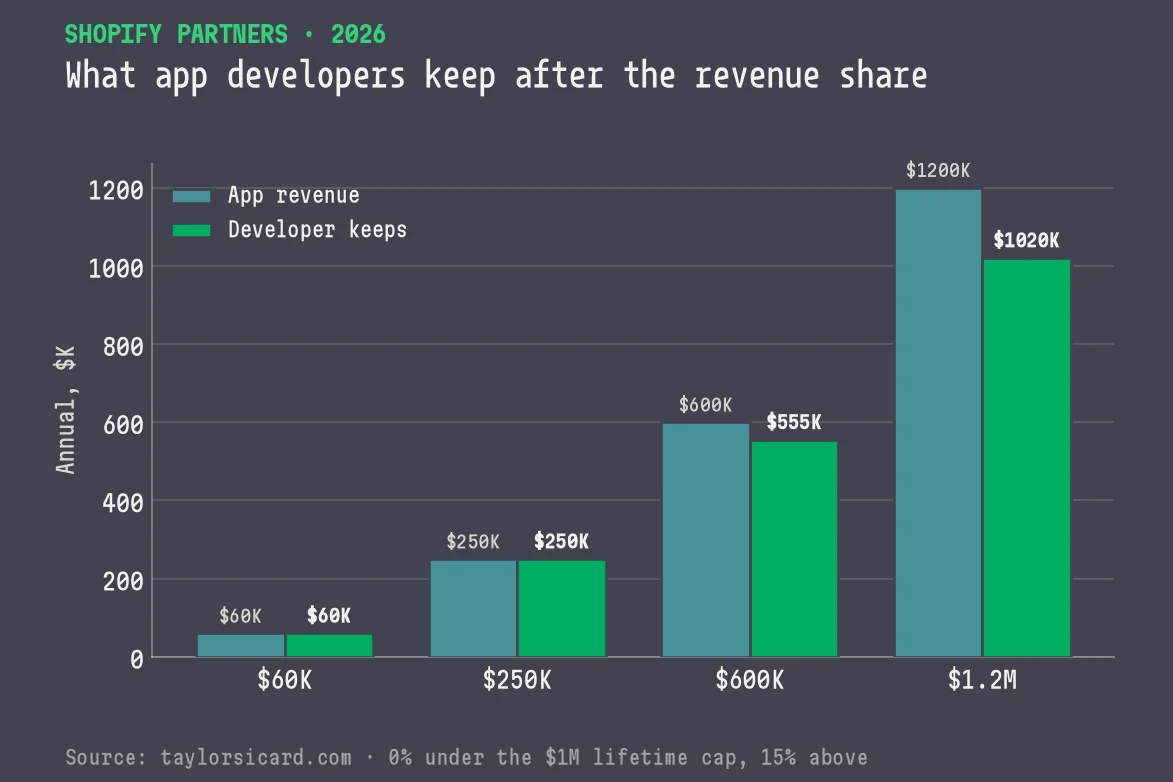
The number to sit with is the $5M row. An app doing $5M a year keeps roughly $4.25M, and that is recurring, and it renews every month with high gross margins. No other partner path comes close to that at the same revenue. The catch is that getting there is hard: you have to build real software, win distribution, and survive the churn that eats most apps. For what it really takes, I wrote about what a Shopify app at $500K ARR is really worth, and the lifetime-cap mechanic in more depth in the piece on the $1M lifetime revenue-share cap.
"An app doing $5M a year keeps about $4.25M, recurring, at high margin. No other partner path is in the same conversation at the same revenue."
And the app is an asset, which the other paths mostly are not. A profitable Shopify app changes hands at roughly 3x to 6x ARR, so that $5M app produces $4.25M a year and is worth somewhere in the eight-figure range if you sell it. That is why financial buyers pay attention to the category, a dynamic I unpacked in how private equity is buying Shopify apps. Earnings plus a sellable asset is the combination that makes app development the highest-ceiling path in the ecosystem. You can pressure-test your own app's economics against these rates in the app revenue share calculator.
What agencies and
referrers earn per
merchant, and per book.
This is the path that just got rewritten. Under the model that takes effect August 10, 2026, a partner who refers or transfers a merchant earns two things for four years: 20% of that merchant's subscription and 0.1% of that merchant's eligible online GMV (Shopify, a new partner earning model). Before August 10, the structure was 20% of subscription, recurring for as long as the merchant stayed, with no GMV component. I covered the full mechanics in the earning-model breakdown. Here I am only interested in the income it produces.
Start with a single merchant. The subscription share is small and fixed; the GMV share scales with how big the merchant gets. On a $2M Advanced-plan brand, 20% of the roughly $399-a-month plan is about $958 a year, and 0.1% of $2M is $2,000 a year, so that one merchant is worth about $2,958 a year, or close to $11,830 across the four-year term. Shopify's own example puts a $750K Advanced merchant at $5,872 over four years versus $2,872 under the old model, more than a 2x lift once you add the GMV layer.
One merchant is a rounding error; the agency question is what a book produces. The table shows the annual run-rate for four realistic partner profiles, assuming a mature book where merchants are inside their four-year windows. Each row is the recurring commission only, before the agency's own service fees.
| Partner book | Composition | Per merchant / yr | Annual commissions |
|---|---|---|---|
Solo referrer Side income, light touch | 10 merchants avg $500K GMV (Grow) | ~$752 | ~$7,500 |
Boutique agency A real client roster | 25 merchants avg $2M GMV (Advanced) | ~$2,958 | ~$74,000 |
Established agency Team, retainers, referrals | 50 merchants avg $3M GMV (Advanced) | ~$3,958 | ~$198,000 |
Enterprise partner Plus and mid-market focus | 15 Plus merchants avg $15M GMV | ~$20,520 | ~$308,000 |
Two caveats on this table. First, each merchant's streams stop at four years, so these run-rates only hold if you keep signing. A book you build once and coast on decays. Second, and more important, these commissions are almost never the agency's real business. A good agency charges build fees and monthly retainers that dwarf the referral cut. The Shopify commission is a tailwind on work you were already doing and getting paid for, so treat it as the bonus.
The GMV component rewards agencies who grow their merchants, which is the point. If your work takes a client from $2M to $8M over four years, you capture 0.1% of that entire ramp. That aligns the platform with operators who create value rather than lead-gen shops who introduce a merchant and vanish. It fits the broader direction I mapped in where value sits across the Shopify ecosystem.
What theme developers
keep on every sale.
Theme development is the quietest of the four paths, and the terms are the simplest. A developer who sells a public theme in the Shopify Theme Store keeps 85% of every sale, with Shopify taking a 15% revenue share on all earnings as of January 1, 2025 (Shopify, theme developer revenue share). Note that themes, unlike apps, no longer get a $1M exemption: the 15% applies from the first dollar. A theme sale is a one-time purchase per merchant, and Theme Store themes typically list between roughly $180 and $400, so the model is volume times price.
| Theme business | Annual volume | Gross sales | Developer keeps (85%) |
|---|---|---|---|
Side-project theme One theme, part-time | 40 sales/yr | ~$12,000 | ~$10,200 |
Established theme A well-ranked listing | 400 sales/yr | ~$120,000 | ~$102,000 |
Multi-theme shop A catalog of themes | 2,500 sales/yr | ~$800,000 | ~$680,000 |
The ceiling is real but capped by the shape of the market. There are only so many themes a store buys, and the Theme Store is a crowded, curated shelf, so few developers reach the multi-theme-shop row. What lifts theme income above the sticker price is the service work that clings to it: customization, setup, and support that a developer can charge for outside the Theme Store entirely, where Shopify takes no cut at all. The theme is the top of the funnel and the paid customization is often where the money is, the same distribution logic that applies to how apps really earn beyond the store listing.
What Shopify
affiliates earn per
referral.
The Shopify Affiliate Program is the easiest path to start and the lowest ceiling per unit. An affiliate earns a flat $150 in the U.S. for each referral who signs up and becomes a full-price paying merchant, with the amount varying by the merchant's location (Shopify, affiliate earnings). Referrals are tracked for 30 days from the click and up to 400 days to conversion, there is no cap on total earnings, and commissions are paid monthly on the 22nd. The bar is a full-price merchant, not a click and not a free trial, so your conversion rate is what sets your income.
| Affiliate profile | Full-price conversions | Per year | Annual earnings |
|---|---|---|---|
Casual creator Occasional mentions | 2 / month | ~24 | ~$3,600 |
Active educator Tutorials, a course audience | 20 / month | ~240 | ~$36,000 |
Creator at scale A large community or platform | 100 / month | ~1,200 | ~$180,000 |
Affiliate income is pure flow. It builds no asset, it stops when you stop publishing, and hitting the top row requires a real audience of would-be merchants, which is rare. But it has the lowest barrier of any path: no software to build, no clients to service, no book to maintain. For a creator or educator whose audience is already thinking about starting a store, it is real money with almost no infrastructure. It is the path I would point someone toward if they want to earn from the ecosystem this month rather than next year.
Which partner path
actually earns the
most.
There is no single winner, because the paths trade off ceiling against effort and time. But if you line them up, the ranking is clear at the top and the bottom. App developers have the highest ceiling and build a sellable asset. Affiliates have the lowest ceiling and build nothing, but start the fastest. Agencies and theme developers sit in between, closer to the top than the bottom once they scale.
| Path | Entry earnings | Scaled earnings | Builds a sellable asset? |
|---|---|---|---|
App developer Highest ceiling, hardest to build | ~$60K/yr | $4M+/yr | Yes, sells at ~3x to 6x ARR |
Agency / referral Commission on top of fees | ~$7,500/yr | ~$308,000/yr | Fees are the business, not the cut |
Theme developer Niche, volume-driven | ~$10,000/yr | ~$680,000/yr | A catalog, plus paid customization |
Affiliate Fastest to start, pure flow | ~$3,600/yr | ~$180,000/yr | No, income stops when you stop |
Recurring, sellable revenue wins, and this table makes it plain. The app developer at scale out-earns everyone and walks away with an eight-figure asset. That does not make apps the right choice for everyone, because most people cannot or should not build software. But if you are choosing a path deliberately and your goal is maximum earnings, the order is app, then agency, then theme, then affiliate, and the gap between the top and the bottom is enormous. If your goal is speed to a first dollar, flip it: affiliate, then theme, then agency, then app.
They stack paths. The most successful people in this ecosystem are rarely on one meter. An agency refers merchants (path 2), builds a niche app for its own clients (path 1), and ships a theme (path 3). Each path feeds the others, and the referral and app meters compound while the agency fees pay the bills.
They lead with the asset. Even a small recurring app or a well-ranked theme changes the math, because it keeps paying while you sleep. Partners who only ever trade time for one-time bounties hit a ceiling fast.
They treat the Shopify cut as a bonus. Referral and affiliate commissions ride on top of real work and do not hold up as a business model on their own. The partners who quit their day job to chase bounties usually come back.
How to pick the
path that fits you.
The rates are fixed. What you control is which path you build on and how well you execute it. If you are deciding where to point your effort in the Shopify ecosystem, here is the order I would think it through.
The through-line across all four paths is the same one that has been true since I helped build this program: the partners who earn the most are the ones who create value merchants can feel, not the ones optimizing for the bounty. The rates reward that now more than they ever have, especially with the GMV share tying agency pay to merchant growth.
Measured. The terms for four partner paths (app revenue share, referral commission, theme revenue share and the affiliate bounty), plus modelled annual earnings for each.
Period. Shopify's published terms as of July 2026, with each term's effective date given where it's cited.
Sources. Shopify's app and theme developer revenue share pages, Shopify's post on the new partner earning model, and the Shopify Affiliates page.
Basis. The earnings scenarios in Figures 2 to 6 are my models, labelled "Model: TSC". They are not reported earnings.
Common questions
about Shopify
partner earnings.
How much do Shopify partners make in 2026?
It depends entirely on which of the four partner paths you run. App developers keep 100% of their first $1M in lifetime App Store revenue and 85% after that, so a $5M-a-year app nets roughly $4.25M. Agencies and referrers earn 20% of a merchant's subscription plus 0.1% of that merchant's eligible online GMV for four years, which is about $2,958 a year on a $2M Advanced-plan brand. Theme developers keep 85% of Theme Store sales. Affiliates earn a flat $150 per full-price merchant referral in the U.S. The ranges span from a few thousand dollars a year to seven figures.
Do Shopify app developers keep 100% of their revenue?
Only up to a point. As of June 16, 2025, developers keep 100% of their first $1,000,000 in lifetime App Store revenue counted from January 1, 2025, then Shopify takes a 15% revenue share on everything above that. So a small app under the cap keeps every dollar, while a larger app that has crossed $1M lifetime keeps 85% of new revenue. Developers earning $20M or more a year through the App Store, or with $100M or more in company revenue, pay 15% on all app revenue with no exemption.
How much does a Shopify agency earn per merchant?
Under the earning model that starts August 10, 2026, a partner earns 20% of a merchant's subscription plus 0.1% of that merchant's eligible online GMV, both for four years. On a $2M Advanced-plan brand that is about $958 a year in subscription share plus $2,000 a year in GMV share, roughly $2,958 a year, or close to $11,830 over the four-year term. A single Plus brand doing $15M in online GMV is worth about $20,520 a year. A book of 25 to 50 merchants turns that into $75,000 to $200,000 a year in commissions, on top of the agency's own service fees.
How much does the Shopify Affiliate Program pay per referral?
The Shopify Affiliate Program pays a flat $150 in the U.S. for each referral who signs up and becomes a full-price paying merchant. The amount varies by the merchant's location. Referrals are tracked for 30 days from the click and up to 400 days to conversion, there is no cap on total earnings, and commissions are paid monthly on the 22nd. The bar is a full-price merchant, not a click or a free trial, so conversion rate is what drives affiliate income.
Which type of Shopify partner earns the most?
App developers have by far the highest ceiling because the revenue is recurring, keeps 85% or more past the cap, and the app itself is a sellable asset worth roughly 3x to 6x ARR. A $5M-a-year app nets over $4M annually and can sell for eight figures. Agencies earn strong recurring commissions (roughly $75,000 to $300,000 a year on a real book) but their service fees, not the Shopify commission, are the actual business. Theme developers and affiliates have real but capped ceilings, generally low six figures at scale. App developers have the highest ceiling, and affiliates are the fastest to start.
The rates are set, but turning them into a real income is a strategy problem, and that is the work I do. If you are building an app or an agency in the Shopify ecosystem and want to turn these earning paths into something durable, the Shopify growth consulting practice is where I work with founders on distribution, retention, and the path to scale. The form takes two minutes: start the conversation.
Building in the Shopify ecosystem?
I was an early Shopify employee who helped build and scale the Partner Program, then founded and sold a Shopify app to Tiny. I work with a small number of app founders and agencies on distribution, retention, and the path past six figures of ARR. If that is you, the form takes two minutes.
Start a conversation How I work with Shopify apps →Free tools: Model the app path with the app revenue share calculator, or estimate an app's sale value with the Shopify app valuation tool.