Starting August 10, 2026, Shopify partners earn on two things for every merchant they bring in: 20% of that merchant's subscription for four years, plus 0.1% of the merchant's eligible online GMV for four years. Same rates on every plan, partner-led or sales-assisted. For the first time, partners share in merchant sales, not just the subscription fee.
- The GMV share is the real story. As a merchant grows, 0.1% of its sales becomes the larger half of the payout, so the model rewards partners who help merchants sell more, not just sign up.
- Shopify's own examples show the new four-year payout at roughly 2x to 2.4x the current one. On list-price plans, a $2M Advanced brand is worth about $11,800 over four years, a $15M Plus brand about $82,000.
- Nothing changes for merchants already launched. The new structure applies only to deals signed or stores transferred on or after August 10, 2026, and the four-year term starts with the first partner payment.
- It caps a busy 2026 for partners: a January reset, the February agreement update, the Scripts sunset, and the App Store review crackdown all landed first.
Shopify just changed how partners get paid, and it is the biggest shift to partner economics in years. On July 7, 2026, it announced a new earning model that, starting August 10, pays partners on two things for every merchant they bring to Shopify: 20% of that merchant's subscription for four years, and 0.1% of that merchant's eligible online GMV for four years. If you run an agency, build apps, or refer merchants, this changes the math on your whole book.
I read this one from a specific seat. I was an early Shopify employee who helped build the Partner Program back when the deal was simple: bring a merchant, earn a cut of their subscription. That subscription-referral model ran for more than a decade. Tying partner pay to merchant GMV is the first time the program has moved off that foundation, and it is worth understanding exactly what moved and why.
Shopify's framing is "same side of the table." When merchants grow, you grow with them. That is the right instinct, and mostly true. But 0.1% is a thin slice, and a four-year clock is not forever, so the honest question is what this is actually worth to a working partner. Let me walk through the change, then put real numbers on it.
What Shopify
actually changed.
Two payouts now apply to every merchant a partner brings to Shopify going forward, whether the deal is partner-led or sales-assisted: 20% of the subscription fee for four years, plus 0.1% of eligible online GMV for four years. Both run on every plan at the same rate. That last part matters more than it sounds, and I will come back to it.
The subscription share is familiar. Partners have long earned a cut of the plan fee for merchants they refer. Twenty percent is the rate, and it now runs for a fixed four-year term on every plan, from Basic to Plus. On a $399-a-month Advanced plan, that is about $958 a year in subscription share, or roughly $3,830 across the four years.
The GMV share is the new part. Partners now also earn 0.1% of the merchant's eligible online GMV, the sales that merchant runs through Shopify, for four years. That is 10 basis points on what the store actually sells. On a brand doing $2M a year online, that is $2,000 a year, or $8,000 over the term. This is the first time a partner's pay is tied to how well the merchant does, not just whether the merchant pays their bill.
Shopify also equalized the rates across deal types. Historically, a deal that Shopify's own sales team helped close paid the partner differently from one the partner sourced alone. Under the new model, every partner earns the same rates on every plan, partner-led or sales-assisted. If you have ever co-sold an enterprise deal and watched the economics get murky, this is a real simplification.
On top of the two core components, Shopify widened four other earning paths. These are where a lot of the upside in their own examples comes from, so they are worth reading closely.
| Component | What you earn | Term | Applies to |
|---|---|---|---|
Subscription share The long-standing referral cut, now fixed-term |
20% of the subscription fee | 4 years | Every plan |
GMV share New. Ties pay to what the merchant sells |
0.1% of eligible online GMV | 4 years | Every plan |
Plus upgrade payout Refer an existing merchant who moves up to Plus |
$2,500 one-time | One-time | Plus upgrades |
POS Payments profit share Earning window extended |
Existing rate, longer | 2 → 4 years | Retail POS |
B2B Payments profit share New wholesale payments earning |
20% of B2B payments profit share | 4 years | B2B merchants |
Shop Component Payments via the Shop Component |
0.1% of Gross Payment Volume | 1 year | Shop Component |
One detail worth flagging up front: none of this touches merchants you have already launched. Every existing payout keeps its current rate and structure, and Plus referrals and POS Pro referrals continue as they do today. The new model only applies to deals signed or stores transferred on or after August 10, 2026. Your back book is safe. The change is about what you sign next.
Why the GMV share
is the whole point.
The 0.1% GMV share looks small next to a 20% subscription cut, but it changes what the program rewards. The old model paid you to acquire a merchant. The new one pays you, for four years, to help that merchant grow. Those are different jobs, and the second one is the one that actually builds a durable Shopify.
Think about what a partner used to optimize for. Under a pure subscription referral, your incentive ended at signup. Once the merchant was on a plan, your earnings were fixed regardless of whether they did $100K or $10M. A referral partner and an operator who spent two years growing a brand earned the same cut on the same plan. That is a strange thing to reward the same way, and it quietly pushed the ecosystem toward lead generation over merchant success.
The GMV share flips that. Now the partner who helps a merchant double their sales earns roughly double the GMV component. The 0.1% is deliberately modest, so no single merchant makes anyone rich, but it compounds across a book and it keeps paying as the merchant scales inside the four-year window. That is the mechanism behind "same side of the table," and it is real rather than a slogan.
"The old program paid you to acquire a merchant. The new one pays you, for four years, to help that merchant grow. Those are different jobs."
There is a reason Shopify can afford this now. Merchant volume is enormous: in the first quarter of 2026 alone, Shopify merchants cleared $100.7 billion in GMV, up 35% year over year (Shopify, Q1 2026 results). When the base is that large, sharing 10 basis points of it with the partners who help drive it is affordable for Shopify and meaningful for partners in aggregate. Shopify also said it paid partners more than $1 billion in 2025 (Atlee Clark, Shopify, January 2026), and this model is how that number grows.
The honest caveat: 0.1% is a share of eligible online GMV, and Shopify's glossary definition of eligible online GMV excludes some categories, so do not model it against a merchant's total top line. Retail POS sales, for instance, run through a separate POS profit share, not this component. Read the definition before you promise anyone a number.
What a partner
can actually earn.
Here is the part everyone wants: real numbers. Shopify published two examples, and I have built a wider table below so you can see how the payout scales with merchant size. The pattern is the important thing: the bigger the merchant, the more the GMV share carries the total.
Shopify's own examples. For an Advanced-plan merchant doing $750K in annual eligible online GMV, Shopify says a partner earns $5,872 over the first four years, versus $2,872 under today's model, more than 2x. For a sales-assisted Plus merchant doing $10M in annual online GMV plus $2M in retail GMV, the four-year figure is $73,380 versus $30,900 today, nearly 2.4x (Shopify, A New Partner Earning Model, July 2026). The Plus example includes retail POS profit share and a Plus referral bonus, which is why it runs higher than the two core components alone.
To show the shape of it, here is a cleaner illustration using the two core components only (20% of subscription plus 0.1% of online GMV, over four years), on list-price plans. I am leaving out the POS, B2B, and Shop Component add-ons so you can see the base engine clearly.
| Merchant profile | Plan · annual online GMV | Subscription 20% (4 yr) | GMV 0.1% (4 yr) | 4-year total |
|---|---|---|---|---|
Early DTC Just launched, finding traction |
Basic ($39/mo) · $200K | $374 | $800 | ~$1,174 |
Growing DTC Product-market fit, scaling spend |
Grow ($105/mo) · $750K | $1,008 | $3,000 | ~$4,008 |
Scaling DTC Real operation, multiple channels |
Advanced ($399/mo) · $2M | $3,830 | $8,000 | ~$11,830 |
Established brand Eight figures in sight |
Advanced ($399/mo) · $5M | $3,830 | $20,000 | ~$23,830 |
Plus brand Enterprise DTC on Plus |
Plus (~$2,300/mo) · $15M | $22,080 | $60,000 | ~$82,080 |
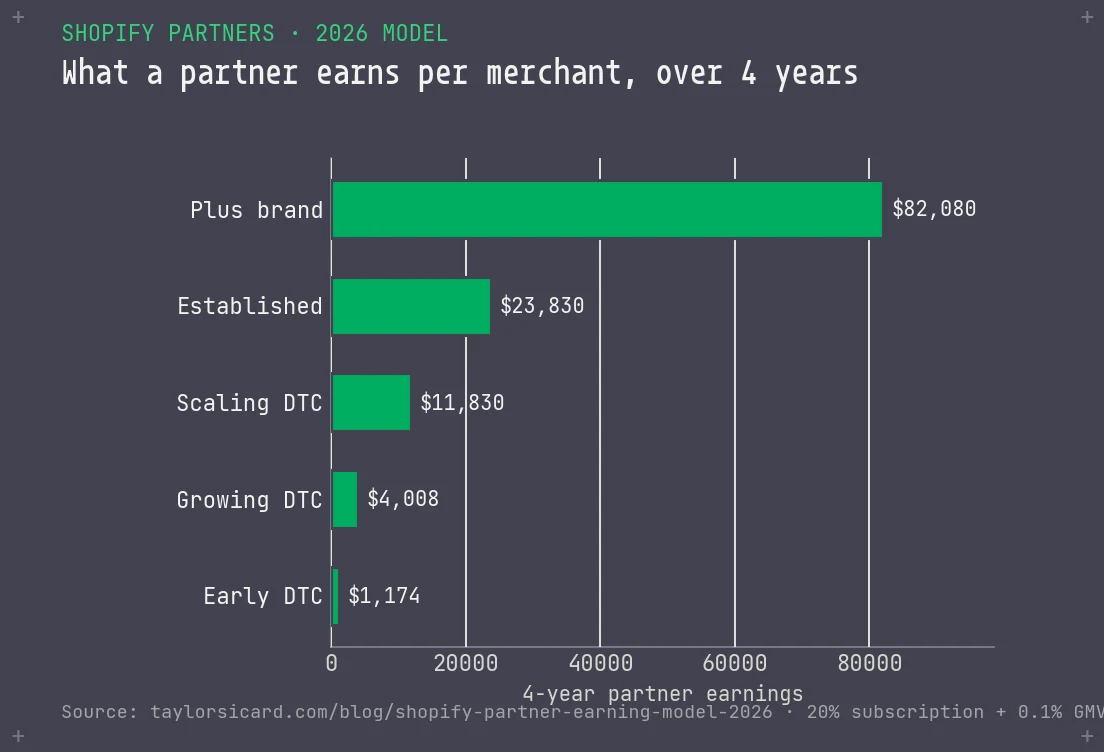
Look down the last two columns. At $200K in GMV the subscription share and GMV share are in the same ballpark. By $5M the GMV component is more than 5x the subscription share, and by the Plus row it is nearly 3x. The lesson is blunt: past a certain merchant size, the GMV share is the payout, and the subscription cut is a rounding error on top. If your work makes merchants bigger, this model pays you for it in a way the old one never did.
One merchant is a rounding error. A book is a business. A partner carrying 25 scaling brands that average $2M in online GMV earns about $50,000 a year from the GMV share alone, before the subscription cut, recurring across each merchant's four-year window.
It rewards retention, not churn. Because the clock runs four years per merchant and pays on their sales, keeping a merchant healthy and growing is now directly in your economic interest. That is the alignment Shopify is buying.
New signings compound. Every August-2026-and-later merchant adds a fresh four-year GMV stream on top of the ones already running. The book builds on itself.
How my numbers relate to Shopify's: mine are intentionally conservative, using list-price subscriptions and the two core components only, on a single merchant. Shopify's headline examples are higher because they layer in retail POS profit share and referral bonuses. Treat my table as the floor of the base engine and Shopify's as a fuller picture with the add-ons. If you want to sanity-check app-side economics separately, the app revenue share calculator handles that different stream.
Everything that
changed for partners
in 2026.
This earning model did not arrive in a vacuum. It is the capstone on a year of partner-facing changes, and the pattern across all of them is the same: Shopify tightening the rules and raising the rewards at the same time. If you only track one of these, you miss the direction of travel. Here is the year in order.
| When | What changed | What it meant for partners |
|---|---|---|
Jan 2026 |
Partnerships reset and reinvestment commitment | Shopify reorganized its partnerships team and said it would reinvest in the ecosystem, on the back of paying partners more than $1B in 2025. This model is the follow-through. |
Feb 27, 2026 |
Partner Program Agreement and API License update | Updates for agentic commerce, plus clarified limits on merchant and customer data use, billing transparency, and payment-app rules. |
Jun 30, 2026 |
Shopify Scripts shut off | Checkout and shipping logic built on Scripts stopped running, pushing that work to Functions and checkout extensibility. |
Jul 6, 2026 |
App Store review crackdown | A standalone review-incentivization policy plus a fake-review purge, cleaning up the store's most important trust signal. |
Jul 7, 2026 |
New partner earning model | 20% of subscription plus 0.1% of GMV for four years, on every plan, effective August 10. |
January set the tone. Shopify reorganized its partnerships group and committed publicly to reinvesting in the ecosystem, framed around the fact that it had paid partners over $1 billion in 2025. At the time it read as words. The earning model is the receipt. When a platform says it is going all in on partners and then changes the comp structure to share GMV, those two things belong in the same sentence.
February rewrote the rulebook. The 2026 Partner Program Agreement and API License update landed on February 27, largely to support agentic commerce and to tighten how partners can use merchant and customer data. It also touched billing transparency and set clearer rules on what partners can and cannot train AI on. Read together, the message was that more reward comes with more accountability.
June and July raised the quality bar. The Scripts sunset on June 30 forced a real migration for anyone with checkout logic on the old system. A week later, the App Store review crackdown went after bought and fake reviews. Both were Shopify cleaning house, which matters here because the new earning model only pays off in an ecosystem where merchants trust the shelf enough to keep buying.
One thing worth separating from all of this: the app developer revenue share is a different stream. When you sell an app in the App Store, Shopify takes 0% on your first $1M in lifetime revenue and 15% after that. That $1M lifetime cap is about what you keep from app sales. The new earning model is about what you earn for introducing and growing merchants. If you both build an app and refer merchants, you now have two separate meters running. I put the streams side by side in the breakdown of what Shopify partners actually earn by partner type.
Who this model
rewards, and
who it doesn't.
Every incentive change picks winners. This one clearly favors partners whose work makes merchants bigger, and it quietly pressures partners whose model was volume referral with no follow-through. That is a feature, not a bug, and it is the most important thing to understand about your own position.
Agencies and operators win the most. If your business is growing merchants, through build work, retention, CRO, paid media, or ongoing operating help, you now earn on the outcome you were already driving. A well-run agency that takes a merchant from $2M to $8M over the four years captures the GMV share on the whole ramp. For the first time, the platform pays you to be good at your actual job.
Enterprise and Plus partners win on the equalized rates. Because partner-led and sales-assisted deals now pay the same, the awkward economics of co-selling large deals with Shopify's team go away. On a big merchant, the four-year GMV share plus the extended POS and new B2B payments components can add up to real money, and the $2,500 Plus upgrade payout rewards moving existing merchants up.
0.1% is thin for the work. For an agency doing the heavy lifting to grow a brand, 10 basis points of GMV is a modest thank-you, not a business model on its own. Treat it as a tailwind on top of your real fees, not a replacement for them.
The four-year cliff is real. Each merchant's streams stop at four years. This rewards a constant flow of new signings and can feel like a treadmill for a partner who wanted to build a book and coast. Plan for replacement as well as accumulation.
Attribution will get debated. Sharing GMV raises the stakes on who gets credit for a merchant, especially on sales-assisted and transferred stores. Watch how Shopify adjudicates that as volume grows.
Pure lead-gen referrers feel the squeeze. If your model was introduce a merchant and move on, your ceiling is now lower relative to the operators, because the biggest component of the payout, GMV, only grows if the merchant does, and you are not the one making that happen. That is Shopify deliberately steering rewards toward partners who stay involved. I think that is the right call for the health of the ecosystem, even though it makes some existing playbooks worth less.
Zoom out and this fits a clear pattern in where the Shopify ecosystem is heading: reward the partners who create durable merchant value, raise the bar on everyone else. The Partner Program I helped build was always meant to make merchants better. Paying partners on merchant GMV is the most literal version of that idea the program has ever had.
What partners
should do before
August 10.
The change is a month out, so there is time to get ahead of it. The move is not to overhaul your business, it is to make sure your pipeline and your model line up with what now pays. Five things, in order.
The through-line: the partners who do best under this model are the ones who were already good at making merchants successful. If that is you, this is a raise. If it is not yet, it is a clear signal about where to point your business. The same instinct that drives real app distribution beyond the App Store applies here: earn by creating value merchants can feel, and the economics follow.
Common questions
about the new
earning model.
What is Shopify's new partner earning model?
Starting August 10, 2026, partners earn two things on every merchant they bring to Shopify: 20% of that merchant's subscription fee for four years, plus 0.1% of the merchant's eligible online GMV for four years. The same rates apply on every plan, whether the deal is partner-led or sales-assisted. It is the first time partners share directly in the sales their merchants generate, not only the subscription fee.
When does the new Shopify partner earning model take effect?
The new model applies to deals signed or stores transferred on or after August 10, 2026. Merchants you have already launched do not change: every existing payout stays at its current rate and structure. The four-year earning term begins with the first partner payment for each new merchant.
How much can a Shopify partner earn under the new GMV model?
It scales with merchant size. On list-price subscriptions, a partner earns roughly $4,000 over four years from a Grow-plan brand doing $750K in annual online GMV, about $11,800 from an Advanced brand at $2M, and around $82,000 from a Plus brand at $15M. As merchants grow, the 0.1% GMV share becomes the larger half of the payout. Shopify's own examples show the new model paying roughly 2x to 2.4x the current one over four years.
Does the new model change earnings for merchants I already referred?
No. Nothing changes for merchants already launched. Every existing payout keeps its current rate and structure, and Plus referrals and POS Pro referrals continue as they do today. The 20% subscription plus 0.1% GMV structure applies only to new deals signed or stores transferred on or after August 10, 2026.
What else did Shopify expand in the 2026 partner earning update?
Four additions: a $2,500 one-time payout for referring an existing merchant who upgrades to Plus, POS Payments profit share extended from two years to four, 20% of B2B Payments profit share for four years, and 0.1% of Gross Payment Volume through Shop Component for one year. Together they widen the ways a partner earns from a merchant's growth, not just its signup.
The partners who win the next four years will be the ones who treat merchant growth as the product, not the referral. If you are building an app or an agency in the Shopify ecosystem and want to turn this model into real earnings, the Shopify growth consultant is where I work with founders on distribution, retention, and the path to scale. The form takes two minutes: start the conversation.
The arithmetic: what merchant size makes the GMV share actually pay
The most common question about this model is not what the rates are, it is at what merchant size the 0.1% of GMV starts to matter against the 20% subscription share. The two components behave very differently, and the crossover point is less intuitive than it looks.
Subscription share is bounded and predictable. GMV share is unbounded and scales with the merchant's success, which means the model rewards partners who place merchants that grow rather than merchants that merely sign. Shopify published the worked examples. An Advanced merchant at $750K annual GMV returns a partner $5,872 over four years, against $2,872 under the old structure. A sales-assisted Plus merchant at $10M online plus $2M retail GMV returns $73,380, against $30,900.
Two consequences follow for how a partner business should be run. The first is that referral quality now compounds in a way it did not before, so the effort that used to go into volume is better spent on fit. The second is that the four-year clock starts at first payment, not at signature. Where a merchant's growth curve sits inside that window is therefore a real input into what the referral is worth. A merchant who takes eighteen months to scale spends a large share of the earning period below the level where GMV share is meaningful.
For the agency-side version of this calculation, the retainer and referral mix is covered in the comparison of advisory, agency and in-house models.
Building in the Shopify ecosystem?
I was an early Shopify employee who helped build and scale the Partner Program, then founded and sold an app to Tiny. I work with a small number of app founders and agencies on distribution, retention, and the path past six figures of ARR. If that is you, the form takes two minutes.
Start a conversation How I work with Shopify apps →Free tools: Model the app side with the app revenue share calculator, or price a Plus move with the Shopify Plus cost calculator.