Shopify conversion rates vary widely by vertical in 2026: Food and Beverage runs 3.5 to 4.9 percent, Health and Wellness 2.5 to 3.5 percent, and Beauty and Skincare 2.0 to 3.0 percent. Knowing your category band matters more than chasing a single sitewide average.
- Benchmark against your vertical, not a generic store-wide conversion number.
- A strong Food and Beverage store clears 4 percent; a strong Beauty store clears 2.5 percent.
- Use the band as a target, then close the gap on the product page and store speed.
| Category | Typical CVR | Good benchmark |
|---|---|---|
Food & Beverage | 3.5% – 4.9% | 4%+ is strong |
Health & Wellness | 2.5% – 3.5% | 3%+ is strong |
Beauty & Skincare | 2.0% – 3.0% | 2.5%+ is strong |
Apparel | 1.5% – 2.5% | 2%+ is strong |
Electronics | 1.5% – 2.0% | 1.8%+ is strong |
Home & Furniture | 1.0% – 1.6% | 1.4%+ is strong |
Luxury & Jewelry | 0.9% – 1.4% | 1.2%+ is strong |
The honest short answer: a good Shopify conversion rate in 2026 is 2.5% to 3.5% for most consumer categories, with top stores hitting 4.7% or better. But that average is nearly useless without knowing your vertical. A furniture brand at 1.4% is doing well. A supplements brand at 1.4% has a problem. Find your row in the table above and benchmark against that, not the global figure. And if you want the gap in dollars instead of points, my free conversion revenue-leak calculator turns your sessions, AOV, and benchmark gap into an annual number. It's part of the free Shopify calculators suite, and your inputs carry over between tools. Conversion is one line in the wider 2026 benchmark report covering margin, CAC, churn and more.
Someone emails me their Shopify conversion rate about once a week, usually with a question attached: is this good? The number is almost always missing the context that would make it answerable. A 1.8% conversion rate can be a disaster or a triumph depending on what is sending the traffic, what the product costs, and what category you are in. The number on its own tells you very little.
This is the most over-simplified metric in DTC. Founders treat conversion rate like a credit score, one figure that grades the whole store, when it is really a blend of a dozen different things averaged into a single percentage. I have watched brands panic over a 2% rate that was completely healthy for their category, and I have watched brands celebrate a 4% rate that was quietly propped up by a small base of repeat buyers while new-customer conversion was falling off a cliff.
So here are the honest 2026 benchmarks, by vertical, with the context that actually makes them useful. And more importantly, the reason your average number is lying to you, and what to look at instead.
What the number
actually is, before
we judge it.
Conversion rate is the share of sessions that end in a purchase. If 100 people visit your store and 2 buy, that is a 2% conversion rate. Simple to calculate, easy to misread. The trouble is that the denominator (sessions) and the numerator (orders) are both moved by things that have nothing to do with how good your store is. A flood of cold traffic from a broad ad campaign drops the rate even if nothing on the site changed. A burst of repeat buyers from an email lifts it. Same store, different number.
A few terms you will see in any benchmark report, in plain language.
| Term | What it actually means |
|---|---|
Session | One visit. The same person visiting twice counts as two sessions, which is why session-based rates run lower than visitor-based ones. |
CVR | Conversion rate. Orders divided by sessions, as a percentage. |
AOV | Average order value. A higher-priced product almost always converts lower, which is why CVR has to be read next to AOV. |
Add-to-cart rate | Share of sessions that add an item to cart. The upstream signal: if this is healthy but CVR is weak, the leak is in cart and checkout. |
New vs returning CVR | Conversion split by first-time and repeat visitors. The single most important cut, and the one most dashboards bury. |
Hold onto that last one. The gap between new and returning conversion is where most of the real story lives, and we will come back to it.
What good actually
looks like in 2026.
Start with the wide view. The global average ecommerce conversion rate sits somewhere around 1.6% to 2%, depending on whose methodology you trust. Shopify stores specifically tend to run a bit higher, roughly 2.5% to 3%, and a genuinely good Shopify conversion rate lands in the 2.5% to 3.5% range. Cross 3% and you are already among the better-converting stores online; the top tier pushes past 4.7% (Shopify, Littledata).
Those are real numbers and they are also nearly useless applied blindly, because the spread inside them is enormous. A supplements brand converting at 2.5% is underperforming. A furniture brand converting at 2.5% is doing extremely well. The average flattens a range that runs from under 1% to over 6% depending entirely on category.
Never read a conversion rate without three things next to it: the category, the average order value, and the traffic source mix. A 1.4% rate on $400 furniture driven by cold paid social is healthy. A 1.4% rate on $35 supplements driven mostly by email is a problem. The percentage is identical. The diagnosis is opposite.
Your category sets
the goalpost, not
the global average.
Purchase frequency and price are the two forces that bend conversion the most. Low-price, repeat-purchase categories convert high because the decision is small and familiar. High-consideration, high-price categories convert low because the decision is large and infrequent. Here is roughly where the major DTC verticals land.
| Category | Typical CVR | Why it lands there |
|---|---|---|
Food & Beverage | 3.5% – 4.9% | Low price, high repeat, fast decision. The highest-converting consumer category. |
Health & Wellness | 2.5% – 3.5% | Replenishment cycles and subscription help. Strong if the product delivers a felt result. |
Beauty & Skincare | 2.0% – 3.0% | Repeat-friendly but crowded and discount-heavy, which pulls the rate around. |
Apparel | 1.5% – 2.5% | Sizing friction and high return rates suppress completed conversion. |
Electronics | 1.5% – 2.0% | High consideration, heavy comparison shopping, longer path to purchase. |
Home & Furniture | 1.0% – 1.6% | High AOV, infrequent purchase. A low rate here can still be a great business. |
Luxury & Jewelry | 0.9% – 1.4% | The lowest-converting category. The decision is large, slow, and emotional. |
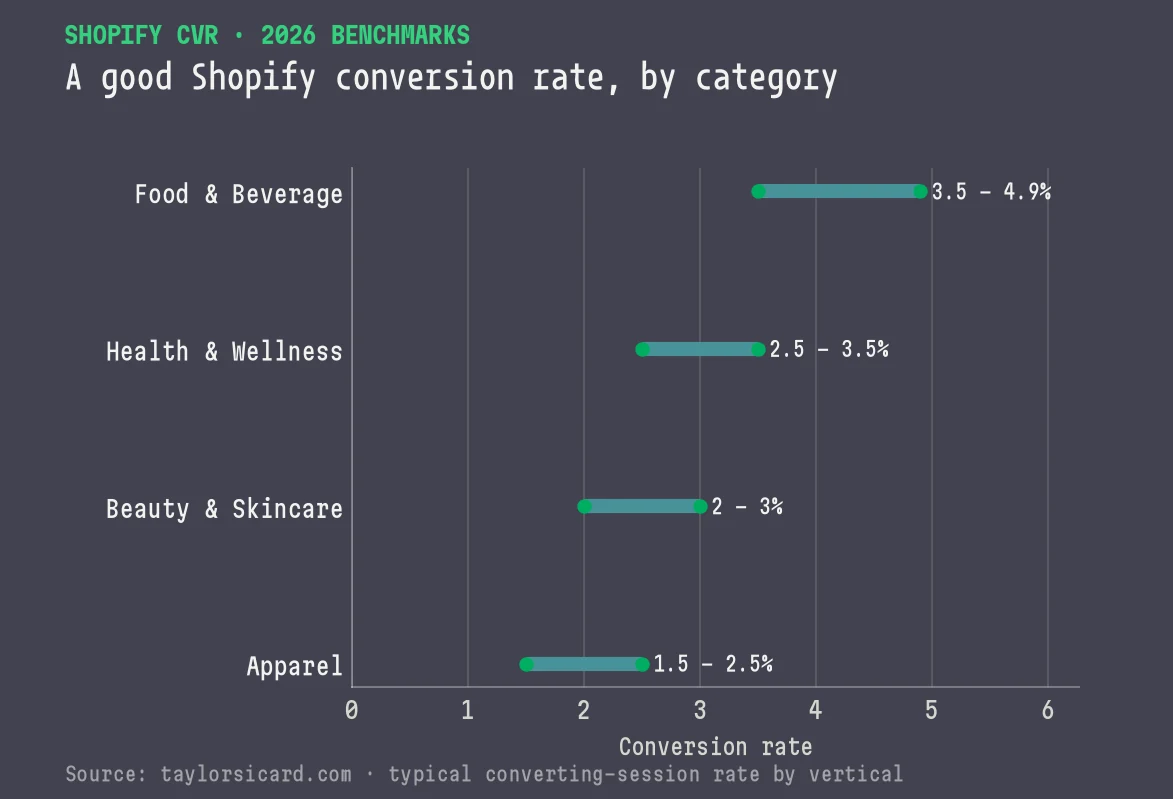
Find your row before you judge your number. If you are a furniture brand benchmarking yourself against the 3% "good Shopify" figure, you are chasing a goalpost that was never set for you, and you will burn budget trying to fix a conversion rate that is already strong for your category.
The same store
converts five
different rates.
Your blended conversion rate is an average of segments that behave nothing alike. Desktop has historically converted around 3.9% against mobile near 1.8%, though one-tap payment adoption is closing that gap toward the high-2s on both (Littledata). If your traffic shifts more mobile this quarter, your blended rate drops even though nothing about your store got worse.
Traffic source matters even more. Email and returning visitors convert several times higher than cold paid social, because they arrive with intent and trust already built. A brand that scales a broad top-of-funnel campaign will watch its blended conversion rate fall, and that fall is not a problem to fix, it is the expected cost of reaching new people. One segment is worth watching closely here: AI-referred traffic. The data shows those shoppers convert at meaningfully higher rates and arrive further down the funnel, which I broke down in detail in the AI-buyer conversion piece.
"A falling blended conversion rate during a growth push is not a leak. It is the math of reaching colder audiences. Judge new-customer conversion separately or you will optimize the wrong thing."
One number hides
the two that matter.
Here is the trap. Your store-wide conversion rate blends new and returning visitors, and returning visitors convert far higher. A brand with a growing base of loyal repeat buyers can show a flat or rising blended rate while its new-customer conversion is quietly deteriorating. The repeat buyers carry the average. By the time the blended number drops, the acquisition engine has been weakening for months.
This is the same structural error I see in how brands read LTV, blending cohorts that should be separated. The fix is the same: split the metric. Track new-visitor conversion and returning-visitor conversion as two distinct numbers, every week. New-visitor conversion is your true acquisition health. Returning-visitor conversion is your retention and merchandising health. Averaged together, they cancel each other's signal. The connection to lifetime value is direct, and I go deep on the cohort approach in the LTV math piece.
Where the points
actually come from.
Once you know your category baseline and you are reading new-customer conversion separately, the levers that move the rate are not mysterious. They are, roughly in order of impact: site speed, the product page, and checkout friction. On the middle one, it is worth knowing which product page changes actually have published evidence behind them before you spend a sprint on any of them.
Speed first, because it gates everything else. A store that loads slowly loses buyers before they ever see your merchandising, and mobile is where most of the damage happens. I treat this as its own discipline in the store-speed piece. The product page is next: it is where the buying decision is actually made, and small changes to the hero, the proof, and the buy box move conversion more than almost anything upstream. I built a full audit for that in the product-page CRO audit. Checkout is last in the path and first in neglect, the place revenue leaks quietly because nobody looks at it.
Where the Leak Usually Is
If your rate is below your category baseline, the leak is almost always in one of two places, and the data points clearly at the second. Roughly 70% of carts are abandoned at checkout, and the leading reasons are not mysterious: the single biggest is unexpected extra costs, shipping, taxes, and fees revealed too late, cited by close to half of abandoners, followed by being forced to create an account (Baymard Institute). Before you blame your traffic or your product, check whether your checkout is surfacing cost surprises or forcing friction that a buyer who already wanted to purchase will not tolerate. That is the cheapest conversion you will ever recover, because the intent was already there. And before you reach for a discount to close a gap, run the conversion vs margin tipping-point calculator to see the lift a price cut would actually have to deliver.
The Mobile Gap Is Probably Dragging You
Desktop has historically converted at roughly twice the rate of mobile, and while one-tap payment is closing that gap, most brands still convert meaningfully worse on phones than on laptops. That gap matters for your headline number because if your traffic has shifted more mobile, which for most consumer brands it has, your blended rate falls even if nothing got worse, simply because the lower-converting segment is now a bigger share of sessions. Pull your conversion rate split by device. If mobile is dragging the blend and the bulk of your traffic is mobile, your highest-return work is mobile speed and mobile checkout, not another round of desktop tweaks few of your buyers see.
A Simple Diagnostic Order
When a rate looks low, run the teardown in this order rather than guessing. First, segment new versus returning, because a low blended rate is often just a healthy store reaching a lot of cold new traffic. Second, split by device and confirm mobile is not quietly dragging the average. Third, look at add-to-cart rate: if people are adding to cart but not converting, the leak is in cart and checkout, so audit for cost surprises and forced friction. Fourth, only after all of that, question the product page and the traffic quality. Most founders start at step four and never run steps one through three, which is how they end up rebuilding a product page when the real problem was a surprise shipping fee at checkout.
Stop watching one
number. Watch two.
If you take one thing from this, make it this. Retire blended conversion rate as your headline metric and replace it with a pair: new-visitor conversion rate and add-to-cart rate. New-visitor conversion tells you whether your acquisition and your store are actually turning strangers into buyers. Add-to-cart rate tells you where a problem lives, because if people are adding to cart but not converting, your leak is in cart and checkout, not in your product or your traffic.
That pair will tell you more in one glance than the blended rate tells you in a quarter. The blended number is fine as a vanity line on a board deck. It is a terrible number to run the business on.
Common
questions
answered.
What is a good Shopify conversion rate in 2026?
For most consumer categories, 2.5% to 3.5% is the benchmark for a well-optimized Shopify store. Top stores hit 4.7% or better. But the number only means something in context. Food and beverage brands routinely convert at 3.5% to 4.9%. Luxury and jewelry brands at 0.9% to 1.4% are performing correctly for their category. Always find your vertical row before deciding if your number is a problem. More context is in the DTC benchmark card.
Why is my conversion rate dropping even though I changed nothing?
A falling blended rate without store changes almost always means the traffic mix shifted, usually toward colder paid social audiences, or toward more mobile. More cold traffic pulls the rate down because new visitors convert far lower than returning ones. More mobile traffic pulls the rate down because mobile converts lower than desktop. Segment by new versus returning visitors and by device before assuming anything is broken. A falling blended rate during a growth push is expected math, not a store problem. See store speed and conversion for the fastest technical lever once you have ruled out traffic mix.
What is the biggest cause of cart abandonment on Shopify?
Unexpected extra costs at checkout, such as shipping fees, taxes, and handling charges not disclosed earlier in the session, are the leading cause. Being forced to create an account is the second most common reason. Both are fixable: show shipping costs earlier, offer guest checkout by default. These are the cheapest conversion points to recover because the buyer's intent was already there. Full audit sequence is in the product page CRO audit.
Should I use conversion rate or revenue per session as my headline metric?
Revenue per session is often more actionable for mature stores because it blends conversion rate with average order value into a single signal that accounts for both. A small improvement in AOV can offset a modest conversion rate drop and still improve the business outcome. Conversion rate alone does not capture that tradeoff. The full break-even math for it, including what a price cut must earn back, is in conversion rate versus profit margin. That said, if you are early stage and AOV is relatively fixed, conversion rate split by new versus returning is the right primary metric. For how AOV connects to the broader financial picture, see contribution margin for DTC brands.
Is a 2% conversion rate bad for a Shopify store?
Depends entirely on your category and traffic mix. A furniture brand at 2% is doing well. A food brand at 2% is underperforming. A supplements brand at 2% with 70% cold paid traffic is in a different situation than one at 2% with 60% email traffic, because email converts several times higher and brings your blended average up. The number needs the context of what sent the traffic and what category you are in before it tells you anything meaningful.
So, is your conversion rate good? Now you can actually answer it. Find your category row, read your number against it, separate new from returning, and look at the funnel underneath. A good conversion rate is not a universal figure you hit. It is your category baseline, met or beaten, by customers you acquired profitably. Everything else is noise dressed up as a KPI.
For the financial layer that sits underneath conversion, read the LTV math brands get wrong and max allowable CAC by vertical. Conversion rate is only part of the unit economics story.
Reading the right conversion signal is one of the first things I fix with brands. It is core to the DTC growth consultant, and the form takes two minutes: start the conversation.
Landing page conversion rate by industry, and how it differs from a store's rate
A landing page conversion rate and a store conversion rate measure different things, and most "by industry" tables online mix the two. A landing page has one job, usually a form fill or a single offer, and the visitor came for it. A store session can be someone checking an order or comparing three tabs before deciding. That is why landing page medians run well above store rates. Across all industries the landing page median is 6.6%, roughly double the 2.5% to 3.5% that counts as good for most Shopify categories in the table at the top of this post, so holding a store to a landing page number sets the wrong goal.
Unbounce's 2024 Conversion Benchmark Report covers more than 41,000 landing pages and 57 million conversions. Its medians by industry:
| Industry | Median landing page conversion |
|---|---|
Entertainment | 12.3% |
Education | 8.4% |
Finance and insurance | 8.3% |
Legal | 6.3% |
Professional services | 6.1% |
Healthcare | 5.1% |
Travel and hospitality | 4.8% |
Ecommerce | 4.2% |
SaaS | 3.8% |
All industries | 6.6% |
Two notes on the ecommerce row. Unbounce's ecommerce page gives 4.2% in two places and 5.2% in one, so read it as roughly 4% to 5%. And it counts landing pages built for a campaign, not product pages inside a store, so the fair comparison is a paid-traffic page you built around one offer. For the store itself, use the category table at the top. Source: Unbounce Conversion Benchmark Report.
Scaling a consumer brand?
I work with a deliberately small number of DTC operators. I've run brands at this scale myself, from $5M past $100M. If you're in that range, the form takes two minutes.
Start a conversation More about Taylor →Free tools: Want to run your own numbers? Try the conversion revenue leak calculator, and the conversion vs margin calculator.