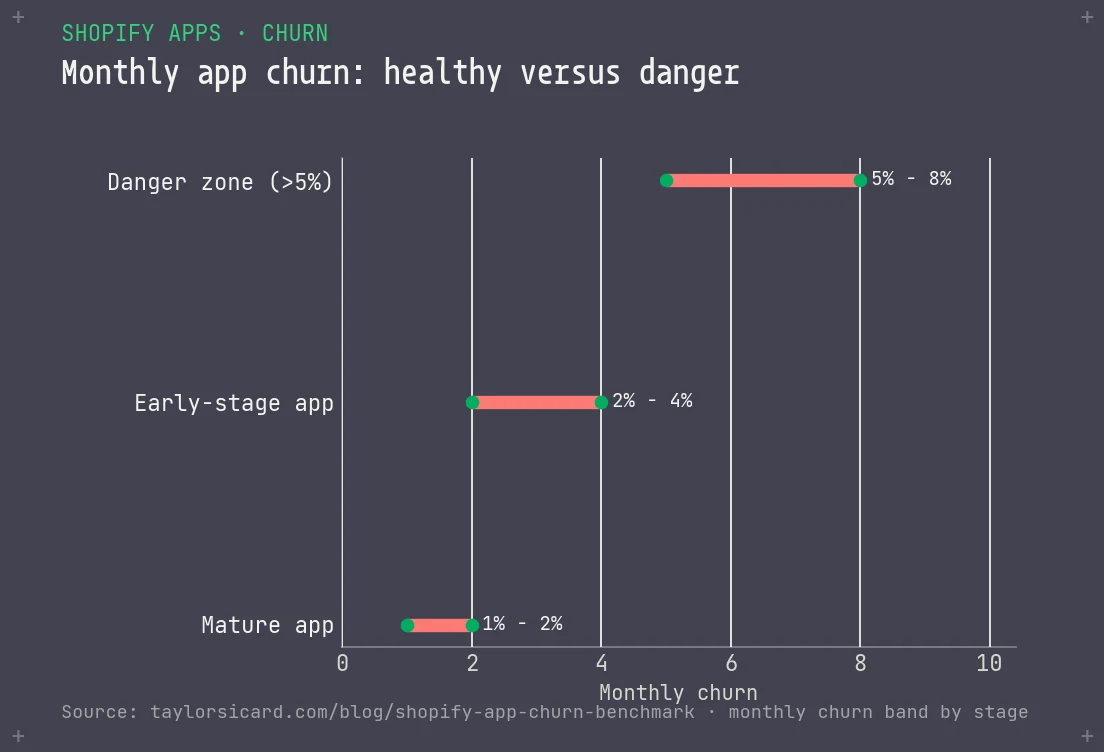
The average Shopify app loses around 30 percent of its revenue base to churn each year. Under 8 percent annual is strong. Monthly rates of 2 to 4 percent are acceptable early; sustained above 5 percent is a product-market fit problem no save flow will fix.
- Know which churn number you are actually measuring before you act on it.
- The gap that matters is the distance between the 30 percent average and the under-8 percent bar.
- Seasonal merchant behaviour quietly distorts nearly every churn measurement.
The average Shopify app loses around 30% of its revenue base to churn each year. Under 8% annual is strong. Monthly rates of 2–4% are acceptable early; sustained above 5% is a product-market fit problem that no save flow will fix. Those are the benchmarks. What matters more is knowing which number you are actually measuring, and why the seasonal shape of merchant behaviour quietly makes every measurement wrong. Churn sits alongside the other app numbers in the 2026 DTC and Shopify app benchmarks.
The average
is bad.
Do not aim there.
The average Shopify app loses somewhere around 30% of its revenue base to churn each year. That number is high because the App Store has a low cost to install and an even lower cost to uninstall, and because a meaningful share of merchants who install never had a durable need in the first place. They were curious, not committed. You got their first month; you never had their second. For brands running subscriptions, the tooling cost behind that retention is broken down in the 2026 Recharge pricing decoder.
A genuinely strong app holds annual churn under about 8%. That is the gap you should care about, the distance between the 30% average and the under-8% bar, because that gap is the difference between a treadmill and a flywheel. At 30% annual churn you are rebuilding nearly a third of your business every year before you grow a dollar. At 8% you keep almost everyone and growth compounds on itself. To see your own gap in dollars, my free app churn-cost calculator shows the revenue your current rate burns each year and the valuation it quietly erases.
I want to be direct about what "average" means here. The 30% figure exists because most apps never fully solve retention. It reflects the entire App Store population, including apps that launched with a splash and quietly died, including apps that found a narrow niche and never expanded beyond it, including apps where the founder already knows the product needs a rebuild. Benchmarking against the average is comfort, not strategy.
| Window | Range | What it means |
|---|---|---|
Annual, average app | ~30% | The middle of the pack. Survivable, not healthy. A treadmill. |
Annual, strong app | Under ~8% | A real moat. The base compounds. Worth building on. |
Monthly, early stage | ~2–4% | Acceptable while you find fit and tighten onboarding. |
Monthly, mature | ~1–2% | Where a sticky app settles as it ages into its category. |
Monthly, danger zone | Sustained above ~5% | A product-market fit problem. Stop and diagnose before spending on acquisition. |
Net Revenue Retention, strong | 110–130%+ | Existing accounts grow faster than churned ones shrink. Rare and defensible. |
One number
can hide
two stories.
Before you compare yourself to any benchmark, know which churn you are measuring. Gross revenue churn is the revenue you lost to cancellations and downgrades, full stop. Net revenue churn nets in the expansion from accounts that upgraded or grew during the same period. They can tell completely opposite stories from the same base.
An app can have ugly gross churn and beautiful net retention because a handful of growing accounts more than cover the departures. That is a real business, but it is a fragile one. You are leaning on a few large merchants to paper over a leaky base. The moment those anchor accounts stop growing or leave, the true churn rate becomes visible all at once. The reverse situation, clean gross churn with weak expansion, is a sturdier foundation that is leaving growth on the table.
This distinction matters especially if you are thinking about raising capital, running a partnership with a larger platform, or preparing for acquisition. Buyers and investors who know the space look at both numbers. If you hand them gross churn alone, they will assume the worst about expansion. If you hand them NRR alone without breaking out gross churn, they know you are hiding something. If you have never computed it, calculate your app's net revenue retention from your churn and expansion numbers in a couple of minutes. How a Shopify app gets valued breaks down how this shows up in practice when a deal actually lands on a table.
Net revenue retention, the honest scoreboard
NRR is gross churn and expansion combined into one figure. Above 100% means your existing base grows on its own, even if you never acquired another shop. The best apps run roughly 110–130%. If your gross churn looks alarming but your NRR is comfortably above 100%, the business is healthier than the churn line alone suggests. Report both. Always.
Your churn
has a calendar
you did not set.
This is the part most app founders miss, and it is the part I lived through as a merchant. Your churn rate is not yours alone. It rides on the seasonal rhythm of the shops you serve. A merchant who installs apps in October to gear up for the holiday push and then trims their stack in January is not churning because your product failed. They are churning because their year has a shape.
If you measure churn in a single month and benchmark off it, you will draw the wrong conclusion. January and February look like a fit disaster for plenty of healthy apps, simply because a wave of seasonal merchants prunes their app stack after the peak. That same app might look completely healthy if you had measured it in September. Measure churn on a rolling trailing-twelve-month basis, or at minimum compare the same calendar month year over year, so the seasonal merchants wash out of the signal.
"Your churn rate rides on someone else's calendar. Measure it over twelve months or it will lie to you twice a year."
This distortion is worse in verticals where merchant seasonality is extreme. A holiday-focused app, a tax-prep integration, a summer subscription gifting tool: these all see natural install spikes followed by predictable pruning. If you serve merchants in categories like apparel or gifting, expect your January numbers to always look bad. That is not a retention problem. That is commerce seasonality wearing your data.
The trailing-twelve-month figure absorbs the holiday build-up and the January trim into a single honest number. Monthly churn is useful for spotting a sudden break in a metric that was previously stable, like a spike in March that does not match any historical seasonal pattern. But monthly churn is too noisy to benchmark against. Use it to find problems, not to grade yourself.
Send me your trailing-twelve-month churn and I will tell you if it is seasonal noise or a real problem. The form takes two minutes.
The two windows
are not
interchangeable.
Founders often quote a monthly churn number and an annual one as if they are the same story scaled by twelve. They are not. Monthly churn compounds, so a steady 3% monthly does not become 36% annually. It lands closer to the low 30s once you account for the shrinking base each month. The intuition trap is treating monthly times twelve as your annual rate, which overstates the problem on a percentage basis while understating the compounding drag.
The practical move is to pick the window that matches the decision in front of you. For weekly operating cadence and for spotting a sudden break in retention, watch monthly. For benchmarking the health of the business and for any conversation with someone who might invest or acquire, use trailing-twelve-month. And never compare your monthly number to someone else's annual number. That happens more often than you would think and always flatters or panics you for no reason. It is like comparing your sprint time to someone else's marathon pace.
Comparing to the average is comfort, not strategy. The 30% annual average exists because most apps never solve retention. Matching it is not an achievement, it is the median. Benchmark yourself against the under-8% strong apps instead, because that is the bar that produces a business worth owning. A business running at average churn is a business that PE buyers and acquirers discount heavily at the table.
The number
is a verdict.
Not a fix.
A benchmark tells you where you stand. It does not tell you what to do, and this is where founders waste the most time. They see a churn number above the strong bar and reach for retention tactics: the discount, the save flow, the win-back email. Those move the number a little and fix nothing, because churn is downstream of value delivery, not a lever you pull in isolation.
The real diagnostic question is whether merchants who churn actually got value from your app before they left. If they churned after 90 days of genuine use, that is a different problem than churning after 10 days of non-use. A merchant who used the product, got results, and still left is telling you about price, positioning, or a competitive shift. A merchant who never got past setup is telling you about onboarding. Those require completely different fixes. The 90-day save playbook walks through both.
If your trailing-twelve-month churn is comfortably under 8% and your NRR is above 100%, you have a benchmark you can build on. Go spend on distribution and partnership distribution. If you are sitting near the 30% average, the work is not a save flow. It is finding out why the value is not landing and fixing that upstream of retention. I made the full case in why churn is a symptom, not the problem, and it is the right next read here.
How pricing
shapes the
churn rate.
One thing founders often overlook: your pricing model selects for the type of merchant who installs. A free plan with a low-friction upgrade path attracts curious merchants who have not yet committed. They try, they decide it is not critical, they uninstall. A slightly higher entry price filters out the window-shoppers and leaves you with merchants who have already decided the problem is worth solving. Your churn rate reflects that selection, not just your product quality.
Usage-based pricing introduces its own churn dynamic. When a merchant's volume drops, their bill drops, and they are less likely to cancel. But when their volume is low for long enough, they start to wonder if they are even using the app. Revenue-based pricing can give you lower cancellation rates while masking the underlying disengagement. Worth knowing, especially if you are comparing your churn numbers against flat-rate subscription apps in the same category.
Shopify app pricing strategy goes deeper on the model tradeoffs. What matters here is that churn and pricing are not independent variables. The benchmark you are comparing against may reflect a different pricing model and a different merchant quality mix than what you have. Context matters when you read any number.
Common
questions
on churn.
What is a good churn rate for a Shopify app?
Under 8% annual gross churn is the strong benchmark. The average is around 30% annually. Monthly rates of 2–4% are acceptable early-stage; under 2% monthly is where mature, sticky apps tend to land. Sustained monthly churn above 5% is a product-market fit signal, not a retention tactics problem.
Should I track gross churn or net revenue retention?
Track both and report both. Gross churn tells you how many paying accounts or how much revenue you are losing. Net revenue retention (NRR) layers in expansion from upgrades and volume growth. An NRR above 100% means your existing base is growing even after churn, which is the real health signal. Gross churn alone hides expansion; NRR alone hides a leaky base.
Why does my churn spike every January?
Because your merchants run retail businesses with a seasonal calendar. October through December is when they gear up: they install apps, add seats, expand plans. January is when they trim: they cancel what they did not use heavily during peak, renegotiate costs, clean up their tech stack. This is not your product failing. It is commerce seasonality. Use trailing-twelve-month figures so seasonal spikes average out of the signal.
How does churn affect a Shopify app's valuation?
Directly and significantly. Apps near the 30% annual average are typically valued at lower multiples because the revenue base is seen as unstable. Apps under 8% annual churn with strong NRR command higher multiples. Buyers discount heavily for churn because they are paying for a future revenue stream, and high churn means that stream shrinks fast unless you keep spending on acquisition. See what Shopify app buyers want for how the full picture gets read.
What should I do if my churn is above the average?
Do not build a save flow first. First, find out whether churning merchants got genuine value before they left. If they used the app and still left, you have a positioning or competitive problem. If they never got past setup, you have an onboarding problem. The fix is upstream of retention tactics either way. The churn as symptom post covers the full diagnostic.
Know your numbers. Measure them over twelve months. Report gross and net both. Stop comparing yourself to an average that exists because most apps fail at this. And if you want a second read on whether your churn is seasonal noise or a real fit problem, send it through the inquiry form and put your churn in context with the full economics chart while you are at it.
Is your churn normal or a warning?
Send me your monthly and annual churn split by gross and net, and I will tell you whether you have a benchmark you can live with or a fit problem to fix.
Start a conversation How I work with Shopify apps →Free tools: Want to run your own numbers? Try the app churn cost calculator, and the CAC payback calculator.