Going headless on Shopify with Hydrogen costs the build plus the upkeep, because Oxygen hosting is free on every paid plan. In 2026, agency builds commonly run $50,000 to $250,000 and up, with $3,000 to $8,000 a month in ongoing engineering, which is where most brands underestimate the bill.
- Oxygen, Shopify's edge runtime for Hydrogen, is included free on every paid plan with unlimited bandwidth and built-in deploys.
- Build cost depends on scope: a lean MVP can land near $50,000, a full enterprise storefront runs $250,000 or more, often over six to twelve months.
- Maintenance runs several times higher than a Liquid theme, because you own the framework, CMS, and integrations.
- Headless tends to pay back above roughly $5M in revenue with a real reason. Under that, tuning Liquid usually returns more.
Brands eyeing headless almost always open with the wrong question. They ask what the hosting costs, because Shopify markets Oxygen as free, and they take that to mean headless is cheap. The hosting is free, and it is also the smallest line on the invoice. The cost of going headless on Shopify is the build and the people who keep it alive afterward, which in 2026 lands somewhere between a serious investment and a six-figure standing commitment, depending on how ambitious you get. Before you price it, the prior question is whether you need headless at all, which I settle in headless versus native Shopify.
A Hydrogen build from an agency commonly runs from around $50,000 for a lean, focused storefront to $250,000 and up for a full enterprise rebuild, and then $3,000 to $8,000 a month to maintain. Oxygen hosting is $0. Your Shopify plan still runs underneath it, and for most brands serious about headless that means Plus, which starts around $2,300 a month. So engineering dominates the total cost of ownership and infrastructure barely registers, the opposite of how the pitch usually reads.
I have lived on both sides of this. At WIN we ran brands on heavily tuned Liquid themes and got most of the speed a headless storefront promises without touching a single React component. I have also sat across from founders who paid for a custom storefront they could not staff to maintain, and watched the content velocity grind to a halt because every banner change now needed a developer. This post is the cost decoder I wish those founders had read first. If you want the wider platform picture, the 2026 ecommerce platform comparison sets the context this sits inside.
Before the numbers, it helps to see headless as a capability you take on. When you run a Liquid theme, you are renting a managed storefront, and Shopify absorbs a long list of work you never see: the hosting, the framework, the security patches, the platform upgrades. The day you go headless, that work moves onto your side of the ledger. So the right way to read every number below is as the cost of bringing a job in-house that someone else was doing for you, often very well, for the price of your monthly plan. Sometimes that trade is worth it, and this piece is meant to help you tell when.
The plan: walk the stack so you know what you are paying for, lay out the full cost breakdown in real ranges, and separate the build from the maintenance most brands forget to budget. Then price the third-party services and the Plus floor that never make the pitch, settle whether headless wins on speed, and compare the framework and theme paths. Last, run the math at three brand sizes and give a verdict on which brands still need headless and which are better off tuning what they have.
The hosting is free.
The build and the
upkeep are not.
Strip away the marketing and the cost of headless is three buckets: a one-time build, a recurring engineering spend, and the Shopify plan running underneath. Oxygen, the hosting, is the only free line, and it is free on purpose, because Shopify wants you building on its framework rather than someone else's. The build is where the variance lives. The same brand can get a $50,000 quote and a $300,000 quote depending on whether it wants a focused storefront or a full custom commerce experience.
That spread confuses people, so anchor it to scope. A lean build (a storefront that swaps the front end and keeps the experience relatively standard) can land near the bottom of the range. A full enterprise rebuild with custom design, a separate CMS, multi-market logic, and bespoke integrations sits at the top and routinely crosses $250,000 once you count the team it takes to ship it. The number tracks ambition more than any price list, and most of the cost overruns I see come from a brand quoting a lean build and then asking for enterprise features halfway through.
"Oxygen being free is the cheapest thing about going headless. The expensive part is that you now own a storefront, and owning it is a permanent job, not a one-time invoice."
Headless converts a hosting-and-platform cost that Shopify used to carry into an engineering cost that you carry. You are trading a managed storefront for control, and control has a salary attached. Before you sign anything, ask whether the storefront is the thing holding your business back, which is the lens I bring to every profitability teardown I run with a brand.
What Hydrogen and
Oxygen actually are,
and why one is free.
Hydrogen is Shopify's open-source React framework for building a custom storefront against the Storefront API. It ships with the commerce primitives you would otherwise rebuild by hand: cart, customer accounts, Shop Pay, analytics, and server-side rendering with granular caching. Oxygen is the edge hosting runtime that runs your Hydrogen storefront, built on Cloudflare's workerd, with unlimited bandwidth, auto-scaling, and GitHub-integrated deploys. The current release, Hydrogen 2026.4.0, shipped in April 2026.
Shopify makes Oxygen free for a strategic reason: it gives away the hosting to keep brands inside its framework instead of wiring a Next.js front end to a third-party host, where the bandwidth bill alone for a high-traffic storefront can run several hundred to well over a thousand dollars a month. Free Oxygen removes that line entirely, which is a real advantage, as long as you are willing to build on Shopify's React stack instead of your own. The trade is control of the framework for free, scalable hosting.
Checkout is the part people forget. Even on headless, Shopify still owns the checkout, which is why the platform underneath matters and why most headless brands land on Plus for checkout extensibility and Shopify Functions. The storefront is yours to build, the checkout stays Shopify's, and that boundary is why a brand still pays its full plan price on top of a custom front end. The way the rest of the tooling stacks by stage is laid out in the tech stack by revenue breakdown.
What Oxygen actually
includes, and the one
caveat to check.
Oxygen is free, and it pays to be precise about what that buys you, because it is the only line on this whole invoice without a number attached. It is Shopify's managed edge runtime for Hydrogen storefronts, built on Cloudflare's workerd, and it ships included at no extra charge with unlimited bandwidth, automatic scaling, GitHub-integrated continuous deployment, preview deployments for every branch, and global edge delivery across hundreds of locations with sub-second response times. You do not provision servers, you do not configure a CDN, and you do not get a bandwidth bill at the end of the month. For a high-traffic storefront, that last point alone removes a line that would otherwise run several hundred to well over a thousand dollars a month on a third-party host.
One caveat catches brands, and it concerns plan eligibility rather than price. Oxygen access depends on your Shopify plan, and the deployment target is strongest on the higher tiers. Sources in 2026 are not consistent on which plans qualify, with some listing Oxygen on Advanced and Plus only and others including the lower paid plans, so confirm your exact entitlement with Shopify before you architect around it. Oxygen is not available on Starter plans or on development stores. If you are serious about headless you are almost certainly heading to Plus anyway, where Oxygen is unambiguous, which is part of why the plan floor matters so much to the total cost.
The second thing to know: Shopify does not publish an overage schedule for Oxygen. For the vast majority of brands the unlimited framing holds and you never think about it again. If you are running tens of millions of requests a month, do not assume; verify the current entitlement with your Plus account manager. None of this changes the headline: hosting is free, and it stays the cheapest part of going headless no matter how big you get. The money lives everywhere else, and the rest of this breakdown follows it.
The full cost of
headless, line by
line, in 2026.
The table lays out the whole bill in 2026 ranges. The figures come from agency pricing guides and builders documenting real projects in 2026, plus what I have seen quoted to brands I advise. Treat the ranges as ranges: where you land depends entirely on scope, team, and how much custom design and integration work you ask for.
| Cost line | Range | What drives it |
|---|---|---|
Oxygen hosting | $0 | Free on every paid Shopify plan. Unlimited bandwidth, auto-scaling. |
Shopify plan | $39–$2,300+/mo | Most headless builds want Plus (~$2,300/mo) for API limits and checkout extensibility. |
Build, lean MVP | ~$50,000 | Focused storefront, mostly standard UX, smaller team, 4–8 weeks. |
Build, growth tier | ~$80k–$150k | Custom design, a CMS, more integrations, 2–4 month timeline. |
Build, enterprise | $200k–$250k+ | Full custom UX, multi-market, bespoke integrations, dedicated team, 6–12 months. |
Ongoing maintenance | $3k–$8k/mo | Framework upgrades, bug fixes, new features, the engineers to do it. |
Optional CMS / page builder | Varies | If you want non-developers editing pages without a ticket. |
Read the table as a whole and the shape is clear: the recurring lines (the plan and the maintenance) can exceed the one-time build over a couple of years. A growth-tier brand on Plus paying $5,000 a month to maintain a $120,000 build is spending roughly $60,000 a year just to keep the lights on, before any new feature work. That is the number brands skip when they fixate on the build quote. The full year-one outlay for a serious build, once you stack the build, the stack, and the engineering, frequently lands in the low-to-mid six figures.
One more caveat on the build range: the ceiling moves. I have seen well-documented enterprise headless projects quoted into the hundreds of thousands and beyond once the scope includes a full design system, a headless CMS, and a custom integration layer. Whatever the exact top number, headless does not have a tidy fixed price, and any agency that gives you one without scoping the work carefully is guessing. When the same dollars could go to a profit-first teardown of your unit economics or to acquisition, the comparison matters.
Agency, in-house, or
freelancer: who builds
it changes the bill.
The build number swings as much on who builds it as on what you build. There are three routes, and they price differently, fail differently, and suit different brands. Pick the wrong one and you either overpay for a simple storefront or under-resource a complex one and inherit a build no single person can maintain. This is how the three shake out in 2026.
A freelancer or small pod is the cheapest route and the right one for a focused, well-scoped build. Senior Hydrogen freelancers in 2026 charge roughly $100 to $250 an hour, and a clearly defined project can land anywhere from a few thousand dollars for narrow feature work up to around $30,000 for a lean storefront. The sweet spot is a brand doing $500K to $10M that knows exactly what it wants and is not asking for a sprawling custom platform. The risk is continuity: a freelancer is not a standing engineering function, so a complex or long-running build with no in-house owner can leave you stranded the moment they move on.
A boutique or specialist agency is the middle and most common route, and what most people mean when they say a headless build cost six figures. Agencies bill around $150 to $300 an hour, or roughly $5,000 to $75,000 a project for the build itself, more once you stack design, a CMS, and integrations. The advantage is that you get design and engineering under one roof and a team that has shipped this before, so a launch-focused Hydrogen build commonly runs six to eight weeks and a full migration usually lands inside three months. You are paying for delivery certainty and a team that has hit these walls already. The catch is that the agency leaves when the build ships, so you still need a maintenance answer for the day after launch.
"The build quote is the part everyone negotiates. Who maintains it on month four is the part nobody asks about, and that is the question that actually decides whether headless was a good idea."
Building in-house is the most expensive route up front and the only one that makes sense if storefront work is continuous rather than a one-time project. A real in-house team for this is a front-end engineer, a back-end engineer, a tech lead, a product manager, and QA, which in fully loaded cost runs well past $50,000 a month before recruiting, tooling, and management overhead. Nobody stands that up for a single build. You stand it up when the storefront is a permanent product you are shipping against every week, the way a large multi-brand or multi-market operator does. For everyone else, in-house is how a $120,000 build quietly becomes a $700,000-a-year line item.
| Route | Typical cost | Best for | The risk |
|---|---|---|---|
Freelancer / small pod $100–$250/hr | A few $k to ~$30k | Focused, well-scoped build at $500K–$10M revenue. | No standing team. Continuity gap if they leave. |
Boutique / specialist agency $150–$300/hr | $5k–$75k+ build | Design plus engineering together, predictable delivery. | Agency leaves at launch. You still need maintenance. |
In-house team 5+ roles, loaded | $50k+/mo standing | Continuous storefront work, multi-brand or multi-market. | Huge fixed cost. Overkill for a one-and-done build. |
AI-assisted development is compressing build timelines in 2026, and that moves these numbers. Teams pairing Shopify's official AI tooling with coding assistants are reporting that a Hydrogen storefront that took twelve weeks in 2025 can ship in four to six weeks now. It does not make headless free (the maintenance reality below is unchanged), but it does pull the build cost down at the margin and narrows the gap between routes. Treat it as a tailwind on the build line; the harder question of who owns the thing afterward still stands. That handoff question is why I push every brand to map this against the wider stack in the tech stack by revenue framing before committing.
Maintenance is the
line that sinks the
headless business case.
When headless goes wrong financially, the culprit is almost always the maintenance and almost never the build. On a Liquid theme, Shopify carries the hosting, the framework, the platform upgrades, and most of the plumbing, so a brand can run a tuned theme with a fractional developer or an agency on a light retainer. On headless, all of that becomes yours: framework upgrades when Hydrogen ships a new version, CMS updates, hosting configuration, and every custom integration that needs to keep working when an upstream API changes.
That is why the maintenance line runs several times higher than a comparable Liquid theme. The builders documenting this in 2026 put headless upkeep at multiples of classic Shopify, and that matches what I see. The brands that struggle are the ones that budgeted the build, shipped a beautiful storefront, and then discovered they need a standing engineering relationship to change a hero image or survive a framework upgrade without breaking the cart.
There is a staffing version of this trap that catches even well-funded brands. The agency that built your storefront knows it intimately, but the moment the contract ends, that knowledge walks out the door unless you have kept someone in the room. Brands that did not plan for the handoff end up either re-hiring the original agency at a premium every time something breaks, or paying a new team to learn a codebase from scratch, which is slow and expensive. The fix is to decide who owns the storefront on day one of the build, not month four, and to have that person involved while the agency is still around to transfer what they know. A maintenance plan that exists only as a line item in a budget, with no named owner, is not a plan.
None of this rules out headless; it means budgeting it honestly. The right way to scope a headless decision is to price the build and three years of maintenance together, then ask whether the storefront is generating enough additional value to cover that whole number. If you cannot answer that cleanly, you are not ready to go headless, and the way to pressure-test it is the same revenue-staged lens behind the tech stack by revenue framework.
The costs nobody
puts in the quote,
and they add up.
The build number and the maintenance retainer are the lines an agency will tell you about. There is a third bucket they tend to leave out of the pitch, because it is awkward to quote and easy to wave away: the third-party services a real headless storefront needs to function. On a Liquid theme, a lot of this is bundled into the platform or handled by an app from the Shopify App Store for a flat monthly fee. Go headless and you re-buy several of those capabilities as standalone tools, each with its own contract, its own integration work, and its own monthly bill.
Start with the content management system. Liquid has a theme editor where a merchandiser drops in sections and edits copy. Headless does not, so most brands bolt on a headless CMS to give non-developers a way to edit pages without filing a ticket. Contentful's Team plan runs around $300 a month and climbs from there, Sanity's paid tiers start near $15 per seat per month and scale with usage, and Strapi is free self-hosted but then you are hosting and maintaining it yourself, which is a cost wearing a different hat. None of these is outrageous on its own, but the CMS line did not exist before you went headless, and now it is permanent.
Then search. Liquid ships with native search that is fine for most catalogs, and a headless storefront often replaces it with Algolia, Searchanise, or a similar service to get the instant, faceted search experience that justified the rebuild in the first place. A headless search plan commonly runs a few hundred dollars a month at the low end and climbs into four figures at enterprise scale. Add image transformation and a CDN layer if your host does not cover it, monitoring and error tracking so you know when the storefront breaks, and preview environments that some CMS vendors meter per environment, and the standalone-services line becomes a real number.
| Service | Typical monthly | What it replaces on Liquid |
|---|---|---|
Headless CMS Contentful / Sanity / Strapi | $0–$300+/mo | The native theme editor and sections. |
Search Algolia / Searchanise | $300–$2,000+/mo | Native Shopify storefront search. |
Image CDN / transformation Cloudinary or equivalent | $99–$999+/mo | Shopify's built-in image pipeline. |
Monitoring / error tracking Sentry, uptime tooling | $0–$500+/mo | Platform-managed reliability. |
Preview environments Metered on some CMS plans | Varies | Theme preview, included free. |
The reason these costs hide so well is that they arrive one at a time, after launch, each looking small on its own. The CMS gets added because a marketer is tired of waiting on a developer. Search gets upgraded because the native experience felt cheap next to the new storefront. Monitoring gets bought the first time the site goes down silently and nobody notices for an hour. Each decision is reasonable, each invoice is modest, and none of them was in the original quote. Six months in, the brand looks up and the storefront it was told would cost a build plus a retainer is running a stack of subscriptions that, added together, rival the retainer itself. That is what owning the front end costs once it is live.
Stack those and a brand that thought it was paying $5,000 a month to maintain a headless build is paying that plus another $1,000 to $4,000 in services it never priced. The composable-commerce guides documenting full builds in 2026 put healthy headless upkeep, once you count the CMS, search, monitoring, and the engineering behind it, anywhere from $8,000 to $40,000 a month. That top number is enterprise territory, but the bottom of it is the range that sinks the ROI math for a $5M to $15M brand that budgeted only the build. The fix is to put every one of these tools in the model before you commit, the same way I make brands count the full picture in a profitability teardown instead of only the headline line items.
The Shopify Plus
floor that runs
underneath it all.
Every headless build runs on a Shopify plan underneath, because the platform still owns the catalog, the checkout, and the order pipeline. You can technically run Hydrogen and Oxygen on any paid plan, but in practice most serious headless brands land on Plus, and that is a real line in the total cost that the free-hosting story conveniently ignores. For a brand with a real reason to go headless, Plus is the practical floor.
Shopify Plus in 2026 starts at roughly $2,300 a month on a three-year contract, or about $2,500 a month on a one-year term. That flat fee holds until your sales cross a high threshold, around $800,000 a month, at which point billing switches to a variable rate of roughly 0.35% of sales on the longer contract, capped so you never pay more than $40,000 a month in platform fees no matter how large you get. For most brands considering headless, the flat $2,300 is the number that matters, and it sits on top of everything else in this post.
Headless builds gravitate to Plus because the things that justify going custom tend to be the same things Plus gives you: 10x higher Storefront API rate limits for a high-traffic custom front end, checkout extensibility and Shopify Functions for bespoke checkout logic, and the B2B and multi-market features a complex storefront leans on. A brand that needs none of those probably does not need headless either, which is part of why the Plus floor and the headless decision travel together. The full breakdown of what Plus costs and when it earns its keep is in the Shopify Plus pricing guide.
If you are going headless and want the API limits and checkout control that make it worth doing, budget Plus at about $2,300 a month as a standing line, separate from the build and the maintenance. At very high revenue the fee goes variable, capped at $40,000 a month. The number to plan around for most brands is the flat $2,300, and it does not go away.
Does headless
actually load
faster than Liquid?
Speed drove most headless rebuilds for years, and the 2026 answer has changed enough to need its own section. The old pitch went: themes are slow, headless is fast, pay for headless and your store gets quick. That was directionally true in 2019 and is mostly untrue now, and pretending otherwise is how brands talk themselves into a six-figure build for a speed problem they could have fixed for a fraction of the cost.
Shopify ranks near the very top of the CrUX Technology Report for Core Web Vitals pass rates, second only to one other platform, and roughly 60% of Liquid sites pass all three Core Web Vitals. That figure drops on mobile and varies by store size, with one benchmark of a thousand real stores finding 48% passing all three on mobile, but the floor is high. A tuned Liquid theme in 2026 is fast by default, which means the speed gap headless used to exploit has narrowed to the point where, for a standard storefront, it barely exists.
"Headless raises the ceiling on speed. It does not raise the floor, and Liquid's floor is already high. Most brands have a slow store because of their apps, not because of Liquid."
What slows most Shopify stores is apps, while Liquid gets the blame. Installed apps are the single biggest cause of Core Web Vitals failure on Shopify, and every new app adds an estimated 50KB to 150KB of JavaScript to every page load. A store carrying fifteen apps is dragging a meaningful amount of script on every view, and that is where the speed wins are. Strip a bloated app stack and tune the theme, and page-load improvements of forty to sixty percent are realistic, without touching a single React component or paying for a rebuild.
There is a measurement trap here too. Brands often point at a slow Liquid store and a fast headless demo and conclude headless is the cause of the speed difference, when usually it is not. The headless demo is a clean build with no app cruft, served from the edge, and the slow Liquid store is carrying years of accumulated apps, third-party pixels, and unoptimized images. Put the same discipline into the Liquid theme, strip the apps, lazy-load what is left, fix the images, and the gap collapses. The comparison was a neglected store against a fresh one, and you can get a fresh one without a rebuild.
Headless can be faster than a tuned theme when it is built well, by a team that knows what it is doing, for a storefront whose requirements exceed what Liquid can express. But the inverse is just as true and far more common: a poorly built Hydrogen storefront loses to an optimized Liquid theme, and now you are paying six figures for a slower store. Speed alone is no longer a reason to go headless. If a faster, better-converting store is the goal, start with the app audit and the theme, the same levers behind the conversion benchmarks, and only reach for headless when the experience itself, not the speed, is the constraint.
Hydrogen on Oxygen,
or Next.js on your
own hosting?
If you have decided headless is right, the next fork is which framework you build on, and it has direct cost consequences. The two real options in 2026 are Shopify's own Hydrogen running on Oxygen, or a backend-agnostic React framework like Next.js running on a host you pay for. The choice turns on how committed you are to Shopify and how much of the integration layer you want to own, more than on which is technically better in the abstract.
Hydrogen on Oxygen is the default if Shopify is your long-term home. You get free edge hosting, native integration with the Storefront API and Shopify's commerce primitives, a faster path to launch, and a lower total cost because the hosting line is zero. The trade is that you are committing to Shopify's framework and its release cadence. For a brand whose business is on Shopify and intends to stay there, that trade costs little, and Hydrogen is the cheaper, faster, better-integrated path I steer most brands toward.
Next.js makes sense in a narrower set of cases: when commerce is one part of a wider composable stack with multiple backends, when there is a heavy editorial or content side that wants a content-first framework, or when a brand already has a strong React team that values backend-agnostic portability over Shopify-native convenience. The cost difference is real. With Next.js you typically pay for separate hosting, where a high-traffic storefront's bandwidth bill can run several hundred to well over a thousand dollars a month, and you own more of the integration work between the front end and Shopify, which raises both the build and the upkeep. If the question underneath is whether to move the whole backend along with the front end, I worked through commercetools vs Shopify on total cost of ownership separately.
| Factor | Hydrogen + Oxygen | Next.js + own host |
|---|---|---|
Hosting cost | $0 (Oxygen included) | $200–$1,500+/mo, scales with traffic |
Shopify integration | Native, built in | You own the integration layer |
Time to launch | Faster, primitives included | Slower, more to wire up |
Best for | Shopify-committed brands | Multi-backend composable stacks |
Lock-in | Tied to Shopify's framework | Backend-agnostic, portable |
If Shopify is where you live, Hydrogen on Oxygen is the lower-cost, faster, better-supported default in 2026, and the free hosting is a real advantage worth taking. Next.js is the right call when you have a real multi-backend or content-heavy reason and a team that can carry the extra integration and hosting weight. Picking Next.js for portability you will never use means paying for optionality you do not need, which is the same mistake brands make when they over-buy across the rest of the Shopify tech stack by revenue tier.
Headless, native
Liquid, or a Plus
theme: pick by need.
Before you decide between frameworks, decide whether you need a rebuild at all. Most brands jump straight to the headless-versus-Next question when the real fork is one step earlier: headless, a standard Liquid theme, or a premium Plus-grade theme. Each is a different cost tier and a different ownership model, and the storefront's requirements should set the answer, whatever sounds most advanced. I frame the three this way.
A standard Liquid theme is the right answer for the large majority of brands. Shopify handles the hosting, the framework, and the upkeep, the speed floor is high, and a fractional developer or a light agency retainer keeps it running. Cost is a theme purchase plus modest customization, often a few thousand dollars, and the maintenance burden is small. If your storefront needs are standard, this is the correct choice, and the money you save goes to growth.
A premium or custom Plus theme is the middle tier for brands that need more design and merchandising flexibility but not a full architectural rebuild. You stay on Liquid, keep Shopify's managed hosting and upkeep, and invest in a heavily customized theme that expresses a more distinctive experience. This captures most of what brands think they need headless for, the custom look and the merchandising control, without taking on the engineering ownership that sinks the headless ROI math. It is the most underrated option, because it is what a lot of would-be headless brands want.
Headless is the top tier, and it is the right answer only when the experience exceeds what a theme can express: a configurator, an editorial-commerce hybrid, multi-market logic on one front end, or an interface that does not fit the theme model, plus the engineering to own it. If your requirement fits a theme, a theme wins on cost every time. Headless earns its price only when the storefront itself is doing something a theme cannot.
| Approach | Build cost | Upkeep | Choose it when |
|---|---|---|---|
Standard Liquid theme | ~$0–$10k | Light, Shopify-managed | Standard storefront, speed and cost matter most. |
Custom / Plus theme | ~$15k–$60k | Moderate, still on Liquid | You want a distinctive look without owning the stack. |
Headless (Hydrogen) | $50k–$250k+ | Heavy, you own it | Custom UX or multi-market a theme cannot express. |
Read the table left to right and the decision is usually clear. The build cost and the upkeep both jump by an order of magnitude as you move from a theme to headless, and the thing that justifies that jump is a structural experience requirement, never speed and rarely the look. If you cannot point to one, you are on the theme tiers, and the only real question is how custom a theme you want.
Brands skip the middle tier (the custom Plus theme) mostly for status. Headless sounds like the serious choice, the one a real brand makes, and a theme can feel like settling. That instinct costs brands a fortune. A heavily customized theme, built by a good agency, can deliver a storefront that looks and merchandises nothing like the template it started from, while keeping every bit of Shopify's managed hosting and upkeep. I have watched brands spend six figures going headless to get an experience a $40,000 custom theme would have delivered, and then spend years carrying the maintenance for it. Before you let the word headless pull you to the top tier, make someone show you, concretely, what the storefront needs to do that a custom theme cannot. If the list is short or vague, stay on a theme.
What the numbers
look like at three
different brand sizes.
Ranges are useful, but they are abstract until you put them against a real brand. The three scenarios below sit at different revenue levels, each with a plausible build, the year-one all-in cost, and a verdict. They are not the only configurations; they show that the same headless decision produces very different answers depending on the size of the business carrying it, and you cannot judge the cost without judging the revenue it sits on.
Scenario one: a $3M brand on a standard theme. A storefront doing $3M a year, growing well, on a tuned Liquid theme, gets a headless quote of $120,000 to build plus $5,000 a month to maintain, plus Plus at $2,300 and another $1,500 in services. Year one all-in: roughly $200,000. Against $3M in revenue and the margin a brand that size actually keeps, that is a large bet on a build that has to deliver a measurable lift to justify itself, and the storefront was almost certainly not the constraint. The verdict: do not go headless. Audit the apps, tune the theme, and put the $200,000 into acquisition and retention where it returns more.
Scenario two: an $8M brand with a real UX requirement. A brand at $8M wants a product configurator and a custom editorial experience that does not fit the theme model, and it has one in-house engineer who can co-own the build. The headless quote is $160,000 plus $6,000 a month maintenance, Plus at $2,300, and $2,500 in services. Year one all-in lands near $290,000. Here the math is live but not automatic. The requirement is real, the engineering capacity exists, and at $8M a conversion or experience lift is a meaningful absolute number. Payback in the twelve-to-eighteen-month window is plausible. The verdict: worth a serious look, with the maintenance and services modeled honestly before signing.
Scenario three: a $30M multi-market brand. A brand at $30M runs several markets, wants one custom front end serving all of them, and already employs a small engineering team shipping storefront work every week. A full enterprise build runs $250,000-plus, and the team that maintains it is a standing cost the brand already carries, so the marginal upkeep is capacity it already has rather than a new line. Year one is the largest absolute number of the three, but it is also the smallest share of revenue and profit. The verdict: headless is likely the right call, because the absolute return on a better, unified, multi-market storefront finally exceeds the cost of owning it.
| Brand | Build | Year-one all-in | Verdict |
|---|---|---|---|
$3M, standard theme No custom UX, no in-house eng | ~$120k | ~$200k | No. Tune the theme, spend on growth. |
$8M, real UX need Configurator, one in-house eng | ~$160k | ~$290k | Maybe. Model upkeep first. |
$30M, multi-market Standing eng team in place | $250k+ | $300k+ | Likely yes. Return exceeds cost. |
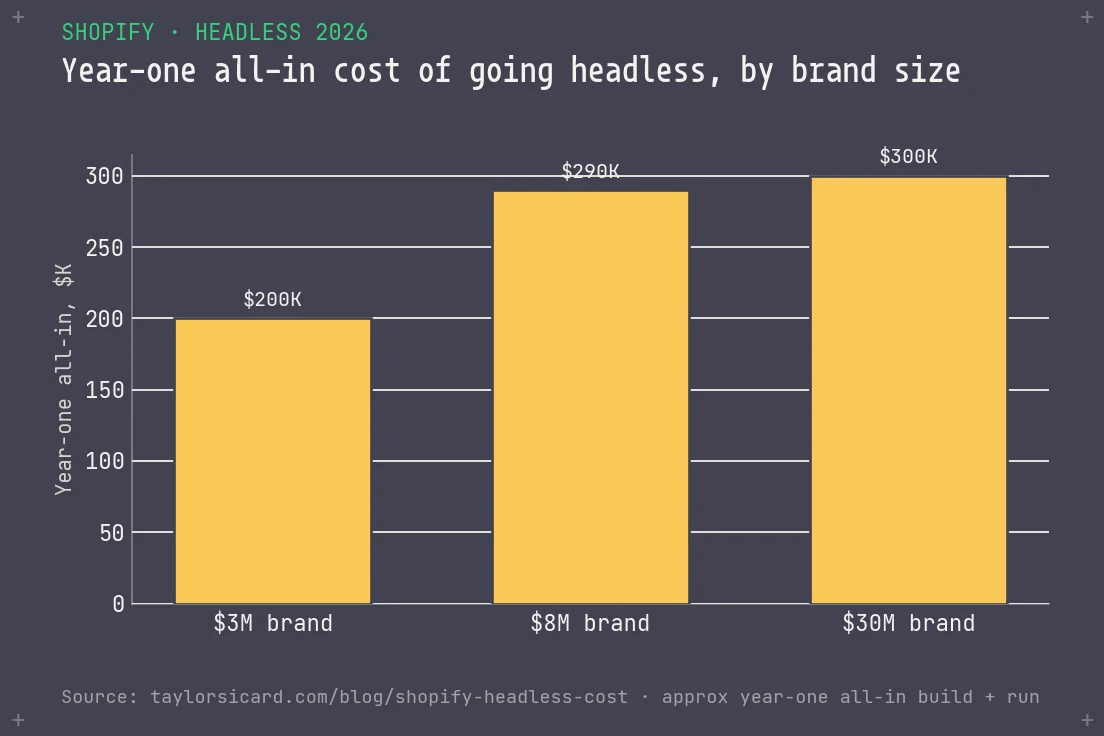
None of the three scenarios includes a brand that should go headless purely to be faster or purely to look more premium, because that brand does not exist. In every case where headless was the right answer, the deciding factor was a structural requirement the storefront could not meet otherwise, the configurator, the multi-market front end, the experience that did not fit the theme model. Speed and polish came along for the ride, but they were never the reason. If your own version of this scenario has speed or aesthetics as the headline justification, you have a theme problem that looks like an architecture problem, and the cheaper fix is the right one.
The pattern across the three is the one I come back to with every brand: the build cost barely moves the verdict, the revenue and the requirement decide it. A $250,000 build is reckless at $3M and reasonable at $30M because the business carrying it changed while the build stayed the same. Price the whole thing, the build plus three years of upkeep plus the plan and the services, then ask whether the storefront is generating enough additional value to cover that number. If you cannot answer cleanly, you are not ready, and the cleanest way to size the bet is to run the numbers the way the profitability teardown walkthrough does, against the margin the business actually keeps.
The build timeline
is a cost too, and
brands forget it.
There is a cost in a headless build that never shows up on the invoice: the months it takes. While a headless rebuild is in flight, your team's attention is on the migration instead of on growth. That is real opportunity cost, and it is one of the reasons I push brands to be honest about timeline before they sign, not after. The documented projects in 2026 cluster into three tiers, and knowing which one you are buying changes both the cash cost and the distraction cost.
A lean MVP, a focused storefront that swaps the front end and keeps the experience relatively standard, commonly ships in four to eight weeks. A growth-tier build with custom design, a CMS, and more integrations runs eight to sixteen weeks. A full enterprise build with feature parity, multi-market logic, and bespoke integrations runs eight to fourteen months from contract to launch, and that is the realistic median, not the optimistic agency estimate. The longer the build, the longer your roadmap is frozen, and a frozen roadmap at a growing brand has a number attached even if no one writes it down.
| Scope | Timeline | What ships |
|---|---|---|
Lean MVP | 4–8 weeks | Front-end swap, mostly standard experience. |
Growth tier | 8–16 weeks | Custom design, a CMS, more integrations. |
Enterprise | 8–14 months | Feature parity, multi-market, bespoke integrations. |
AI-assisted development is compressing these tiers in 2026. Teams pairing Shopify's official AI tooling with coding assistants report that a storefront that took twelve weeks in 2025 can ship in four to six weeks now, which pulls the build cost down and shortens the roadmap freeze. Treat it as a tailwind, with a limit: faster to build does not mean cheaper to own, and the maintenance reality this whole post keeps returning to is unchanged. A build you shipped in half the time still needs the same engineers to keep it alive afterward.
Count the timeline as part of the cost from the start. If a build will freeze your storefront roadmap for eight months, ask what that roadmap would have produced in growth over those eight months, and put that number next to the build quote. For a fast-growing brand, the opportunity cost of the freeze can rival the cash cost of the build, and it is the line that almost never makes it into the decision. The brands that get this right scope the smallest build that solves the actual requirement, ship it fast, and protect the roadmap, rather than buying a grand rebuild that pauses the business for a year.
Does AI commerce
change the headless
cost calculation?
One question I now get on every headless conversation: with AI agents and assistants starting to shop on behalf of customers, does going headless help or hurt? It is a fair question, because the storefront is changing from a place humans browse into one a machine may also read, and brands are right to wonder whether owning the front end gives them an edge there. Headless does not buy you AI-commerce readiness, and assuming it does is an expensive misread.
What matters for AI agents is structured product data, a clean catalog, and the APIs that expose it, regardless of whether your front end is a Liquid theme or a custom React app. An AI assistant reading your catalog through Shopify's commerce APIs sees the same structured data whether the human-facing storefront is headless or not, which is why I point brands to the work on the catalog API and AI agents rather than to a rebuild. The readiness lever is your product data and your API surface, and a tuned Liquid theme sitting on a clean catalog is more AI-ready than a beautiful headless storefront sitting on a messy one.
Where headless can matter at the margin is control. If your AI-commerce strategy involves bespoke agent-facing experiences, custom endpoints, or experiences a theme cannot express, then the same control argument that justifies headless for human UX can extend to machine UX. But that is a narrow, forward-looking case for a small number of brands, and it is not a reason for a $5M store to rebuild today. For almost everyone, the right AI-commerce investment in 2026 is clean structured data and the API discipline behind it, which is the foundation under any serious agentic commerce strategy, not a six-figure storefront rebuild done in the name of being future-proof.
The AI angle reinforces the cost math. The brands that will win as agents start shopping are the ones with disciplined catalogs and clean APIs, and you can have both on a tuned theme for a fraction of a headless build. Spend on the data layer first. Reach for headless only when the human experience, or a custom machine experience, is the constraint a theme cannot solve, and price it with the same honesty as every other line above.
The revenue line
where headless
starts to pay back.
Put everything together and the threshold gets concrete. For a brand around $5M a year, a conversion or experience lift of a few points is real money, but a $200,000 build with $200,000 of three-year maintenance is a large share of profit, so payback is slow and the bar for the build delivering a measurable lift is high. For mid-market brands in the $5M to $20M range with a well-executed build and a real reason, payback typically lands in the twelve to eighteen month window. Above that, the same percentage lift is a much bigger absolute number, and the build pays back faster.
The line I give brands: below roughly $5M, optimize the Liquid theme you have and put the money into growth. Between $5M and $20M, headless is worth a serious look only if you have a specific UX or multi-market reason and the engineering to maintain it. Above $20M with real custom requirements, headless often becomes the right call, because the absolute return on a better storefront finally exceeds the cost of owning it. This same revenue-staged thinking is how I evaluate the whole platform question in the enterprise platform guide, and how the broader ecommerce platform comparison frames the trade-offs across vendors.
Shopify headless cost, in one line: the hosting is free, the build runs $50,000 to $250,000 and up, the upkeep runs $3,000 to $8,000 a month before third-party services, and the Plus floor adds about $2,300 a month underneath it. The real cost is owning a storefront forever rather than renting a managed one. That ownership is worth it for brands above roughly $5M in revenue with a real UX or multi-market reason and the engineering to maintain it. For everyone else, tune the theme, spend the rest on growth, and revisit headless when the storefront is the thing holding you back. The Shopify Plus pricing breakdown covers the floor that runs underneath either path.
What brands ask me
about the cost of
going headless.
Oxygen hosting is free on every paid plan, so the cost is the build plus the upkeep. Agency builds in 2026 commonly run from $50,000 for a lean scope to $250,000 and up for enterprise, with maintenance of roughly $3,000 to $8,000 a month. Add the Shopify Plus floor, around $2,300 a month, since most headless builds want it.
Yes. Oxygen, Shopify's edge runtime for Hydrogen storefronts, is included at no extra charge on every paid Shopify plan, with unlimited bandwidth, auto-scaling, and built-in deploys. It is not available on Starter plans or development stores. Hosting is the one genuinely free line. The cost lives in the build and the engineers who keep the storefront running.
Not as a technical requirement: you can run Hydrogen and Oxygen on any paid plan. In practice most serious headless builds want Plus, because it gives 10x higher Storefront API rate limits, checkout extensibility, Shopify Functions, and B2B features a high-traffic custom storefront leans on. Plus is not a hard requirement, but it is a practical floor for the kind of brand with a real reason to go headless.
Headless tends to pay back for brands above roughly $5M in revenue with a specific reason: complex custom UX, multi-store or multi-market operations, or a ceiling a tuned Liquid theme genuinely cannot clear. Below that line, the same budget spent on conversion optimization and acquisition usually returns more, because a tuned theme captures most of the speed gain for far less.
On a Liquid theme, Shopify handles the hosting, framework, and most of the platform upkeep, so maintenance is light. On headless you own the storefront stack: framework upgrades, CMS, integrations, and the engineers who maintain them. In the builds I have seen, headless maintenance runs several times higher than a comparable Liquid theme, which is the cost most brands underestimate.
Not automatically. Shopify's CrUX data shows tuned Liquid themes passing Core Web Vitals at a high rate, near the top of all ecommerce platforms, with roughly 60% of Liquid sites passing all three. Headless can be faster, but only when built well, and a poorly built Hydrogen storefront loses to an optimized theme. The reliable speed wins come from cutting a bloated app stack, where forty to sixty percent improvements are realistic. Headless raises the ceiling on speed. It does not guarantee it, and Liquid's floor is already high.
If Shopify is your long-term home, Hydrogen on Oxygen is the default in 2026: free hosting, native Shopify integration, faster time to market, and lower total cost. Next.js makes sense when commerce is one part of a wider composable stack with multiple backends, a heavy editorial side, or a strong existing React team that wants backend-agnostic portability. The tradeoff is that Next.js usually means paying for separate hosting and owning more of the integration layer, which raises both the build and the upkeep.
If you stay on Plus and tune it instead, the roadmap call is Shopify Plus advisory.
Weighing a headless rebuild, or wondering if your storefront is even the problem?
I have run brands on tuned Liquid and watched six-figure headless quotes land on the table. Before you spend it, I will help you figure out whether the storefront is the constraint, or whether the same money returns more somewhere else.
Start a conversation See the case studies →A note on sources: Oxygen being included free on every paid Shopify plan, with unlimited bandwidth and built-in CI/CD, and Hydrogen 2026.4.0 are from Shopify's developer docs and the Hydrogen site. The 2026 build, timeline, and maintenance ranges, including the $8,000 to $40,000 a month composable-stack upkeep figure and the per-service CMS, search, and CDN costs, are drawn from agency pricing guides and documented projects, including Weaverse, Charle, Conversion Design, and Ask Phill, plus what I have seen quoted to brands I advise. The Shopify Plus floor of roughly $2,300 a month, the variable-rate switch near $800,000 in monthly sales, and the $40,000 monthly fee cap are from 2026 Plus pricing breakdowns. The Core Web Vitals figures, Shopify ranking near the top of the CrUX Technology Report, roughly 60% of Liquid sites passing all three vitals, and apps being the leading cause of failure, are from Shopify's own theme performance data and 2026 Core Web Vitals benchmarks. The read on when headless pays back, the maintenance trap, the timeline-as-cost framing, and the revenue thresholds are mine, from operating brands on Shopify and advising on these builds.