The median Shopify app converts 15 to 20 percent of trial installs to paying merchants. What that number hides is the 60 to 70 percent who install, look around, and disappear before the conversion window opens. They do not fail to convert. They fail to activate.
- Most lost merchants never become real conversion candidates because they never activate.
- Abandonment is usually inertia after a blank first screen, not product disappointment.
- Fix activation in the first session before optimizing the trial-to-paid number.
The median Shopify app converts 15–20% of trial installs to paying merchants. That number sits on every founder's dashboard. What it obscures is the gap before it, the 60–70% of merchants who install, look around, and disappear before the conversion window even opens. They don't fail to convert. They fail to activate. Nobody ever sees their name in a win-back queue because they were never real candidates in the first place. If you're earlier in the build and still working out product-market fit, see How to Build a Shopify App in 2026 for the upstream decisions that shape what onboarding even has to work with. For where onboarding and free-to-paid sit against every other app metric, see the full benchmark report.
I've installed hundreds of Shopify apps over the years. I know what abandonment looks like from the inside: the setup took longer than expected, the first screen after install showed me a blank dashboard with no obvious starting point, and within twenty minutes I was back in my Shopify admin doing something else. The app sat on my installed list for two weeks. Then I audited my apps and removed it. That pattern (not malice, not disappointment, just inertia) is what kills trial conversion for most apps.
The product wasn't bad. The onboarding was.
Most merchants who install
never experience what
makes the app worth keeping.
The first 7 days of an app install determine more about long-term retention than the quality of features built over the preceding 12 months. That's not a comfortable thing to say to an app team that spent most of the year shipping product. But it's what the data shows, and it's what I've observed across every app company I've worked with.
Across the Shopify apps I have worked with, the activation rate for a typical app (the percentage of installs that reach a meaningful first value moment) sits in the 35–40% range. Top-quartile apps hit 60–70%. The range shifts with who you are selling to and what the app costs, but the gap between median and top quartile holds remarkably consistently. That gap is not explained by product quality. The apps in the top quartile are not universally better products. They are apps that reliably get merchants to the moment that makes the product worth keeping, before the merchant gives up and moves on.
For a merchant running a $2M Shopify store, an app install is a five-minute decision. The uninstall is a fifteen-second one. The entire job of your onboarding is to create enough demonstrated value between those two moments that the fifteen-second decision goes the other way.
The funnel numbers
most app founders
don't want to look at.
Let's put real numbers on this. Median Shopify apps convert 15–20% of trial installs to paying merchants. Top-quartile apps convert 35–50%. At 60-day retention after first paid month, median is 50–60%; top quartile is 75–85%. These are not marginal differences, compounded across a year of cohorts, they describe two fundamentally different businesses with identical product quality. To benchmark your own rate against the right band, the free free-to-paid conversion benchmark tool does it in a minute, freemium and billed trial handled separately.
| Funnel Stage | Median App | Top-Quartile App |
|---|---|---|
Monthly Installs |
1,000 |
1,000 |
Reach First Activation Event Activation rate |
370 (37%) |
650 (65%) |
Convert to Paid Trial-to-paid rate |
170 (17%) |
425 (42.5%) |
Still Active at 60 Days First-month retention |
93 (55% of paid) |
340 (80% of paid) |
Monthly Recurring Base Net new retained MRR contributors |
~93 net new |
~340 net new |
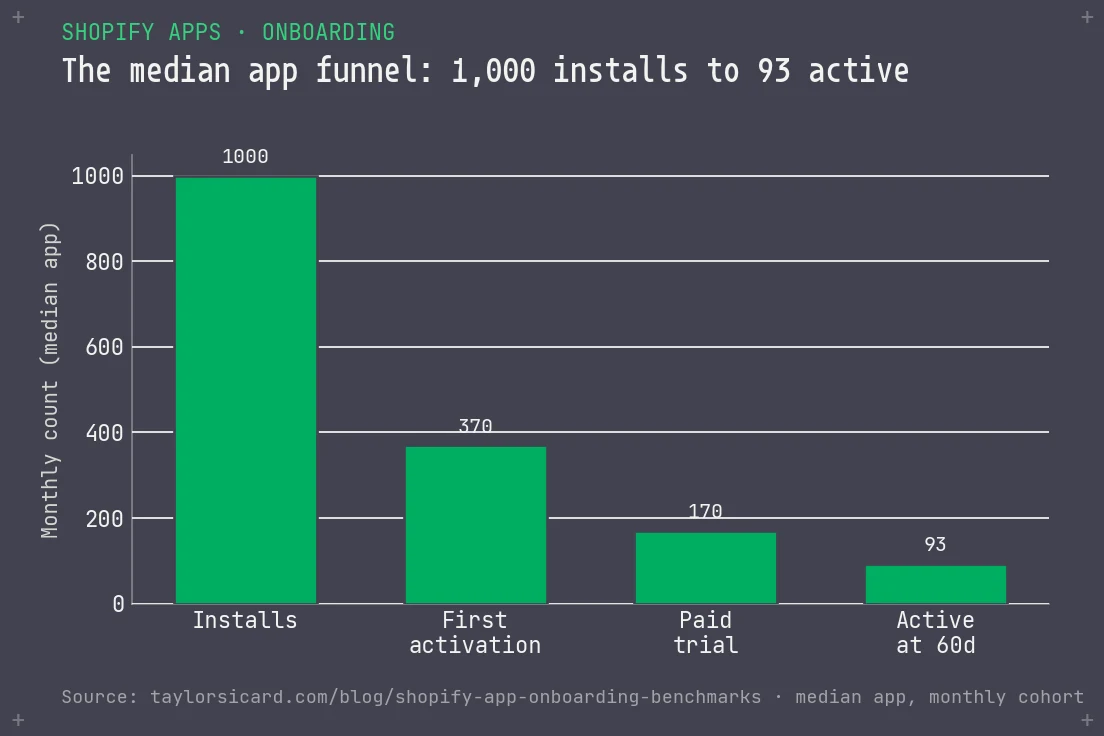
That last row is the one that matters. From the same 1,000 installs, the top-quartile app adds 3.6 times as many retained paying merchants as the median app. Not because the product is 3.6 times better. Because the onboarding converts 3.6 times more of the merchants who were interested enough to install in the first place. For the stage-by-stage context on how onboarding fits into the path from launch to $1M ARR, see From Shopify App MVP to $1M ARR.
This is the work I do, with Shopify app and SaaS founders. I ran the DTC brands your app was trying to win. That vantage point is harder to find than you'd expect. The form takes two minutes.
The merchant's question
isn't "is this a good product?"
It's "is this worth my time right now?"
That question gets answered in the first session. Sometimes in the first ten minutes.
During a trial, a merchant isn't really evaluating your feature set. They're running a cost-benefit calculation in the background of everything else they're doing. The cost is setup time, configuration effort, and the cognitive overhead of learning something new. The benefit (at this stage) is entirely hypothetical until something happens to make it real. Until your app delivers an observable outcome, the cost side of that equation is the only thing the merchant has actually experienced. Trial length is one lever on that math, and the case for 7, 14, or 30 days is in how long a Shopify app free trial should run.
Every Shopify app has an activation threshold: a specific moment where the merchant stops evaluating friction and starts experiencing value. For an email marketing app, it's the first campaign sent with an above-average open rate number visible in the dashboard. For a reviews app, it's the first review collected and displayed on a product page. For a loyalty app, it's the first redemption notification. These are concrete, unambiguous moments. The merchant sees a number change, a notification fire, a customer action happen, and suddenly the product is real to them.
The activation metric is the single action that, when completed, most strongly predicts a merchant will still be paying 90 days later. It is specific, small, and deterministic, not vague like "engaged with the app" but precise like "collected first review" or "generated first automated flow" or "sent first loyalty reward."
To find yours: pull your cohort of merchants retained for 90+ days and compare what they did in their first 7 days against your cohort of merchants who churned before day 30. The action that appears consistently in the retained group and rarely in the churned group is your activation metric. Everything in your onboarding should point toward getting new merchants to that action as fast as possible.
If you don't yet have enough data to run that analysis, hypothesize it based on what you know about the core value your app delivers, then start measuring it. The metric you're looking for is already in your product. You just haven't isolated it yet.
Users who interact with core features in their first three days convert at approximately four times the rate of users who don't. After day 7, without activation, recovery becomes statistically unlikely. After day 14, the window closes almost entirely. These are not soft patterns, they show up consistently across SaaS cohort data, and they show up in Shopify app retention analyses too. The apps that win this window consistently aren't just building great products, they're also winning distribution through App Store ranking signals that reward retention and review quality above raw install volume. And the Shopify Partner Program rewards the same merchants-first outcomes through Built for Shopify certification.
From the merchant's side
of the install,
here's what goes wrong.
I've been the merchant who churned from apps. Dozens of them, probably hundreds over the years. The abandonment pattern is almost always one of four things.
The most common failure in Shopify app onboarding: the product tries to configure everything before showing anything. The merchant opens a new app to a 12-step setup wizard. Step one: connect your store. Step two: configure your notification settings. Step three: set your email domain. By step six, the merchant is making decisions about features they've never seen in action, optimizing for an outcome they haven't yet experienced. The setup becomes the product, and the product has not yet demonstrated why it deserves to be set up.
The correct sequence is minimum setup, first value, then progressive configuration. Show the merchant what the app does before you ask them to fully configure how it does it. The setup wizard that locks 12 decisions behind a gate before delivering anything is the worst-performing pattern in Shopify app onboarding, and also the most common one.
No Clear Progress Indicator
Merchants don't know what "fully set up" looks like with a blank admin interface. An onboarding checklist with five items and a visible completion state (where you can see you're on step 3 of 5) consistently outperforms a feature-rich admin screen that offers no clear starting point. Progress indicators don't just help merchants navigate. They reframe the experience from "figuring this out" to "almost done." That psychological shift matters more than most app teams realize.
Value Hidden Behind Features the Merchant Won't Use Yet
Showing all features on day one creates noise, not excitement. The merchant who installs a loyalty app doesn't need to understand the API integration, the enterprise reporting suite, or the referral engine on their first login. They need to issue one loyalty point to one customer and see it work. Advanced features belong in a progressive disclosure layer, revealed after activation, not before it.
Email Sequences That Explain Instead of Prompt
Most onboarding email sequences describe the app's capabilities. "Did you know you can customize your review widget?" "Our loyalty program supports 14 reward types." These are feature announcements, not conversion prompts. The sequences that convert tell merchants to take one specific action that will produce one specific observable result. "Your first review request is ready to send, here's the one-click path to do it" outperforms a capabilities overview by a significant margin. Every email in your onboarding sequence should have exactly one ask, and that ask should be the next step toward activation.
"I've been on both sides of this. As a merchant, I've churned from apps that were probably excellent, I just never found out, because the first session didn't give me a reason to come back for a second one."
Five practices that separate
top-quartile trial conversion
from everyone else.
These are not hypothetical. Every one of these shows up in the onboarding of apps that consistently convert above 35% trial-to-paid.
You're not competing
with other apps.
You're competing with everything else.
A $5M Shopify brand has 30–50 apps installed on average. The merchant running that store (who is probably also the buyer, the content creator, the operations lead, and the person handling the supplier who just emailed at 11pm) has very little spare attention. Every new app install is a bet that it will save more time than it costs to set up. That bet has to pay off before the merchant runs the next app audit, which happens when they need to cut costs or streamline their stack. The merchant's decision calculus is the same whether they're a $500K store or a $10M one. Understanding what they're actually optimizing for is the insight that shapes good onboarding design; see the Shopify app economics overview for how the merchant perspective translates into the founder's unit economics problem.
The framing that actually works: speed to value over depth of features. The merchant who experiences value in the first twenty minutes will come back and configure the advanced features at their convenience. The merchant who spends twenty minutes in your setup wizard without seeing a result will not come back. The product you shipped matters. The order you reveal it in matters more.
Speed to value also determines the quality of the merchant's mental association with your app. If the first thing they associate your app with is "that complicated setup I still haven't finished," you're fighting that association for the life of the subscription. If the first thing they associate with it is "the thing that got me 47 new reviews in the first week," you've created a retention anchor that survives their next cost audit. High churn after the paid conversion point (when merchants who activated and converted are still leaving at month 3) is a different problem. That diagnostic lives in Churn Is a Symptom, Not the Problem.
"The app companies that have actually solved onboarding almost always have a founder or early employee who personally onboarded their first 100 merchants by hand. They built the automation after they understood the pattern."
This is the observation I've made consistently across the app companies I've advised. The ones with genuinely good onboarding didn't design it in a product meeting. They sat on calls, watched merchants get confused, saw where people dropped off, and fixed each failure point one at a time until they had a path that reliably produced activation. The automation came after that understanding existed, not before.
The apps with a "good product, bad retention" problem (where the quality is evident once you're inside but the conversion rate is terrible) almost always skipped that stage. They built the feature set, wrote onboarding documentation, and shipped the setup flow without personally watching enough merchants try to get through it. The gaps that were invisible in the product spec are immediately visible when you watch someone encounter them cold.
The improvement cycle
most app teams
never actually run.
Onboarding is an ongoing measurement and optimization process, never a one-time design project. The teams that consistently improve trial conversion are the ones that instrument the onboarding funnel the same way a commerce brand instruments a purchase funnel, step by step, with a clear view of where merchants fall off.
The Four Metrics That Actually Matter
Time to activation, average hours from install to the first activation event. Lower is better. If this number is above 48 hours for merchants who do activate, there's friction in the path that can be reduced. If it's above 72 hours, the path is broken for most merchants who try.
Activation rate, percentage of installs that reach the activation event within 7 days. This is your primary onboarding health metric. Benchmark: top quartile is 60–70%. If you're at 35%, that's a starting point, not a ceiling.
Trial-to-paid conversion rate by cohort, tracked monthly. If activation rate improves but trial-to-paid conversion doesn't follow within 1–2 cohorts, the activation metric you've defined may not be the right one. The metric that predicts retention will show a correlation with conversion.
Onboarding completion rate by step, the percentage of merchants who complete each step in your onboarding sequence. This tells you exactly where people abandon. Most apps find two steps that account for 60–70% of abandonment. Fixing those two steps often moves activation rate by 15–20 percentage points in a single cohort.
The Improvement Cycle
Instrument each onboarding step. Identify the highest drop-off point. Diagnose why, watch merchant sessions, review support tickets, look at what question gets asked most at that step. Fix it. Measure the next cohort. Repeat. This is not complex. Most app teams don't do it because they're busy shipping features. The compounding return on fixing onboarding is higher than almost any feature work, especially below $500K ARR. One lever that often gets overlooked at this stage: pricing structure that creates natural expansion rather than friction at the moment a merchant is most engaged.
- Define activation metric from cohort data
- Remove setup steps not required for activation
- Build checklist with 5 items maximum
- Send one-ask email at 24 hours post-install
- Trigger rescue sequence at 72 hours without activation
- Watch merchant sessions at onboarding, not just the data
- 12-step setup before any value is shown
- Feature tour as the first onboarding experience
- Welcome emails that describe the product
- Asking for full configuration before demonstrating anything
- Treating onboarding as a one-time design project
- Win-back campaigns after day 14 without activation
- 24-hour triggered email with single activation ask
- 72-hour in-app modal for non-activated merchants
- Activation event tracking with cohort segmentation
- Step-by-step onboarding completion rate reporting
- Personalized 72-hour rescue email (founder-signed)
- Progressive feature reveal post-activation
The principle that closes this: the gap between a median Shopify app and a top-quartile one is not a product gap. In most categories, the feature sets are comparable. The gap is the distance between install and activation, how many merchants actually reach the moment that makes the product worth keeping, and how quickly they get there.
You spent twelve months building the features. Spend the next quarter making sure merchants actually experience them.
Onboarding is where activation is won or lost, and benchmarks only matter once you act on them. The Shopify growth consultant helps you turn the numbers into changes. The form takes two minutes: start the conversation.
Building in the Shopify ecosystem?
I helped build and scale the Shopify Partner Program. I also ran the DTC brands your app is trying to win. That combination (ecosystem insider and the customer you're selling to) is a hard thing to find in one person. If you're building in the ecosystem, the form takes two minutes.
Start a conversation How I work with Shopify apps →