Most subscription brands sell the same thing: a monthly plan at about 15% off. The ones worth copying build the plan itself to keep people: they bill every 28 days on consumables, push a quarterly option with a better rate, explain any price step-up before it happens, and give subscribers perks they'd lose by cancelling. I read the live plans of 107 brands and scored 17 of them end to end to see who does what.
- 35 of 107 brands offer a 28-day option, which bills 13 times a year instead of 12.
- 77 offer a quarter-length cadence or longer, but only 14 give it a better rate.
- None of the 15 checkouts I reached showed the date of the next charge.
Source: public selling plans of 107 Shopify subscription brands, plus product pages, checkouts and help pages of 17, read from Canada and the US, November 2026; churn and renewal figures from Recharge's published research · Analysis by Taylor Sicard, Taylor Sicard Consulting
Six checkpoints,
and how the brands did.
Brands will spend weeks testing ad creative to take a few dollars off acquisition cost. Then they leave the subscription plan as it was set up on launch day: one monthly cadence, one discount, the app's default product-page widget.
I read the live selling plans of 132 subscription brands on Shopify, found plans on 107 of them, and went through the product page, checkout and help pages of 17 of them as a new customer would. The brands range from early DTC names to Harry's, ButcherBox, Quip and Vital Proteins.
The basics are still missing in places you'd expect them: none of the 15 checkouts I reached told the buyer when the next charge would land. And each of the tactics that move retention most (a better rate for a longer cadence, billing ahead, perks that build with tenure) is used by fewer than one brand in six.
| Checkpoint | What good looks like | Five-minute test | What I found |
|---|---|---|---|
The plan | A 28-day or quarter-length option, a better rate for the longer cadence, cadences named in the customer's terms | Is there any reason to pick a longer cadence? | 72% offer a cadence of about a quarter or longer; 13% give it a better rate |
Product page | Subscribe pre-selected, both prices shown, cadence and cancel terms next to the button | Can you find the cadence and how to cancel without leaving the page? | 10 of 13 pre-select subscribe |
Checkout | Recurring amount, next charge date and saving shown before payment | Does checkout say when you'll be charged next? | 0 of 15 show a date |
First two weeks | Welcome email with a manage link that logs you straight in, then a check-in on what to expect | Can you change your next order without a password? | 11 of 17 sign in with an emailed code |
Before every charge | Reminder a few days out with skip, swap and change-date links | Does a reminder arrive? | Not measured: needs a live subscription |
The exit | Cancel easy to find, one smaller option first, a reason asked | Do the help pages say how to cancel? | 4 of 17 give a clear route |
Source · TSC audit of 17 subscription brands and plan read of 107, November 2026
How I did this
I started with 17 subscription brands across supplements, food, drinks and pet, and scored each one from a fresh browser with no account: the product page, the first checkout screen (stopping before payment), the sign-in page and the help pages. I ran it from a Canadian and a US connection, because some stores change currency or redirect by country.
Then I widened the sample to 132 brands: subscription brands from my own brand directory, plus the brands Recharge features in its case studies and on its homepage. For each one I read the store's public product data, every subscription plan on up to 25 products (name, cadence, discount, and whether the discount changes after the first order), and the store's subscription, FAQ and rewards pages. 107 showed plans. The other 25 either run a custom storefront or keep their plans somewhere I couldn't read.
What this can't see: anything after the first order. Reminder emails, the customer portal and the cancel flow need a real subscription, so Figures 6, 7 and 9 show what good looks like there, drawn for a fictional brand, rather than what brands do.
Build the plan before
you design the page.
Most of the retention a subscription will ever get is decided in the plan settings, before anyone sees the product page. This is where I found the widest gap between what works and what brands do.
Bill consumables every 28 days
A 30-day supply on a monthly plan never quite fits. Some months have 28 days, some 31, so the customer is either running out or building a stockpile, and a stockpile is how a skip turns into a cancel. Sell a 28-day supply (28 servings, 28 capsules, four weeks of pods) on a 28-day cadence and the box always arrives as the last one runs out.
Count the shipping days as well. If the charge goes out on day 28 and the box takes five days to arrive, the customer goes five days without product. Set the charge date so the box lands a few days before the last serving, and walk the dates yourself once: when does the supply run out, and when does the next one actually arrive?
It also changes the math. A 28-day cadence bills 13 times a year instead of 12. For a subscriber who stays all year, that's 8.3% more revenue from the same customer, with no price change and no extra acquisition cost.
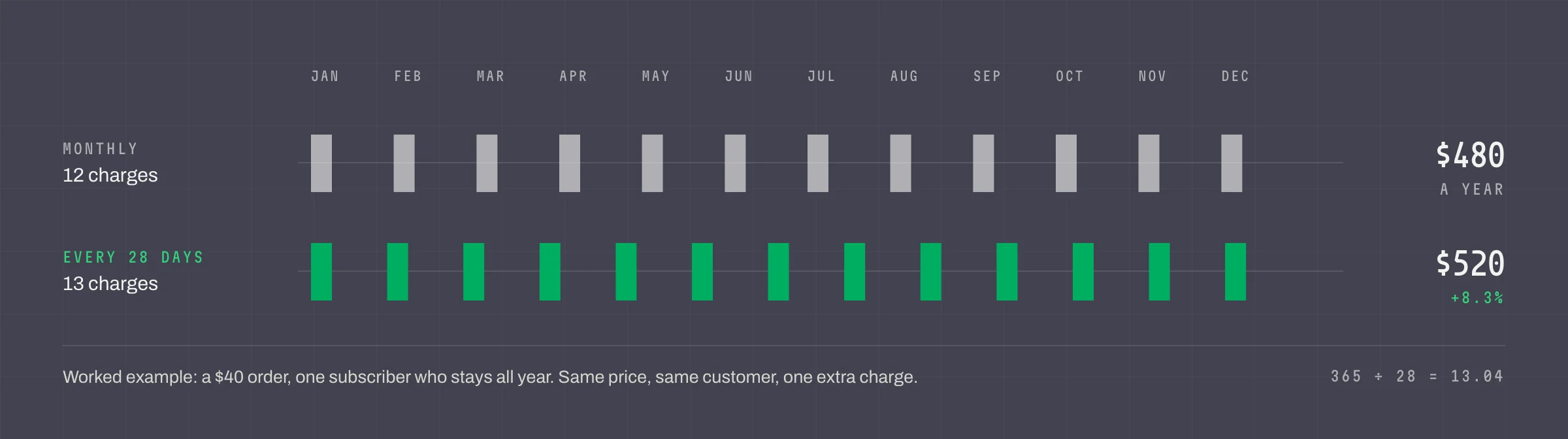
Source · TSC worked example at a $40 order
35 of the 107 brands already offer a 28-day or 4-week option. One setup detail: Recharge requires every cadence on a product to use the same unit, so a product can offer "every 28 days" or "every month", not both.
Make quarterly the plan worth choosing
The other plan I'd add to almost every consumable brand is quarterly: three months of product in one shipment.
A quarterly order is three times the monthly one, so the first order pays back more of what it cost to acquire the customer (more on that in how to calculate LTV against CAC). That matters more every year acquisition costs go up. A quarter is also long enough for a product to become part of someone's routine, even if they take a break in the middle.
And longer plans churn less. Recharge looked at 65.1 million subscriptions across 13,158 Shopify brands: lifetime churn was 84.2% on monthly plans, 67.7% on quarterly and 30.1% on annual. Part of that gap is selection, since the people who pick longer plans were more committed to begin with, but the direction is consistent.
Most brands already have the option: 77 of the 107 offer something about a quarter long or longer. Very few give anyone a reason to pick it. Only 14 pay a better rate for the longer cadence, and only 4 label any cadence "most popular". The ones that do:
- Sun Powder: 12.7% off every 30 days, 20% at 60, 22.8% at 90, 32% at 180.
- Act + Acre: 20% every 2 months, 25% every 4, 30% every 6.
- Native Pet: 15% monthly, 40% at two months and longer.
- Native labels its 3-month option "most popular", and Auri does the same.
The fix is two plan settings: a bigger discount at 12 weeks than at 4, and the quarterly option labelled as the one most people pick.
Bill ahead, ship on the usual rhythm
The step past quarterly is to charge for six or twelve months up front and keep shipping on the normal schedule. Only 3 of the 107 do it:
- CrunchLabs ships monthly and charges every 3, 6 or 12 months ("Charge every 6 months ($449.00)").
- Bokksu bills every 6, 12 or 24 months and ships every 2 months, and adds gifts for a 6- or 12-month plan.
- Balance of Nature sells an annual subscription.
At the 2,037 brands in Recharge's data that sell an annual plan, 48.0% of annual subscribers were still active at month 13, against 15.7% of monthly subscribers at the same brands. Only about 22% of brands sold an annual plan at all in 2025.
Name the cadence in the customer's terms
Two paper brands let the customer pick their household instead of a calendar interval. Naked Paper's plans read "Every 4 months (1 person)" and "Every 1.5 months (3-4 people)". Who Gives A Crap does the same. Filter and brush-head brands match the product's real life instead: Clearly Filtered offers 1 to 18 months, Quip 3, 6, 9 and 12. Fewer people pick the wrong cadence, so fewer of them need to skip.
Decide what the first order
costs, and say what
comes after.
The median plan discount across the 107 brands is 15%. Brands differ more in how they shape it.
Front-loaded: a bigger cut on the first order (17 of 107). Momentous takes 25% off the first order and 10% after, Native Pet 40% then 15%, Arrae up to 50% then 20%. It lowers the first price, but the second charge is the first time the subscriber sees a price go up. In Recharge's data on 29.8 million new subscriptions, the first-renewal rate was 65.0% with no first-order discount and 53.4% at 90% off or more. If you front-load, show the renewal price at the moment of purchase.
Starter kit, then cheaper refills (7 of 107). This one runs the other way: full price on the first order, which includes something you only buy once, and a discount on the refills. Better & Better's plan says it plainly: "Today: full Starter Set for $99.99. Every 90 days after: refills only for $46.99." MUD\WTR and Clearly Filtered work the same way. For any product with a tin, a device or a starter set, it's cleaner than a discount that disappears.
No plan discount at all. The brands Recharge features had a median plan discount of 11%, against 18% for the smaller directory brands, and 11 of them set no plan discount at all. Oats Overnight, Athletic Brewing, Bokksu and CrunchLabs sell convenience, curation or membership instead of a price cut. It matches what I found in 1,494 welcome offers, where only 3.3% said anything about the second order.
| Plan tactic | Brands | Examples |
|---|---|---|
A cadence of about a quarter or longer | 77 | Most supplement and personal-care brands |
28-day or 4-week option | 35 | Grüns, Magna, Manukora, Auri |
First order discounted more than renewals | 17 | Momentous, Native Pet, Arrae, Tiege Hanley |
Better rate for a longer cadence | 14 | Sun Powder, Act + Acre, Native Pet, Quip |
Starter kit at full price, refills discounted | 7 | Better & Better, MUD\WTR, Clearly Filtered |
Bill ahead, ship monthly or bi-monthly | 3 | CrunchLabs, Bokksu, Balance of Nature |
Cadence set by household size | 2 | Naked Paper, Who Gives A Crap |
Source · TSC read of public selling plans, 107 brands, November 2026
The product page decides
what the subscriber thinks
they agreed to.
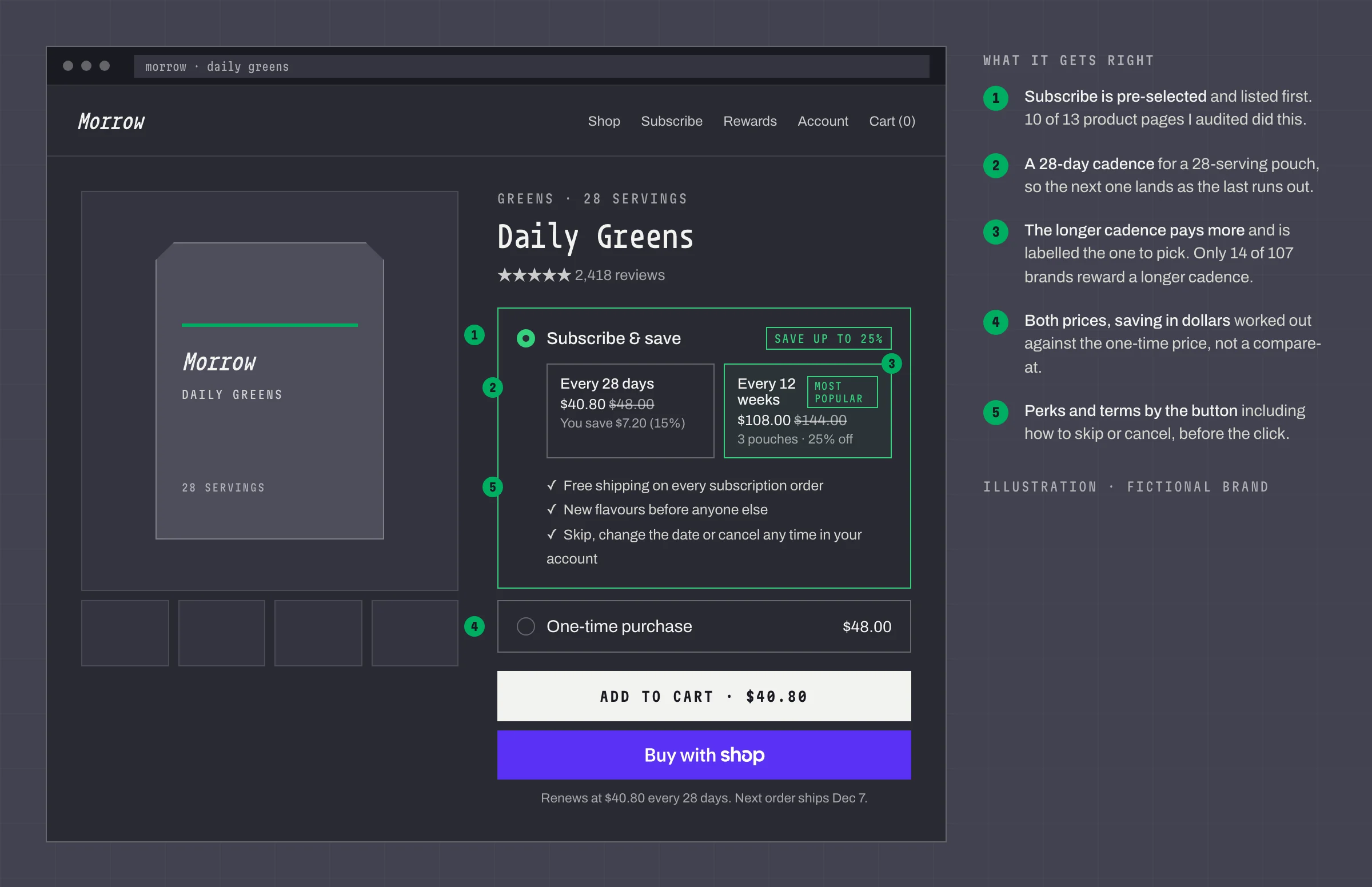
Source · Illustration by TSC; Morrow is a fictional brand
Ten of the 13 product pages I could read pre-select subscribe. Two of those list one-time first and still pre-select subscribe. That's the right default, and the rest of the buy box has to earn it:
- Both prices, and the saving in dollars. Two brands in the audit worked out their saving against a compare-at price, so the badge said 15% or 24% when the actual cut against the one-time price was 5.6% or 20%. A shopper who does the math stops trusting the rest.
- The cadence, visible. If the default is every 28 days, say so before the click, not in the cart.
- Cancel terms next to the button. 11 of the 13 buy boxes I could read said skip or cancel any time next to the button. If a shopper has to hunt for how cancelling works, they start to wonder why it's hidden.
- The perks, if you have any. Most brands keep them on a separate subscription page nobody visits. Magic Spoon lists four in the buy box.
Checkout should repeat
the deal, with a date.
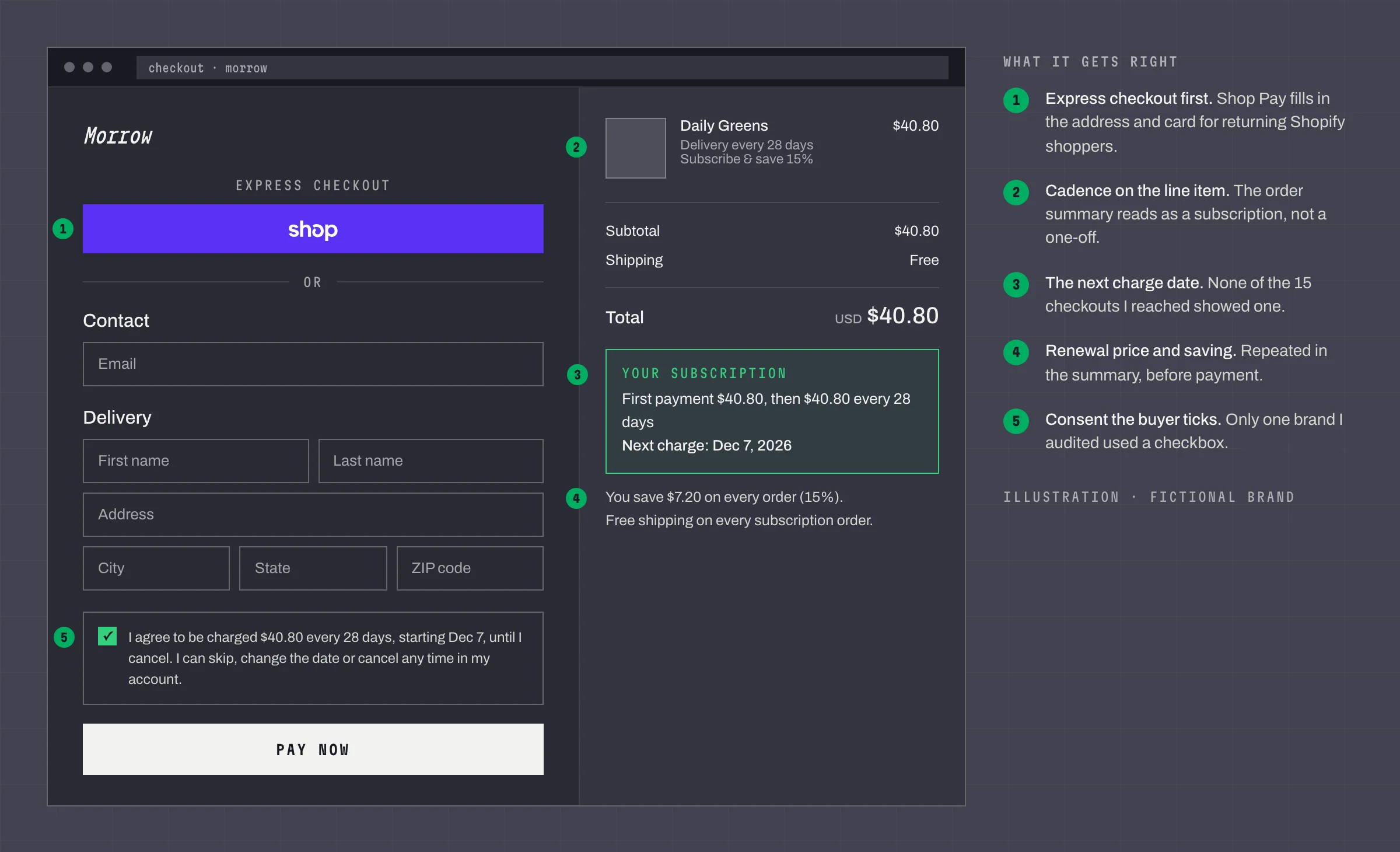
Source · Illustration by TSC; Morrow is a fictional brand
Shopify's checkout already prints a line for subscription items, like "First payment $37.49, then $44.99 every 2 months" on Momentous's US checkout. It gives the amount and how often. None of the 15 checkouts I reached added the one fact a subscriber wants: the date of the next charge. All 15 showed the standard auto-renew consent paragraph. Only Athletic Brewing made it a checkbox.
Add the date. And if the first order is discounted, make sure the renewal price is in that line, not only in the terms.
Some brands put the full deal in the plan description itself, so it shows wherever the plan does:
- Kollo Health: "Free bottle today. In 28 days, you'll be charged £34.18 for a 3-month supply every 84 days."
- CrunchLabs: "Delivery every 1 month. Charge every 6 months ($449.00)."
- Quip: "You will be charged $12 for a toothpaste every 3 months."
The first two weeks:
easy to manage, and
"is it working?"
Eleven of the 17 brands sign customers in with a code sent by email instead of a password. That's the right call for a subscriber who wants to change one order. Send the welcome email right away, say what's coming and when, and link straight to the subscription so they can change the date or the cadence in one tap.
Two things go wrong in the first weeks. Some subscribers end up with more product than they can use, and a welcome email that makes changes easy handles that. Others aren't sure the product works, and that takes longer to show up. For anything that takes time (supplements, skincare, sleep), send a check-in around the second week. Say what they should notice by now, what takes longer, and what to check about how they're using it. If you include a customer story, match it to the product and to how far in they are. Someone describing what changed over three months gives a two-week subscriber a timeline. A generic five-star review doesn't tell them where they are.
One low-tech version is worth testing: a handwritten card a week or two in, with a thank-you and one tip for getting more from the product. Almost everything else they get from you is automated, so it stands out.
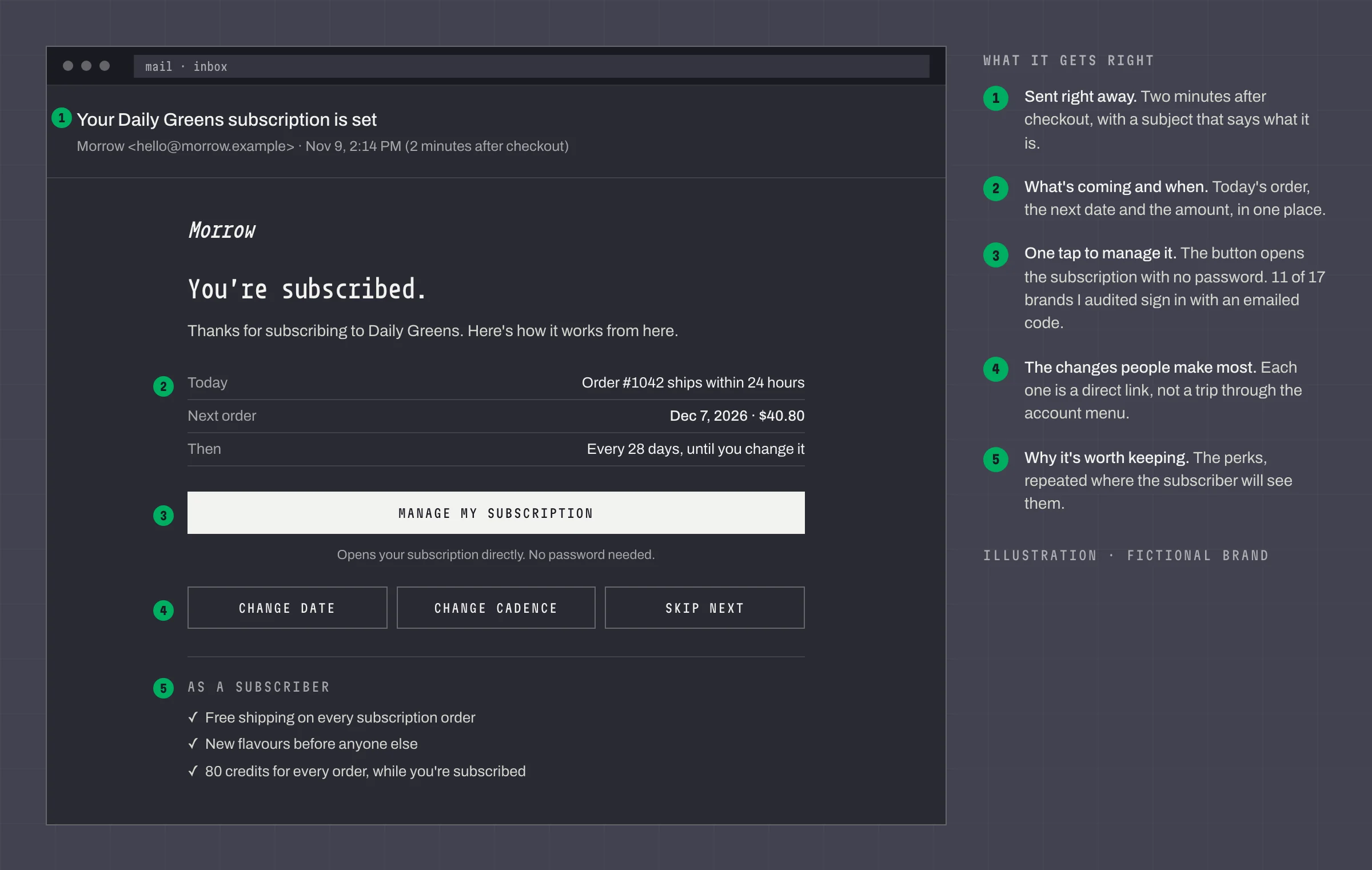
Source · Illustration by TSC; Morrow is a fictional brand
Tell them before
you charge them.
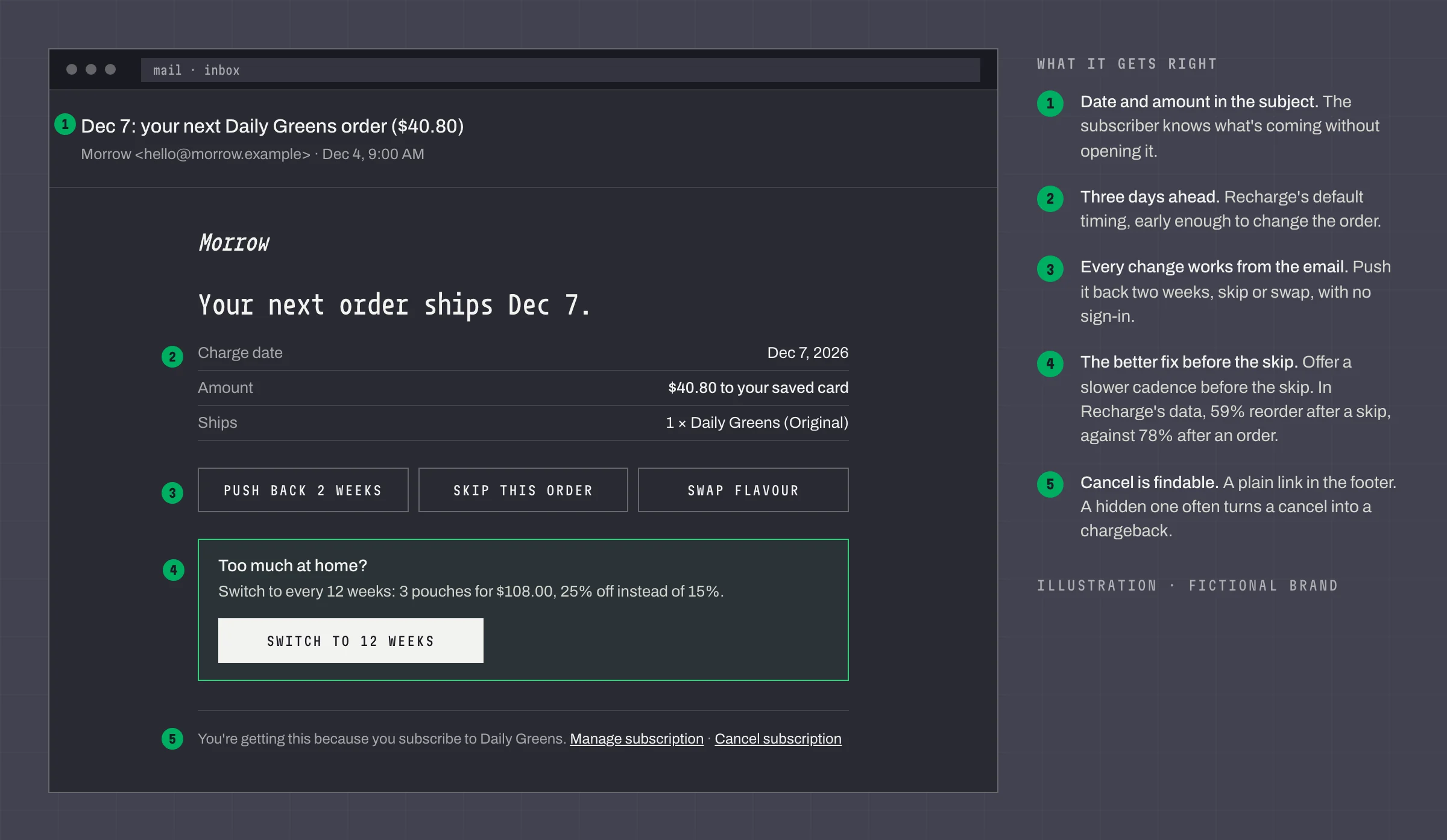
A charge nobody expected is how a subscriber finds out they forgot about you, and it's often how a chargeback starts. Send a reminder a few days before every order, with skip, swap and push-back links that work without signing in. Pushing the next shipment back matters most here, because plenty of subscribers open that email with half a bottle still at home. Put that control next to the order so they can use it right there. Recharge's own default for that reminder is three days before the charge.
Source · Illustration by TSC; Morrow is a fictional brand
Skips are worth watching. In Recharge's supplement data, 59% of skips were followed by another order, against 78% after an order that went through. So a skip is an early warning, and the reminder is where you can offer the better fix: a slower cadence.
Several US states require renewal notices in some cases, California among them. The legal detail is in my post on subscription churn.
Give subscribers
more than a discount.
| Benefit | Brands that say so publicly | Examples |
|---|---|---|
Free shipping on subscription orders | 25 | Bloom, Olipop, Dr. Squatch, Vital Proteins; Flamingo lowers the threshold for subscribers ($15 vs $30) |
Loyalty points or credit tied to the subscription | 21 | Dermalogica gives 2x points on subscription orders; Waiakea gives points for starting one |
A gift | 11 | David Protein and Magic Spoon on the first order; Bokksu for a 6- or 12-month plan; Tiege Hanley "to keep you motivated" |
Early access or subscriber-only products | 9 | Olipop and Lemme (new flavours), Cadence, Athletic Brewing (members-only brews) |
Rewards lost on cancel, or growing with tenure | 7 | Quip, Balance of Nature, Wild Earth, Betterway Health |
Discounts on other products | 4 | Athletic Brewing, Homecourt, Battlbox |
Price protection | 1 | Dermalogica ("best price guarantee") |
Source · Subscription, FAQ and rewards pages of 87 brands, classified by TSC, November 2026
Free shipping is the most common perk and the least distinctive. The ones worth stealing:
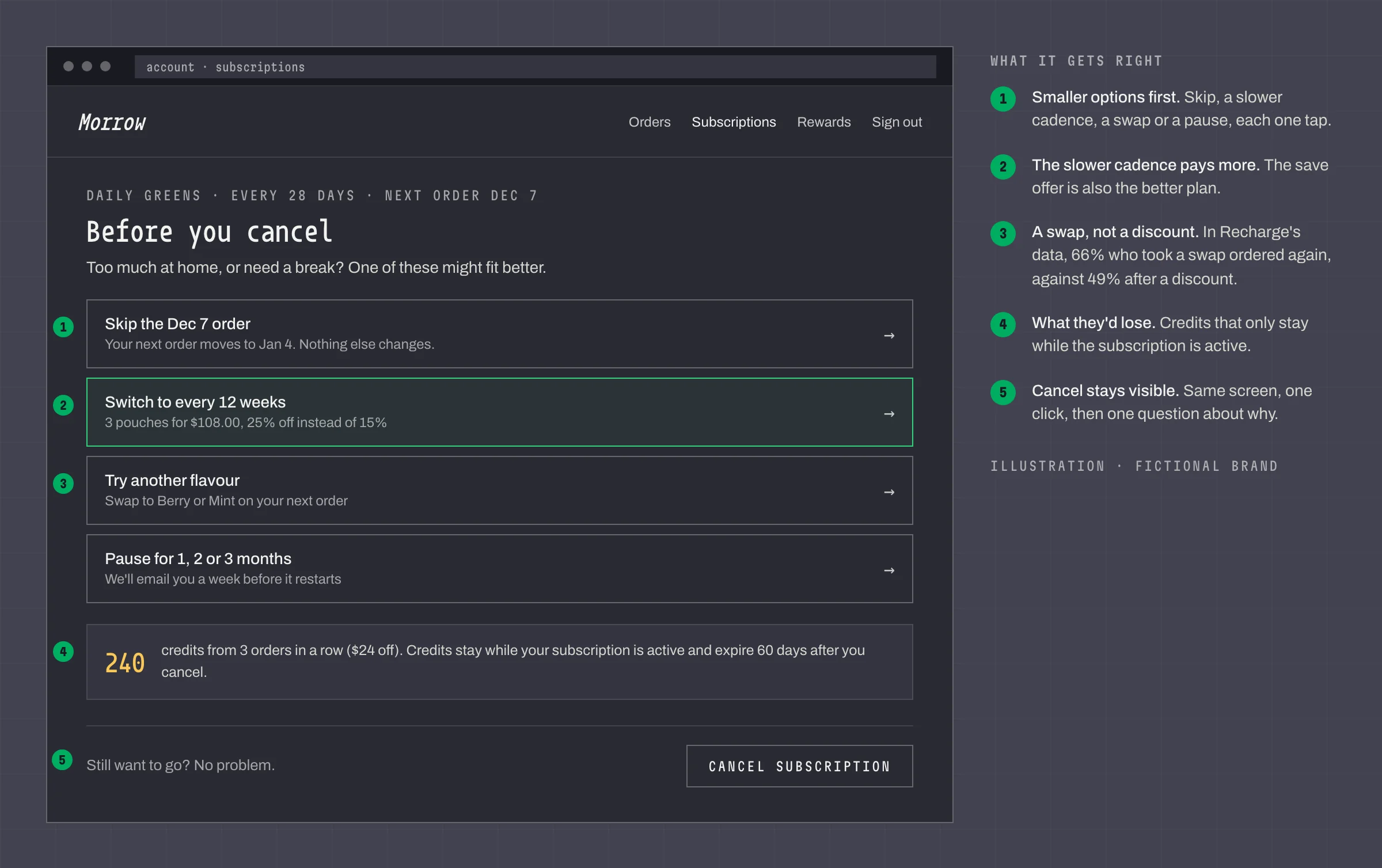
- Rewards you'd lose by cancelling. Quip: "You must maintain at least one active subscription to keep your credits and loyalty streak." Balance of Nature: credits expire 60 days after a subscription is cancelled. Wild Earth restarts the rewards journey if you leave and come back. These give the cancel screen something real to point at.
- Access instead of discount. Olipop's subscribers get new flavours first. Bloom gives them priority when a product sells out. On a product anyone can copy, access is the part a competitor's discount can't match.
- Perks that follow the subscriber. Athletic Brewing gives subscribers tiered discounts of 5, 10 and 15% on limited and pilot brews and merch. Homecourt gives "exclusive discounts on all full-price products." Very few brands extend anything to a subscriber's one-time orders, which makes it a cheap way to stand out.
Dermalogica is the case for not discounting at all: Recharge reports its subscribers ranked a free gift with every order and fast free shipping above a discount. That's one brand's own survey, with no sample size given, so treat it as an example, not a rule. More options that aren't a price cut are in what to offer instead of a discount.
Make the exit easy,
and give them a smaller
option first.
Source · Illustration by TSC; Morrow is a fictional brand
Only 4 of the 17 brands' help pages say plainly how to cancel. Seven are partial and four say nothing usable. A hidden cancel button rarely keeps anyone, and often it turns a cancel into a chargeback.
Keep cancel visible, and put one or two smaller options in front of it. If you ask the reason first, lead with the option that fits it: a delay or a slower cadence for "too much at home", a swap for "not right for me". A short video from the founder walking through that option is worth testing. In Recharge's supplement data, 66% of subscribers who accepted a product swap at the cancel screen ordered again, against 49% who took a discount and 44% who took a skip. A slower cadence belongs on that list too.
Read the cancel reasons every month, and let them decide where the next fix goes. If "too much product" leads, give subscribers more control over the next shipment. If "not sure it works" leads, fix what you tell them after delivery. Save offers, dunning and the click-to-cancel rules are covered in depth in my post on subscription churn, and the repeat purchase benchmarks by category show what a normal second-order rate looks like.
Walk your own
subscription.
Subscribe to your own product with a personal card. Pick the cadence, look for the next charge date at checkout, skip an order, change the date, try to cancel, all on your phone. Then check the plan against this list:
- Is there a 28-day option on consumables?
- Does the quarterly option get a better rate, and is it labelled as the one to pick?
- Does checkout show the next charge date and the renewal price?
- Is there one perk a subscriber would lose by cancelling?
- Can someone cancel in under a minute, after seeing one better option?
You should know this flow as well as you know your ad account.
Taylor Sicard holds equity in Recharge, which also owns Skio. Recharge's research is cited in this post, and some of the example brands come from Recharge's case studies.
Questions brands ask
about subscriptions.
Q: Is it better to bill every 28 days or monthly?
For consumables, 28 days. A 28-day supply on a 28-day cadence always arrives as the last one runs out, and it bills 13 times a year instead of 12, about 8% more revenue from a subscriber who stays all year. In my sample, 35 of 107 brands offer it.
Q: Should a subscription offer a quarterly option?
Yes, with a better rate than monthly. A quarterly order is three times the value of a monthly one, and in Recharge's data quarterly plans had lower lifetime churn (67.7% against 84.2% for monthly).
Q: How big should a subscription discount be?
The median across the 107 brands I read is 15%. The brands Recharge features discount less, and Recharge's data shows deep first-order discounts lower the first renewal rate. Many brands get further with a better rate for a longer cadence than with a bigger cut on the first order.
Q: What should a subscription checkout show?
The recurring amount, how often it renews, the saving, and the date of the next charge. None of the 15 checkouts I reached showed the date.
Q: What benefits do subscription brands offer besides a discount?
Free shipping most often, then loyalty points, gifts and early access. Rewards that are lost on cancelling, and perks on a subscriber's other purchases, are rare and worth copying.
Want your subscription read the same way?
I go through a brand's plans, product page, checkout and cancel flow, and tell the team what to change first.
Start a conversation