Buck Mason sells heritage menswear and womenswear from a headless storefront and 44 stores, with no sale on November 16, 2026. It keeps a Markdown copy of every product page for AI assistants, and 50 of its 155 live Meta ad cards sell a visit to a store. The biggest fix is the signup: two footer signups on October 21 were promised complimentary shipping, and 25 days later neither address had a single email (two caveats below).
- Working: dated Markdown twins of every product page and a 365-day return window in three places.
- Worth borrowing: a catalog AI assistants can read, kept current, and store ads sold like products.
- To fix or test: the missing welcome and cart emails, product-page reviews, and a pinned buy button on phones.
Source: Meta Ad Library (US, active ads), buckmason.com and its page source, and my own signups, cart walks and inbox, October 21 to November 16, 2026 · Analysis by Taylor Sicard, Taylor Sicard Consulting
What I'd tell Buck Mason
on a discovery call.
This is what I'd tell Buck Mason's team, and why.
What they're doing
Buck Mason sells heritage American menswear and womenswear from a custom headless storefront (Gatsby on Shopify) and 44 stores. Two promises run across the top of every page: "Shipping On Us Over $150 & 365-Day Returns". Every product and collection page, plus the FAQ, store list and Knitting Mills pages, has a Markdown copy at the same URL plus .md, indexed in an llms.txt that listed 425 product lines on November 16. On November 16 the homepage leads with a fall campaign called "West Coast Ivy" and tailoring under the "Carry-On" name, with no sale anywhere. The ads match the store: about 160 live in the US, no discounts, no creators, and a third of the cards (50 of 155) selling a visit to one of the shops. (Observed.)
What I think is great
The Markdown catalog is the most deliberate AI-search work I've come across on a DTC store. Each product file carries price, sizes in stock, fabric, fit, care, pairings and a last_updated line that carried that day's date both times I read it, so an assistant asked about "vintage high-rise chinos" gets clean facts instead of scraping a JavaScript page. The return promise is long and it's everywhere: in the banner, in the product page's own Returns row ("365 days") and in the structured data (merchantReturnDays: 365). And the stores do real work online, from "Select size to view store availability near you" in the buy box to 50 ads that sell a store as the destination. (Observed. That it's great is my opinion.)
What other brands can learn
If you want AI assistants to describe your products accurately, give them a version that's easy to read and keep it current. Put your return window in three places: the banner, the product page and the schema. And if you have stores, advertise them like products. (My opinion.)
What I'd change first
Make the signup send something. I signed up twice through the footer on October 21, once from Canada and once from the US, and both forms promised complimentary shipping. In the 25 days since, neither address has received a single email from Buck Mason, and neither got a reminder about the Big Chino I left at checkout. (Observed. I can't see a spam folder, and my US address came from an October 21 VPN batch in which every Klaviyo signup, including one at a brand that welcomed my other address in under a minute, also got nothing, so the US result may describe my test rather than the brand.)
The fix list
| Fix or test | Why | Watch | Effort | When |
|---|---|---|---|---|
Send the welcome the form promises | Two footer signups on October 21 (Canada and US) were promised complimentary shipping. 25 days later neither address had any email from Buck Mason. My Klaviyo flows guide covers the setup. | First orders from new subscribers | Low | Do first |
Send a cart reminder after checkout starts | Both test sessions left the Big Chino at the first checkout screen minutes after signing up in the same browser. No cart email followed. | Recovered checkouts | Low | Do first |
Test buyer reviews on a few best sellers | No rating, review count or widget on the product pages I read, and the ads are silent product shots, so the page makes the whole case. My August Handoff entry said the same. See product page elements. | Conversion on the tested pages | Medium | Test next |
Say the first-order shipping offer near the price | Shipping is free over $150, and the $48 tees sit well under it. The offer lives in the footer and the popup, not on the product page. My free-shipping threshold tool covers the trade-off. | First-order rate on items under $150 | Low | Test next |
Pin the add-to-cart button on phones | On a 375px product page the "Select size to add to cart" button scrolls away with the page (November 16 scan). | Mobile add-to-cart rate | Low | Test next |
Try more video in the account | 16 of 155 live cards carry video. The store ads are where motion would help most: a flagship is hard to show in a still. (My opinion.) | Cost per store visit and per add to cart, by format | Medium | Later |
Link the terms page in the footer | The terms page exists but the footer doesn't link it, and my audit counted that against trust. Shipping terms live in the FAQ, which the footer does link. | Audit trust score | Low | Later |
Source · buckmason.com, Meta Ad Library and my signup inboxes, October 21 to November 16, 2026; ranking by Taylor Sicard, Taylor Sicard Consulting
What does Buck Mason's site
do with the click?
The first ten ads in Meta's order send people to products, collections and one flagship page, all on buckmason.com. The product page asks little of a shopper. The weak spot comes after the signup.
The funnel, from ad to checkout
Ad click. I decoded the outbound links on the first ten cards in Meta's default order. All stay on buckmason.com: four go to the men's new arrivals collection, four to a single product page (two to the Coal Venice Wash slub tee, one to the same tee in black, one to a navy felted chore coat), one to the Made in USA collection and one to the New York flagship's store page. The top card links to the Coal Venice Wash slub tee, the same $48 product page my August Handoff entry rated Continuous. (Observed. Counts are links on cards, and some cards stand for several ads.)
The popup. On November 16 a fresh US desktop browser got a modal about 25 seconds in, after some scrolling: "THE FIRST ONE'S ON US. Get complimentary U.S shipping on your first order when you sign up for first word on new releases, restocks, and collaborations." It asks for an email and a "Shopping for" choice, then [SUBSCRIBE]. A 375 × 650 phone visit saw no popup in its first 12 seconds. My scripted phone scan the same day did get it on a product page after scrolling. (Observed.)
On October 21 neither a Canadian nor a US visit saw a popup in about 25 seconds, so I used the footer form both times: "Sign up for complimentary shipping and the latest news". My September tracker capture had the same headline with the footnote "*Excludes international orders", timed at 13 to 18 seconds on desktop. The new wording builds the US limit into the sentence. (Observed. Whether the October gap was a pause or a timing difference, I can't say.)
Offers like this are uncommon. 84 of the 152 popups in my welcome offer tracker lead with a percentage off (median 15%), 10 offer a free gift and 1 offers free shipping. Buck Mason sits in my wider popup directory, where its offer is classed as a free gift. See my welcome popup study. (Observed.)
Product page. I used the Big Chino in Classic Khaki: $248 on November 16, unchanged since October, nine waist sizes from 28 to 38, with Back in Stock, New Arrival and Best Seller badges. The buy box has a size guide, an Afterpay placement, a store-availability check by size, and two short rows that answer the usual questions: Fit ("Oversized") and Returns ("365 days"). Below it, "Pair it with" shows pieces from $48 to $1,498, then a Best Sellers row. I saw no reviews or rating. (Observed.)
What I like most is how little the page asks of you. Pick a size, see whether a store near you has it, and know you have a year to change your mind. For a $248 pair of pants, the 365-day window and the store check probably do more than a discount would. (My opinion.)
Cart. The cart is a drawer with an estimated total and a checkout button. From Canada, the Big Chino in a 32 came to 365.00 CAD; from the US the drawer showed one item at $248 and the first checkout screen showed $248.00. I stopped there both times and typed nothing. (Observed.)
What arrived after I signed up
Every message after my two October 21 signups is in the timeline below. There's nothing after the signup rows. (Observed through the tracking job's November 16, 02:13 UTC run.)
| After signup | What it carries | The offer | |
|---|---|---|---|
0 | Footer signup from Canada, Oct 21, 13:45 UTC | Promised "complimentary shipping and the latest news" | Complimentary shipping |
0 | Item left at the first checkout screen, Oct 21 | Big Chino, Classic Khaki, 32, 365.00 CAD in cart | None followed |
8 h | Footer signup from the US, Oct 21, 21:42 UTC (a second address) | The same footer promise | Complimentary shipping |
8 h | Item left at the first checkout screen (US) | Big Chino, Classic Khaki, 32, $248 in cart | None followed |
day 25 | Nothing to either address | No welcome, no promotion, no cart email | Not delivered |
Source · my two signup inboxes, read by my tracking job through November 16, 2026, 02:13 UTC
Abandoned cart. I left the Big Chino at the first checkout screen from Canada at 13:45 UTC and from the US at 21:43 UTC on October 21, each in the same browser where I'd signed up minutes earlier; I typed nothing at checkout. No cart email reached either address in the 25 days after. (Observed. Whether the store linked the cart to the signup is unknown.)
The apps it runs
What I could see in the page source, plus the signup notes from my walk:
- Front end: a custom headless storefront built on Gatsby (
generator: Gatsby 5.15.0), with product images, the store domain and checkout on Shopify. - Email: Klaviyo (the footer form, per my walk notes, and the stack my September directory capture loaded).
- Cross-border: Global-e (the merchant storefront script from web.global-e.com), which fits the CAD cart.
- Support: Gladly (chat widget, app ID buckmason.com).
- Measurement: Elevar's Shopify GTM suite and Google Tag Manager.
- Consent: OneTrust.
- Pay later: Afterpay (the placement in the buy box).
- Accounts, returns and tracking run on orders.buckmason.com.
In the page source, each piece has a visible job: Global-e for the 20 countries and territories beyond the mainland US, Gladly for the chat bubble, Elevar for tracking on a headless build. My October 22 scan loaded more than the source shows: Heatmap, PostPilot, ShopMy, Haus, Awin, Roeye, Universal Ads, and Reddit, TikTok, X and DoubleClick pixels. (Observed lists. The reading is mine.)
Trends
- The popup ran in September. I didn't see it in 20 to 25 seconds on October 21, and saw it at about 25 seconds on November 16 from the US, with "U.S" written into the offer. (Observed.)
- llms.txt went from 379 product lines and 106 collections on October 21 to 425 and 112 on November 16, and both files carried that day's date, so they're regenerated at least daily. (Observed. The daily part is inferred.)
- My scripted scan counted 137 live US ads on October 22 and 157 on November 13; Meta showed about 160 on November 16. The oldest cohort, launched July 2, is still running. (Observed.)
- Brand Pulse, my catalogue tracker, doesn't follow buckmason.com, so I have no price or launch events for the period. (Observed.)
Style
The site reads like a catalog from a good men's shop: a custom typeface, product shot flat on plain grounds, and outfit photos on location. Product names carry the heritage pitch ("Field-Spec", "Carry-On", "Sportsman"), and the copy is plain. The ads use that same flat cutout as most of their creative, so the click from ad to page looks like turning a page in the same catalog. What others could borrow: shoot your product photo once, the same way, and use it in the ad, on the product page and in the Markdown file.
How does Buck Mason's store
score on ecommerce basics?
The store leads on AI readability, has a gap on alt text, and has three rows to watch.
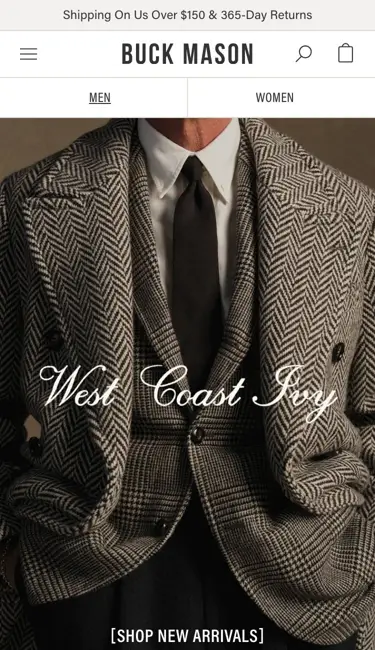
Free shipping over $150 and 365-day returns.
The campaign photo and its name, “West Coast Ivy”.
The one button, at the very bottom edge. No rating, and no popup in the first 12 seconds.
Source · buckmason.com at 375 × 650 from a US connection, November 16, 2026
| Area | What Buck Mason does | Verdict |
|---|---|---|
First screen on a phone (375 × 650) | The offer is in the bar (free shipping over $150, 365-day returns), the promise is the campaign photo and its name, "West Coast Ivy". The one button, [SHOP NEW ARRIVALS], sits at the very bottom edge of the first screen. No rating, and no popup on the homepage in the first 12 seconds. | Watch |
Navigation and collections | Men and Women tabs under the logo, with Made in USA, the Journal and Our Stores in the desktop menu. | Meets |
Search | A search icon in the header. My scan couldn't open a search box on the phone, so I haven't graded it. | Not graded |
Product page | 365-day Returns row, store stock by size, Fit and Fabric rows, "Pair it with" and Best Sellers. No reviews. | Watch |
Mobile product page | The add-to-cart button scrolls away rather than staying pinned (November 16 scan). | Watch |
Cart | A drawer with an estimated total and a checkout button (October 21 walk). | Meets |
Speed and page weight | 247 requests and 53 third-party hosts on October 22; 177 and 22 on November 16, when my proxy blocked the tag manager, so that read is likely low. Brooklinen was 544 and 40 the same October day. | Not graded |
AI readability | A Markdown twin of every product and collection page and the main info pages, dated on each read, and an llms.txt index of 425 product lines. | Ahead |
Accessibility basics | 63% of product-page images had no alt text in my October 22 scripted capture. | Gap |
Source · buckmason.com on desktop and a 375px phone, October 21 to November 16, 2026; verdicts by Taylor Sicard, Taylor Sicard Consulting
Is there enough variety
in Buck Mason's creative?
About two-thirds of the cards sell a product and a third sell a store. None names a discount or runs through a creator.
| In all 155 live US cards | Cards | Share |
|---|---|---|
Images and carousels | 139 | 90% |
Video (counted from the card's player) | 16 | 10% |
Sell a store visit ("Come on Down", a flagship, a new opening) | 50 | 32% |
Carry Meta's "multiple versions" label | 155 | 100% |
Run as a creator partnership | 0 | 0% |
Name a discount anywhere on the card | 0 | 0% |
Started in the last 30 days | 47 | 30% |
Started July 2, the oldest batch | 39 | 25% |
Source · Taylor Sicard analysis of Meta Ad Library, US, active ads, Buck Mason page, November 16, 2026
What they do well
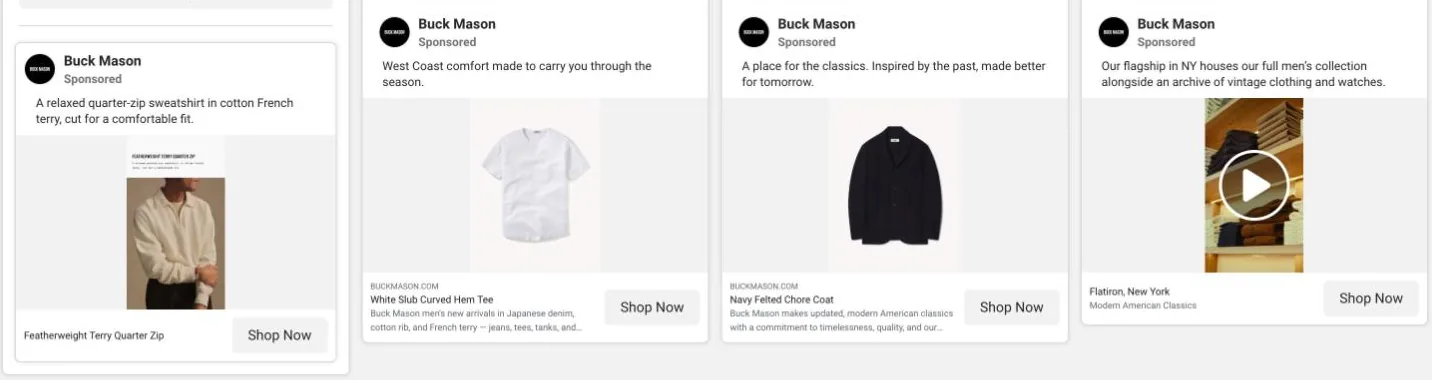
One product per card, shot as a cutout or on location, with one plain sentence: "A relaxed quarter-zip sweatshirt in cotton French terry, cut for a comfortable fit." Every one of the 187 ads behind those cards uses Shop Now. The most-repeated line runs on 18 ads, for the Three-Season Graduate Suit: "Inspired by 1960s American tailoring". The next are the Canvas Double Knee Big Work Pant (8), the new Greenwich, Connecticut store (6) and the Bruiser PCH jacket in veg-tanned cowhide (6). (Observed.)
The stores are in the ads
50 cards sell a place rather than a product: "Our flagship in NY houses our full men's collection alongside an archive of vintage clothing and watches", city-by-city "Come on Down" ads, and the Greenwich opening. The flagship ad links to that store's own page. Ten of the first 30 cards in Meta's order are store ads. (Observed.) Meta sorts by impressions, so they're getting delivery. (Inferred.) For a brand with 44 shops and free in-store returns, the ads send people to the stores the same way the buy box does. (My opinion.)
What testing I can see
Every card carries Meta's "multiple versions" label, so each one is running more than one version of its creative. The launches come in waves: July 2 (39 ads, still live), September 25 (14), October 8 and 12 (12 each), October 15 (9), and October 28 and 29 (16 each). (Observed.) So the account adds a few products every couple of weeks on top of a July batch that's still running. (My read.)
Is it cohesive with the site?
The homepage leads with "West Coast Ivy" and Carry-On tailoring. In the Ad Library, "tailoring" appears in about 16 live ads and "ivy" in about 3, so the tailoring half of the campaign is in the account and the campaign name mostly isn't. (Observed with Meta's keyword filter.) The cutouts match the product pages, as they did in August. (Observed.)
Source · Meta Ad Library, US, active ads, November 16, 2026
My Meta creative benchmarks give the comparison set.
What does Buck Mason's Meta
ad account look like?
Meta showed about 160 live US ads on Buck Mason's page on November 16, 2026. My scripted scan counted 137 on October 22 and 157 on November 13.
| Measure | Nov 16, 2026 | Nov 13, 2026 | Oct 22, 2026 |
|---|---|---|---|
Live US ads | about 160 (Meta header); 155 cards, 187 ads | 157 (my scripted scan) | 137 (my scripted scan) |
Oldest live ad | July 2 (137 days) | 133 days | 111 days |
Share started in the last 30 days | 34% of ads | 34% (30-ad sample) | 54% (30-ad sample) |
Source · Meta Ad Library, US, active ads, November 16, 2026, and my scripted scans of October 22 and November 13, 2026
Meta's date filter is the zero-before proof: active ads with impressions between January 2025 and July 1 return none, and widening it to July 2 returns about 39, the July 2 batch. (Observed.) The oldest ad aged in step across my three reads (111 and 133 days by my scan's count, which runs a day short, and 137 by the calendar), so the same summer batch has run the whole time. This is my first full pull of the account and the baseline for the next one. (Observed. The reading is mine.)
Where do Buck Mason's
ads send the click?
I've rated one Buck Mason ad against the page it clicks to in The Handoff.
- Continuous: a bare cutout of a charcoal slub curved-hem tee, no copy on it, lands on the $48 tee's product page, whose lead image is the same cutout in the same pose, with the advertised colour already selected. A Made in USA tag and the Mohnton, Pennsylvania knitting-mill band carry the heritage line through. On November 16 the top card in Meta's order still links to that tee.
The entry's one note is the same as my fix-list test: an ad with no claim on it hands the whole argument to the page, and that page shows no rating or review count.
Popup to welcome email: Break, provisionally. The footer form promises complimentary shipping and the popup complimentary shipping on a first order. Nothing arrived at either of my addresses in 25 days. (Observed. The rating is mine.) My US address came from an October 21 VPN batch in which every Klaviyo signup, including one at a brand that welcomed my other address in under a minute, also got nothing, so the US result may describe my test rather than the brand. (Observed.)
What did my Store Audit
find on buckmason.com?
My free Store Audit scored buckmason.com 64 out of 100 on October 21, 2026. Across the 31 DTC storefronts in my benchmark, the median is 57, the top quarter starts at 62 and the highest is 73.
I ran it because it's the one tool of mine that works from a public URL. The DTC Growth Scorecard and the calculators need a brand's own numbers, so I didn't run them on Buck Mason. Run them on your own store.
- Score: 64 / 100.
- By pillar: technical foundation 100, search visibility 91, AI search visibility 61, conversion and merchandising 43, trust 83. Performance has no score: the PageSpeed test didn't return on this run.
- Detected stack: Bold and Google Tag Manager. Bold doesn't hold (see below).
The audit raised eight flags and listed one app I couldn't find. I checked each against the page source:
- No free-shipping or returns messaging: doesn't hold. "Shipping On Us Over $150 & 365-Day Returns" sits at the top of every page.
- No email capture: doesn't hold. The footer has a signup form, which my walk used. It renders in the browser, so a plain fetch of the page doesn't see it.
- No Product schema: true of the homepage only. The product page carries Product markup with price, availability for each size and a 365-day return policy.
- No policy pages: partly holds. The footer links the FAQ, returns and exchanges, and accessibility, and shows a Privacy control. The terms page exists but isn't linked in the footer; shipping terms live in the FAQ, which is.
- No reviews or rating: holds. I found none on the homepage or the product page. My audit's separate product-page reviews check passed anyway, and I think it matched page-template names like "preview" in the source (inferred). That one is my bug.
- No H2 headings: holds for the homepage and the product page as served.
- No FAQ schema, no urgency cues: hold. I wouldn't add urgency to a brand built on a year-long return window.
- "Bold" in the stack: doesn't hold. The only "bold" in the source is font styling.
Read against the source, the 64 undercounts the shipping, returns and capture work, and it's right about the missing proof. The 61 on AI search visibility credits the llms.txt but has no check for the Markdown twins behind it.
What I read, and what
I can't see from outside.
Signups and cart walks on October 21, 2026, then the ad read and fresh US visits on November 16.
- What I read: the live buckmason.com homepage and the Big Chino product page and their source, the product's Markdown twin, llms.txt, the FAQ, store list and Knitting Mills pages in Markdown (October 21, rechecked November 16), my footer signups and cart walks from Canada and a US VPN on October 21, a fresh US desktop and phone visit through my US proxy on November 16, every live card on Buck Mason's Meta advertiser page, the tracking inbox, my September welcome-tracker captures, the August Handoff entry and my Store Audit.
- Email window. October 21 to the early hours of November 16, about 25 days, for both addresses. My tracking reads the inbox, not the spam folder.
- What the source can't show: how well any app works for Buck Mason, what it costs, or how the stores and the site split sales. Where I read intent, I've said so.
- My audit reads one homepage and one product page once, from the served HTML. On a headless site that renders parts of the page in the browser, it misses things. I've said where above.
- No spend, traffic or revenue figures. The Ad Library doesn't show spend, and I don't estimate it.
Questions brands ask
about Buck Mason.
Q: What is Buck Mason's welcome offer?
Complimentary US shipping on a first order for an email signup. On November 16 the desktop popup said so ("THE FIRST ONE'S ON US"), and the footer form promises complimentary shipping. Neither of my October signups received the email that would carry it.
Q: What are Buck Mason's shipping and returns terms?
Free shipping over $150 and a 365-day return window. Per the FAQ, returns by mail carry an $8 fee and returns in a Buck Mason store are free.
Q: What apps does buckmason.com run?
From the page source and my signup walk: Klaviyo, Global-e, Gladly, Elevar, Google Tag Manager, OneTrust and Afterpay, on a headless Gatsby storefront with Shopify checkout.
Q: How many Meta ads does Buck Mason run?
About 160 live in the US on November 16: 155 cards standing for 187 ads. 10% of the cards are video, none name a discount, none run through creators, and 50 sell a store visit. The oldest started July 2.
Q: Does Buck Mason send an abandoned-cart email?
Not to me. I left the Big Chino at the first checkout screen from two signed-up addresses on October 21, and no cart email came in the 25 days after.
Work with Taylor
Want this read on your own brand?
I go through a brand's site, ads, emails and checkout from the outside and tell the team what's working and what to fix first.
Tell me what's stuck