Every follower you have lives on rented land. As paid acquisition gets more expensive and AI splinters discovery, the audience you own, email, SMS, accounts, community, becomes your cheapest and most durable distribution. It is a margin lever, not a retention afterthought.
- Paid reach re-clears at auction daily and rises with scale. Owned reach costs near zero per contact and gets cheaper as it grows.
- Community is a distribution channel and a retention engine, which makes it a CAC hedge, not a support cost.
- As shoppers start buying through AI agents, an owned audience is the one channel a machine cannot disintermediate.
Every brand I work with is one algorithm change away from a bad quarter. You do not own your Instagram followers. You do not own your TikTok reach. You rent all of it, and the landlord changes the terms whenever it wants. The founders who internalize this early build something the algorithm cannot take away. The ones who do not spend years compounding an asset they can lose overnight.
The smart money in consumer brands is moving the relationship off rented platforms and onto channels the brand controls: email, SMS, customer accounts, a members area, a founder channel. Not because owned channels are trendy, but because the math changed. Paid got expensive, trust got harder to buy, and discovery started fragmenting into places no brand controls. Owned audience is the hedge against all three.
I have watched this from the operator seat. Across the consumer brand portfolios I have run to nine-figure revenue, the ones that held their margin through rising ad costs were, almost without exception, the ones with a real owned audience underneath the paid. That is the argument for treating audience as core distribution rather than an afterthought, and the numbers below explain why the window to build it is open. Retail is the other half of that distribution question, and the retail velocity playbook covers the wholesale side.
Rented reach gets
pricier. Owned reach
gets cheaper.
The reason owned audience matters is not sentiment, it is arithmetic. In 2026, email marketing still returns roughly $36 for every $1 spent, an order of magnitude above paid channels, which land closer to $2 to $2.80 per dollar (HubSpot, email marketing benchmarks, 2025). Same customer, wildly different cost to reach them again.
Here is the structural difference. When your growth depends on rented reach, your acquisition cost is set by an auction you do not control, and that auction only moves one direction over time. Every dollar of paid reach re-clears every morning at whatever the market will bear. Every dollar of owned audience you build is distribution that does not go back to auction, and it gets cheaper per contact as the list grows. Paid gets more expensive as you scale. Owned gets cheaper. That inversion is the whole game.
First-party data sharpens the same edge. In 2026, brands that put first-party data at the center of their marketing have reported a 1.5 to 2.9 times revenue lift versus those leaning on other data sources (Boston Consulting Group with Google, Think with Google, 2024). An owned audience does more than cut the cost of reaching people. It is the source of the data that makes every other channel, including the paid you still run, work harder.
| Dimension | Rented reach (paid + social) | Owned audience (email, SMS, community) |
|---|---|---|
Cost curve |
Rises with scale and competition. Re-clears at auction daily. |
Near-zero marginal cost. Cheaper per contact as it grows. |
Control |
The platform decides who sees you. Terms change without notice. |
You decide when and who to reach. No algorithm in between. |
Durability |
An algorithm change can erase reach overnight. |
Survives platform shifts. Compounds year over year. |
Return |
Roughly $2 to $2.80 per $1 on paid channels. |
Roughly $36 per $1 on email. |
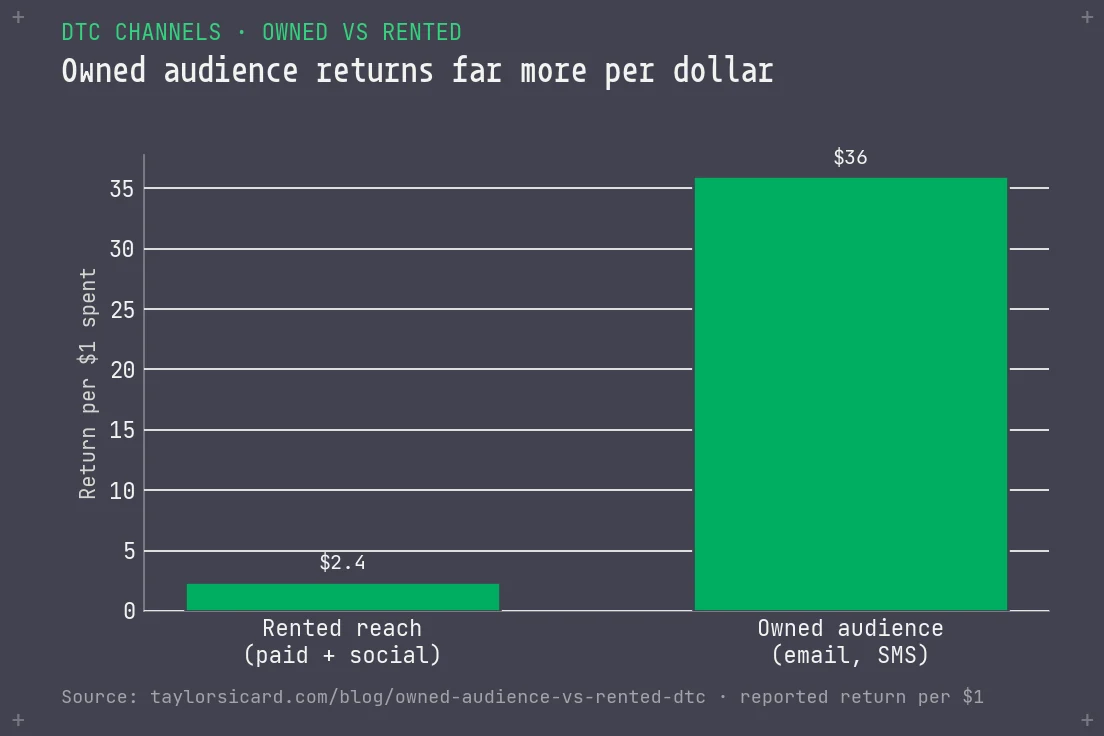
None of this means turning off paid. Paid acquisition is how most brands find the top of the funnel, and it is not going away. The point is where the advantage sits. Owned audience is the asset that lowers the cost of the paid you were going to run anyway, and it is the only part of your distribution that keeps working when the ad account has a bad month. If you want to see how far your acquisition cost can stretch before it stops making sense, the max allowable CAC calculator models it against your own margins.
Community is a
retention engine
and a CAC hedge.
Most brands still file community under support or brand, which is a costing error. A real community is a distribution channel that also raises the value of the customers you already have, and both effects show up on the P&L. Nielsen's long-running trust research keeps landing on the same number: around 92% of consumers trust recommendations from people they know over any form of advertising. Community is how you manufacture those recommendations at scale.
The retention side is where the compounding lives. A University of Pennsylvania Wharton study on referral programs found that referred customers stay longer and carry meaningfully higher lifetime value than customers acquired through paid channels. That is the quiet magic of an owned community. It lowers the cost of the next customer and raises the worth of the last one at the same time. You are funding acquisition, retention, and content with the same dollar.
Look at the brands that built this on purpose. Gymshark grew into a nine-figure fitness label largely on an owned community of athletes and micro-creators, and a direct relationship with its customers, before mainstream influencer marketing even had a name. Liquid Death turned a can of water into a $333M-revenue business in 2024 by running its audience as an entertainment property whose fans buy merch and co-create the marketing (Sacra, 2025). Neither brand rents its growth. They own the relationship, and the relationship does the distribution.
The failure mode here is confusing audience size with community. A million followers who never interact is rented reach with a big number on it. A thousand people who show up, post, and refer is a distribution channel. The second one is worth more, and I have watched it prove out on the P&L every time. The nuance of building that from nothing is its own subject, which I worked through in building an audience from zero.
An agent cannot
disintermediate
an audience you own.
Discovery is fragmenting fast, and this is the part most operators are underrating. In the 2025 holiday season, traffic to US retail sites from generative-AI tools rose about 693% year over year (Adobe Analytics, 2026 Holiday Shopping Report). Shoppers are starting product research inside AI assistants as well as in search and social. When a machine mediates discovery, the rules of who gets found change underneath you.
This is not a someday problem. McKinsey estimates that agentic commerce, where AI agents help shoppers find and buy, could orchestrate $3 trillion to $5 trillion in transactions globally by 2030 (McKinsey, The agentic commerce opportunity, 2025). Brands from Glossier to SKIMS to Etsy are already live inside AI-assistant checkout. The discovery layer is being rebuilt, and it will not favor brands that depend on being algorithmically surfaced.
This is why owned audience is the answer, not a nice-to-have. When an agent stands between the shopper and the shelf, the brands with a direct, owned relationship to their customers are the ones that still get reached on purpose. You can email your list. You can text your buyers. You can bring your members a launch without asking a platform, a feed, or an agent for permission. Your owned audience is the one channel a machine cannot disintermediate, because you hold the connection. I unpack the mechanics of that shift in agentic commerce for Shopify brands and what the new AI-assistant funnels mean in how ChatGPT is rerouting shoppers back to your site.
Owned audience used to be a retention tactic bolted on beneath paid. In an agentic world it becomes a discovery moat. The brands that can reach their customers directly are the ones that stay in the consideration set when the algorithm, or the agent, decides not to surface them. Build the list now, while acquiring the customer is still relatively cheap.
You already have
the primitives.
Use them as strategy.
If you run on Shopify, you already hold most of the pieces of an owned audience. The problem is rarely the tooling. It is that these assets get treated as retention plumbing bolted on beneath paid, instead of as the core distribution strategy they should be. The shift is to fund and staff them like a channel, because they are one.
- Email list, segmented and active
- SMS for launches and drops
- Customer accounts and login
- Post-purchase and win-back flows
- A members area or loyalty tier
- A founder channel with a voice
- A community space people return to
- IRL events and UGC programs
- First-party purchase history
- Zero-party preferences from quizzes
- Consent to reach them directly
- Feedback loops that shape product
The three columns work together. Direct lines are how you reach people, belonging is why they stay subscribed and engaged, and data is what makes every message and every paid dollar sharper. A brand that only collects emails but never gives anyone a reason to belong ends up with a list that unsubscribes. A brand that builds belonging but never captures the data cannot act on it. Owned audience is the system, not any single tool in it.
Fund it accordingly. The brands getting this right assign real ownership to the owned channels, measure them as a distribution line, and reinvest in them the way they would a paid channel that returned $36 on the dollar. Because that is what it is. If you want to see how a stronger owned mix flows through to profit, the profitability calculator lets you model the margin against your own numbers, and the contribution-margin breakdown shows where owned reach quietly widens it.
Rebuilding growth around an audience you own is a chunk of what I do with DTC operators. If this is landing, the form takes two minutes.
Two expensive ways
to fumble an
owned audience.
The first mistake is treating community as a launch stunt. A brand spins up a Discord or a giveaway, gets a spike, and lets it go quiet in a month. Community is a standing channel, not a campaign. It compounds only if you show up in it on a schedule, the same way you would never run paid for one week and call it a strategy. An owned audience you neglect decays back into a rented one, because the people drift back to the feed.
The second mistake is chasing vanity size over engagement. Founders fixate on follower and subscriber counts because they are easy to screenshot, but a list nobody opens is a cost, not an asset. The brands that win the owned game optimize for depth: open rates, reply rates, referral rates, repeat purchases from the engaged segment. Glossier is the canonical example, it grew from a beauty blog and a genuinely engaged readership into a billion-dollar brand by building products from community feedback, not by buying the biggest audience it could.
"A million followers who never interact is rented reach with a big number on it. A thousand people who show up, post, and refer is a distribution channel. The second one is worth more."
There is a subtler version of the second mistake: building the owned audience and then only ever using it to sell. If every email is a promo, the list burns out, and you are back to renting attention through discount codes. The brands that keep an owned audience valuable give it something worth staying for between the asks, a point of view, real utility, a reason to belong. That is what keeps the channel alive long enough to compound.
The brands that
held margin owned
their audience.
When we took over or acquired a brand at WIN, one of the first things I looked at was the ratio of rented to owned. A brand that lived entirely on paid, with a thin email list and no real community, was fragile no matter how good its top-line looked, because its growth was leased from an ad auction that could reprice at any time. A brand with a deep, engaged owned audience had a floor under it. That floor is what you are buying when you invest in owned.
The pattern that bit brands hardest was the one that felt fine right up until it did not. Cheap paid masks a weak owned foundation for a while. Then CAC climbs, the ad account has a rough quarter, and the brands with nothing but rented reach discover they have no way to reach their own customers without paying the toll again. This is the same fragility I see brands hit at the $5M growth inflection, where a model that worked on cheap acquisition stops working and there is no owned audience to fall back on.
What I tell operators is unglamorous, and it holds up. Build the owned audience while acquiring the customer is still relatively cheap, and treat it as your core distribution strategy rather than a retention afterthought. Capture the email and the consent on every order. Give people a reason to belong as well as a reason to buy. Reach them directly and often enough that the relationship stays warm. Do that, and when paid gets expensive or an agent stands between you and the shopper, you still own the one thing that matters: the ability to reach the people who already chose you.
Owned audience is not the flashy part of a growth plan. It is the durable part. In a market where paid keeps getting pricier and discovery keeps fragmenting, the brands that own their audience are the ones that get to keep their margin and their choices. Everyone else is renting, one algorithm change away from starting over.
Common questions
about owned vs
rented audiences.
What is the difference between an owned and a rented audience?
A rented audience is reach you access on a platform you do not control, like Instagram or TikTok followers, where the algorithm decides who sees you. An owned audience is a direct relationship you control: email and SMS lists, customer accounts, a members area, or a founder channel. You can reach an owned audience whenever you choose, at close to zero marginal cost, with no algorithm in between.
Why is an owned audience cheaper than paid acquisition?
Paid acquisition re-clears at auction every day and gets more expensive as you scale, while owned reach costs almost nothing per contact and gets cheaper as your list grows. Email marketing returns roughly $36 for every $1 spent, compared with about $2 to $2.80 for paid channels. That gap is why owned distribution protects margin as paid CAC rises.
Is community building worth it for a small DTC brand?
Yes, and often more so than for a large brand. A small brand cannot outspend a big one on paid media, but it can out-belong it. Community is the one channel where being smaller and more personal is an advantage. Referred customers also retain longer and carry higher lifetime value, so an engaged community compounds acquisition, retention, and content at the same time.
How does an owned audience lower customer acquisition cost?
Owned reach costs near zero at the margin, community members refer new customers who retain longer, and first-party data makes the paid you still run more efficient. Brands that put first-party data at the center of their marketing have reported a 1.5 to 2.9 times revenue lift. All three effects reduce dependence on paid acquisition, which is where CAC lives.
How does AI-driven discovery change the value of an owned audience?
As shoppers begin discovering products inside AI assistants and agentic checkout, discovery gets mediated by machines rather than search and social feeds. Generative-AI traffic to US retail sites rose about 693% year over year in the 2025 holiday season. An owned audience is the one channel an agent cannot disintermediate, because you can reach it directly instead of hoping to be surfaced.
A brand that rents all of its reach has no floor under it. If you want to build growth on an audience you actually own, the DTC growth consultant practice is where we work it, from the channel mix to the margin math underneath it. Setting up that conversation takes about two minutes: get in touch.
What an owned channel actually costs to run
The argument in this piece is about the benefit of owning the relationship. The question that keeps arriving alongside it is the cost, and it deserves a direct answer rather than an implication, because owned is frequently sold as though it were free.
It is not. An owned channel carries a platform fee that scales with list size, not with revenue. It costs more as the list grows whether or not the list is engaged. It carries creative and production time, which is the largest line and the one nobody budgets. It carries deliverability work, which is invisible until it is urgent. And it carries the cost of list hygiene, because an unpruned list quietly raises the platform bill while lowering the engagement rates that determine whether anything reaches an inbox.
The honest comparison against paid is therefore not free against expensive. It is a largely fixed cost that scales with audience size against a variable cost that scales with volume purchased. Owned wins over time because the fixed cost amortises across repeat purchases while the variable cost is incurred fresh on every one. That crossover arrives earlier for high-repeat categories than for considered one-off purchases. For a brand with a genuinely low repeat rate, the crossover may not arrive at all, and pretending otherwise is how owned channels get over-invested in.
Two things sharpen this calculation. The lifetime value maths most brands get wrong covers the input that decides where your crossover sits. The Meta location fee breakdown is a recent example of the variable side rising with no notice, which is the risk owned channels insure against.
Renting all your reach?
I work with a deliberately small number of DTC operators. I have run brands at this scale myself, from $5M past $100M, and rebuilding growth around an owned audience is one of the first places I look for durable margin. If that is you, the form takes two minutes.
Start a conversation More about Taylor →Free tools. Run your own numbers with the max allowable CAC calculator or the DTC profitability calculator.